
Home > Alabama
Final Expense Insurance in Alabama — A Statewide Guide for Seniors and Families

Alabama’s 67 counties stretch from the Tennessee Valley in the north down through the Black Belt prairie to the Gulf Coast beaches of Baldwin and Mobile. The state is home to a large senior population concentrated in retirement-friendly areas like the Shoals, Birmingham’s southern suburbs, and coastal Baldwin County, alongside major metros in Birmingham, Huntsville, Montgomery, and Mobile. This guide walks Alabama families through final expense insurance — a small whole life policy designed to cover funerals, burials, and end-of-life costs — with attention to how funeral pricing, state regulations, and burial laws work specifically here.
Funeral and Cremation Costs in Alabama
Funeral and cremation costs in Alabama run consistently below national medians, though pricing varies by region and metro. The figures below reflect statewide averages from the National Funeral Directors Association, Funeralocity, and the Funeral Consumers Alliance, with regional variation noted where it exists. County-specific pricing is covered on each individual county page.
Statewide averages
Alabama falls in the NFDA’s East South Central region, which reports the lowest funeral prices in the country. The median funeral with viewing and burial in the region is $7,615, and the median funeral with viewing and cremation is $5,858 — both below the national medians of roughly $8,300 and $6,280 respectively.
| Service type | Alabama average | National comparison |
|---|---|---|
| Traditional full-service burial | $7,000–$10,000 | Slightly below national average |
| Full-service cremation | $6,137 | Below national average |
| Cremation with memorial service | $3,065–$3,827 | Below national average |
| Direct cremation (funeral home) | $1,500–$3,500 | In line with national range |
| Direct cremation (specialty provider) | $895–$1,200 | Well below national average |
| Immediate burial (no service) | $1,920–$2,975 | Below national average |
Regional variation within Alabama
Alabama’s three main regions — North Alabama (the Tennessee Valley and the Shoals), Central Alabama (the Birmingham-Montgomery corridor and the Black Belt), and South Alabama (the Wiregrass and Gulf Coast) — show modest pricing differences driven by urban density, competition among providers, and local cost of living.
| Region | Direct cremation range | Notes |
|---|---|---|
| Birmingham metro | $1,400–$2,200 | Largest metro, widest provider competition |
| Huntsville and North Alabama | $1,200–$1,900 | Often the state’s most competitive pricing |
| Montgomery area | $1,300–$2,000 | State capital with several established providers |
| Mobile and Gulf Coast | $1,250–$2,100 | Coastal pricing, coastal tourism economy |
| Rural counties | $1,100–$1,800 | Fewer providers, but lower base prices |
How Alabama compares to national medians
The national median funeral with burial is approximately $8,300, and the national median with cremation is approximately $6,280 (NFDA). Alabama runs roughly 15–20% below these figures. Traditional burial remains more common in Alabama than in most of the country — about 60–70% of Alabama families still choose burial, compared to a national cremation rate of 63.4% in 2025. This preference for traditional services keeps full-service burial demand strong across the state.
What drives cost differences in Alabama
Several factors explain why Alabama pricing varies by location:
- Urban density and competition. Birmingham, Huntsville, and Mobile have more providers, which pushes some prices down but also creates a wider range between budget and premium options.
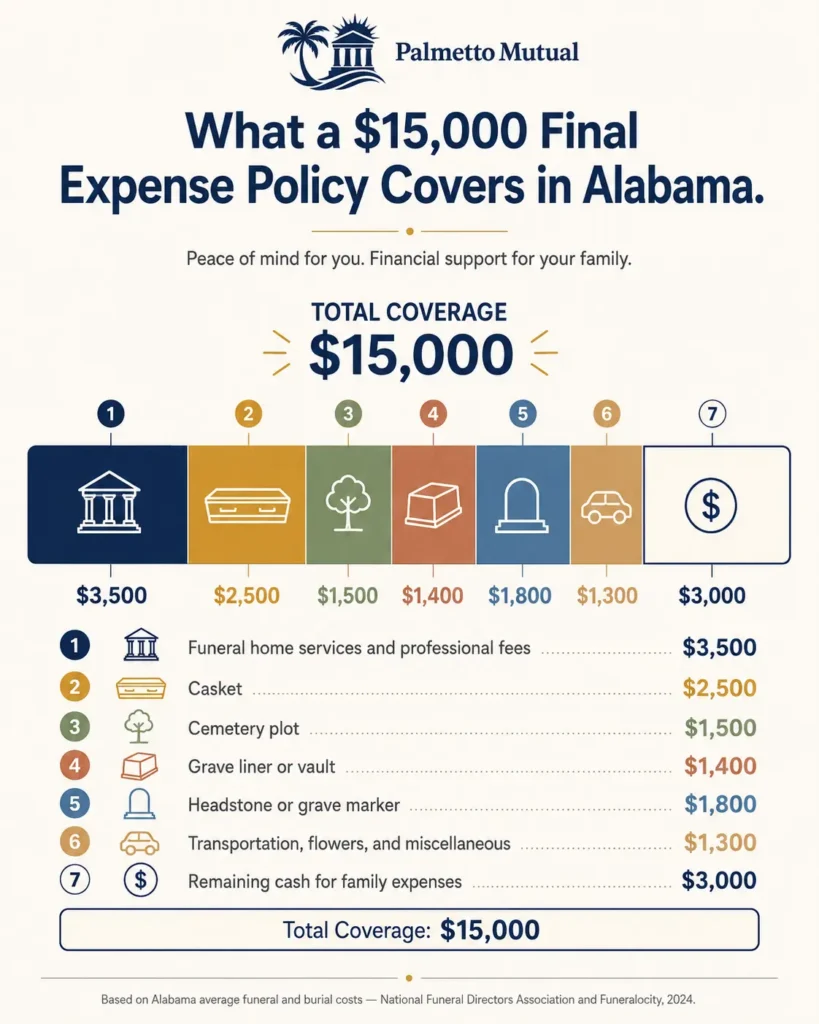
- Cemetery costs. Municipal cemetery plots in Alabama typically run $500–$1,500, while private cemetery plots run higher. Grave liners and vaults, often required by cemeteries, add $800–$2,500.
- Cost of living. The Shoals, Wiregrass, and Black Belt have lower overall costs of living than Birmingham’s southern suburbs or coastal Baldwin County, and funeral pricing tends to follow.
- Rural vs. urban service mix. Rural counties often have one or two funeral homes serving a wide area, which can reduce competition but also reduce overhead.
Because burial insurance and final expense insurance policies are generally written in $5,000 increments from $5,000 to $35,000, understanding realistic cost ranges for your region helps you size a policy that actually covers what your family will face.
Final Expense Insurance Regulations in Alabama
Alabama regulates final expense and other life insurance policies through the state’s insurance code, which sets minimum consumer protections that apply to every policy sold in the state. The protections below are state-mandated floors — individual carriers may offer longer periods or broader terms, but not shorter ones. This section covers the rules that matter most to Alabama seniors buying burial insurance.
Who regulates insurance in Alabama
The Alabama Department of Insurance (ALDOI), led by Commissioner Mark Fowler, is the state agency that licenses insurance companies and agents, reviews policy forms, handles consumer complaints, and enforces state insurance law. Anyone selling final expense insurance in Alabama must hold an active producer license from ALDOI. Consumers can verify an agent’s license, check a company’s complaint history, or file a complaint directly through the department’s website.
Key consumer protections
| Protection | Alabama rule | Source |
|---|---|---|
| Free look period | 10 days minimum from policy delivery | Ala. Admin. Code r. 482-1-131-.03 |
| Grace period for missed payments | 30 days minimum | Ala. Code § 27-15-3 |
| Claim payment timeline | 30 days from receipt of proof of death, with interest after | Ala. Code § 27-15-13 |
| Incontestability | 2 years maximum contest period | Ala. Code § 27-15-4 |
| Guaranty association coverage | Up to $300,000 death benefit and $100,000 cash value per insured | Alabama Life and Disability Insurance Guaranty Association |
Free look period
Alabama law gives every life insurance policyholder a minimum 10-day free look period starting the day the policy is delivered. During this window, the policyholder can cancel for any reason and receive a full refund of premiums paid. Some carriers voluntarily extend this to 30 days on certain products — Medicare supplement policies, for example, carry a state-mandated 30-day free look under separate rules. For standard final expense and burial life insurance in Alabama, plan on 10 days as the legal minimum and check the policy for any extension.
Replacement rules
Alabama has adopted the NAIC Life Insurance and Annuities Replacement Regulation as Chapter 482-1-133 of its administrative code. If a new final expense policy is meant to replace coverage the applicant already owns, both the agent and the replacing insurer must follow strict disclosure rules. The applicant must receive a written “Important Notice Regarding Replacements” form, and the existing insurer must be notified so the policyholder has a chance to compare. Agents who advise applicants to hide a replacement, or who misrepresent the facts to avoid the notice requirement, face penalties from ALDOI. This protection exists specifically because replacing an older policy with a new one can cost seniors their incontestability status and reset waiting periods — it is worth understanding before signing anything.
Graded death benefit rules
Alabama does not set a specific statutory cap on graded death benefit periods for final expense policies, so carriers generally follow industry-standard waiting periods of 2 to 3 years for applicants who cannot qualify for level-benefit coverage. During the graded period, a death from natural causes typically pays out a return of premiums plus interest (often 10%) rather than the full death benefit. Accidental death is usually covered at the full face amount from day one. Alabama’s general life insurance disclosure regulation (Chapter 482-1-131) requires these terms to be clearly explained in the policy summary and buyer’s guide before the applicant pays the first premium. If an agent is vague about whether a policy is level or graded, that is a red flag worth pressing on.
Preneed funeral contracts funded by life insurance
Alabama regulates preneed funeral arrangements funded by life insurance under the same disclosure regulation (Ala. Admin. Code r. 482-1-131-.06). When a final expense or burial life insurance policy is used to fund a preneed contract with a funeral home, the applicant must be told in writing that a life insurance policy is involved, that the death benefit may be affected by policy loans or surrenders, and that the policyholder retains ownership of the policy separate from the funeral home contract. This matters for Alabama seniors who are being offered prepaid funeral plans — the insurance policy behind the plan is still yours, and the protections above still apply.
Guaranty association protection
If the insurance company behind your Alabama burial insurance policy becomes insolvent, the Alabama Life and Disability Insurance Guaranty Association steps in to cover claims up to $300,000 in death benefit per insured person and up to $100,000 in cash value. This is why carrier financial strength ratings (A.M. Best, Standard & Poor’s) matter even for smaller $10,000–$25,000 final expense policies. A well-rated carrier reduces the chance you will ever need to rely on guaranty coverage at all.
can work very differently when your family actually needs it.
Funeral and Burial Laws in Alabama
Alabama regulates funerals, burials, and cremations through a combination of public health statutes in Title 22 of the Alabama Code and funeral industry rules in Title 34. The section below outlines the laws that most affect Alabama families planning end-of-life arrangements. Individual cemeteries and funeral homes may have additional requirements beyond state law.
Death certificate filing
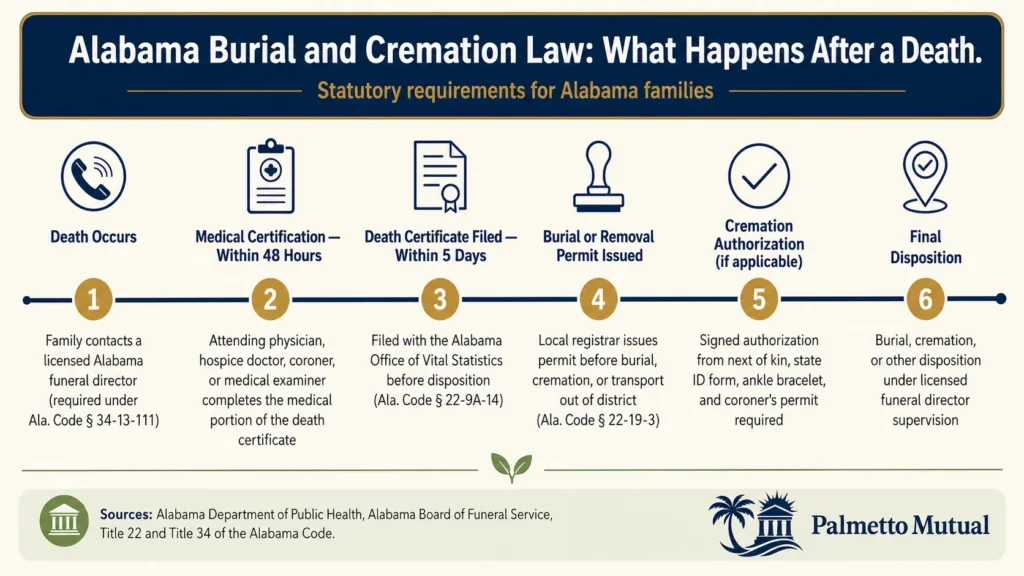
A death certificate must be filed with the Alabama Office of Vital Statistics within five days of death and before the body is disposed of (Ala. Code § 22-9A-14). The medical certifier — usually the attending physician, hospice physician, coroner, or medical examiner — must complete the medical portion and return it to the funeral director within 48 hours. Certified copies of the death certificate are handled by the Alabama Department of Public Health at $15 for the first copy and $6 for each additional copy. Plan on ordering at least 8 to 10 copies — insurance companies, banks, the Social Security Administration, and county probate courts will each require their own.
Burial or removal permits
Before a body can be interred, cremated, or moved from the registration district where the death occurred, a burial or removal permit must be issued by the local registrar under Ala. Code § 22-19-3. In modern practice, a fully completed death certificate often serves as this authorization. Failing to obtain the required permit is a misdemeanor under Alabama law.
Funeral director supervision requirement
Alabama is one of the few states that requires a licensed funeral director to oversee final disposition. Under Ala. Code § 34-13-111, every funeral service, memorial service, or committal service conducted in Alabama for hire or profit must be under the direct supervision of a funeral director licensed by the Alabama Board of Funeral Service. Home funerals are legal but still require a licensed director to coordinate the paperwork and final disposition.
Embalming rules
Embalming is not required under Alabama law in most circumstances. The state does not mandate embalming for a standard burial or cremation, and refrigeration can be used instead to preserve the body. Embalming is typically required only when a body is transported across state lines by common carrier, or when a funeral home has its own policy requiring it for a public viewing. Families can decline embalming to reduce costs and must be told by the funeral home that it is optional under the FTC Funeral Rule.
Cremation authorization rules
Cremation in Alabama is governed by Ala. Code § 34-13-121 and overseen by the Alabama Board of Funeral Service. Key requirements include:
- A signed cremation authorization form from the legal next of kin or an authorizing agent designated in a written affidavit
- A completed state identification form that stays with the remains through every phase of the process
- An undetachable ankle bracelet identifying the remains
- A cremation permit issued by the local coroner or medical examiner (no fee in most jurisdictions)
- Arrangement through a licensed funeral establishment — crematories cannot accept bodies directly from families without one
Alabama does not have a statutory waiting period before cremation at the state level, though some local jurisdictions and individual funeral homes impose a 24-hour minimum. Once the authorization and permit are in place, the cremation can proceed. If a crematory cannot cremate immediately, the remains must be kept in refrigeration.
Home funerals and home burial
Home funerals are legal in Alabama, but as noted above, a licensed funeral director must still oversee key steps. Home burial on private land is also legal — many rural counties still allow family cemeteries — but families must check local zoning rules, may need a health department inspection, and still need a burial permit from the local registrar. Private family cemeteries established on land that later changes ownership retain access rights for interested parties to visit graves, a protection rooted in Alabama’s historic cemetery preservation law.
Burial at sea
Alabama’s Gulf Coast makes burial at sea a practical option for families in Mobile and Baldwin counties. Burial at sea is governed by federal law under the EPA’s Marine Protection, Research, and Sanctuaries Act. Key federal requirements include scattering or committal at least three nautical miles offshore, a minimum water depth of 600 feet (1,800 feet in some Gulf zones), and notification to EPA Region 4 within 30 days. These rules apply to full-body burial at sea as well as ash scattering over ocean waters.
Green burial legality
Green burial is legal in Alabama, though largely unregulated at the state level. The state has no specific statutes governing natural burial, which means standard burial permit and death registration rules apply, with embalming declined and biodegradable materials used. The state’s first certified green burial ground, The Good Earth Burial Ground in Hazel Green (just north of Huntsville), offers vault-free and embalming-free interments and is certified by the Green Burial Council. A few traditional Alabama cemeteries have begun offering hybrid green burial sections where vaults are optional.
Regulatory body for funeral service
The Alabama Board of Funeral Service (PO Box 309522, Montgomery, AL 36130; 334-242-4049) licenses and regulates all funeral directors, embalmers, funeral establishments, and crematories operating in the state. The board handles consumer complaints, enforces Title 34 Chapter 13 of the Alabama Code, and publishes the current administrative rules at 395-X. Families who believe a funeral home or crematory has violated state law can file a complaint directly with the board. Understanding these funeral and burial laws helps Alabama families size a final expense insurance policy that actually covers what the law requires — and nothing more than what they want.
Regions and Major Metros in Alabama
Alabama spans four distinct regions, each with its own geography, economy, and demographic profile. Understanding where you live within the state helps frame the local cost of funeral services, the funeral home market, and the cemetery options near you. The section below covers named regions, major metros, and the county groupings that fall under each.
Named regions of Alabama
Alabama’s regional identity is shaped by geography — mountains in the north, Black Belt prairie through the middle, pine forests and wiregrass in the southeast, and coastal wetlands on the Gulf.
- North Alabama (Tennessee Valley and Highland Rim). The Tennessee River cuts across the top of the state, anchoring the Shoals in the northwest and Huntsville in the northeast. This region covers the Appalachian foothills, Sand Mountain, and Lookout Mountain, with a mix of aerospace and defense industry (Huntsville–Madison), manufacturing (Decatur, the Shoals), and rural mountain counties.
- Central Alabama (Birmingham Metro, Metropolitan Alabama, and the Piedmont). Anchored by Birmingham, the state’s largest metro, Central Alabama runs from the Appalachian ridges around Gadsden and Anniston through the industrial corridor of Jefferson, Shelby, and Tuscaloosa counties. The terrain shifts from Valley and Ridge topography in the east to rolling Piedmont hills.
- The Black Belt. A crescent-shaped region of rich dark soil stretching across the middle of the state, the Black Belt historically included 17 counties — Barbour, Bullock, Butler, Choctaw, Crenshaw, Dallas, Greene, Hale, Lowndes, Macon, Marengo, Montgomery, Perry, Pike, Russell, Sumter, and Wilcox. Today this region includes Montgomery, the state capital, and remains largely rural with significant African American populations and slower growth than the rest of the state.
- Wiregrass (Southeast Alabama). Named for the native long-stemmed Aristida stricta grass, the Wiregrass covers nine southeastern counties — Barbour, Coffee, Covington, Crenshaw, Dale, Geneva, Henry, Houston, and Pike. Dothan is the regional hub, Fort Novosel (formerly Fort Rucker) anchors the military economy, and peanuts and timber drive agriculture.
- Gulf Coast (South Alabama / Lower Alabama). Baldwin and Mobile counties define Alabama’s coastal region — port industry and shipbuilding around Mobile Bay, tourism and retirement migration to the beach communities of Gulf Shores, Orange Beach, and Fairhope. Baldwin County is the fastest-growing county in the state by percentage.
County groupings by region
The table below groups all 67 Alabama counties by region. Some counties straddle boundaries and could reasonably sit in more than one; placement here follows the most common cultural and geographic grouping.
| Region | Counties |
|---|---|
| North Alabama | Colbert, Cullman, DeKalb, Franklin, Jackson, Lauderdale, Lawrence, Limestone, Madison, Marion, Marshall, Morgan, Winston |
| Central Alabama / Birmingham Metro & Piedmont | Bibb, Blount, Calhoun, Chambers, Cherokee, Chilton, Clay, Cleburne, Coosa, Etowah, Fayette, Jefferson, Lamar, Lee, Pickens, Randolph, Shelby, St. Clair, Talladega, Tallapoosa, Tuscaloosa, Walker |
| Black Belt | Barbour, Bullock, Choctaw, Dallas, Greene, Hale, Lowndes, Macon, Marengo, Montgomery, Perry, Russell, Sumter, Wilcox |
| Wiregrass (Southeast Alabama) | Autauga, Butler, Coffee, Covington, Crenshaw, Dale, Elmore, Geneva, Henry, Houston, Pike |
| Gulf Coast / South Alabama | Baldwin, Clarke, Conecuh, Escambia, Mobile, Monroe, Washington |
Top metros in Alabama
The table below ranks Alabama’s largest metropolitan statistical areas by population, using the most recent Census Bureau estimates as compiled by the Public Affairs Research Council of Alabama.
| Rank | Metro Area | Population (approx.) | Core Counties |
|---|---|---|---|
| 1 | Birmingham–Hoover MSA | 1.2 million | Jefferson, Shelby, St. Clair, Blount, Bibb, Chilton, Walker |
| 2 | Huntsville MSA | 527,000+ | Madison, Limestone |
| 3 | Mobile MSA | 411,000 | Mobile |
| 4 | Montgomery MSA | 385,000 | Montgomery, Autauga, Elmore |
| 5 | Tuscaloosa MSA | 271,000 | Tuscaloosa, Hale, Pickens |
| 6 | Daphne–Fairhope–Foley MSA | 254,000 | Baldwin |
| 7 | Dothan MSA | 151,000 | Houston, Geneva, Henry |
Demographic patterns relevant to final expense planning
Alabama’s senior demographics concentrate in specific geographic patterns that matter for funeral planning:
- Baldwin County and the Gulf Coast are the state’s primary retirement destination. Retirees from the Midwest and Northeast have driven Baldwin to the fastest percentage growth rate in Alabama, and the 65+ population share there exceeds the state average.
- The Shoals (Lauderdale, Colbert, Franklin, Lawrence) has an older population profile than the state as a whole, anchored by retirees from the Tennessee Valley Authority and the region’s manufacturing base.
- The Huntsville area carries a significant military retiree population tied to Redstone Arsenal and the defense contractor economy. Military retirees often qualify for VA burial benefits at Alabama National Cemetery (Montevallo) or Fort Mitchell National Cemetery (southeast Alabama).
- Rural Black Belt counties have lost population over the past two decades and tend to skew older as younger residents migrate to Birmingham, Huntsville, and out of state. These counties often have fewer funeral homes per capita and longer distances to the nearest provider.
- Statewide, Alabama’s 65+ population is approximately 18% and growing, above the national share. Burial remains the more common choice across most of the state — Alabama’s cremation rate sits around 40%, well below the national average of 63% — which keeps traditional funeral demand strong and supports the case for final expense insurance sized to cover full-service burial costs.
Regional differences matter when planning a burial life insurance policy. A retiree in Baldwin County faces different cemetery costs than a lifelong resident of Sumter County in the Black Belt, and the right policy size reflects the local reality — not a national average. health history, and budget.

About the Author
Dvir Mosche is an award-winning independent insurance agent and the founder of Palmetto Mutual, a trusted insurance brokerage specializing in Final Expense Life Insurance. Since entering the industry in 2017, he has been recognized multiple times as a top agent for his dedication to educating and assisting seniors in finding the proper coverage. His mission is to simplify the process, provide honest and personalized guidance, and ensure that every client gets coverage they can depend on for life.


