
Home > Funeral Cost
How Much Does a Funeral Cost in America?

Funeral Cost Estimator
Pick a service type and your region to see a realistic cost range.
Estimated cost — Full burial, national average
$10,000 – $15,000
Want to see how a small policy could cover a cost like this? We can walk you through your options at no cost.
Get a Free QuoteEstimates are planning ranges built from national research, including the National Funeral Directors Association, the U.S. Bureau of Labor Statistics, and industry cost studies. Actual costs vary by provider, service choices, and local pricing. This tool is for general guidance, not a quote.
Planning ahead is easier when you know what a funeral really costs. This guide walks through what families across the country typically spend, what makes the price go up or down, and how costs differ from one region to the next. Many people use final expense insurance to help cover these costs, so knowing the real numbers can help you plan for the right amount of coverage.
What Americans Actually Spend on a Funeral
A full-service funeral with burial costs about $8,300 nationally. A funeral with cremation and a service costs about $6,280. These are the middle-of-the-road numbers — half of funerals cost more, half cost less.
Both of these figures cover a full service: a viewing, a ceremony, and the funeral home's care of your loved one. The burial figure includes a metal casket. The cremation figure includes the cremation and a basic urn.
In the real world, most families land somewhere between $6,000 and $12,000 for a traditional funeral. Where you fall depends on your choices and where you live.
There are also simpler, lower-cost paths. A direct cremation — no viewing, no service, just the cremation — runs about $2,000 to $2,200 on average. A direct burial, with no viewing or ceremony, averages around $5,100.
| Type of service | Typical national cost |
|---|---|
| Funeral with burial (viewing, service, casket) | $8,300 |
| Funeral with cremation (viewing, service, urn) | $6,280 |
| Direct burial (no viewing or service) | ~$5,100 |
| Direct cremation (no viewing or service) | ~$2,000–$2,200 |
One important note about the $8,300 burial figure: it does not include the cemetery. That means no burial plot, no vault, and no headstone are counted in that number. We explain what gets left out — and how much it adds — in the next section.
Knowing these numbers up front helps you plan. Many families use a burial insurance policy to cover these costs, and seeing the real figures makes it easier to choose the right amount of coverage.
Where the Money Goes — and What the Average Hides
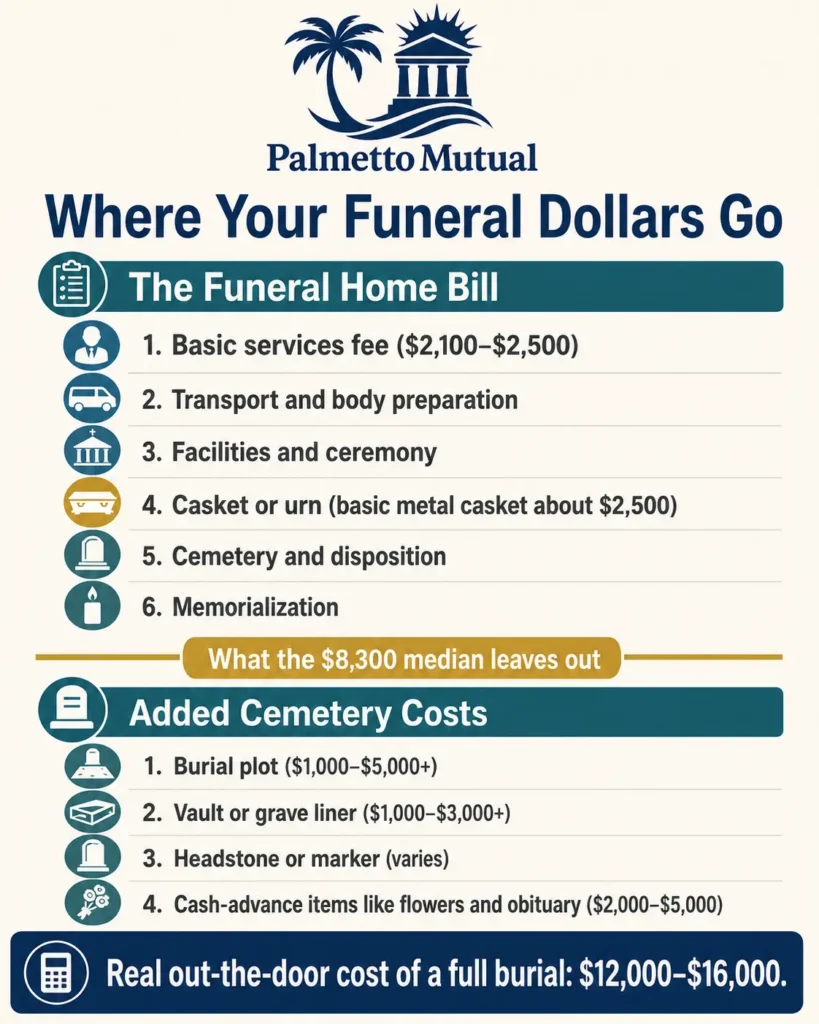
A funeral bill is built from several parts. Here is a plain look at each piece, so the total makes sense.
| Cost bucket | What it covers |
|---|---|
| Basic services fee | The funeral director's planning, staff, permits, and overhead. You cannot decline this fee. Typically $2,100–$2,500. |
| Transport and preparation | Moving your loved one, plus embalming or refrigeration and basic prep. |
| Facilities and ceremony | Use of the funeral home's rooms and staff for the viewing and service. |
| Casket or urn | A metal casket is often the largest single item. A basic urn costs far less. |
| Cemetery and disposition | The burial plot, the vault, and the grave opening — or the cremation fee. |
| Memorialization | The headstone, grave marker, or memorial plaque. |
The basic services fee is the one charge you cannot say no to. It usually makes up a large share of the bill, so it is worth comparing across two or three funeral homes.
For a traditional burial, the casket is often the biggest variable. A basic metal casket runs about $2,500, but prices climb past $10,000 for premium materials like bronze or mahogany.
Now for the part the headline number hides. The widely quoted $8,300 median is for funeral home services only. It leaves out several real cemetery costs that most families still have to pay.
| What the median leaves out | Typical added cost |
|---|---|
| Burial plot | $1,000–$5,000+ |
| Vault or grave liner (most cemeteries require one) | $1,000–$3,000+ |
| Headstone or grave marker | varies widely |
| Cash-advance items (flowers, obituary, death certificates) | $2,000–$5,000 |
When you add those pieces back in, the true out-the-door cost for a full burial often lands between $12,000 and $16,000 — well above the quoted median.
This is the gap that surprises families most. The funeral home quote is real, but it is only one of two bills. The cemetery sends its own. We dig into the full burial breakdown on its own page, but for funeral insurance planning, the key takeaway is simple: plan for the cemetery costs, not just the funeral home figure.
What Drives Funeral Costs Up or Down
Two funerals in the same town can cost thousands apart. The difference comes down to a handful of choices. Here are the biggest levers that move the price.
Burial or cremation. This is the single largest factor. A full burial runs about $8,300, a cremation with a service about $6,280, and a direct cremation closer to $2,000.
How much service you want. A full funeral with a viewing and ceremony costs the most. Skipping the viewing, or holding a simple memorial later, brings the price down. Direct burial and direct cremation are the lowest-cost paths because they remove the facility and staff hours.
The casket or urn you pick. A basic metal casket costs around $2,500, but premium wood or bronze models climb past $10,000. An urn costs far less. This one choice can swing the bill by thousands.
Embalming. Embalming runs about $500 to $1,000 and is not required by law in most states. If there is no open-casket viewing, refrigeration is a lower-cost option.
Who owns the funeral home. This one surprises most families. Corporate-owned funeral homes often charge more than local independent ones for the same services.
A widely cited 2017 study by the Consumer Federation of America and the Funeral Consumers Alliance found that funeral homes owned by Service Corporation International — the largest chain, which often operates under the Dignity Memorial name — charged median prices 47 to 72 percent higher than nearby independent funeral homes.
| Service | SCI (corporate) median | Independent median |
|---|---|---|
| Simple cremation | $2,700 | $1,562 |
| Simple burial | $2,845 | $1,893 |
| Full-service funeral | $7,705 | $5,241 |
Here is the catch: a corporate-owned home usually keeps its original local family name after it is bought. There is no rule requiring it to tell you who owns it. If it matters to you, just ask, or check the fine print at the bottom of its website for a parent company like SCI, Dignity Memorial, or Carriage Services.
Package vs. picking items one by one. Funeral homes often sell bundled packages. But under the FTC Funeral Rule, you have the right to buy only the items you want, one by one.
Comparing two or three funeral homes is the most effective way to control the cost. Knowing these levers ahead of time also helps you set the right amount of burial insurance, so your coverage matches the choices your family is likely to make.
Funeral Costs by State and Region
Where you live can change a funeral bill by thousands of dollars. The same arrangements that cost one amount in a rural Southern town can cost far more in a dense coastal city.
A quick note on the numbers: different studies report different state-by-state figures depending on their methods, so exact state rankings shift from one source to the next. The regional pattern, though, is steady and well documented. We have written to that pattern below.
The most expensive areas. The Northeast, and New England in particular, consistently ranks as the priciest region. NFDA's own regional data has long shown New England at the top for a full funeral with viewing and burial.
Hawaii is the standout high-cost state. With little available land and the need to ship materials to the islands, both plots and services run high.
| Region | Cost vs. national average |
|---|---|
| Northeast / New England | Highest — roughly 8% to 20%+ above average |
| West / Pacific | Above average, driven by California and urban land costs |
| Midwest | Near the national average |
| South | Lowest — roughly 13% below average |
| Mountain | Often lowest, especially for cremation |
The least expensive areas. The South and the Mountain states tend to be the most affordable. Mississippi is frequently named among the least expensive states. These areas benefit from lower land costs, lower wages, and more funeral homes competing for business.
A few clear reasons drive the spread:
- Land and real estate. Cemetery plots follow local land prices. A single plot can run a few hundred dollars in a rural area or well over $10,000 in a major city.
- Labor costs. Funeral directors earn more in higher-cost regions, and those wages show up in the bill.
- Competition. More funeral homes in an area tends to mean more competitive pricing.
- State rules. Some states have stricter requirements — for example, certain embalming or storage rules — that add to the cost.
- Cremation rates. States where more families choose cremation often show lower average totals, since cremation costs less than burial.
The takeaway for planning is simple: look up your own area before settling on a number. A national average is a starting point, but your local costs are what your final expense insurance should be built around. We cover individual states in more detail on their own pages.
How Funeral Costs Have Changed Over Time
Funerals cost far more today than they did a generation ago. Over the long run, their price has climbed faster than the cost of most other things families buy.
The clearest measure comes from the U.S. Bureau of Labor Statistics, which has tracked funeral prices since 1986. From late 1986 to 2017, funeral costs rose about 227 percent, while prices for all goods and services rose about 123 percent — nearly twice as fast.
That gap has held in recent years too. Over the past five years, funeral prices have risen roughly 4.6 percent a year, compared with about 3.1 percent a year for general inflation.
| Time period | Funeral cost increase | General inflation |
|---|---|---|
| 1986 to 2017 (about 30 years) | ~227% | ~123% |
| Past 5 years (annual pace) | ~4.6% per year | ~3.1% per year |
There is one exception worth knowing. During the sharp inflation spike of 2021 to 2023, funeral costs actually rose slower than the broader economy. NFDA reported funeral prices up about 5.8 to 8.1 percent over those two years, while general inflation ran around 13.5 percent.
So the long-run story is that funerals have outpaced inflation, even though the funeral industry held the line better than most during the recent price surge.
What is pushing the long-run climb? The main drivers are rising labor costs, higher real estate prices for funeral homes and cemeteries, and the growing cost of caskets and materials.
These rising costs are also one reason more families have turned to cremation, which costs less than a traditional burial. We cover that shift in detail on its own page.
For planning, the lesson is steady: prices tend to rise over time, so a funeral insurance amount that fits today may need a second look in ten or fifteen years.
What Should You Actually Plan to Spend?
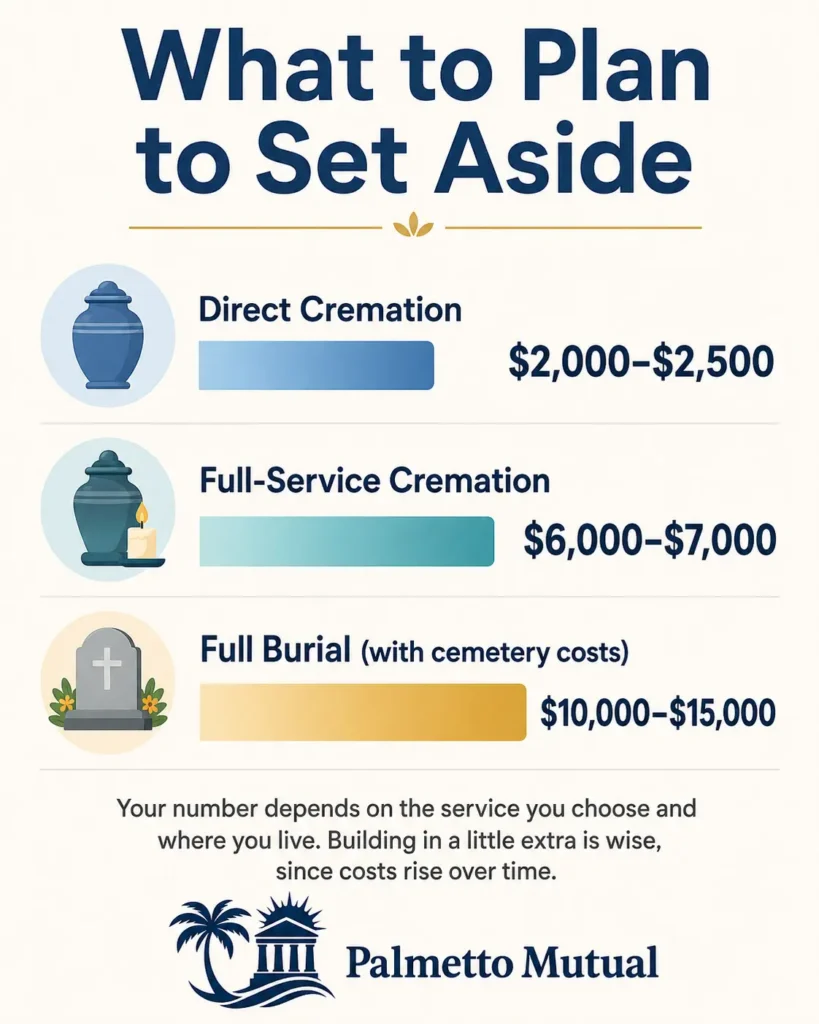
After all the numbers, here is the simple version. Below are three realistic figures to set aside, depending on the kind of service you have in mind.
A full burial: plan for about $10,000 to $15,000. This covers the funeral home services plus the cemetery costs — the plot, the vault, and a grave marker. The often-quoted $8,300 figure is only the funeral home's share, so a realistic all-in target runs higher.
A full-service cremation: plan for about $6,000 to $7,000. This includes a viewing and a ceremony, along with the cremation and a basic urn. It costs less than a burial mainly because there is no plot, vault, or burial casket.
A direct cremation: plan for about $2,000 to $2,500. This is the simplest path — the cremation with no viewing or formal service. Many families still hold a memorial later at a home, park, or place of worship.
| What you have in mind | Realistic amount to set aside |
|---|---|
| Full burial (with cemetery costs) | $10,000–$15,000 |
| Full-service cremation | $6,000–$7,000 |
| Direct cremation | $2,000–$2,500 |
Your own number will land somewhere in or near these ranges, shaped by your choices and where you live. Building in a little extra room is wise, since costs tend to rise over time.
These figures are the foundation of a final expense insurance plan. Knowing the target helps you choose a coverage amount that fits your wishes — enough to cover the service you want, without paying for more than your family will need.
Frequently Asked Questions
Keep Reading







About the Author
Dvir Mosche is an award-winning independent insurance agent and the founder of Palmetto Mutual, a trusted insurance brokerage specializing in Final Expense Life Insurance. Since entering the industry in 2017, he has been recognized multiple times as a top agent for his dedication to educating and assisting seniors in finding the proper coverage. His mission is to simplify the process, provide honest and personalized guidance, and ensure that every client gets coverage they can depend on for life.


