
Home > Alaska
Alaska Final Expense Insurance — A Complete Guide for Seniors Across The Last Frontier
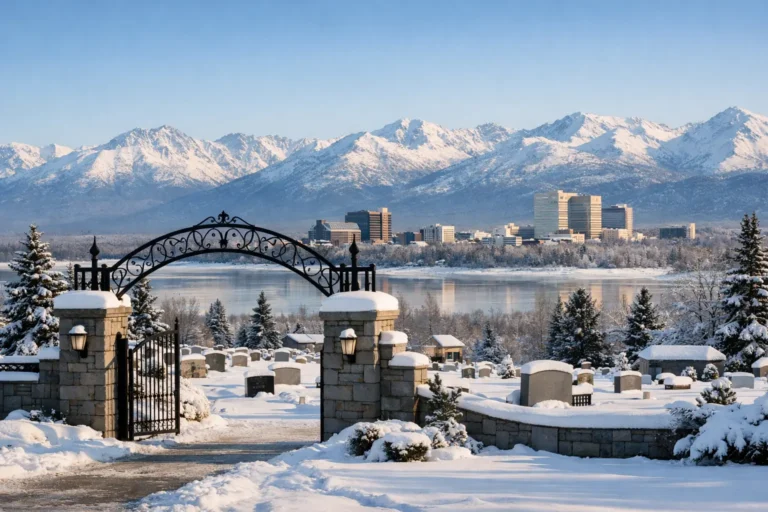
Alaska’s scale reshapes nearly every part of end-of-life planning. The state spans five distinct regions — Southeast, Southcentral, Interior, Southwest, and the North Slope — and more than 80 percent of communities are unreachable by road, which drives up the logistics and cost of funeral, burial, and cremation services in ways seniors on the mainland rarely face. Whether you’re researching final expense insurance in Anchorage, the Mat-Su Valley, Fairbanks, or a remote village off the Dalton Highway, this page is built to help Alaska seniors understand statewide costs, insurance rules, and funeral laws before narrowing down to their borough or census area.
Funeral and Cremation Costs in Alaska
Alaska’s funeral and cremation costs reflect the same logistical realities that shape everyday life in the state — transportation distance, seasonal conditions, and urban versus bush access. Statewide averages sit near the national median, but the ranges widen sharply once a family factors in air transport, frozen ground, or remote village logistics. Burial insurance in Alaska is often purchased with these specific cost drivers in mind, rather than the flat national figures used in most planning guides.
Statewide averages
The average burial cost in Alaska ranges from $7,848 to $9,913, and cremation ranges from $1,500 to $3,300 depending on service type and provider. The National Funeral Directors Association figures a typical Alaska funeral at $7,225 for a burial and $6,028 for cremation with service. Direct options land well below those numbers — direct cremation in Alaska ranges from $1,400 to $3,000 depending on provider and services offered.
| Service Type | Typical Alaska Range |
|---|---|
| Traditional full-service burial | $7,848 – $9,913 |
| Full-service cremation with ceremony | $3,500 – $7,000 |
| Direct cremation (no service) | $1,500 – $3,300 |
| Immediate/direct burial | $5,000 – $7,500 |
| Cemetery plot | $775 – $3,000+ |
| Casket (basic) | $2,000 – $2,500 |
Regional cost variation within Alaska
Costs shift noticeably across the state’s five regions. Legislative filings from Alaska funeral homes show that even within Southcentral and Interior Alaska, minimum burial packages differ by hundreds of dollars between cities. A traditional funeral service preceded by visitation runs roughly $7,835 in Anchorage, $7,320 in Kenai, and $8,675 in Fairbanks, with Fairbanks requiring an outer burial container and vault installation that other markets do not.
Remote and bush Alaska is the biggest variable. Airline shipping costs published on Alaska funeral home price lists include Anchorage to Fairbanks at $221 plus $0.12 per pound, Anchorage to Nome at $315 plus $0.12 per pound, and an air tray required for airline transport at $200. Families in villages off the road system often pay these freight charges on top of a standard funeral bill, which is why final expense insurance quoted to Alaska seniors typically assumes higher total outlay than the Lower 48.
| Region | Cost Pattern |
|---|---|
| Southcentral (Anchorage, Mat-Su, Kenai Peninsula) | Closest to state averages; most provider options and pricing competition |
| Interior (Fairbanks, Denali, Yukon-Koyukuk) | Higher on the burial side due to vault and outer container requirements; cold-weather grave preparation |
| Southeast (Juneau, Ketchikan, Sitka) | Island and panhandle logistics raise transport costs; limited provider count in smaller communities |
| Southwest (Bethel, Dillingham, Aleutians) | Highest variability; village-to-hub air transport is the dominant cost driver |
| North Slope and Northwest Arctic (Utqiaġvik, Nome, Kotzebue) | Significant freight and medical examiner transport costs; longest logistics chain in the state |
How Alaska compares nationally
NFDA’s most recent general price list data shows the national median cost of a funeral with cremation at $6,280, up 8.1 percent from $5,810. Alaska’s cremation figures track close to that national median in urban markets but climb well above it in bush communities once transport is factored in. Burial costs in Alaska sit near the national midpoint, but — unlike most states — headstones, plots, and vaults are only part of the picture. Transportation logistics in remote areas of Alaska can add significantly to costs, because long distances and isolated areas require extra handling, and seasonal conditions further complicate delivery.
State-specific cost drivers
Four factors move Alaska funeral pricing away from national averages more than almost any other state:
Winter burial conditions. Alaska’s intense winters create unique challenges for burials, with frozen ground often making grave digging difficult and requiring special equipment, leading to additional labor costs and sometimes delays until spring when the ground softens.
Bush and village transport. More than 80 percent of Alaska communities are not on the road system. Families in these communities either pay air freight to bring a loved one to a regional hub funeral home or work with a funeral home that coordinates the medical examiner, airline carrier, and return transport — often a several-thousand-dollar line item on top of the funeral itself.
Urban-rural pricing spread. In larger cities like Anchorage and Fairbanks, direct cremation tends to cost more, ranging from $2,000 to $4,000, while in smaller towns and remote areas the cost may be lower, but transportation costs can drive up the total price.
Cremation preference shift. Cremation is more popular than burial in Alaska, and the higher cremation rate can be partially attributed to the difficulties with burial during the winter months, with cost also a factor in the rising cremation rate. This gives Alaska seniors more flexibility on the low end of the cost spectrum than families in traditional-burial states.
These combined factors are why a $10,000 final expense insurance policy that covers a full funeral in most Lower 48 states may only cover a direct cremation with basic air transport in parts of Alaska — something worth weighing carefully when choosing coverage amounts.
Final Expense Insurance Regulations in Alaska
Alaska regulates life insurance at the state level, which means the rules governing final expense and burial insurance sold in Anchorage, Fairbanks, or any village on the road system come from Alaska statutes and administrative code — not federal law. Seniors comparing policies benefit from knowing the basics of how the state handles cancellations, replacements, claims timelines, and consumer protections before signing anything.
Who regulates insurance in Alaska
The insurance industry in Alaska is regulated by the Alaska Division of Insurance, which is a division of the Department of Commerce, Community, and Economic Development Ez. The Division licenses every carrier and producer selling final expense or burial life insurance in the state, reviews policy forms before they are sold, and handles consumer complaints. The specific laws governing the sale of life insurance, features of policies, and payment of death benefits are found in Chapter 45 of Title 21 of the Alaska Statutes.
Free look period
Alaska law gives every buyer time to change their mind after a policy is delivered. Any Alaska resident buying a life insurance policy has 10 days to back out of coverage and receive a full refund of any premiums paid for a new life insurance policy, and this period is a full 30 days for a replacement policy. The clock starts when the policy is physically delivered — not when the application is signed — which matters in rural Alaska where mail delivery can add days or weeks to that timeline.
Replacement rules
Alaska has strong consumer protections around replacing an existing life insurance policy with a new one, codified in 3 AAC 26, Article 8. The replacing insurer must include in the life insurance policy the right to return it within 30 days after delivery, and must retain copies of replacement notifications indexed by insurance producer for at least five years. This is an important protection for seniors because some final expense sales involve swapping out an older policy, and the 30-day window plus the producer’s written disclosure requirement exists specifically to prevent pressured or unsuitable replacements.
Grace period and claim timelines
Alaska requires a 30-day payment grace period, which ensures an Alaska life insurance policy cannot be canceled due to a reasonably late payment, and when a life insurance claim is filed, an Alaska insurance provider is required to pay the amount to the beneficiary promptly. Claims that are not paid promptly can expose insurers to penalties under state unfair claims settlement regulations.
Contestability and misstatements
Life insurance companies in Alaska have only two years to investigate details of the policy to cancel or refuse to pay death benefits, and after the two-year anniversary of the policy, the insurance company can’t contest payout requests. This is standard across most states, but it’s especially relevant for final expense policies, which are usually sold to seniors with some level of health history. Accurate answers on the application protect the beneficiary’s claim during that two-year window.
Graded death benefit policies
Final expense carriers commonly offer graded (or modified) benefit policies to applicants who cannot qualify for immediate, first-day coverage. On a graded policy, natural-cause deaths during the first two or three years typically result in a return of premium plus interest rather than the full death benefit, while accidental deaths are usually covered in full from day one. Alaska does not prohibit graded benefit structures, but the Division of Insurance requires that policy language clearly disclose the waiting period and the benefit payable during it — which is why reading the schedule page of any final expense policy matters before purchase.
Burial insurance sold by funeral homes
The Alaska Division of Insurance has published specific consumer guidance on policies sold directly by funeral homes, often called preneed or burial contracts. Licensed insurance agents who work for a funeral home commonly sell these policies in the form of a whole life insurance policy, and if there is no price guarantee, the insured should insist on naming their own beneficiary instead of naming the funeral home as beneficiary. This matters in Alaska specifically because funeral home preneed sales are common in smaller communities where independent agents are less accessible.
Guaranty association protection
Life insurance policies that are current are backed by the Alaska Life and Health Insurance Guaranty Association, with this guarantee limited to $300,000 maximum for lost death benefits and $100,000 maximum for lost cash surrender, even if the deceased person was insured for a larger amount or covered under multiple policies. Final expense policies typically cap at $25,000 to $35,000 in death benefit, which is well inside the guaranty association’s coverage ceiling — meaning Alaska buyers are fully protected on a burial insurance policy if the carrier ever becomes insolvent.
Filing a complaint
If a claim is denied, delayed, or a sales practice looks questionable, consumers can file a complaint directly with the Alaska Division of Insurance. The Division has investigative authority over licensed producers and carriers, and complaints are a standard channel for resolving final expense disputes before litigation.
| Alaska Final Expense Regulation | Detail |
|---|---|
| Regulator | Alaska Division of Insurance (Department of Commerce, Community, and Economic Development) |
| Governing statutes | Alaska Statutes Title 21, Chapter 45 |
| Replacement rules | 3 AAC 26, Article 8 |
| Free look — new policy | 10 days from delivery |
| Free look — replacement policy | 30 days from delivery |
| Payment grace period | 30 days |
| Contestability period | 2 years |
| Guaranty association (death benefit cap) | $300,000 |
| Guaranty association (cash surrender cap) | $100,000 |
Funeral and Burial Laws in Alaska
Alaska’s funeral and burial laws are shaped by two realities: the state’s geographic scale, which creates unique rules for transporting remains and authorizing disposition, and a comparatively permissive legal framework that gives families more flexibility than most states to handle arrangements themselves. The core rules below apply statewide, though local borough and municipal ordinances can add requirements in specific communities.
Death certificate filing
Every death in Alaska has to be registered quickly. A death must be registered with the local registrar within three days, and the body may not be buried or cremated until the death certificate is filed. Typically, the funeral home, mortuary, cremation organization, or other person in charge of the deceased person’s remains will prepare and file the death certificate. The governing statute is Alaska Statute 18.50.230. The attending physician completes the medical certification within 24 hours of death, then the funeral director or family member filing the certificate submits it to the registrar of the district where the death occurred.
A death certificate costs $30.00, with each additional copy charged at $25.00. Most families order at least 10 certified copies at the time of death because each life insurance claim, property transfer, Social Security filing, and benefit application requires its own certified copy.
Burial-transit permits
Alaska uses a burial-transit permit to authorize final disposition, shipment of remains out of state, holding a body beyond 72 hours, or moving a body by common carrier. Under Alaska Statute 18.50.250, the funeral director or person acting as the funeral director who first assumes custody of a dead body shall obtain a burial-transit permit before final disposition or removal from the state of the body, and within 72 hours after death, except as otherwise authorized by regulation for special problem cases. The local registrar issues the permit once the death certificate is on file, and a permit accompanying a body brought into Alaska from another state is valid for final disposition here.
Embalming rules
Alaska is one of the more permissive states on embalming. The laws requiring embalming were repealed in 2006, and Alaska has no requirements controlling the time schedule for the disposition of unembalmed bodies — weather and reasonable planning should be considered. Embalming is not required for burial, cremation, or in-state transport. It may be required by the airline or destination state when remains are shipped outside Alaska, and state health officials may authorize embalming in specific public-health circumstances.
Cremation rules
Cremation in Alaska requires a signed authorization from the legal next of kin, a burial-transit permit, and — importantly — a mandatory waiting period. Before a cremation can proceed a Cremation Authorization Form must be signed by the next of kin, and there is a mandatory 24-hour waiting period after a death has occurred in Alaska before the cremation can be performed. No casket is required by law for a cremation, all that is required is a suitable cremation container, and this is often a simple cardboard container. Approval for cremation must be granted by a local medical examiner or magistrate, and most crematories insist that a pacemaker be removed, with authorization by next of kin usually required.
Home funerals
Alaska law permits families to care for their own dead at home, and this is one of the state’s notable consumer-friendly features. It is legal to conduct a home funeral in Alaska, and there are no laws that specifically prohibit burial on your own land, although you should check with local county zoning. A family member can act as the person in charge of the remains, file the death certificate, obtain the burial-transit permit, and arrange final disposition without a funeral director. This is particularly meaningful in remote villages where no licensed funeral establishment operates within hundreds of miles.
Burial at sea
With more than 33,000 miles of coastline, burial at sea is a realistic option for many Alaska families. The rules come from federal law rather than state statute. The federal Clean Water Act requires that cremated remains be scattered at least three nautical miles from land. If the container won’t easily decompose, you must dispose of it separately. The EPA doesn’t permit scattering at beaches or in wading pools by the sea. Finally, you must notify the EPA within 30 days of scattering ashes at sea. Full-body burial at sea requires additional EPA authorization and specific depth and distance criteria.
Green burial and private-land burial
Green burial — interment without embalming, in a biodegradable container, and without a concrete vault — is legal in Alaska. There are no state laws in Alaska that prohibit burial on private property. This doesn’t mean there are no regulations at all — many local governments have rules governing burial, for example in Anchorage bodies may be buried only in an approved cemetery. Before burying a body on private land or establishing a family cemetery, you should check municipal and borough zoning rules. Families considering a private-land burial should also confirm setback requirements from water sources and check with the Alaska Division of Environmental Conservation.
Who licenses funeral directors in Alaska
Unlike most states, Alaska does not have a dedicated state board of funeral service. Funeral directors, embalmers, and funeral establishments in Alaska are licensed through the Division of Corporations, Business and Professional Licensing within the Department of Commerce, Community, and Economic Development, with funeral establishments also required to obtain an Alaska Business License. Qualification for a license to practice funeral directing under Alaska Statutes 08.42.050 requires completion of at least one year (30 semester credit hours) at an accredited college or university, passing the examination for a license to practice funeral directing conducted by the department, and completing at least one year of apprenticeship as a trainee under a person licensed to practice funeral directing in this state.
Preneed funeral contracts
Alaska regulates contracts sold directly by funeral homes to prepay for services. Only licensed funeral establishments may sell preneed contracts, and they must obtain a special license to sell such contracts. Preneed contracts may be funded either through a trust fund or through an insurance policy. This is the same category of product that sometimes gets mixed up with final expense insurance — the key distinction is that final expense insurance is a whole life policy with a death benefit payable to a beneficiary, while a preneed contract is tied to a specific funeral home and specific services.
| Alaska Funeral and Burial Law | Detail |
|---|---|
| Death certificate filing deadline | 3 days after death |
| Certified death certificate cost | $30 first copy, $25 each additional |
| Burial-transit permit required within | 72 hours after death |
| Embalming required by state law | No (repealed 2006) |
| Cremation waiting period | 24 hours after death |
| Home funerals permitted | Yes |
| Private-land burial | Permitted statewide; subject to local zoning |
| Burial at sea (cremated remains) | Federal rule: 3+ nautical miles offshore |
| State funeral board | None — licensing through Department of Commerce |
| Licensing authority | Alaska Division of Corporations, Business and Professional Licensing |
Alaska Final Expense Coverage Amounts: How Much Is Enough?
Picking the right coverage amount in Alaska is not just about using a national average. It is about thinking through what a funeral, cremation, transportation, and any leftover bills could really cost in your part of the state. For many families in Anchorage and Fairbanks, that is why $10,000 to $15,000 often feels like a more realistic middle ground than a very small policy.
Matching your coverage to Alaska’s real final expense costs
Many Alaska seniors look at final expense coverage in the $5,000 to $25,000 range. That range makes sense because a traditional burial can land well above the lower end, while cremation with added services, transportation, and a memorial can still climb into the mid-range quickly.
It is also smart to think past the funeral home bill alone. A family may still face cemetery costs, a marker, travel between communities, and unpaid medical or personal bills. In a state where logistics can add so much, buying too little coverage is one of the easiest mistakes to make.
One Mistake, Five Consequences — what happens when coverage falls short in Alaska
The mistake is simple: choosing a policy amount based on a national number that does not reflect Alaska.
Consequence one: the policy may not cover the full burial or cremation bill.
Consequence two: transportation from a place like Nome, Bethel, or Kodiak adds a cost the family did not expect.
Consequence three: winter conditions can create extra timing and preparation costs.
Consequence four: relatives traveling Alaska highways or flying across regions may face extra lodging, gas, or missed work.
Consequence five: medical bills from larger hospitals can stack on top of funeral costs.
That is why a policy that looks big enough on paper can still fall short in real life. Alaska has too many moving parts for guesswork to be safe.
Alaska before you apply — quick prep table
This is especially helpful for seniors who live alone or do not have close family nearby.
| Step | What to prepare | Why it matters | Time needed |
|---|---|---|---|
| 1 | Coverage amount goal | Helps match the plan to real final expense needs | 1–2 minutes |
| 2 | Beneficiary or arrangement choice | Helps make sure the money goes where you want | 1–2 minutes |
| 3 | Monthly budget range | Helps keep the policy affordable long term | 1–2 minutes |
Simple roadmap:
Get Ready → Review Options → Choose Plan → Apply → Coverage Active
What to know about premium payment options and billing cycles
Most final expense plans let people pay by automatic bank draft, card, or mailed billing. Monthly payments are the most common, though some companies also allow quarterly, semiannual, or annual billing.
In Alaska, automatic payment is often the safest option because it reduces the chance that mail delays or routine mix-ups cause a missed premium. The easier the billing setup, the easier it is to protect the coverage long term.
Why seniors often misunderstand grace periods
A grace period does not mean you can relax about a missed payment. It usually means the policy stays active for a short window, often around 30 days, while you catch up. After that, the policy can lapse.
The common mistake is thinking, “I’m still covered, so I can deal with it later.” That is risky anywhere, and it is even riskier in Alaska where mail and communication delays can slow everything down. A grace period is a backup. It is not a payment strategy.
Regions and Major Metros in Alaska
Alaska is organized into five distinct regions and uses boroughs and census areas rather than counties. The region a senior lives in matters a great deal for final expense planning — it drives everything from which funeral homes are accessible to how much transportation will add to a final bill. Understanding where each borough and census area falls regionally is also the fastest way for Alaska families to find the right local page on this site.
The five regions of Alaska
Alaska has five main regions: the Far North, Interior, Southwest, Southcentral, and Southeast. The Alaska state tourism office defines these as Inside Passage, Southcentral, Interior, Arctic, and Southwest — the same five areas under slightly different names. Regional identity is a real part of how Alaskans describe where they live, and it’s how final expense logistics are typically organized on the ground.
Southcentral Alaska is the state’s population and economic center. Anchorage, the Mat-Su Valley, the Kenai Peninsula, and Prince William Sound all sit here. Southcentral is home to over half of the state’s population, most of whom live in Anchorage. It’s the only region with a significant road system linking communities, which keeps funeral costs closer to national averages than in the rest of the state.
Interior Alaska runs from the Alaska Range north to the Brooks Range, with Fairbanks as the regional hub. The Interior has a modest road network connecting Fairbanks to Denali, Tok, and the Yukon River corridor, but vast areas remain accessible only by air. Extreme winter temperatures regularly drop below -40°F, which affects burial timing and graveside services.
Southeast Alaska, also called the Inside Passage or the Panhandle, is a coastal region of islands, fjords, and rainforest. Southeast has no road connections between communities, and travelers reach it by cruise ship, ferry, or plane. Juneau, Ketchikan, Sitka, and Petersburg anchor the region. Families here routinely work with funeral homes in one town and crematories in another, connected by the Alaska Marine Highway System.
Southwest Alaska covers the Aleutian Chain, the Alaska Peninsula, Bristol Bay, and the Yukon-Kuskokwim Delta. No roads connect Southwest Alaska with the rest of the state, and the region has limited ferry service, so most locals and visitors will arrive by plane from Anchorage or Homer. The communities in this region are primarily Native Alaskan villages, including people from the Aleut, Alutiiq, and Yupik tribes. Bethel is the major regional hub for Yukon-Kuskokwim villages.
The Far North (Arctic) covers everything above the Arctic Circle, including the North Slope and the Brooks Range. The population of this entire region is just over 10,000 people, and main towns include Utqiagvik (formerly Barrow), Nome, Kotzebue, Anaktuvuk Pass, Bettles, and Fort Yukon. This is the most logistically challenging region for funeral arrangements in the state.
Top metros in Alaska
Alaska’s population is highly concentrated. The most populous boroughs in Alaska are Anchorage Municipality with 289,600, Matanuska-Susitna Borough at 117,613, Fairbanks North Star Borough with 94,951, Kenai Peninsula Borough at 61,259, and Juneau City and Borough with 31,572.
| Metro | Borough / Census Area | Population | Region |
|---|---|---|---|
| Anchorage | Anchorage Municipality | ~290,000 | Southcentral |
| Mat-Su Valley (Wasilla, Palmer) | Matanuska-Susitna Borough | ~117,600 | Southcentral |
| Fairbanks | Fairbanks North Star Borough | ~94,950 | Interior |
| Kenai Peninsula (Kenai, Soldotna, Homer) | Kenai Peninsula Borough | ~61,260 | Southcentral |
| Juneau | Juneau City and Borough | ~31,570 | Southeast |
| Ketchikan | Ketchikan Gateway Borough | ~13,800 | Southeast |
| Sitka | Sitka City and Borough | ~8,400 | Southeast |
Anchorage and the Mat-Su Valley together form a single contiguous metro area of roughly 400,000 people — more than half the state’s total population in one connected region. This is where burial insurance policies are most actively sold in Alaska, with the highest concentration of funeral homes, crematories, and licensed insurance producers.
Boroughs and census areas by region
Alaska’s 19 organized boroughs and 11 census areas map onto the five regions as follows. Alaska is divided into 19 organized boroughs and 11 census areas in the Unorganized Borough. Boroughs and census areas are both treated as county-level equivalents by the Census Bureau.
| Region | Boroughs and Census Areas |
|---|---|
| Southcentral | Anchorage Municipality, Matanuska-Susitna Borough, Kenai Peninsula Borough, Valdez-Cordova Census Area (now Chugach and Copper River census areas) |
| Interior | Fairbanks North Star Borough, Denali Borough, Southeast Fairbanks Census Area, Yukon-Koyukuk Census Area |
| Southeast | Juneau City and Borough, Sitka City and Borough, Ketchikan Gateway Borough, Wrangell City and Borough, Petersburg Borough, Haines Borough, Skagway Municipality, Hoonah-Angoon Census Area, Prince of Wales-Hyder Census Area, Yakutat City and Borough |
| Southwest | Kodiak Island Borough, Bristol Bay Borough, Lake and Peninsula Borough, Aleutians East Borough, Aleutians West Census Area, Dillingham Census Area, Bethel Census Area, Kusilvak Census Area |
| Far North (Arctic) | North Slope Borough, Northwest Arctic Borough, Nome Census Area |
Demographic patterns that matter for final expense planning
Alaska has a younger median age than most states, but that’s shifting quickly. Alaska’s 65-and-older population grew 3 percent year over year, and the state’s highest median age was 48.8 in the Haines Borough, while the Kusilvak Census Area was youngest at 24.1. The senior population is concentrated in Southeast Alaska, the Kenai Peninsula, and parts of Southcentral — all areas where retirement is the dominant demographic driver.
A few state-level patterns are particularly relevant for funeral life insurance planning in Alaska:
Military retiree concentration. Anchorage (Joint Base Elmendorf-Richardson) and Fairbanks (Eielson Air Force Base, Fort Wainwright) host large active-duty populations, and many retirees stay in the state. VA burial benefits and the Fort Richardson National Cemetery outside Anchorage are significant resources for military families, though these federal benefits rarely cover the full cost of a funeral without supplemental burial insurance.
Alaska Native villages. More than 229 federally recognized tribes are based in Alaska, most of them concentrated in Southwest, Far North, and rural Interior communities. Tribal burial assistance — including programs like the AVCP burial assistance in the Yukon-Kuskokwim region — can offset some final expenses but typically does not cover full funeral costs, which is why many Alaska Native seniors still carry a small burial insurance policy as backup.
Out-migration of working-age residents. Alaska has lost more movers than it has gained every year since 2013, with net outflow of 3,246 people from July 2022 to July 2023. This demographic pattern affects final expense planning because adult children of Alaska seniors often live in the Lower 48, meaning many Alaska burial policies are structured specifically to avoid forcing out-of-state family to finance a funeral on short notice.
Coastal retirement communities. Homer, Seward, Sitka, and the Kenai Peninsula in general have become retirement destinations for both in-state and out-of-state seniors. Final expense insurance in these communities often needs to account for cremation (the dominant choice) plus scattering at sea or transport of ashes back to family in the Lower 48.
Frequently Asked Questions

About the Author
Dvir Mosche is an award-winning independent insurance agent and the founder of Palmetto Mutual, a trusted insurance brokerage specializing in Final Expense Life Insurance. Since entering the industry in 2017, he has been recognized multiple times as a top agent for his dedication to educating and assisting seniors in finding the proper coverage. His mission is to simplify the process, provide honest and personalized guidance, and ensure that every client gets coverage they can depend on for life.


