
Final Expense Insurance After a Stent Placement

If you’ve had a stent placed, you may be wondering whether it affects your options for final expense insurance. The short answer is that coverage is usually available — what changes is the price you’ll pay and how soon your coverage begins. This guide explains whether you can be approved after a stent, how insurance companies review the procedure, which carriers tend to be most flexible, and how to put yourself in the best position for a good rate.
Can you get final expense insurance after a stent placement?
Yes. In almost every case, you can qualify for final expense insurance after a stent, and the stent itself is rarely the reason an application gets turned down.
Stents are very common among people in their 50s, 60s, and 70s, and underwriters evaluate these applications regularly. A stent often works in your favor, because it shows a heart condition is being actively and successfully managed. For that reason, stent history can support a burial insurance application rather than hurt it.
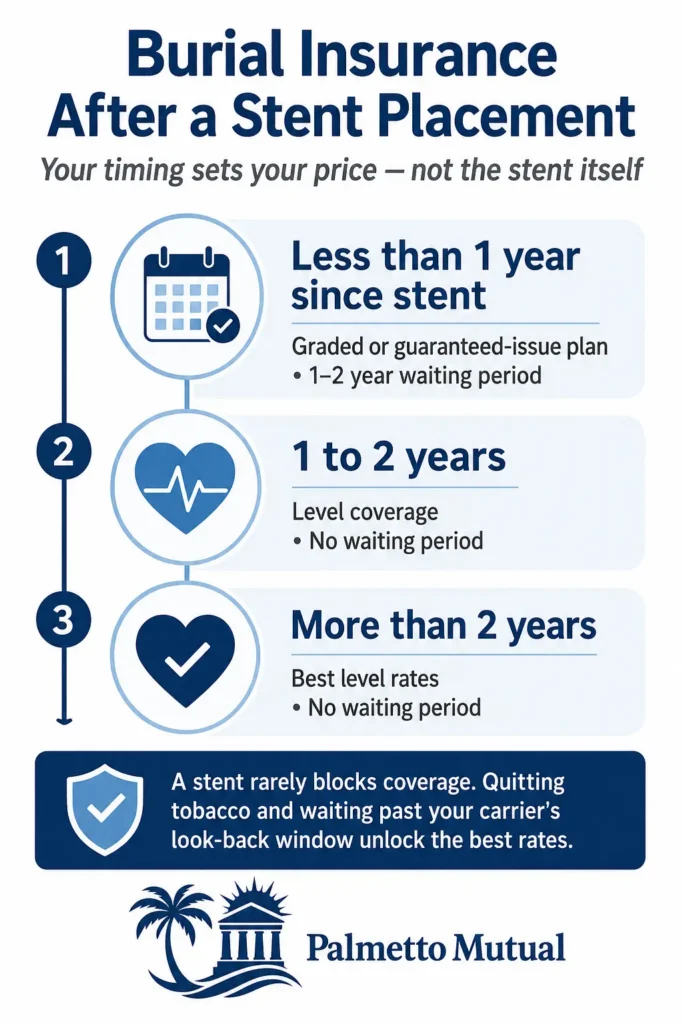
The real question isn’t whether you can get covered. It’s which type of policy you’ll qualify for, and that mostly comes down to one thing: how long ago your stent was placed.
Here is the general pattern most carriers follow:
| Time since your stent | Coverage you’ll usually qualify for | Waiting period |
|---|---|---|
| Less than 1 year | Graded or guaranteed-issue plan | Usually 1–2 years |
| 1 to 2 years | Level (standard) coverage | None |
| More than 2 years | Level (best) coverage | None |
Within the first year, most carriers want to see that you have healed and had follow-up visits before they offer their best plans. During that window you can still get covered, usually through a graded or guaranteed-issue policy that pays a reduced amount if you pass away in the first couple of years.
Once you are a year or more out and stable, full coverage from day one opens up with many companies. The strongest options generally appear once you are more than two years out from the stent placement.
A stent on its own usually leaves you in good shape. What changes the picture is other conditions stacked on top. A recent heart attack or congestive heart failure typically pushes an applicant into graded or guaranteed-issue coverage, even when the stent is years behind you. The next sections walk through how carriers read your file and what you’ll pay.
How carriers underwrite a stent placement
Final expense insurance is “simplified issue.” There is no medical exam — you answer a short set of yes-or-no health questions about specific conditions, hospitalizations, and medications, and the carrier checks a few databases behind the scenes. There is no nurse visit and no blood draw.
For a stent, the questions zero in on a handful of things: how long ago the stent was placed, whether a heart attack came with it, whether you have had any recent hospital stays or additional heart procedures, and what other conditions you manage alongside it.
The timing is what carries the most weight. A cardiac event in the recent past is treated as a “knockout” that points you toward a waiting-period plan, while distance from the procedure opens up immediate coverage. As a general industry pattern:
| When the stent (or related event) happened | Typical effect |
|---|---|
| A heart attack or stent within the last 12–24 months | Usually graded or guaranteed-issue coverage |
| Stent 1–2 years back, stable, no event | Level coverage becomes available |
| More than 2 years back and stable | Best level coverage |
Exact windows vary from one carrier to the next, which is why the same history can earn a day-one plan at one company and a waiting period at another.
Carriers confirm what you report by checking prescription-history databases and the Medical Information Bureau, and sometimes by pulling your doctor’s records. How those systems work, and why answering honestly matters so much, is covered in full on our prescription history page rather than repeated here. The short version: your medication list tells the underwriter most of the story before you say a word.
H3: Medications underwriters watch for with a stent placement
Your prescriptions are a map of your heart history. After a stent, most people take a predictable set of drugs, and underwriters read each one as a signal about how serious and how stable your condition is. Here is how the common ones break down:
| Medication | Why you’re likely on it | What it signals |
|---|---|---|
| Aspirin plus a second antiplatelet — clopidogrel (Plavix), ticagrelor (Brilinta), or prasugrel (Effient) | The standard pair that keeps the stent from clotting in the early months | Expected and reassuring — shows you’re following the normal post-stent plan |
| Statins (atorvastatin, rosuvastatin, others) | Lower cholesterol and slow further buildup | Routine; rarely moves your rate |
| Beta-blockers, ACE inhibitors, or ARBs | Control blood pressure and ease strain on the heart | Routine management; generally a good sign |
| Nitroglycerin (nitrates) | Relieve chest pain (angina) | A caution flag — points to ongoing symptoms |
| Warfarin (Coumadin), apixaban (Eliquis), rivaroxaban (Xarelto) | Stronger blood thinners, often added when a second heart issue is present | Suggests a more complex picture and closer review |
If you take the first three groups, you are in good company. Antiplatelet drugs like Plavix, a statin, and a beta blocker are the standard medications doctors prescribe after a stent, so seeing them tells an underwriter your recovery is going by the book. The aspirin-plus-antiplatelet combination is usually taken for up to a year, and sometimes longer, so being on it does not count against you.
The one to flag honestly is nitroglycerin. Because it treats active chest pain, an applicant taking nitroglycerin or reporting chest pain after a stent will often be declined, since it suggests the heart issue is not fully settled.
Stronger blood thinners like warfarin or Eliquis usually show up when another condition, such as an irregular heartbeat, sits alongside the stent. If you take any of these, our blood thinners page explains how that single prescription is weighed across the conditions it can point to.
Best companies and what you’ll pay after a stent placement
The most important thing to know about cost: with final expense insurance, a stent does not add a “surcharge” the way it would with a traditional, fully underwritten policy. Your price is set by which tier you land in, not by an extra charge bolted onto your premium.
So the real cost question is the one from the sections above — level coverage or a waiting-period plan? Once your tier is settled, you simply pay the standard rate for your age, gender, and tobacco use. A past heart stent generally won’t stop you from getting coverage; it mainly changes which company gives you the best price.
If you qualify for level (day-one) coverage, you pay the same rates as someone with no stent at all. For a $10,000 policy, the general market range looks like this:
| Age | Typical monthly cost — $10,000 level policy |
|---|---|
| 60 | about $45–$75 |
| 65 | about $50–$90 |
| 70 | about $70–$120 |
| 75 | about $100–$165 |
These are general averages. Women pay less than men, tobacco raises every figure, and your exact number depends on the carrier. The full breakdowns live on our cost-by-age and cost-by-coverage pages rather than here.
If a recent stent or a stacked condition puts you in a waiting-period plan, expect to pay more. Guaranteed-issue coverage runs roughly 30–50% more than a simplified-issue plan, and it comes with a two-year waiting period. If you pass away from natural causes inside that window, your family receives a return of your premiums plus interest rather than the full death benefit.
The principle that guidance fills in is simple: every carrier draws its stent line in a different spot, so the same health history can earn a preferred rate at one company and a strict rule at another. That spread is exactly where an independent agent who knows the cardiac guidelines saves you real money — and it is the one part of this no software can shortcut.
How to get the best rate and coverage after a stent placement
You have more control over the outcome here than it may seem. A few simple steps before you apply can move you from a waiting-period plan to day-one coverage, or trim real money off your monthly premium for the right burial or funeral insurance policy.
Start by knowing your own history cold. Before you talk to anyone, have these details ready:
- The date your stent was placed
- Whether it followed a heart attack, or was done as a preventive measure
- Your current medications and doses, including aspirin and any blood thinner
- Any other conditions you manage, such as diabetes or high blood pressure
Gathering your medications, diagnoses, and timelines ahead of time helps an agent match you to the carrier that fits your history best.
Let the calendar work in your favor. The look-back clock is the biggest factor you can simply wait out. Many carriers offer immediate coverage once you are more than 12 months past the stent, while applying inside that window usually means a waiting period and a higher price. The strongest options tend to open up around the two-year mark, though a few carriers look back further.
That said, once you are stable and past your carrier’s line, there is little reason to keep waiting. Every year you age, your base rate rises, so the best time to apply is as soon as you qualify.
Quit tobacco if you still use it. This is the single change that moves your rate the most. Tobacco users pay at least double what non-users pay, and most carriers want you tobacco-free for 12 months before offering non-smoker rates.
Answer every health question honestly. Your prescription record and the MIB will reveal anything you leave out, and an omission can cost your family the benefit. For the first two years, the insurer can review a claim and check whether your application answers were truthful before paying it. Be especially upfront about any chest pain or nitroglycerin use.
Work with an independent agent who knows cardiac guidelines. This is where the savings live. A captive agent can only offer one company’s product, so if that carrier dislikes stent history you are stuck, while an independent agent can shop your case to the company most likely to approve you at a good rate. A strong agent can even run your details past underwriting for feedback before you formally apply.
Two things this page won’t rehash: how the waiting period itself works, and exactly how and why an application gets declined. Those are covered in full on our no-waiting-period page and our can-you-be-denied page.
Keep Reading







About the Author
Dvir Mosche is an award-winning independent insurance agent and the founder of Palmetto Mutual, a trusted insurance brokerage specializing in Final Expense Life Insurance. Since entering the industry in 2017, he has been recognized multiple times as a top agent for his dedication to educating and assisting seniors in finding the proper coverage. His mission is to simplify the process, provide honest and personalized guidance, and ensure that every client gets coverage they can depend on for life.