
Home > Arizona
Final Expense Insurance in Arizona — A Guide for Seniors Across the Grand Canyon State
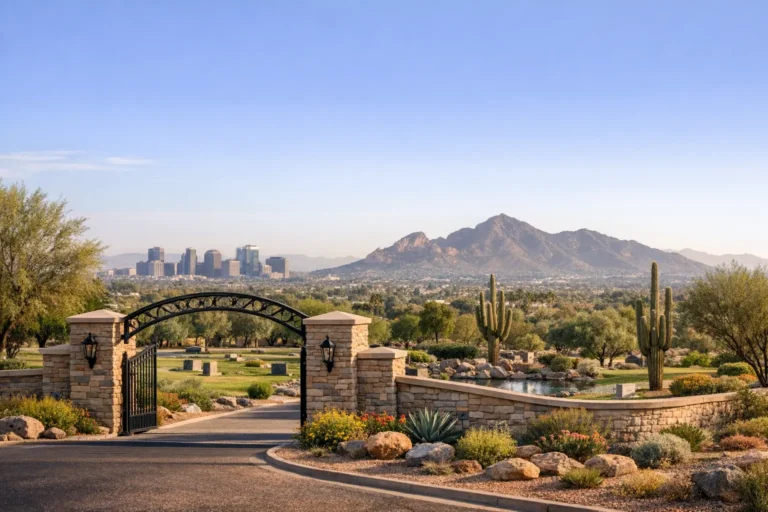
Arizona’s final expense landscape is shaped by a retiree population that has reshaped the state — more than a fifth of residents are 65 or older, with heavy concentrations in the Phoenix metro, Tucson, and the snowbird corridors of Yuma and Lake Havasu. Costs and burial customs shift noticeably between the high country around Flagstaff and Prescott, the Sonoran Desert cities of Maricopa and Pima counties, and the border communities along the Mexican line. This page walks through what burial insurance typically costs in Arizona, how the state regulates small whole life policies, and what funeral and cremation laws apply from the Navajo Nation down to Sierra Vista.
Funeral and Cremation Costs in Arizona
Arizona sits below the national median for funeral costs, driven largely by one of the country’s highest cremation rates. Statewide averages hold reasonably steady across the major population centers, but real cost swings show up between the Phoenix and Tucson metros, the rural high country, and smaller border and retirement communities. The figures below reflect statewide ranges — individual county cost data is covered on each county page.
Statewide averages
Traditional burial runs higher than the national direct comparison in some parts of Arizona but lower overall. According to the NFDA’s 2023 General Price List Study, the national median for a funeral with casket and burial is $8,300, and $6,280 for a funeral with cremation and viewing. Arizona’s averages typically come in 15 to 20 percent below those national figures, with most families paying between $6,500 and $9,000 for a full-service funeral and between $1,000 and $2,000 for direct cremation.
| Service type | Arizona typical range | National median (NFDA) |
|---|---|---|
| Traditional burial (full service) | $7,000 – $10,000 | $8,300 |
| Full-service cremation with viewing | $4,000 – $6,000 | $6,280 |
| Direct cremation | $1,000 – $2,000 | $2,202 |
| Immediate (direct) burial | $4,000 – $5,500 | $5,138 |
Individual line items in Arizona generally track the national pattern. Caskets average over $3,000, embalming runs $600 to $700, and basic transportation to the funeral home costs $400 to $700, according to 2025 Arizona funeral cost data. A standard headstone adds roughly $2,000, and a cemetery plot in an urban Arizona county often runs $2,500 to $5,000 depending on location.
Regional cost variation within Arizona
Costs shift noticeably across the state’s three broad regions — the Phoenix metro, the Tucson and southern Arizona corridor, and the rural high country of northern Arizona.
| Region | Typical full-service cremation | Notes |
|---|---|---|
| Phoenix metro (Maricopa County) | $5,300 – $5,400 | Large provider network keeps competition active, though urban facility costs push averages up |
| Tucson and Pima County | $5,400 – $5,500 | Slightly higher full-service averages than Phoenix despite lower direct cremation costs |
| Yuma and southwest Arizona | $4,900 – $5,100 | Smaller market with fewer providers, bordered by snowbird demand |
| Flagstaff and northern Arizona | $4,300 – $5,600 | Rural market with wider price range; transportation costs add up in remote counties |
Tucson tends to be the most affordable metro for direct cremation specifically, while Phoenix’s Glendale area runs at the higher end for full-service options. The Navajo Nation and other tribal lands in northeastern Arizona operate under distinct customs and service structures that fall outside typical commercial market pricing.
How Arizona compares nationally
Arizona’s cremation rate sits near 72 percent — well above the national cremation rate of 61.8 percent in 2024 reported by the Cremation Association of North America. That preference for cremation is the single biggest reason Arizona funeral costs run below national medians. Families opting for direct cremation in Arizona routinely pay less than half the cost of traditional burial, and the state’s large cremation provider network keeps direct cremation pricing competitive.
Why costs vary in Arizona
A handful of state-specific factors shape final pricing. Urban density drives up facility and staff fees in Maricopa and Pima counties, while rural counties like Apache, Greenlee, and La Paz see higher transportation charges because bodies often travel longer distances to a licensed provider. Arizona law requires a licensed professional to handle body transport, which eliminates the do-it-yourself savings available in some other states. The state’s large retiree and snowbird population also increases demand for pre-need planning, which can lock in today’s prices through burial insurance or a prepaid funeral trust — a meaningful consideration for seniors comparing burial insurance in Arizona against out-of-pocket payment at the time of need.package.
Final Expense Insurance Regulations in Arizona
Final expense insurance in Arizona is regulated at the state level under Title 20 of the Arizona Revised Statutes, which governs all life insurance policies delivered or issued for delivery in the state. A few Arizona-specific rules are worth knowing before buying a burial insurance policy, particularly the state’s unusual position on free look periods and its guaranty fund coverage limits.
State regulator
The Arizona Department of Insurance and Financial Institutions (DIFI) oversees all insurance companies and producers operating in Arizona. DIFI was formed when the former Arizona Department of Insurance merged with the Department of Financial Institutions, consolidating insurance, banking, and other financial oversight under one agency. The department licenses carriers, approves policy forms, investigates consumer complaints, and enforces Title 20 of the Arizona Revised Statutes and the insurance rules in Arizona Administrative Code Title 20, Chapter 6.
Free look period
Arizona is unusual among states in that it does not mandate a free look period for most individual life insurance policies, including final expense policies. According to Fidelity Life’s state-by-state summary and Arizona consumer protection attorneys, the state has no statutory right to cancel a life insurance policy within a set number of days after delivery. That said, nearly every carrier voluntarily includes a free look provision ranging from 10 to 30 days, and the contract itself will specify the terms.
Two exceptions exist in statute. Variable life insurance policies carry a mandatory 10-day return period under A.R.S. § 20-2604, and annuity contracts sold to buyers age 65 or older must include a 30-day free look period under A.R.S. § 20-1233. Final expense buyers should confirm the free look terms in writing before signing, since the right is contractual rather than statutory in Arizona.
Grace period
Arizona law requires a grace period of at least 30 days on all life insurance policies for premiums after the first. A missed premium during this window does not cause the policy to lapse, which matters for seniors on fixed incomes whose Social Security deposits sometimes arrive on dates that do not align with premium draft dates. A final expense policy in Arizona will not terminate the day after a missed payment — the beneficiary remains protected throughout the 30-day window.
Replacement rules
Arizona has specific protections for buyers replacing an existing life insurance policy with a new one. Under Arizona Administrative Code R20-6-212, both the producer and the insurer must provide replacement notices and disclosures when a new final expense or burial life insurance policy will replace coverage already in force. The rule is designed to prevent seniors from being pressured into dropping a policy with accumulated cash value in favor of a new policy without fully understanding the trade-offs. If an agent proposes replacing an existing policy, Arizona seniors should receive a written replacement form and a buyer’s guide before signing.
Contestability and suicide clauses
Arizona follows the common two-year rule for both contestability and suicide exclusions. After a policy has been in force for two years, the insurer generally cannot contest the policy during the insured’s lifetime based on misstatements in the application, and the suicide exclusion lapses after the same two-year window. Graded death benefit final expense policies — common for applicants with serious health conditions — typically apply their own two-to-three-year graded payout schedule, which is a contract feature rather than a state-specific requirement.
Guaranty fund protection
If an insurance company becomes insolvent, Arizona residents are protected by the Arizona Life and Disability Insurance Guaranty Fund, established under A.R.S. Title 20, Chapter 3, Article 7. The fund covers up to $300,000 in death benefits and up to $100,000 in cash surrender value per insured life, regardless of how many policies a person holds with the insolvent carrier. For most final expense policyholders, whose face amounts typically fall between $5,000 and $35,000, the guaranty fund provides full coverage. Buyers with larger combined coverage across multiple policies should be aware the cap is per insured life, not per policy.
Policy language requirements
Under A.A.C. R20-6-213, all life and disability insurance policies issued in Arizona must meet a minimum Flesch reading ease score of 40 and use at least 10-point type. The rule was designed to prevent unreadable fine print in policy contracts — useful for senior buyers who want to actually read and understand a funeral life insurance contract before signing.
Tax treatment
Arizona does not impose a state income tax on life insurance death benefits, and the state does not tax Social Security income. For beneficiaries receiving a final expense payout in Arizona, the full death benefit passes to them without state-level tax withholding, and federal law generally exempts life insurance death benefits from federal income tax as well. This is a useful planning consideration for seniors comparing burial insurance in Arizona against other end-of-life funding options.
Funeral and Burial Laws in Arizona
Arizona law covers every step of disposition from death certificate filing to burial permit issuance, with some genuinely distinctive provisions that have evolved significantly in the last few years. Funeral industry oversight transferred from an independent board to the Department of Health Services in 2023, and Arizona has legalized both alkaline hydrolysis and natural organic reduction as alternatives to traditional burial and cremation. These rules apply to all dispositions in the state regardless of whether a family uses a licensed funeral director or handles arrangements themselves.
State funeral regulator
Funeral licensing and regulation in Arizona shifted in 2023. According to the Arizona Department of Health Services, oversight of roughly 1,800 funeral industry licenses transferred from the former Arizona State Board of Funeral Directors and Embalmers to ADHS, which now operates the Funeral Services Licensing section. A seven-member advisory committee appointed by the Governor assists ADHS with oversight — including two licensed funeral directors, one embalmer, one cremationist, and three public members. Statutory authority for funeral practice still rests in A.R.S. §§ 32-1301 through 32-1399. Cemetery development and plot sales remain regulated separately by the Arizona Department of Real Estate under A.R.S. §§ 32-2194 through 32-2194.33.
Death certificate filing
A death in Arizona must be registered with the local or state registrar within seven days under A.R.S. § 36-325. The medical portion of the certificate must be completed by a physician, medical examiner, or designated health care provider within 72 hours of death. Arizona is a closed-record state, meaning vital records are not public — only eligible parties specified under A.A.C. R9-19-314 can request certified copies. Families can obtain certified copies through the Arizona Office of Vital Records or the county health department where the death occurred. Arizona uses an Electronic Death Registration System (EDRS) to speed up filing, though families filing independently can still work with the local registrar.
Burial and disposition permits
Arizona requires a disposition-transit permit before final disposition, issued by the state registrar or local registrar under A.R.S. § 36-326. The permit requires a certified death certificate. Notably, the permit may be issued to “a funeral director or other responsible person,” meaning a family member can obtain the permit without hiring a funeral director for most disposition types. Cremation is a partial exception — see below.
Embalming rules
Arizona does not require embalming in most circumstances. Under A.A.C. § 4-12-303, a body must be embalmed or refrigerated only if final disposition will not occur within 24 hours of death, or if the body will be shipped interstate. Refrigeration or dry ice is a legally accepted alternative to embalming. This is an important consumer point — families opting for prompt burial or cremation can avoid embalming charges, which typically run $600 to $700 in Arizona.
Cremation rules
Cremation in Arizona has two features worth knowing. First, there is a mandatory 24-hour waiting period between death and cremation. Second, Arizona law requires cremations to be arranged through a licensed funeral director — crematories cannot contract directly with the public. The Arizona Funeral Resources and Education organization confirms this is a genuine Arizona-specific restriction, unlike many states where families can arrange cremation directly with a crematory. A county medical examiner must also approve each cremation, and the next of kin or authorizing agent must sign a cremation authorization form. Unclaimed cremated remains may be disposed of by the crematory 120 days after death or the agreed pickup date.
Home funerals and home burial
Home funerals are legal in Arizona. A funeral director is not required to file the death certificate or witness a burial — next of kin or a designated agent can handle filings directly with the local registrar. Home burial on private property is also permitted, but the location must be recorded with the county recorder’s office before the burial occurs. The local or state registrar will not issue a disposition-transit permit for a home cemetery that has not been recorded with the county. Rural counties generally accommodate home burial more easily than urban Maricopa or Pima, where zoning typically prevents it.
Alkaline hydrolysis and natural organic reduction
Arizona has legalized two alternatives to flame cremation and traditional burial in the last four years. Alkaline hydrolysis (also called water cremation or aquamation) became legal for human use on May 27, 2022, under A.R.S. § 32-1365.02. Natural organic reduction (human composting) followed on March 29, 2024, making Arizona one of a relatively small number of states offering this option. Both alternatives have their own licensing and operational requirements under the ADHS Funeral Services Licensing section.
Casket requirements
No Arizona law requires a casket for burial or cremation. A cemetery may have its own rules requiring a burial container or vault, but statute does not mandate one. For cremation, federal law requires only a rigid combustible container, which can be purchased from a third-party seller under the FTC Funeral Rule rather than from the crematory or funeral home.
Green burial
Green burial is legal in Arizona with no statutory barriers. Several cemeteries across the state offer dedicated green burial sections, and some new conservation burial grounds have opened in recent years. Because embalming is not mandated and home burial is permitted with recording, Arizona is friendlier to green burial than many states with stricter requirements. The Green Burial Council maintains a directory of certified green burial grounds in Arizona and neighboring states.
Burial at sea
Arizona is landlocked, so traditional burial at sea is not applicable within state borders. Arizona residents who wish to have a burial at sea typically work with providers operating out of California or the Gulf of Mexico under federal Environmental Protection Agency rules, which require burial to occur at least three nautical miles from shore.
Scattering of cremated remains
Arizona places few restrictions on where cremated remains may be scattered. On private land, permission from the landowner is required. On public land, including Arizona’s many national parks, national forests, and state parks, scattering typically requires a permit from the managing agency. Scattering at sea is governed by federal EPA rules. Federal aviation regulations prohibit dropping containers from aircraft, though ashes themselves may be scattered from the air.
County indigent burial
If no family member or responsible party is willing or able to pay for disposition, A.R.S. § 36-831 places the burial duty on the county where the death occurred. Counties run indigent burial or cremation programs through their human services or medical examiner’s offices. For honorably discharged veterans, the county must notify the Department of Veterans Affairs or a local veterans organization to give them the opportunity to provide burial. Each Arizona county handles application and eligibility differently, and families concerned about covering funeral costs should contact the relevant county office directly or consider a final expense insurance policy to avoid the indigent burial process entirely.
Regions and Major Metros in Arizona
Arizona’s geography divides cleanly into three broad regions that shape everything from climate and cost of living to retirement settlement patterns. Understanding where a county sits regionally helps clarify what to expect from local funeral pricing, cemetery availability, and the demographic mix served by burial insurance in Arizona. The state has 15 counties and a population of roughly 7.6 million, with nearly 80 percent concentrated in just two counties — Maricopa and Pima.
The three regions of Arizona
Arizona’s terrain runs from the Colorado Plateau in the north down through the Transition Zone to the Basin and Range desert plains in the south, a diagonal split that roughly corresponds to how the state’s regional economies, climates, and retirement markets operate.
Northern Arizona (Colorado Plateau). The high country covers the northern third of the state, running from Lake Powell at the Utah line down to the Mogollon Rim. Elevations range from 5,000 to 12,637 feet at Humphreys Peak, the highest point in Arizona. The region includes Flagstaff, Prescott, Sedona, Page, Williams, and much of the Navajo and Hopi tribal lands. Four seasons, pine forests, and genuinely cold winters distinguish this region from the popular image of Arizona.
Central Arizona (Transition Zone). A diagonal band of mountain ranges and river valleys runs northwest to southeast across the middle of the state, separating the high plateau from the desert. Globe, Payson, Superior, and parts of the Verde Valley sit here. The region is rural, ranches-and-copper-country in character, and serves as a gateway between the Phoenix metro and the high country.
Southern Arizona (Basin and Range / Sonoran Desert). The southern half of the state is low-elevation desert broken up by isolated mountain ranges. This region contains Phoenix, Tucson, Yuma, and the Mexican border communities of Nogales, Douglas, and Bisbee. Hot summers, mild winters, and the iconic saguaro cactus landscape define the region. The heaviest concentration of retirees, military bases, and snowbird communities sits here.
Counties by region
| Region | Counties |
|---|---|
| Northern Arizona (Colorado Plateau) | Apache, Coconino, Navajo, Yavapai, Mohave |
| Central Arizona (Transition Zone) | Gila, Greenlee, Graham |
| Southern Arizona (Sonoran Desert / Basin and Range) | Maricopa, Pima, Pinal, Yuma, La Paz, Cochise, Santa Cruz |
Boundaries between regions are not rigid — Yavapai County spans both the Colorado Plateau and the Transition Zone, and Mohave County straddles the plateau and the Mojave Desert along the Colorado River. The table reflects the primary regional identity of each county.
Major metros in Arizona
Arizona has seven officially designated metropolitan statistical areas per the Eller College of Management’s Economic and Business Research Center. The Phoenix–Mesa–Chandler MSA is the only multi-county MSA in the state.
| Metro area | Counties | Population |
|---|---|---|
| Phoenix–Mesa–Chandler MSA | Maricopa, Pinal | ~5.1 million |
| Tucson MSA | Pima | ~1.06 million |
| Prescott Valley–Prescott MSA | Yavapai | ~249,000 |
| Lake Havasu City–Kingman MSA | Mohave | ~224,000 |
| Yuma MSA | Yuma | ~218,000 |
| Flagstaff MSA | Coconino | ~145,000 |
| Sierra Vista–Douglas MSA | Cochise | ~125,000 |
Population figures reflect 2024 Census Bureau estimates and Arizona Office of Economic Opportunity data.
The Phoenix metro in detail
The Phoenix metro — locally known as the Valley of the Sun — is the anchor of the state. The 11th-largest metropolitan area in the country by population, the MSA contains Phoenix, Mesa, Chandler, Gilbert, Scottsdale, Glendale, Peoria, Tempe, and Surprise, along with the rapidly growing Pinal County communities of Casa Grande, Maricopa, and Queen Creek. Maricopa County alone holds roughly 60 percent of Arizona’s total population at around 4.6 million residents. Pinal County is the fastest-growing county in the state, expanding more than 17 percent in recent years.
The Phoenix metro includes several of the country’s largest retirement communities. Sun City, Sun City West, and Sun City Grand in the West Valley are age-restricted communities originally built by Del Webb starting in 1960 and still among the nation’s best-known retirement destinations. Mesa, Scottsdale, and Surprise also host substantial retiree populations.
The Tucson metro in detail
Tucson and Pima County make up the second-largest metro in Arizona at just over one million residents. Tucson has a different character from Phoenix — more Hispanic, more rooted in its Sonoran Desert identity, and home to the University of Arizona and Davis-Monthan Air Force Base. Green Valley, Saddlebrooke, and Oro Valley are the largest retirement communities in the Tucson area, attracting snowbirds and permanent retirees who prefer a smaller, less developed alternative to the Phoenix Valley.
Other regional centers
Flagstaff (Coconino County) is the largest city in northern Arizona at roughly 145,000 metro population, a university town and regional hub for the Grand Canyon and the surrounding plateau. Prescott and Prescott Valley (Yavapai County) draw a different retiree demographic — people seeking cooler summers and pine-country living rather than desert heat. Yavapai County holds nearly 250,000 residents and has one of the oldest median ages in the state.
Yuma (Yuma County) sits in the far southwest corner near the California and Mexico borders, and swells substantially each winter as tens of thousands of snowbirds arrive from colder states and Canadian provinces. Year-round population is around 218,000, but winter population estimates push well above that. Lake Havasu City and Kingman (Mohave County) anchor the western Colorado River corridor — another heavy snowbird and retiree zone. Sierra Vista (Cochise County) is dominated by Fort Huachuca, a major Army installation, and has a large population of military retirees who stay in the area after separating.
Demographics relevant to final expense insurance
Arizona’s senior share of the population sits well above the national average. According to 2019–2023 American Community Survey estimates from the Census Bureau, roughly 18.6 percent of Arizona residents are 65 or older, compared to 16.8 percent nationally. The Arizona Department of Economic Security has noted that Arizona ranks second in the country for relocating retirees over age 60, with Maricopa County receiving the largest share.
Rural counties skew even older than the state average. In Yavapai County, Mohave County, and La Paz County, residents 65 and older represent well over 25 percent of the population — a reflection of heavy retiree migration into these less expensive, less developed areas. Santa Cruz County, by contrast, has the highest Hispanic share among its senior population at roughly 60 percent, reflecting the border community demographic.
Military retiree populations cluster around Fort Huachuca in Sierra Vista, Davis-Monthan in Tucson, and Luke Air Force Base in the West Valley of the Phoenix metro. These communities drive demand for burial insurance that coordinates with VA burial benefits, since an honorably discharged veteran may be eligible for a plot at a national cemetery but still need coverage for funeral service costs not covered by the VA.
Frequently Asked Questions

About the Author
Dvir Mosche is an award-winning independent insurance agent and the founder of Palmetto Mutual, a trusted insurance brokerage specializing in Final Expense Life Insurance. Since entering the industry in 2017, he has been recognized multiple times as a top agent for his dedication to educating and assisting seniors in finding the proper coverage. His mission is to simplify the process, provide honest and personalized guidance, and ensure that every client gets coverage they can depend on for life.


