
Home > Washington, DC
Final Expense Insurance in the District of Columbia: A Complete Guide for DC Seniors

The District of Columbia is a singular place to plan for — a 68-square-mile federal district that functions as a city, a state-level jurisdiction, and the nation’s capital all at once. DC’s eight wards span distinct neighborhoods from Georgetown and Dupont Circle in the west to Anacostia and Deanwood east of the river, and its senior population skews toward long-tenured federal retirees, military veterans drawn to the VA medical system, and longtime residents with deep roots in historically Black neighborhoods like Shaw, Brookland, and Congress Heights. Because DC is not a state, final expense insurance here is regulated by the DC Department of Insurance, Securities and Banking rather than a state commissioner, and funeral costs track closely with the high-cost Mid-Atlantic corridor running from Baltimore through Northern Virginia. This page covers what DC residents need to know about burial insurance, local funeral pricing, and the District-specific rules that shape end-of-life planning.
Funeral and Cremation Costs in the District of Columbia
Funeral pricing in DC runs well above the national median, reflecting the high cost of living across the Mid-Atlantic corridor and limited land availability for cemetery space within the District itself. Because DC is a single jurisdiction rather than a state with internal regional variation, costs tend to cluster in a tighter range than in larger states, but the figures sit near the top of what American families pay. Final expense insurance in the District of Columbia is typically sized to cover these costs without leaving a gap for families to close on their own.
Average funeral and cremation costs in DC
| Service type | DC average | National median (NFDA) |
|---|---|---|
| Traditional full-service burial | ~$9,010 (DC/Baltimore area) | $8,300 (no vault) / $9,995 (with vault) |
| Basic funeral director services (burial) | ~$4,500 | — |
| Full-service cremation with viewing | $6,000–$7,500 | $6,280 |
| Direct cremation | $1,395–$2,500 | ~$2,200 |
| Immediate burial (no service) | $3,500–$5,500 | $5,138 |
Sources: US Funerals Online places the average traditional funeral in the Washington, DC/Baltimore area at $9,010, with basic funeral director services for a traditional burial found for around $4,500 in the District of Columbia. National figures from the NFDA put the median funeral with burial at $8,300, rising to $9,995 with a vault, and a cremation funeral with viewing at $6,280.
Cemetery costs inside the District
Burial plots are where DC families see the sharpest premium over national averages. Land is scarce, historic cemeteries dominate the market, and plot prices reflect both. At Historic Congressional Cemetery, full burial plots range from $8,000 in the cemetery’s east end to $14,000 in the most historic sections, with each full-sized plot accommodating two traditional full casket burials or up to eight cremation urns. Metropolitan regions like San Francisco, New York, and Washington DC often see single plot prices exceeding $15,000, while rural areas in states like Alabama, Kansas, or Nebraska may offer comparable plots for $1,000 to $3,000. Opening and closing fees, vault requirements, and a grave marker typically add another $2,500 to $5,000 on top of the plot itself.
How DC compares to the rest of the country
The District runs 10% to 15% above the national median on traditional funeral services and well above national averages on cemetery costs. Direct cremation is the one category where DC tracks closer to national pricing — direct cremation service in Washington DC is available starting at $1,395, which sits near the middle of the national range. Burial insurance for DC seniors is most commonly written in the $10,000 to $20,000 range to cover a traditional service, and funeral life insurance at the lower end ($5,000 to $10,000) typically covers a direct cremation with a modest memorial service.
What drives costs in DC
Three factors push DC funeral prices higher than most of the country. First, real estate costs affect every part of the death care supply chain, from funeral home overhead to cemetery land. Second, the District’s limited geographic footprint means cemetery space is genuinely scarce — many DC families end up buying plots in suburban Maryland or Northern Virginia, where prices are often lower but transportation and out-of-jurisdiction coordination add complexity. Third, DC has a relatively high share of traditional burial services compared to the national trend toward cremation, driven in part by strong African American faith traditions in wards east of the Anacostia River and a large Catholic population with ties to Archdiocese of Washington cemeteries like Gate of Heaven and Mount Olivet.
Final Expense Insurance Regulations in the District of Columbia
Insurance in DC is regulated at the District level — not the federal level — by the Department of Insurance, Securities and Banking (DISB). Title 31 of the DC Official Code governs life insurance policies sold in the District, including final expense and burial life insurance. The rules below are the ones most relevant to DC seniors shopping for a policy.
Regulator and legal framework
The Department of Insurance, Securities and Banking is located at 1050 First Street NE, Suite 801, Washington DC 20002, reachable at (202) 727-8000. Life insurance in the District of Columbia is controlled by Title 31 of the Code of District of Columbia, which requires that every life insurance policy include particular terms on the payment of premiums, loans, and other policy features. DISB investigates consumer complaints, licenses insurance producers, and enforces the rules that apply to every final expense policy sold to a DC resident.
Key DC rules for final expense policies
| Protection | What DC law requires |
|---|---|
| Free look period | At least 10 days to cancel for a full refund |
| Premium grace period | 30 days after a missed payment before the policy can be canceled |
| Incontestability | Policy becomes incontestable after 2 years in force |
| Policy loan eligibility | Available after the policy has been in effect for at least 3 years |
| Guaranty Association coverage | Up to $300,000 in death benefits, $100,000 in cash surrender value |
Free look period. Any District of Columbia resident buying a life insurance policy has at least 10 days to back out of coverage and receive a full refund of any premiums paid. DC’s 10-day minimum is on the shorter end nationally — many states require 20 or 30 days — so DC seniors should read their policy carefully during the first week after delivery. Some insurers voluntarily extend the free look period beyond the 10-day minimum, and that longer window, if offered, appears on the first page of the policy.
Grace period and incontestability. DC policies that have been in effect for more than one year must allow a grace period of at least 30 days for late payments, and insurance companies cannot cancel the policy for late payment until the grace period has ended. Policies become incontestable after they have been in place for 2 years, meaning after the two-year mark an insurer generally cannot void the policy over application errors except in cases of fraud.
Graded death benefit rules. DC does not impose a unique statutory cap on graded death benefit periods for final expense products. Most insurers selling burial insurance in the District use the industry-standard two-year graded benefit for applicants who do not qualify for immediate coverage due to health history. During the graded period, the policy typically returns premiums paid plus interest (often around 10%) rather than the full face amount if death occurs from natural causes; accidental death is usually covered at the full face amount from day one. After the graded period ends, the full death benefit is payable for any cause of death.
Replacement and senior protections. The DISB protects consumers from fraud and abuse and provides a fair marketplace for regulated businesses. DC has adopted the NAIC Life Insurance and Annuities Replacement Model Regulation principles, which require agents to provide written notice when a new policy is replacing an existing one and to give the applicant time to compare the old and new coverage. If a DC senior suspects unfair treatment, misleading sales practices, or delayed claim payment, they can file a complaint with the DISB Consumer Services Division at (202) 727-8000, by email, or by fax at (202) 354-1085.
Guaranty Association backstop. If the insurance company issuing a DC resident’s final expense policy becomes insolvent, the District of Columbia Life & Health Insurance Guaranty Association steps in. This guarantee is limited to $300,000 maximum for lost death benefits and $100,000 maximum for lost cash surrender value. Because final expense policies typically carry face amounts between $5,000 and $35,000, the guaranty association coverage fully protects nearly every burial insurance policy written in the District.
Claims payment timing. DC law does not set a specific number of days by which a claim must be paid, but insurers are required to handle claims promptly. Payments are typically made within a month after the provider receives proof of death. Final expense insurance claims in DC are generally paid faster than that — often within 24 to 72 hours once a certified death certificate and claim form are submitted — because the policy is specifically designed to cover funeral costs that come due immediately.
Funeral and Burial Laws in the District of Columbia
DC has its own set of funeral, burial, and cremation laws separate from neighboring Maryland and Virginia. The rules below govern what happens after a death in the District, from filing the death certificate through final disposition of the body. DC families often end up coordinating across jurisdictions — for example, burying a loved one in a Montgomery County or Fairfax County cemetery — so knowing what DC specifically requires can help avoid paperwork delays.
Regulator and legal framework
The DC Board of Funeral Directors regulates licensed funeral directors and funeral home establishments, operating under the Department of Licensing and Consumer Protection at 1100 4th Street SW, Washington DC 20024. The Board’s five members are appointed by the Mayor, with four licensed funeral directors who have practiced for at least three years and one non-licensed consumer member. Burial, cremation, and body disposition rules live primarily in Title 7 (public health and vital records) and Title 43 (cemeteries) of the DC Code.
Death certificate filing
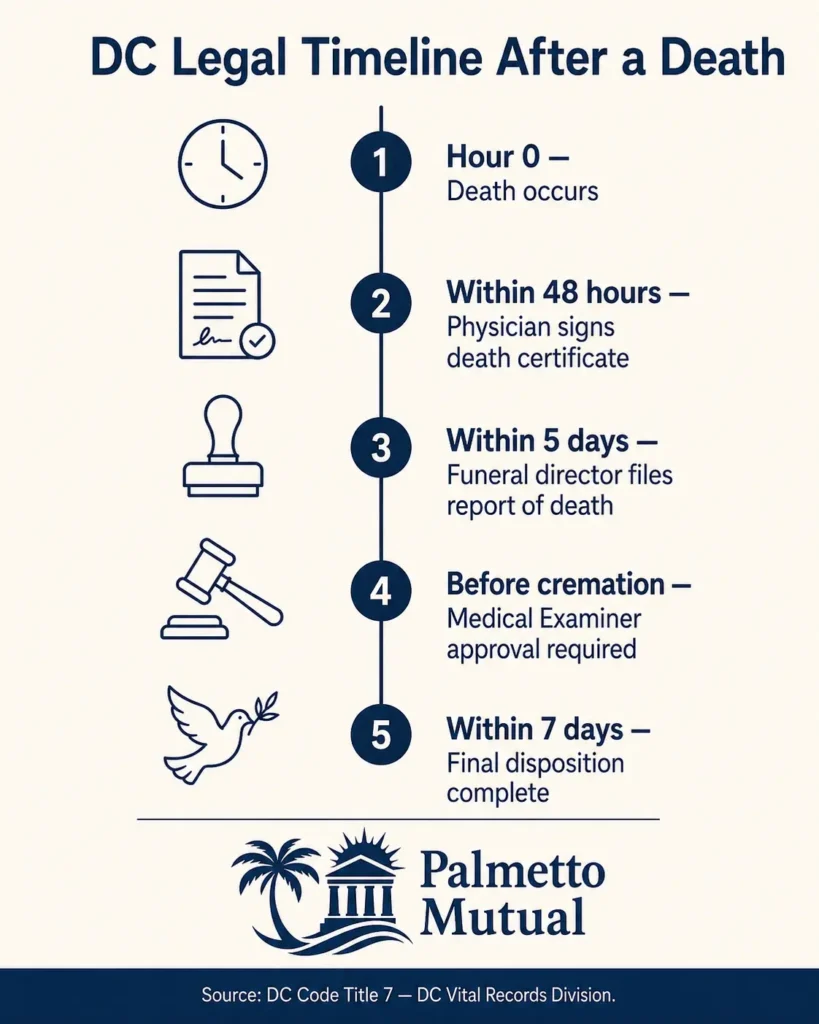
The funeral director who first assumes custody of a dead body must electronically submit a report of death to the Registrar within 5 days after the date of death and before final disposition of the body. Within 48 hours after death, the physician in charge of the patient’s care for the condition that resulted in death must complete, sign, and return the medical certification portion of the certificate of death to the funeral director, except when inquiry is required by the Office of the Chief Medical Examiner. Death records become public after 75 years, and certified copies during that 75-year window are available only to legally entitled parties through the DC Vital Records Division.
Disposition permit and transit
Before the body may be transported from the hospital, nursing home, or residence, a disposition transit permit must be obtained. The District of Columbia does not have requirements for embalming and refrigeration, but it does state that disposition of the remains must take place within one week after death. This one-week disposition window is tighter than in many states and is something DC families should plan around when scheduling services.
Who decides on final arrangements
DC law sets a specific order of priority for who can direct a funeral when the deceased has not left written instructions. The order is: a designated agent named in writing, then the surviving spouse or domestic partner, then adult children, then parents, then adult siblings, followed by other next of kin. Seniors who want to lock in their own plans should put their wishes in writing and name an agent through a durable power of attorney for final disposition.
Embalming
DC does not require embalming by law. The District of Columbia requires authorization from the deceased’s next of kin or agent to perform embalming services. Funeral homes cannot embalm a body without permission, and they cannot charge for embalming on a direct cremation or immediate burial. Refrigeration is an accepted alternative when a brief delay before service is needed.
Cremation authorization
Cremation in DC requires an extra approval step that many states do not impose. Washington DC requires a disposition approval from the Office of the Chief Medical Examiner via the Electronic Death Registration System before a cremation is allowed. This medical examiner review is a standard part of every DC cremation and can add a short waiting period to the overall timeline. The District does not have laws pertaining to how the ashes are kept or scattered, so families have broad flexibility for the final placement of cremated remains.
Burial location and cemeteries
In the District of Columbia, bodies must be buried in established cemeteries, and because of DC’s urban nature, home burial — establishing a new family cemetery — is probably not feasible. DC has no law requiring the deceased be buried in a casket, but the law does require that the remains are buried in an established cemetery. The laws governing burial locations and cemeteries are set out in Title 43 of the DC Code.
Home funerals
DC allows home funerals. Families are not required to use a licensed funeral director, and the body may be kept at home for viewing and ceremony before transport to the cemetery or crematory. In practice, most DC home funerals still involve a funeral director because of the electronic death reporting requirement and the medical examiner approval needed for cremation, but family-led care before and after those steps is permitted.
Green burial and alkaline hydrolysis
Green burial — without embalming fluid, a concrete vault, or a non-biodegradable casket — is legal in DC, though availability within District boundaries is limited. Most DC families interested in green burial use certified grounds in suburban Maryland or Virginia. Historic Congressional Cemetery offers green burial options throughout the cemetery and does not require the use of a concrete vault or grave liner, nor does it require embalming of decedents, making it the primary green burial option within the District itself. The District of Columbia does not currently have any laws or regulations allowing alkaline hydrolysis (water cremation), so families wanting that option must use a provider in a state where it is authorized.
Burial at sea
Because DC has no coastline, full-body burial at sea is not a DC operation, but federal rules apply to DC residents whose remains are transported to coastal waters. The federal Clean Water Act requires that cremated remains be scattered at least three nautical miles from land, and the EPA does not permit scattering at beaches or in wading pools by the sea, and notification to the EPA is required within 30 days of scattering ashes at sea.
Consumer protections
DC has published a Consumer Bill of Rights for funeral home establishments that goes beyond the federal FTC Funeral Rule. A funeral home establishment must post all of its price lists on any websites that it maintains, including the General Price List, Casket Price List, and Outer Burial Container Price List. If you pre-pay for a funeral, you can get a full refund within 30 days of signing the contract, and a refund of at least 90% on services you no longer want 30 days after signing the contract. These online price posting rules are stricter than the federal standard and make price shopping easier for DC families than in many other jurisdictions. Final expense insurance works alongside these consumer protections — the policy provides the funds, and the DC rules make sure the family is not overcharged when spending them.
Quadrants and Wards of the District of Columbia
Because DC is a single 68-square-mile jurisdiction rather than a state with internal regions and metros, the geographic structure that matters for final expense planning is the District’s quadrant and ward system. The four quadrants — Northwest, Northeast, Southwest, and Southeast — divide DC around the US Capitol, and the eight wards subdivide the District for political representation and service delivery. Each ward has its own demographic profile, and the differences between them are pronounced enough to shape everything from median income to senior population share to which funeral homes families typically use.
The four quadrants
The four quadrants are the most basic unit of DC geography and show up in every DC address. Northwest is the largest quadrant and contains most of the District’s affluent neighborhoods. Northeast includes historically Black residential neighborhoods, Catholic University, and a growing NoMa corridor. Southwest is the smallest quadrant, home to The Wharf, L’Enfant Plaza, and most federal employment. Southeast spans from Capitol Hill east across the Anacostia River into Wards 7 and 8.
The eight wards
Each ward has roughly 75,000 to 90,000 residents, though boundaries shift after each decennial census. The table below groups each ward by quadrant and summarizes the neighborhoods within it.
| Ward | Primary quadrant(s) | Population (2020) | Notable neighborhoods |
|---|---|---|---|
| Ward 1 | NW | ~86,000 | Columbia Heights, Adams Morgan, Mount Pleasant, Shaw (partial), U Street |
| Ward 2 | NW, SW | ~79,000 | Georgetown, Dupont Circle, Foggy Bottom, West End, downtown |
| Ward 3 | NW | ~85,000 | Cleveland Park, Tenleytown, Friendship Heights, Spring Valley, Chevy Chase DC |
| Ward 4 | NW | ~86,000 | Petworth, Brightwood, Takoma, 16th Street Heights |
| Ward 5 | NE | ~89,000 | Brookland, Eckington, Fort Totten, Trinidad, Michigan Park |
| Ward 6 | All four | ~108,000 | Capitol Hill, Navy Yard, The Wharf, H Street Corridor, NoMa |
| Ward 7 | NE, SE | ~80,000 | Deanwood, Kingman Park, Hill East, Benning, Lincoln Heights |
| Ward 8 | SE, SW | ~73,000 | Anacostia, Congress Heights, Washington Highlands, Bellevue |
The District is divided into eight wards, each with approximately 75,000 residents, and each with its own rich history, vibrant neighborhoods, and a diverse population. Ward 6 increased by nearly 42% to 108,000 people since the 2010 Census count, making it the only ward with more than 90,000 residents, as it includes neighborhoods like the H Street Corridor, Buzzard Point, and The Wharf.
Senior population by ward
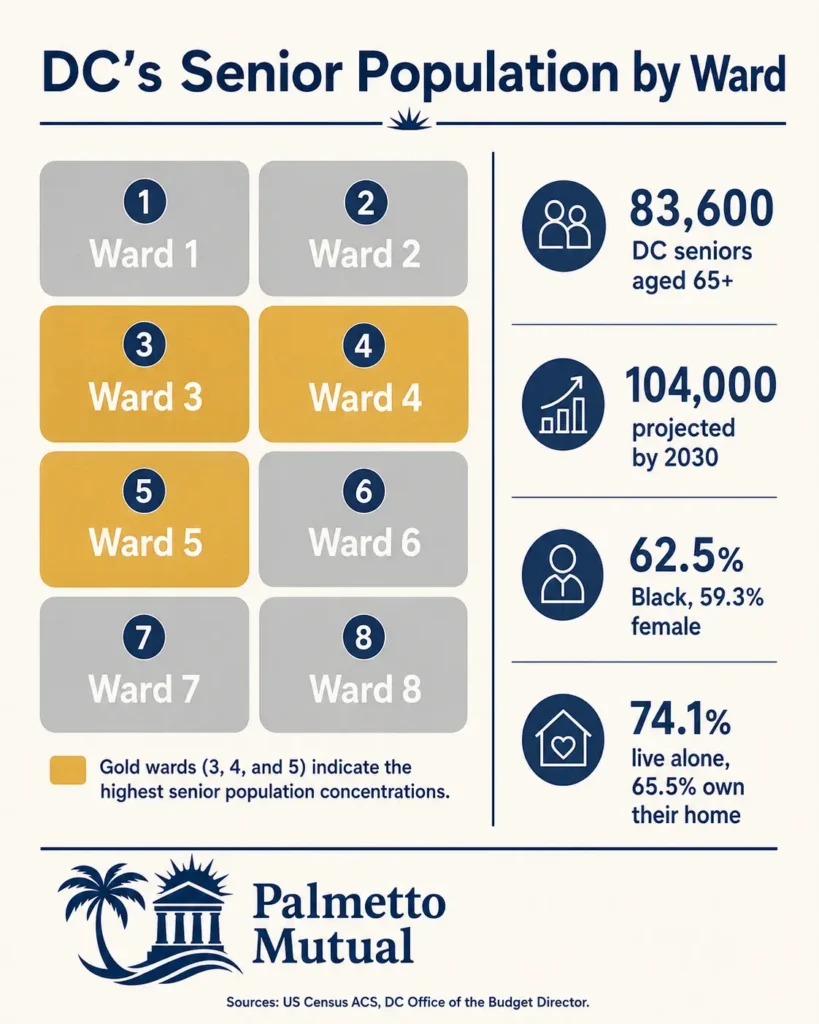
DC’s senior population is concentrated differently than its overall population, which matters for burial insurance planning because final expense policies are sized to meet the real costs seniors face in their specific neighborhood. The State of Older Adults in the District of Columbia report found that most DC seniors are female (59.3 percent), Black (62.5 percent), unmarried (58.6 percent), live alone (74.1 percent), or are homeowners (65.5 percent). The District was home to approximately 83,600 older adults in 2019, and the population could rise as much as 24.4 percent by 2030.
Among the eight wards, the population in Ward 4 is the oldest with a median age of 39.9, while Ward 8 is the youngest with a median age of 29.8. Among all Ward 3 residents, 16.5 percent are age 65 and older, and Ward 5 has the second largest number of seniors, home to about 19,155 older adults or 15.5 percent. Wards 3, 4, and 5 together account for the largest share of DC’s senior population, and these wards are where demand for final expense insurance and burial life insurance is highest.
Demographic patterns that shape final expense planning
Three patterns stand out for DC families thinking about burial insurance. First, racial composition varies sharply by quadrant. The Northwest quadrant of the District includes Wards 1, 2, and 3, with a disproportionately higher White population, while approximately 86% of residents in Wards 7 and 8 (the Southeast quadrant) are African American. This shapes funeral traditions — Wards 7 and 8 have strong African American church funeral traditions that typically involve a full traditional service, viewing, and burial, which generally costs more than cremation.
Second, income and wealth differ dramatically across wards. Ward 3 has the highest median household income in DC, while Wards 7 and 8 have the lowest. Seniors in lower-income wards are more likely to rely on a final expense policy as the sole source of funeral funding, while seniors in higher-income wards may use burial insurance to preserve estate assets for heirs rather than as the primary funeral funding source.
Third, DC has a significant federal retiree and military veteran population concentrated across Wards 3, 4, and 5. Federal retirees often have FEGLI (Federal Employees’ Group Life Insurance) coverage that decreases substantially after age 65, which is why many federal retirees supplement with a standalone final expense policy to lock in a level death benefit that will not shrink with age.
DC within the broader metro area
The Washington metropolitan area extends well beyond District boundaries into Montgomery and Prince George’s counties in Maryland, and Arlington, Fairfax, and Alexandria in Northern Virginia. Many DC families own cemetery plots in suburban jurisdictions — particularly in Prince George’s County (Fort Lincoln, Lincoln Memorial) and Montgomery County (Gate of Heaven, Parklawn) — because District land is scarce. Final expense policies sold to DC residents typically factor in the possibility of burial in an adjoining jurisdiction, including the transportation costs and out-of-jurisdiction coordination that come with it.
Wards We Serve in the District of Columbia
Because DC has no counties, the ward system is the District’s equivalent administrative subdivision and the structure we use to organize local coverage pages. Each ward has its own neighborhoods, demographics, funeral homes, and cemetery options, and the final expense insurance needs of families in Ward 3 look different from those in Ward 8. The directory below lists every DC ward we cover, with a dedicated page for each. The boundaries of the 8 wards of the District of Columbia are updated every ten years based on the results of the latest decennial Census, and the current ward maps were approved by DC Council in 2022.
Ward 1
Ward 2
Ward 3
Ward 4
Ward 5
Ward 6
Ward 7
Ward 8
Frequently Asked Questions

About the Author
Dvir Mosche is an award-winning independent insurance agent and the founder of Palmetto Mutual, a trusted insurance brokerage specializing in Final Expense Life Insurance. Since entering the industry in 2017, he has been recognized multiple times as a top agent for his dedication to educating and assisting seniors in finding the proper coverage. His mission is to simplify the process, provide honest and personalized guidance, and ensure that every client gets coverage they can depend on for life.


