
Home > Funeral Cost > What to Expect
Burial Costs: What to Expect

A full burial involves many separate costs, and it helps to know what each one covers before any decisions get made. This guide breaks down what a burial typically costs — the median price, a realistic range, and a look at each component on its own. You’ll also see which costs are genuinely required and which are optional, even when they are presented as standard. Final expense insurance, sometimes called burial insurance, is the small whole life policy many families use to cover these exact expenses.
Funeral & Burial Cost Estimator
Build a funeral piece by piece to see a rough cost range. Only the basic services fee is required — everything else is your choice. Start simple and add what matters to your family.
Funeral Home Costs
Cemetery Costs
Extras & Cash-Advance Items
This is what a family might pay for the options selected above. A simple direct burial sits near the low end; a full traditional service with cemetery costs sits much higher.
This tool gives a rough estimate using national price ranges drawn from National Funeral Directors Association (NFDA) and Federal Trade Commission (FTC) consumer data. It is not a quote, and prices in your area may be higher or lower. Use it to plan, then ask local funeral homes for an itemized price list to compare.
Want to know how much coverage would take care of these costs for your family?
Get My QuoteThe All-In Cost of a Full Burial
A full burial is not one price. It is a stack of separate costs that add up, and the total depends a lot on where you live and the choices your family makes.
The most-cited national number comes from the National Funeral Directors Association (NFDA). Their most recent figures show the median cost of a funeral with a viewing and burial. “Median” means the middle point: half of families paid less, and half paid more.
| What’s included | Median cost |
|---|---|
| Funeral with viewing and burial (no vault) | $8,300 |
| Same funeral, with a burial vault added | $9,995 |
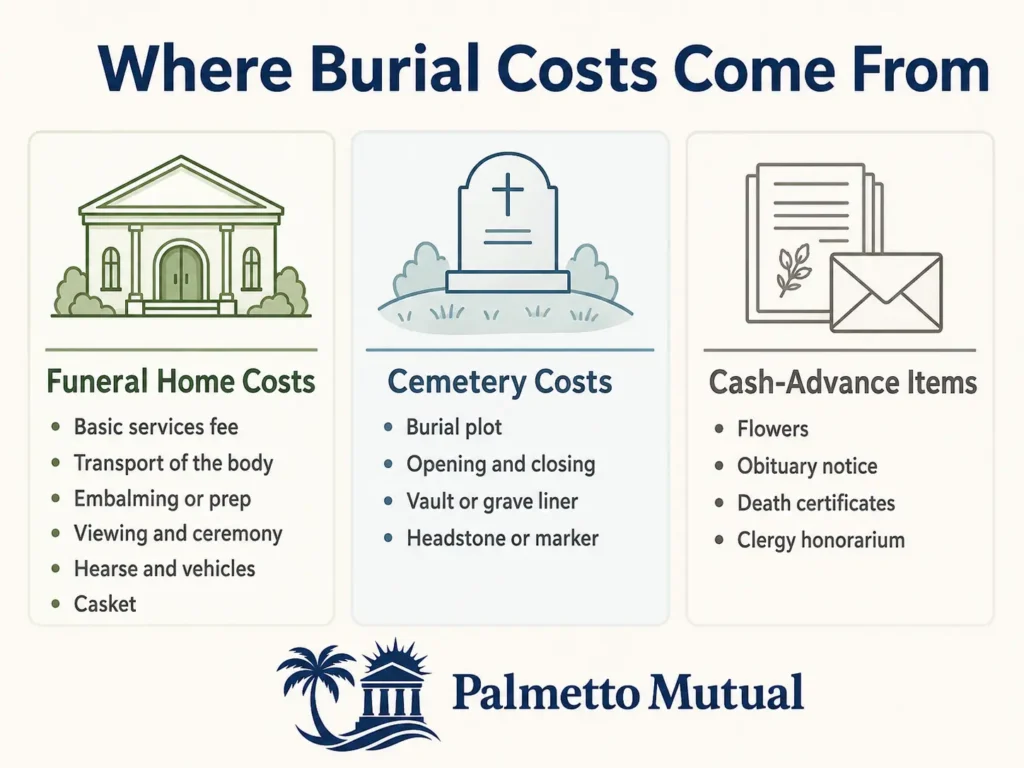
Here is the part many families miss. That NFDA number only covers the funeral home’s services and goods. It does not include the cemetery at all.
Left out of that figure are the cemetery plot, the fee to open and close the grave, and a headstone or grave marker. Those are real costs, and they are often paid to a separate business — the cemetery, not the funeral home.
Once you add the cemetery in, the honest all-in picture looks more like this:
| Cost group | Typical range |
|---|---|
| Funeral home services and goods (with vault) | About $9,995 |
| Cemetery plot | $1,000 (rural) to $4,000+ (city), sometimes far higher |
| Opening and closing the grave | $800 to $2,500 |
| Headstone or grave marker | $500 to $3,000+ |
Put together, a realistic all-in cost for a full burial commonly lands between $13,000 and $18,000, and it can run higher in expensive metro areas. Rural areas can come in well under that.
This is why planning ahead matters, and why many families use burial insurance to set aside a known amount for these exact bills. The rest of this page walks through each piece of the burial — one component at a time — so you can see where every dollar goes.
Required vs. Optional Burial Costs
When you sit down to plan a burial, almost everything is a choice. By federal law, there is only one cost a funeral home can require you to pay. Everything else is something you can accept or decline.
This is the most important thing to understand before you spend a dollar. A federal regulation called the FTC Funeral Rule protects this right, and a good agent or funeral director will be upfront about it. Knowing what is truly required keeps a funeral insurance payout from being spent on things a family never needed.
Below, we separate the costs into two groups. We keep this high-level here — each major cost has its own full section further down the page.
Costs You Can’t Avoid
There is one fee on every funeral home price list that you cannot decline. It is called the basic services fee.
This fee covers the funeral director and staff for the core work behind any arrangement — the planning meeting, filing the death certificate, securing permits, holding the body until burial, and coordinating with the cemetery. It is the only non-declinable charge the FTC Funeral Rule allows, and a funeral home is not permitted to add a second one under another name like a “facilities fee.”
The basic services fee has its own full section later on this page, so we don’t break it down here.
The other cost that is hard to avoid is transport of the body from the place of death to the funeral home. Strictly speaking, this is the practical one to flag: the FTC classifies only the basic services fee as truly “non-declinable.” Transport is technically a separate, declinable line item — but in real life, if the funeral home is handling the burial, the body has to be moved, so nearly every family pays it.
Costs You Can Decline
Most of what fills out a burial bill is customary, not required. These items are often presented as standard or expected, but you have the legal right to decline any of them.
Common declinable costs include:
- Embalming — rarely required by law. It has its own section below.
- Viewing and visitation — a choice, not a requirement.
- Upgraded caskets — you can choose a simpler model, or buy one from an outside seller, and the funeral home must accept it without a fee.
- Burial vault upgrades — many cemeteries require some outer container, but the premium “protective” tiers are an upsell.
- Limousines and extra service vehicles — optional.
- Printed packages, flowers, and obituary notices — optional add-ons.
The honest line to remember: “standard” does not mean “required.” A funeral home may present a full package, but you are free to select only the goods and services you want.
A few of these — the casket, the cemetery plot, and the headstone — are large enough that they each live on their own dedicated guide. We reference them here only so you can see where they fit, and cover the funeral-home-side costs in full further down this page.
Burial Vault or Grave Liner Costs
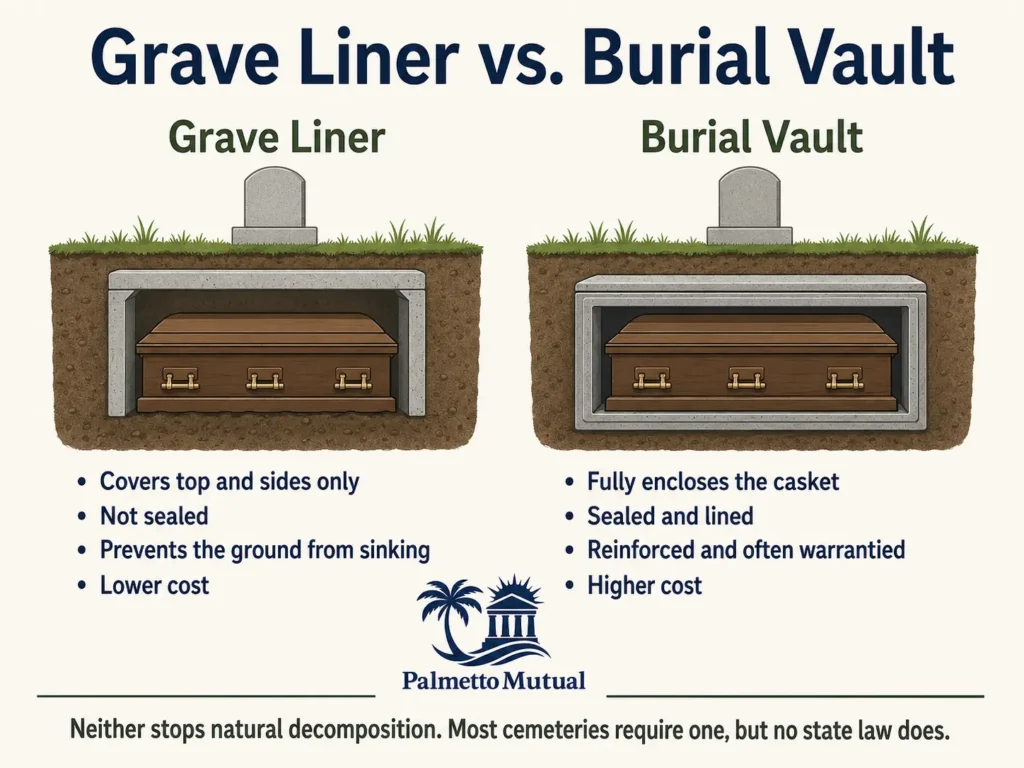
When a casket is buried, most cemeteries require it to sit inside an outer container made of concrete or metal. These come in two forms: a grave liner or a burial vault. The job of both is to keep the ground from sinking later on.
Here is the honest reason they exist. Over many years, a casket breaks down and the soil above it can settle, leaving a dip in the ground. A liner or vault holds that space so the lawn stays level, safe to walk on, and easy to mow with heavy equipment.
That is a cemetery’s reason, not a legal one. No state law requires an outer container. It is a cemetery policy, and the FTC Funeral Rule bars funeral homes from telling you a container is required by law when it is not.
The difference between the two:
A grave liner is the simpler, cheaper option. It covers the top and sides of the casket but is not sealed and has no bottom. It meets most cemetery requirements.
A burial vault is heavier, fully encloses the casket on all sides, and is sealed and lined. It costs more because of the materials, the seal, and often a manufacturer’s warranty.
| Outer container | What it does | Typical cost |
|---|---|---|
| Grave liner | Supports the soil; prevents the grave from sinking | $400 to $1,500 |
| Concrete burial vault | Fully encloses and seals the casket | $900 to $5,000 |
| Metal-lined vault (steel, copper, bronze) | Premium materials, longer warranties | $2,000 to $13,000 |
Now the straight read on the vault upsell. A sealed vault is often sold as “protection” for your loved one. But neither a liner nor a vault stops a body from naturally breaking down over time.
In fact, it is against federal law for a funeral provider to claim that a sealed vault will keep out water, dirt, or preserve the body. The choice between a basic liner and a premium vault is really about budget and personal preference, not safety.
A few ways to save: you can buy a liner or vault from an outside dealer, often for hundreds less. Veterans buried in a VA national cemetery receive a basic grave liner at no cost. And green burial grounds do not require an outer container at all.
Knowing this ahead of time helps a family decide how much of a final expense insurance benefit to set aside for the cemetery, instead of being surprised at the worst moment.
Embalming and Body Preparation Costs
Many families believe embalming is required. In almost every case, it is not. This is one of the most important things to understand before you agree to pay for it.
Embalming is a process that slows the natural changes in a body for a short time. It is a choice, and federal law treats it that way. The cost of embalming averages around $750, though it commonly runs from $500 to $900 depending on your area.
Beyond embalming itself, a funeral home may list separate “body preparation” fees. These cover dressing, hair, light cosmetics, and placing the body in the casket. They are usually a few hundred dollars and are also itemized, so you can see exactly what you are paying for.
When Embalming Is — and Isn’t — Required
No U.S. state requires embalming for every death. The FTC Funeral Rule makes it illegal for a funeral home to tell you embalming is required by law when it is not, with fines that can reach over $53,000 per violation.
Embalming is also not legally required just to have an open-casket viewing. Many funeral homes do ask for it as their own policy when a family wants an open casket, but that is the funeral home’s rule, not the law’s.
There are a few narrow cases where a state may require embalming or a preservation step:
| Situation | What usually applies |
|---|---|
| A long delay before burial | Many states require embalming or refrigeration after 24 to 72 hours |
| Shipping the body across state lines or by air | Some states (such as Alabama, Minnesota, Nebraska, New Jersey) require embalming or a sealed container |
| A public health order | Health officials may set special rules during a disease outbreak |
A good question to ask in a calm voice: “Is that required by law, or is it your funeral home’s policy?” (Funeral.com.) You are entitled to a clear answer.
Refrigeration and Other Alternatives
When the only issue is time — needing a few days before the service or burial — refrigeration does the same job as embalming and usually costs far less.
Refrigeration is often billed as a daily charge, averaging about $75 a day, and some funeral homes include it at no extra cost. A funeral home that has refrigeration but refuses to offer it as an option may be breaking the Funeral Rule.
Other ways families avoid embalming entirely:
- Immediate burial or direct cremation — no preservation is needed at all.
- A closed-casket service — embalming is rarely needed.
- Green burial — natural burial grounds do not allow embalming with standard chemicals.
One note of caution: three states — Iowa, Michigan, and North Dakota — do not accept refrigeration as a substitute when a preservation rule kicks in. Everywhere else, refrigeration is widely accepted.
For most families planning a simple burial, embalming and prep are fully optional costs. Leaving them off can lower the bill by hundreds of dollars — money that funeral insurance can then put toward the parts of the burial that matter most to you.
The Funeral Home Basic Services Fee
Of every cost on a funeral home’s price list, this is the only one you cannot decline. It appears on every itemized price list, and it is charged no matter what choices a family makes.
The basic services fee covers the funeral director and staff for the core professional work behind any arrangement. It is not tied to a viewing, a casket, or any single product — it pays for the time, expertise, and overhead that go into handling a death start to finish.
Here is what the fee typically covers:
- The arrangement meeting where the family makes decisions
- Filing the death certificate and securing the required permits
- Preparing death notices
- Holding (sheltering) the body until the burial or service
- Coordinating with the cemetery, crematory, and any other parties
- General overhead — staff, building, and licensing
Across the country, this fee usually runs from about $2,000 to $2,500.
This is why it shows up no matter what option you choose. Even the simplest direct burial or direct cremation already has the basic services fee built into the package price. You are not being double-charged — it is simply folded into those lower-cost options.
There is one helpful takeaway here. Because this is the single fee you cannot remove, comparing it across two or three funeral homes is one of the easiest ways to save money. A difference of $500 from one home to the next is real savings, and it does not change the quality of care.
For families using burial insurance to plan ahead, knowing this fee is fixed and unavoidable makes it a reliable starting point when deciding how much coverage to set aside.
Service, Facility, and Transport Costs
Beyond the basic services fee, much of a burial bill comes from the ceremony itself — the gatherings, the service, and getting everyone where they need to be. These pieces are mostly optional, and they are usually priced by how much you use them.
The more hours, staff, and vehicles a service involves, the higher these line items climb. The good news is that this is also where families have the most room to simplify and save.
Viewing and Visitation
A viewing or visitation is the time set aside for family and friends to gather and pay respects before the service. The funeral home charges for the use of its rooms and the staff on hand.
This cost usually runs from about $400 to $800, though it depends heavily on how long the gathering lasts and how many staff are needed. A short two-hour visitation costs far less than an all-day viewing, and weekend or holiday times may carry an added charge.
This is an optional component. A family can shorten the hours, hold a private family-only viewing, or skip it entirely to lower the bill.
The Service and Graveside
The funeral ceremony is the formal service, often held in the funeral home’s chapel. The charge covers the use of the space and the staff who run it, and it typically falls between $400 and $800.
A graveside service — held at the cemetery instead of, or in addition to, a chapel service — carries its own staff and setup charge. Holding the service only at the graveside can sometimes cost less than using the funeral home’s chapel.
Families can also hold the gathering somewhere meaningful and free, like a home, a park, or a place of worship, which removes the facility charge altogether.
Transportation — Hearse and Limousine
A hearse, sometimes called a funeral coach, carries the casket from the funeral home to the cemetery. This charge usually runs from about $350 to $500.
A separate service vehicle or limousine may be added to carry the family or to move flowers. This is typically $150 to $400, with a full limousine on the higher end depending on the hours used.
| Transport item | What it does | Typical cost |
|---|---|---|
| Hearse (funeral coach) | Carries the casket to the cemetery | $350 to $500 |
| Service car or limousine | Carries family or flowers | $150 to $400+ |
Both vehicles are optional. A family can use their own cars to travel to the cemetery and decline the limousine entirely. For those planning ahead with funeral insurance, these transport costs are easy to estimate and simple to trim if the budget is tight.
Frequently Asked Questions
Keep Reading







About the Author
Dvir Mosche is an award-winning independent insurance agent and the founder of Palmetto Mutual, a trusted insurance brokerage specializing in Final Expense Life Insurance. Since entering the industry in 2017, he has been recognized multiple times as a top agent for his dedication to educating and assisting seniors in finding the proper coverage. His mission is to simplify the process, provide honest and personalized guidance, and ensure that every client gets coverage they can depend on for life.


