
Home > Iowa
Final Expense Insurance in Iowa — A Guide for Seniors Planning Ahead
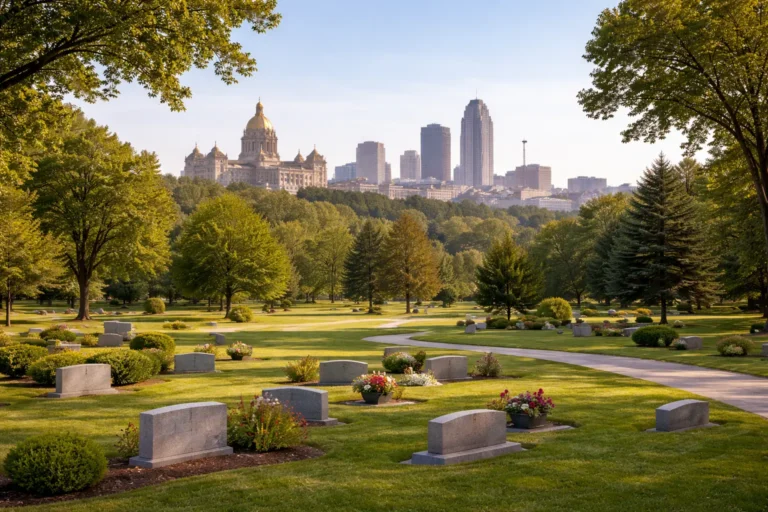
Iowa’s 99 counties stretch from the Mississippi River bluffs of the east through the rolling farmland of the Corn Belt to the Loess Hills along the Missouri River in the west. The state’s senior population is heavily concentrated outside the Des Moines, Cedar Rapids, and Quad Cities metros — nearly half of Iowa’s counties are classified as rural, and many have a median age well above the national figure, which shapes how seniors here approach burial insurance and end-of-life planning. Palmetto Mutual works with Iowa families from the university towns of Iowa City and Ames to the small farming communities of the Driftless Area and the western river counties.
Funeral and Cremation Costs in Iowa
Iowa is one of the more expensive states in the country for end-of-life services. A traditional burial in Iowa averages around $9,382, which sits well above the 2025 national median of about $8,300 reported by the National Funeral Directors Association. Knowing what services actually cost across the state helps families decide how much final expense insurance coverage is realistic for their situation.
Statewide averages
The figures below reflect 2025 Iowa pricing compiled from Funeralocity and US Funerals Online, compared against the NFDA’s 2025 national median cost study.
| Service type | Iowa average | National median (NFDA 2025) |
|---|---|---|
| Traditional funeral and burial | $9,382 | $8,300 |
| Full-service cremation (with memorial service) | $7,244 | $6,280 |
| Immediate or direct burial (no service) | $5,813 | — |
| Direct cremation (no service) | $2,991 | — |
None of these figures include cemetery costs. A burial plot in Iowa averages roughly $3,315, and a headstone typically adds another $1,000 to $5,000 depending on whether it is flat or upright. Families planning a traditional burial should budget $13,000 to $17,000 all-in once cemetery fees and a monument are included.
Regional cost variation
Iowa’s cost patterns run counter to what many people expect. Direct cremation is often cheaper in the larger metros than in the rural counties, because Des Moines, Cedar Rapids, and Davenport have enough cremation providers to create real price competition. Direct cremation in Des Moines can be found for as little as $895, while the same service in rural western or northern Iowa frequently runs $1,500 to $2,500.
Full-service traditional burial runs the opposite direction. Cedar Rapids, Iowa City, and the Quad Cities tend to price full-service funerals at the high end of the state range — sometimes $10,500 or more — because urban funeral homes carry higher overhead, larger facilities, and more staff. Rural counties in the Driftless Area, north-central Iowa, and the Loess Hills region typically come in $1,000 to $2,000 below the state average for the same service.
What drives Iowa’s pricing
Several factors push Iowa’s funeral costs above the national median. The state has a large number of small, family-owned funeral homes serving rural communities, and these firms carry fixed overhead that has to be recovered across a lower volume of services. Iowa also has an older population than the national average, which keeps demand steady but does not translate to the kind of high-volume discounting seen in faster-growing Sun Belt states. Cemetery costs run high across much of the state, particularly in established cemeteries in Des Moines, Cedar Rapids, and Dubuque where plot availability is limited.
The gap between a direct cremation and a traditional burial in Iowa is wider than in most states — often $6,000 or more — which is part of why roughly 60% of Iowa families now choose cremation. For seniors weighing burial life insurance coverage amounts, the choice between traditional burial and cremation is the single biggest variable in deciding how much coverage makes sense.
Final Expense Insurance Regulations in Iowa
Iowa regulates life insurance at the state level, with statutes and administrative rules that set the ground rules for how burial life insurance policies are sold, delivered, and canceled. Understanding these protections matters because final expense policies are often purchased by seniors without agent representation or outside review, and Iowa law provides specific safeguards designed to give buyers time to reconsider and recourse if something goes wrong.
The Iowa Insurance Division
The Iowa Insurance Division, housed within the Iowa Department of Insurance and Financial Services, supervises every insurance company and producer doing business in the state. The division licenses agents, reviews policy forms before they can be sold, investigates consumer complaints, and enforces the Iowa insurance code. Its consumer advocate bureau and market regulation bureau handle complaints against carriers and agents, and seniors who suspect a problem with a final expense policy or sales practice can file a complaint directly with the division.
The primary statutes governing life insurance in Iowa are found in Iowa Code Title XIII, Chapters 505 through 523. Chapter 508 specifically addresses life insurance companies, and Chapter 508C establishes the Iowa Life & Health Insurance Guaranty Association.
Free look period
Iowa requires a 10-day free look period on new life insurance policies, including final expense and burial insurance. A policyholder can cancel the policy within 10 days of delivery and receive a full refund of any premium paid, no questions asked. This protection applies whether the policy was sold in person, by phone, or through direct mail.
When a policy is sold through a direct response replacement transaction — where the consumer is dropping an existing policy to buy a new one by mail — Iowa extends the free look period to 20 days under Administrative Rule 191 Chapter 16. The longer window gives seniors more time to compare the new policy against the one being replaced.
Replacement rules
Iowa has specific consumer protections when a new policy replaces an existing one. Under 191 IAC Chapter 16, agents and insurers must follow disclosure procedures any time a final expense sale involves replacing another life insurance policy. The agent must give the applicant a signed replacement notice, the replacing insurer must notify the existing insurer within ten working days, and the existing insurer must send the policyholder a summary of the current policy so the two can be compared side by side.
These rules exist because replacing a whole life policy is often a bad deal for the consumer — a new policy means a new contestability period, a new waiting period if the product is graded, and potentially higher premiums due to the insured’s older age. Iowa’s rules do not ban replacement, but they force the paperwork that lets a senior see clearly what they are giving up.
Graded death benefits and waiting periods
Final expense policies in Iowa commonly come in three underwriting tiers — level (immediate full benefit), graded (partial benefit in years one and two), and guaranteed issue (full benefit after a two-year waiting period, limited payout for non-accidental death during the waiting period). Iowa does not cap the length of a waiting period by statute, but every policy form sold in the state must be filed with and approved by the Iowa Insurance Division before it can be issued, which means the graded benefit structure, waiting period terms, and return-of-premium language are all reviewed for compliance with state law.
For seniors buying guaranteed issue burial insurance, the practical takeaway is that the two-year waiting period is standard across carriers, but the specifics of what the policy pays if death occurs during that window vary — most pay a return of premiums plus interest of 5% to 10%, and Iowa’s form review process ensures that language is disclosed clearly in the policy itself.
Iowa Life & Health Insurance Guaranty Association
If an insurance company licensed in Iowa becomes insolvent, the Iowa Life & Health Insurance Guaranty Association steps in to continue coverage and pay claims up to state-set limits. For life insurance policies, Iowa’s coverage limit is $300,000 for death benefits — well above the $5,000 to $35,000 range typical of final expense policies, meaning a standard burial insurance policy is fully protected by the guaranty association if the insurer fails.
All life insurance companies licensed to sell in Iowa are required to be members of the association, and they fund it through assessments when a member company becomes insolvent. This is a baseline protection that applies to every final expense policy sold in the state by a licensed carrier.
Senior-specific protections
Iowa applies its suitability and unfair trade practice rules under Iowa Code Chapter 507B to every life insurance sale, including final expense. Agents cannot use misleading advertising, cannot misrepresent policy features, and cannot induce a senior to replace an existing policy through incomplete disclosure. Violations are subject to penalties from the Iowa Insurance Division, up to and including license revocation.
Seniors researching funeral life insurance in Iowa can verify an agent’s license and check for prior disciplinary action through the Iowa Insurance Division’s online license lookup, and any complaint about a sales practice or claim dispute can be filed directly with the division’s consumer advocate bureau.
Funeral and Burial Laws in Iowa
State law governs every step of what happens after a death in Iowa, from filing paperwork to final disposition. Understanding these rules helps families know what the funeral home is actually required to do and what options are legally available to them. The Iowa Board of Mortuary Science regulates funeral directors and establishments, while the Iowa Department of Health and Human Services handles vital records and burial-transit permits.
Death certificate and burial-transit permit
Iowa requires a death certificate to be filed with the local registrar within three days of death and before the body is buried, cremated, or otherwise disposed of, under Iowa Code § 144.26. The funeral director typically completes and files the certificate, while the attending physician, physician assistant, or advanced registered nurse practitioner completes the medical certification of cause of death. If a medical examiner’s inquiry is required, the examiner has up to 72 hours after determining the cause of death to complete the certification. Iowa now uses an electronic death registration system, though paper filings are still accepted.
Before a body can be moved from the place of death, a burial-transit permit must be obtained from a county medical examiner, a funeral director, or the county registrar, under Iowa Code § 144.32. The permit confirms that a death certificate has been filed and grants permission to transport, bury, or cremate the body. If the cause of death is a known or suspected communicable disease, only a licensed funeral director can obtain the permit.
Embalming rules
Iowa does not require embalming in most cases. Under Iowa Administrative Code 481-900.6(3), embalming is only required if final disposition will not occur within 72 hours of death. If the body is refrigerated between 38 and 42 degrees Fahrenheit, that window extends by another 72 hours, for a total of six days before embalming becomes mandatory. This matters for families choosing direct burial, direct cremation, or a home funeral, because refrigeration allows them to avoid the $800 to $1,200 embalming charge entirely.
Cremation authorization
Cremation in Iowa requires a separate permit from a county medical examiner, under Iowa Code § 331.805 and Iowa Administrative Code 641-127.6. The medical examiner’s permit is a safety check intended to confirm the identity of the deceased and rule out any concerns about cause of death before the body is cremated. The permit fee is capped by law at $75.
Iowa law requires a 40-hour waiting period from the time of death before cremation can be performed. Families also cannot arrange cremation directly with a crematory — Iowa requires a licensed funeral director to handle the arrangements, meaning the family must go through a funeral establishment even for a basic direct cremation.
Scattering of ashes in Iowa is legal but restricted. Under Iowa Administrative Code 641-97.13, ashes cannot be scattered on public property or on private property without the owner’s permission. Local ordinances and individual cemetery rules may apply on top of the state rule.
Home funerals and home burial
Iowa is one of the states where families retain significant control over end-of-life arrangements. Home funerals are legal — Iowa does not require a licensed funeral director to handle a body, file the death certificate, or arrange burial, though the family must complete all the required paperwork themselves. The exception is cremation, which always requires a funeral director to act as the intermediary.
Home burial on private land is also legal in Iowa. There is no state statute prohibiting backyard burial, but local county or municipal zoning ordinances may restrict it, particularly in more densely populated areas. Families planning a home burial should check with the county recorder and the county zoning office first, and the burial location should be recorded on the property deed so future owners are aware of it. Iowa law requires a minimum of three feet of earth covering the top of the burial container.
Green burial
Green burial is legal in Iowa but largely unregulated at the state level. Families can choose a biodegradable casket or shroud, skip embalming, and forgo a concrete vault, as long as the cemetery chosen allows it. Several Iowa funeral homes offer certified green burial services through the Green Burial Council, including Cedar Memorial in Cedar Rapids and Hoffmann Schneider & Kitchen in Dubuque. Lensing Funeral Home in Iowa City also offers biodegradable caskets and green burial arrangements.
Iowa does not yet have a dedicated conservation burial cemetery, though a Johnson County nonprofit called Back to Ground Natural Burial Cemetery has been working since 2024 to establish the state’s first. Currently, the closest dedicated natural burial ground for Iowa families is Casper Creek Natural Cemetery in Elizabeth, Illinois, about two hours from Iowa City. Most green burials in Iowa take place in designated green sections of conventional cemeteries.
The Iowa Board of Mortuary Science
The Iowa Board of Mortuary Science licenses and regulates funeral directors, funeral establishments, and cremation establishments under Iowa Code Chapter 156. The board sits within the Iowa Department of Inspections, Appeals, and Licensing (DIAL). Every funeral home and crematory in Iowa must hold a current establishment license, and funeral directors must complete a mortuary science degree, a year-long supervised internship, and pass the national ICFSEB examination before being licensed. Ongoing licensure requires 24 hours of continuing education every two years.
Families who believe a funeral home has mishandled services, overcharged, or violated state rules can file a complaint directly with the Iowa Board of Mortuary Science through the DIAL online portal. The board investigates complaints and can discipline licensees up to and including revoking a license.
Regions and Major Metros in Iowa
Iowa breaks down into five widely recognized regions that reflect the state’s geography, glacial history, and settlement patterns. Knowing which region a county falls in helps orient families to the kind of funeral costs, healthcare access, and service availability they can expect locally, since rural and metro counties in Iowa often behave very differently.
Iowa’s regions
Iowa’s regional map is driven by landform and economic identity rather than formal state designation. These five regions are the most commonly used groupings across state tourism, economic development, and census materials.
| Region | Description |
|---|---|
| Northeast Iowa (Driftless Area) | Rugged, unglaciated terrain along the Mississippi River with bluffs, caves, and deep river valleys. Home to Dubuque and Decorah. |
| Northwest Iowa | Rolling loess prairies, the Iowa Great Lakes region, and the Sioux City metro along the Missouri River. |
| North Central Iowa (Des Moines Lobe) | Flatter glaciated terrain with former prairie-pothole wetlands. Includes Mason City, Fort Dodge, and Ames. |
| Southern Iowa (Southern Iowa Drift Plain) | Classic rolling Iowa landscape of hills and fertile valleys. Home to Des Moines and most of the state’s population center, plus Ottumwa and Creston. |
| Western Iowa (Loess Hills and Missouri Alluvial Plain) | Dramatic wind-deposited hills along the Missouri River and the flat alluvial plain to the west. Home to Council Bluffs and the Loess Hills Scenic Byway. |
Counties by region
The table below groups Iowa’s 99 counties by region. This is the structural payoff of the section — a family in any Iowa county can find which region they belong to and the kind of local context they should expect for burial insurance planning.
| Region | Counties |
|---|---|
| Northeast Iowa (Driftless) | Allamakee, Bremer, Buchanan, Chickasaw, Clayton, Delaware, Dubuque, Fayette, Howard, Jackson, Jones, Mitchell, Winneshiek |
| Northwest Iowa | Buena Vista, Cherokee, Clay, Dickinson, Emmet, Ida, Lyon, Monona, O’Brien, Osceola, Plymouth, Sac, Sioux, Woodbury |
| North Central Iowa (Des Moines Lobe) | Boone, Calhoun, Cerro Gordo, Floyd, Franklin, Hamilton, Hancock, Hardin, Humboldt, Kossuth, Palo Alto, Pocahontas, Story, Webster, Winnebago, Worth, Wright |
| Southern Iowa (Southern Drift Plain) | Adair, Adams, Appanoose, Benton, Black Hawk, Butler, Cedar, Clarke, Clinton, Dallas, Davis, Decatur, Des Moines, Grundy, Guthrie, Henry, Iowa, Jasper, Jefferson, Johnson, Keokuk, Lee, Linn, Louisa, Lucas, Madison, Mahaska, Marion, Marshall, Monroe, Muscatine, Polk, Poweshiek, Ringgold, Scott, Tama, Taylor, Union, Van Buren, Wapello, Warren, Washington, Wayne |
| Western Iowa (Loess Hills) | Audubon, Carroll, Cass, Crawford, Fremont, Greene, Harrison, Mills, Montgomery, Page, Pottawattamie, Shelby |
Top metros in Iowa
Iowa’s nine metropolitan statistical areas are concentrated in the eastern and central parts of the state, with Sioux City and Council Bluffs anchoring the west. The Des Moines-West Des Moines-Ames combined statistical area is by far the largest population center, followed by Cedar Rapids, the Quad Cities (Iowa side), and Iowa City.
| Metro area | Approximate population | Core counties |
|---|---|---|
| Des Moines-West Des Moines | ~720,000 | Polk, Dallas, Warren, Madison, Guthrie |
| Cedar Rapids | ~280,000 | Linn, Benton, Jones |
| Davenport-Moline-Rock Island (Quad Cities, Iowa side) | ~175,000 Iowa-side | Scott, Muscatine |
| Iowa City | ~175,000 | Johnson, Washington |
| Waterloo-Cedar Falls | ~165,000 | Black Hawk, Bremer, Grundy |
| Sioux City (Iowa portion) | ~110,000 Iowa-side | Woodbury, Plymouth |
| Dubuque | ~99,000 | Dubuque |
| Ames | ~98,000 | Story |
| Council Bluffs (Omaha metro, Iowa side) | ~95,000 Iowa-side | Pottawattamie, Mills, Harrison |
Population figures are drawn from 2024 U.S. Census Bureau estimates. Ames is sometimes grouped into the Des Moines combined statistical area rather than counted separately.
Senior population and demographic patterns
Iowa has one of the oldest populations in the country, and the state’s demographic trajectory matters directly for final expense insurance planning. University of Iowa researchers have found that Iowa currently has the highest percentage of adults over age 80 of any state in the nation. By 2030, Iowans 65 and older will outnumber Iowans under 18 — a crossover that most states will not hit until the mid-2030s.
Iowa’s senior population is unevenly distributed. The Des Moines metro and its fast-growing suburbs in Dallas, Polk, and Warren counties have a younger age profile, while rural counties in southern, western, and north-central Iowa often have a median age 10 to 15 years above the state average. Counties like Adams, Ringgold, Wayne, and Monroe in southern Iowa have some of the highest shares of residents over 65 in the state, and these same counties also have the fewest funeral homes and the longest distances to major medical centers — factors that shape how families plan for end-of-life services.
Iowa is not a destination retirement state in the way Florida or Arizona are — the state’s large senior population is driven by aging in place, not by inbound migration. Most Iowans buying funeral life insurance are lifelong residents or returning family members planning for parents who have spent decades in the same community. This tends to make family-owned local funeral homes, long-held cemetery plots, and church affiliations more central to planning in Iowa than in faster-churning states.
Counties We Serve in Iowa
Palmetto Mutual works with families across all 99 counties in Iowa, from the Mississippi River counties of the Driftless Area to the Loess Hills along the Missouri River. The directory below covers every county in the state — select your county to see local funeral cost data, cemetery information, and final expense insurance options specific to where you live.
Frequently Asked Questions

About the Author
Dvir Mosche is an award-winning independent insurance agent and the founder of Palmetto Mutual, a trusted insurance brokerage specializing in Final Expense Life Insurance. Since entering the industry in 2017, he has been recognized multiple times as a top agent for his dedication to educating and assisting seniors in finding the proper coverage. His mission is to simplify the process, provide honest and personalized guidance, and ensure that every client gets coverage they can depend on for life.


