
Home > Maine
Final Expense Insurance in Maine — A Complete Guide for Pine Tree State Seniors
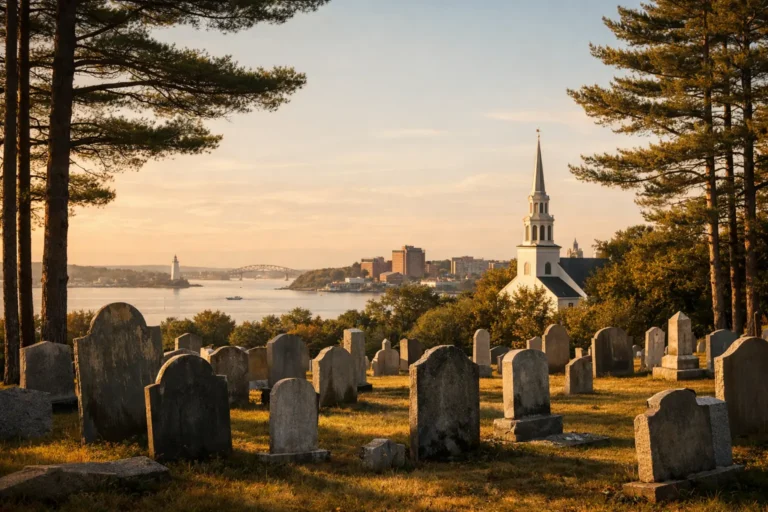
Maine’s geography shapes nearly every decision families make around end-of-life planning, from the fishing villages of Down East and the working harbors of Midcoast to the lakes region, the Western Mountains, and the population centers around Portland and Bangor. As the oldest state in the country by median age, Maine has a large share of residents thinking seriously about funeral costs, burial plots, and how a small burial insurance policy fits into a fixed retirement income. This page covers statewide funeral pricing, Maine’s insurance regulations, the state’s funeral and burial laws, and the regions and counties we serve.
Funeral and Cremation Costs in Maine
Maine is one of the most expensive states in the country for funerals. Maine has the highest average funeral cost of $8,675, according to World Population Review, and pricing varies significantly between the population centers along the southern coast and the rural counties north and Down East.
Statewide averages
The figures below draw on National Funeral Directors Association data and Funeralocity state pricing for Maine. Cemetery plots, vaults, grave markers, and headstones are billed separately by the cemetery and are not included in these totals.
| Service type | Typical cost in Maine |
|---|---|
| Traditional full-service burial | $7,500 – $10,000+ |
| Full-service cremation (viewing + ceremony) | $6,200 – $6,900 |
| Direct cremation (no ceremony) | $1,100 – $3,000 |
| Immediate burial (no viewing) | $4,500 – $5,500 |
The National Funeral Directors Association estimates that the average cost of a traditional full service burial in Maine is $7,553 and a full service cremation $6,219. Families who choose a more elaborate casket, a vault, or a cemetery plot in a high-demand area routinely see burial totals move past $10,000.
Regional cost variation within Maine
Prices inside Maine vary more by population density and distance from a crematory than by a clean north-south line. The four broad regions below reflect the patterns families typically encounter.
| Region | Key counties | Cost pattern |
|---|---|---|
| Greater Portland / Southern Maine | Cumberland, York, Sagadahoc | Highest prices statewide. Cost of living, real estate, and cemetery demand push both burial and cremation totals above the Maine average. |
| Midcoast & Down East | Knox, Lincoln, Waldo, Hancock, Washington | Mid-range pricing. Coastal cemetery plots can be expensive in tourist-heavy towns, while direct cremation stays competitive. |
| Central Maine & Bangor area | Kennebec, Penobscot, Androscoggin, Somerset | Closest to the Maine average. Cremation in Bangor, Maine averages $2,545 for direct service. |
| Northern & rural Maine | Aroostook, Piscataquis, Franklin, Oxford | Fewer providers and longer transportation distances can add transfer fees, though base service charges are often lower than in Greater Portland. |
The average cost for direct cremation in Maine is $2,372, and cities like Portland, Bangor, and Auburn have the highest Maine cremation costs. In the rural north, the driver of cost is usually distance — a funeral home may need to travel an hour or more between the place of death, the crematory, and the cemetery.
How Maine compares to the national median
The NFDA’s 2024 General Price List Study puts the median cost of a funeral with viewing and burial at about $8,300, and the median cost of a funeral with cremation at around $6,280 nationally. Maine’s burial average sits roughly at or slightly above the national median, while Maine’s cremation pricing runs very close to the national number. When families compare Maine to neighboring New England states, Maine’s direct cremation average of $2,372 is lower than Massachusetts ($2,720) and Rhode Island ($2,619) but higher than New Hampshire ($2,190).
What drives Maine’s funeral costs
Several state-specific factors shape what a Maine family actually pays.
A small and aging population spread across a large land area means fewer funeral homes per square mile than in most states, and transportation fees become a real line item in Aroostook, Piscataquis, and inland Washington County. Cemetery plot costs run higher in historic coastal towns and in the Portland metro than in inland rural communities. The state’s cremation rate tracks above the national average, which has pushed direct cremation pricing down over the past decade and made burial insurance and final expense insurance a common way for Maine seniors to cover cremation with room left over for a memorial service. Maine also offers a small public assistance backstop — the General Assistance Program offers up to $785 for cremation and $1,125 for burials and is administered through the local city or town — but these amounts cover only a fraction of even the simplest funeral, which is why most families plan ahead with a funeral life insurance policy rather than relying on municipal aid.
Final Expense Insurance Regulations in Maine
Final expense insurance in Maine is a small whole life policy regulated under the Maine Insurance Code, Title 24-A of the Maine Revised Statutes. The rules below describe the consumer protections that apply when a Maine senior buys burial insurance, and one regulatory quirk that makes Maine genuinely different from nearly every other state.
The Maine Bureau of Insurance
Maine’s Bureau of Insurance regulates the 300+ companies that are licensed to sell life insurance policies in the state, ensuring their compliance with the laws detailed in Title 24 of the Maine Revised Statutes. The Bureau sits within the Maine Department of Professional and Financial Regulation (PFR) and is the agency that licenses insurance companies, licenses individual producers, reviews rates and policy forms, and handles consumer complaints about life insurance and final expense carriers.
Free look period
Maine’s free look rules are a notable exception to the national pattern. A law enacted in 1998 states that life/health contracts must disclose company policy on applications about returning premium and also when you request cancellation of your policy, under 24-A M.R.S.A. § 2453, and you have 10 days from the date the policy is delivered to you to look the policy over. Many carriers voluntarily extend that window to 20 or 30 days as a consumer-friendly practice, and the policy contract itself will state whichever free look period applies. During the free look, a policyholder can cancel the final expense policy in writing and receive a full refund of any premium paid.
Grace period on premium payments
Every final expense policy sold in Maine carries a 30-day grace period on late premium payments. Maine’s life insurance laws prohibit insurers from cancelling a policy for nonpayment during the late-premium grace period, which gives policyholders 30 days to bring their account current. If the insured dies during the grace period, the death benefit is still payable — the late premium is simply deducted from the payout.
Timely payment of claims
Maine law requires final expense carriers to pay valid death benefit claims without unreasonable delay. Insurers have 30 days from the date a claim is filed to issue the death benefit payout, and claims that remain unsettled after 30 days accrue interest, which must be paid to the named beneficiary. The interest-accrual rule is a real consumer protection — it gives carriers a financial reason to move quickly on a file and gives the beneficiary legal leverage if a claim sits too long.
Maine Life & Health Insurance Guaranty Association
If a final expense carrier becomes insolvent, the Maine Life & Health Insurance Guaranty Association provides a statutory backstop. The limits on this fail safe are $300,000 in death benefits per insured person, and up to $100,000 in lost cash value per policy owner. Because most final expense face amounts fall between $5,000 and $35,000, the guaranty association limit covers the full policy for essentially every final expense policyholder in Maine.
The Maine preneed exception
Here is where Maine is genuinely different. For decades, Maine was one of only two states in the country — New York being the other — that did not allow funeral homes to sell preneed life insurance tied directly to a prearranged funeral contract. Along with other preneed insurance carriers, we have not, up to this point, been able to provide those products and services in Maine due to current legislation not allowing life insurance funded preneed arrangements. Maine is one of only two states in the United States with such legislation – the other state being New York.
In 2025, LD 867 moved through the Maine Legislature to change that — this bill provides for a type of insurance for prearranged funeral services or plans, defines preneed insurance and permits its sale in the State, and permits a funeral director to sell preneed insurance to a consumer who has approached a funeral home to preplan a funeral. This regulatory history matters for Maine consumers for a practical reason. In most states, a senior walking into a funeral home to preplan can be sold a preneed insurance policy on the spot by the funeral director. In Maine, that conversation has historically been separate — the funeral home handles the prearrangement, and the senior buys an ordinary final expense or burial life insurance policy from a licensed insurance producer, then assigns or designates the death benefit to cover the funeral.
For most Maine seniors buying funeral life insurance today, this separation is actually an advantage. Buying from an independent final expense agent rather than from a funeral home means the policy is portable, the death benefit belongs to the family rather than to a single funeral home, and coverage doesn’t disappear if the chosen funeral home closes or is sold.
Replacement of existing coverage
Maine follows the standard NAIC-based replacement rules for life insurance. If a Maine senior is replacing an older burial insurance policy or a small whole life policy with a new final expense plan, the replacing producer must provide written replacement disclosures, and the existing carrier is given a window to conserve the policy. These rules are designed to make sure the senior actually benefits from the switch rather than losing accumulated cash value or restarting a contestability period without understanding the tradeoff.
Regulatory resources for Maine consumers
The Maine Bureau of Insurance maintains a licensee lookup tool where any Maine resident can verify that a final expense agent or carrier is properly licensed before signing an application. The Bureau also handles written complaints about claim delays, misrepresentation, or producer conduct, and the Maine Life & Health Insurance Guaranty Association publishes its coverage limits and contact information for beneficiaries dealing with an insolvent carrier.
Funeral and Burial Laws in Maine
Maine’s funeral laws give families more flexibility than most states. There is no requirement that a funeral director handle the arrangements, home funerals are legal, private family burial plots are recognized, and Maine is one of a small number of states to legalize natural organic reduction (human composting). The specifics below explain how the process actually works.
Death certificate filing
In Maine, the funeral director or authorized person is responsible for filing the death certificate. In Maine, the death certificate must be filed with the Department of Health within 3 days, under Maine Health & Human Services Rule 10-146, Chp 1. The medical certifier — the attending physician, nurse practitioner, physician assistant, or the medical examiner when applicable — must complete the medical portion of the certificate, typically within 24 hours of death. Maine uses the Electronic Death Registration System (EDRS), and certificates are registered through the Division of Data, Research, and Vital Statistics (DRVS) within the Maine Center for Disease Control and Prevention.
The first certified copy of a Maine death certificate costs $15; additional copies are $6 each. Families should ask for at least ten certified copies up front, as insurance carriers, banks, and Social Security will each want one.
Burial-transit (disposition) permit
Every death in Maine requires a disposition permit — also called a burial-transit permit — before the body can be transported or finally disposed of. A dead human body may not be buried, cremated, subjected to natural organic reduction or otherwise disposed of or removed from the State until a funeral director or other authorized person in charge of the disposition of the dead human body or its removal from the State has obtained a permit from the State Registrar of Vital Statistics or the clerk of the municipality where death occurred.
The permit is issued by the municipal clerk of the town where death occurred, by the town where the funeral establishment is located, or by the DRVS directly. For cremation, burial at sea, natural organic reduction, donation to medical science, or removal from the state, the clerk also needs a signed release from a medical examiner or medicolegal death investigator before the permit can be issued.
Embalming
Maine does not require embalming as a matter of state law. Families frequently encounter pressure language at funeral homes suggesting embalming is legally required — it is not. Violators/violations of the Funeral Rule may be subject to penalties of up to $43,280.00 per violation under the FTC Funeral Rule, which prohibits funeral homes from claiming embalming is required by law when it is not. Embalming is only practically required when there will be a public viewing with an open casket, when the body will be transported across state lines by common carrier, or when final disposition is delayed beyond a certain period. Refrigeration is an accepted alternative in most circumstances.
Cremation waiting period and authorization
Maine imposes a 48-hour cremation waiting period and a medical examiner review. The body of a deceased person may not be cremated within 48 hours after death unless the person died of a contagious or infectious disease, and in no event may the body of a deceased person be cremated, buried at sea, used by medical science or removed from the State until the person, firm or corporation in charge of the disposition has received a certificate from a duly appointed medical examiner or medicolegal death investigator confirming that no further inquiry into cause of death is needed. A $25 fee is paid to the medical examiner for the certificate. A signed cremation authorization form from the legal next of kin is also required before any crematory will proceed. Maine requires that remains be encased in a casket or other suitable container for transport to the crematory — a rigid cardboard or unfinished wooden alternative container is acceptable, and a traditional casket is never required for cremation.
Home funerals
Home funerals are fully legal in Maine. There is NO legal requirement in Maine that dictates you must employ the services of a funeral director, and the “authorized person” responsible for the disposition of the body is the next of kin or the person given signed authority by said next of kin. A family choosing a home funeral is still responsible for filing the death certificate within three days, obtaining the disposition permit, and meeting any medical examiner requirements before cremation or burial.
Private family burial grounds
Maine is one of the more permissive states for private burials on family land. You may record a family burying ground of up to one-quarter of an acre in the registry of deeds of the county where the body is buried. You must enclose the family burying ground with a fence or otherwise make it clear where the graveyard is situated. If you ever sell the property, you keep the right to access the graveyard, under Me. Rev. Stat. tit. 13, § 1142 (2024). Local zoning and health ordinances may add requirements on top of the state rule — families considering this should check with the municipal clerk before the need arises.
Burial at sea
Maine’s long coastline makes burial at sea a real option for many families. Full-body burial at sea is regulated by the US Environmental Protection Agency under the federal Marine Protection, Research, and Sanctuaries Act. A burial at sea should be 3 nautical miles out, and a written notification should be provided to the local EPA representative within 30 days. Burial at Sea Coordinator, US EPA Region 1, EPA New England Phone: (888) 372-7341 — Maine falls under EPA Region 1. Scattering of cremated remains at sea follows the same three-nautical-mile minimum but does not require the weighted-container rules that apply to full-body burial.
Green burial and natural organic reduction
Green burial has been legal in Maine for years, and the state has a small but growing network of certified green cemeteries. The best-known are Baldwin Hill Conservation Cemetery in Fayette and a natural burial section at Burr Cemetery in Freeport. In a green burial, the body is placed in a biodegradable container — a cotton shroud, cardboard casket, or untreated pine coffin — with no embalming fluids and no concrete vault. Cemetery policies, not state law, are what usually require vaults in conventional cemeteries.
Maine also legalized natural organic reduction — the process by which human remains are converted into soil — in June 2024 under LD 536. As of early 2026, NOR has been legalized in Washington State, Colorado, Oregon, California (effective 2027), New York, Vermont, Maryland, Maine, Delaware, Nevada, Arizona, New Jersey, Georgia, and Minnesota. There are currently no NOR facilities in the state of Maine, however, there is a facility in Vermont slated to be operational in April of 2026. For now, Maine families who want natural organic reduction are sending remains out of state, most often to Washington or Vermont providers.
The Maine State Board of Funeral Service
Funeral directors, embalmers, funeral establishments, and crematories in Maine are licensed and regulated by the Maine State Board of Funeral Service, which operates under the Department of Professional and Financial Regulation. The Board sets education and examination requirements for licensees, inspects funeral establishments, handles consumer complaints about funeral homes, and enforces Title 32, Chapter 21 of the Maine Revised Statutes. A Maine resident who has a complaint about a funeral home’s pricing, conduct, or handling of a loved one’s remains can file a written complaint directly with the Board.
Regions and Major Metros in Maine
Maine is divided into eight official tourism regions defined by the Maine Office of Tourism, a delineation that dates back to 1962 and is used by the state, the Maine Tourism Association, and most regional economic development agencies. The regions are a useful framework for understanding how the state’s 16 counties cluster together geographically and economically.
The eight regions of Maine
Each region has a distinct character shaped by geography, industry, and settlement history.
| Region | Character |
|---|---|
| Greater Portland & Casco Bay | Maine’s economic center. Urban, coastal, fastest-growing, and home to the state’s largest concentration of hospitals, professional services, and retail. |
| The Maine Beaches | Southernmost Maine along the New Hampshire border. Year-round beach communities, outlet shopping, and a commuter connection to Greater Portland. |
| Maine’s Lakes & Mountains | Western Maine from the New Hampshire line to Sebago Lake, including the Lewiston-Auburn metro. Home to Maine’s highest peaks and four-season outdoor recreation. |
| The Kennebec Valley | A north-south stretch running from the state capital in Augusta up to the Canadian border. Healthcare, manufacturing, and state government anchor the economy. |
| Maine’s Midcoast & Islands | Working harbors from Brunswick northeast to Searsport. The largest employers in this region include manufacturing and construction industries. The Midcoast is also home to Maine’s heritage fishing and agriculture industries. |
| DownEast & Acadia | Maine’s eastern coast covering Hancock and Washington counties. Home to Acadia National Park, Bar Harbor, and a traditional lobstering economy. |
| The Maine Highlands | Central interior Maine anchored by Bangor. Located in the center of Maine, the Highlands include many of Maine’s natural attractions from Maine’s highest peak, Katahdin, to its largest lake, Moosehead. |
| Aroostook County | Maine’s northernmost and largest county, bordering Quebec and New Brunswick. Agriculture, forestry, potato farming, and a distinct Acadian-French cultural heritage. |
How Maine’s 16 counties fit into the regions
Every Maine county belongs to one of the eight tourism regions. The table below is the structural map of the state.
| Region | Counties |
|---|---|
| Greater Portland & Casco Bay | Cumberland |
| The Maine Beaches | York |
| Maine’s Lakes & Mountains | Androscoggin, Franklin, Oxford |
| The Kennebec Valley | Kennebec, Somerset |
| Maine’s Midcoast & Islands | Sagadahoc, Lincoln, Knox, Waldo |
| DownEast & Acadia | Hancock, Washington |
| The Maine Highlands | Penobscot, Piscataquis |
| Aroostook County | Aroostook |
Top metros in Maine by population
Maine’s urban population is concentrated heavily in the southern third of the state. The figures below come from the most recent US Census Bureau estimates for Maine cities.
| Metro / City | Population | Region | County |
|---|---|---|---|
| Portland | ~69,568 | Greater Portland & Casco Bay | Cumberland |
| Lewiston | ~38,324 | Maine’s Lakes & Mountains | Androscoggin |
| Bangor | ~31,938 | The Maine Highlands | Penobscot |
| South Portland | ~26,930 | Greater Portland & Casco Bay | Cumberland |
| Auburn | ~24,602 | Maine’s Lakes & Mountains | Androscoggin |
| Biddeford | ~22,808 | The Maine Beaches | York |
| Sanford | ~22,166 | The Maine Beaches | York |
Portland remains the largest city in Maine, with 69,568 people and nearly twice the size of the next-largest city, Lewiston. The Greater Portland metro — anchored by Portland, South Portland, Westbrook, Scarborough, and Brunswick — is where the majority of Maine’s population growth is happening.
Metro cluster notes for final expense buyers
Several metros in Maine cluster across multiple towns within a single county, which matters when a family is planning funeral services or comparing funeral home prices.
The Portland metro extends well beyond Portland itself. Westbrook, Scarborough, South Portland, Falmouth, and Cape Elizabeth all sit within Cumberland County and share the same general funeral pricing pattern — this is the most expensive metro in the state for both burial and cremation services. The Lewiston-Auburn metro, locally known as “L-A,” spans the Androscoggin River and combines Maine’s second and fifth largest cities into a single market. Bangor anchors the Penobscot County metro, which extends across the river to Brewer and Orono and covers most of central and northern Maine’s service needs. The Biddeford-Saco-Sanford corridor forms the core of York County and carries lower funeral pricing than Greater Portland while still offering broad provider choice.
Senior demographics in Maine
Maine is genuinely an outlier on senior population share, and this shapes the state’s final expense insurance market more than in almost any other state. In 2022, Maine continues to be the state with the oldest median age in the country at 45.1 years, and Maine had the highest percentage of all states at 22.6% of its population over age 65. Maine is the only state with more residents aged 65 or older than 18 or younger.
The pattern is not uniform across the state. Four counties in Maine (Piscataquis, Oxford, Hancock and Aroostook) have median ages just over or just under 50. These are the rural counties where the senior population share is highest and where the local funeral home may be the only provider for 30 or 40 miles. The coastal counties of Knox, Lincoln, and Sagadahoc, along with Cumberland, have seen the largest recent growth in the 65-and-over population driven in part by retirees relocating to the Midcoast and Greater Portland from out of state.
Maine’s Department of Health and Human Services estimates 28% of Mainers will be 65 years old or older by 2030. For final expense and burial insurance, the practical consequence is that more Maine seniors are making end-of-life planning decisions earlier, and more are doing so on a fixed income — factors that make small, simple whole life policies a better fit than larger term life coverage for most of the state’s retiree population.
Counties We Serve in Maine
Palmetto Mutual serves every county in Maine, from York County on the New Hampshire border to Aroostook County at the Canadian line. The directory below lists all 16 counties in the state in alphabetical order. Select your county to see local funeral costs, the funeral homes and cemeteries most commonly used by area families, and burial insurance options tailored to seniors living in that part of Maine.
Frequently Asked Questions

About the Author
Dvir Mosche is an award-winning independent insurance agent and the founder of Palmetto Mutual, a trusted insurance brokerage specializing in Final Expense Life Insurance. Since entering the industry in 2017, he has been recognized multiple times as a top agent for his dedication to educating and assisting seniors in finding the proper coverage. His mission is to simplify the process, provide honest and personalized guidance, and ensure that every client gets coverage they can depend on for life.


