
Home > Nebraska
Final Expense Insurance in Nebraska — Burial Coverage for Cornhusker State Seniors
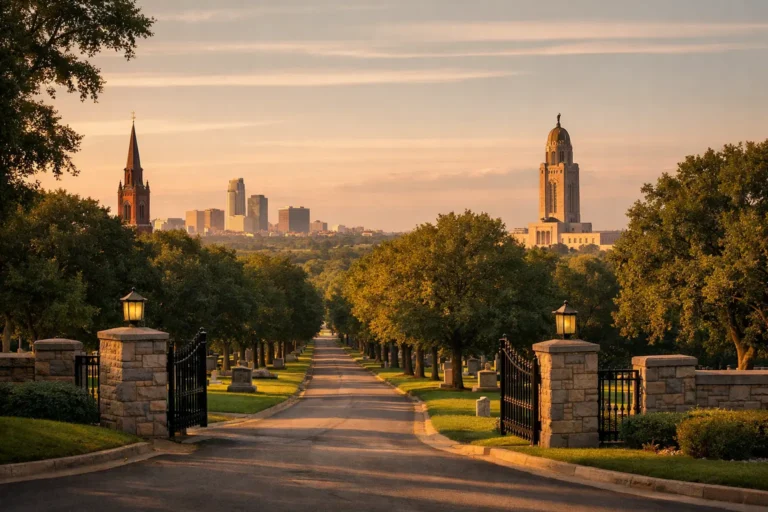
Nebraska’s 1.96 million residents stretch from the Missouri River bluffs of Omaha through the farmland of the Platte Valley to the cattle country of the Sandhills and the High Plains of the Panhandle. The state’s senior population is concentrated in the Omaha and Lincoln metros, but rural counties across central and western Nebraska often carry a higher share of residents over 65 — a pattern that shapes how families plan for funeral costs and burial insurance across the state. This page covers statewide funeral pricing, Nebraska’s insurance regulations, and every county we serve, from Douglas and Lancaster in the east to Scotts Bluff and Cheyenne in the Panhandle.
Funeral and Cremation Costs in Nebraska
Nebraska sits below the national median on most major funeral and cremation expenses. The NFDA’s regional price surveys place Nebraska among states — alongside Arizona, Colorado, Idaho, Montana, Nevada, and South Dakota — where an adult burial with viewing and ceremony costs around $7,400, a few hundred dollars under the national median. Prices still vary widely across the state, with the Omaha and Lincoln metros showing the tightest competition and the western Panhandle and Sandhills counties carrying the highest transportation and provider-scarcity costs.
Statewide averages
Costs below reflect 2025–2026 pricing from NFDA data, Nebraska funeral home General Price Lists, and state-level cost surveys.
| Service | Typical Nebraska cost | National median (2023 NFDA) |
|---|---|---|
| Traditional funeral with viewing and burial | $7,000 – $9,500 | $8,300 |
| Full-service cremation (viewing and ceremony) | $5,500 – $7,500 | $6,280 |
| Direct cremation | $1,070 – $2,700 | ~$1,900 |
| Immediate (direct) burial, no viewing | $3,200 – $4,500 | — |
| Burial plot | $1,200 – $3,000 | — |
| Headstone or grave marker | $1,000 – $2,500 | — |
| Burial vault | $1,500 – $1,700 | $1,695 |
The NFDA’s 2023 General Price List Study reported a national median of $8,300 for a funeral with casket and burial and $6,280 for a funeral with cremation including an alternative casket and urn. Nebraska families typically come in below both benchmarks, though neither figure includes cemetery, monument, or cash-advance costs like flowers and obituaries.
Regional cost variation within Nebraska
Nebraska’s pricing splits cleanly along population density and provider supply. The Omaha and Lincoln metros host the state’s most competitive cremation market — direct cremation in the Omaha area starts around $1,070 through low-cost providers, while full-service funeral homes in the same metros can list direct cremation at $2,500 to $3,600 or more. Burial pricing in Omaha and Lincoln cemeteries sits at the higher end of the statewide range because urban plot costs are elevated.
Outstate Nebraska — the Panhandle, Sandhills, and agricultural counties of the Platte Valley and northeast — shows a different pattern. Fewer providers mean less competition, and funeral homes in small communities often serve multiple counties, which can push transportation charges higher. Burial plot costs, however, are typically lower in rural cemeteries than in Omaha or Lincoln, so the total bill for a traditional burial in outstate Nebraska often lands close to metro pricing despite the transportation premium.
What drives Nebraska’s costs
Several state-specific factors shape pricing. Nebraska’s rural-urban split is unusually sharp — roughly half the state’s population lives in the Douglas, Sarpy, and Lancaster county footprint, while the remaining 90-plus counties cover vast, low-density territory where funeral home consolidation has been the norm for decades. Cremation adoption in Nebraska has historically run below the national rate, which keeps traditional burial services a larger share of the market than in coastal or mountain states. Cost-of-living is moderate statewide, and cemetery costs — particularly in rural church and community cemeteries — remain among the lowest in the country. Final expense insurance and burial insurance policies in Nebraska are typically written in the $10,000 to $25,000 range, which covers most traditional funeral scenarios the state produces.
Final Expense Insurance Regulations in Nebraska
Nebraska regulates life insurance — including final expense and burial insurance policies — through the Nebraska Department of Insurance under Chapter 44 of the state statutes. The rules that matter most to seniors buying small whole life coverage are the state’s free look period, grace period, replacement protections, and the separate Burial Pre-Need Sale Act that governs prepaid funeral contracts. Together, these protections give Nebraska policyholders a clearer path to cancel, replace, or transfer coverage without losing money.
The Nebraska Department of Insurance
The Nebraska Department of Insurance (NDOI) is headquartered in Lincoln and regulates every company and agent selling life insurance in the state. The department regulates the life insurance industry under Chapter 44 of the state statutes, and the Life and Health Division reviews policy forms, rates, and advertising before any insurer can sell a product to Nebraska residents. The department also maintains a consumer complaint hotline — 877-564-7323 in-state — and publishes each insurer’s licensing status and complaint history online at doi.nebraska.gov.
Free look period
All life insurance policies issued in Nebraska must include at least a 10-day free look period, excluding credit life plans. The free look period lets you terminate your coverage without paying any termination fees and receive a refund for any premiums paid, and you can return your policy for any reason during that window. For final expense policies — which are often purchased by seniors over the phone or through in-home agent visits — this window gives the policyholder a chance to review the full contract after delivery and cancel if the terms do not match what was explained at application.
Grace period and premium protection
Nebraska life insurance companies must allow a grace period of at least a month for life insurance products, which ensures enrollees don’t lose their coverage if they make premium payments late. Companies can charge interest up to 6% per annum on late premium payments and can deduct outstanding premiums plus accrued interest from any payouts claimed before settling the missed payment. For a senior on a fixed income, the 31-day grace period is a meaningful protection against an accidental lapse — a common cause of lost coverage when a bank draft fails or a monthly bill is missed.
Replacement rules
Nebraska has adopted replacement regulations modeled on the NAIC standard, which matters for seniors who already own a policy and are considering a new one. Nebraska Title 210, Chapter 19 regulates the activities of insurers and producers with respect to the replacement of existing life insurance and annuity contracts, and establishes minimum standards of conduct to be observed in replacement transactions or financed purchases. In practice, this means an agent proposing to replace an existing policy must provide a written notice comparing the old and new coverage, and the existing insurer has the right to contact the policyholder before the transaction closes. Replacement rules are especially important for final expense buyers who may already own a small whole life policy from decades earlier.
Contestability and suicide clauses
Under Nebraska law, life insurance policies become incontestable two years after issue, meaning the insurance provider can’t contest a claim after this time unless the policyholder fails to pay premiums. The standard two-year contestability window applies to final expense policies, and most carriers also include a two-year suicide clause. Insurers must pay the death benefit if the insured misstated their age on the initial application, though they can adjust the payout to reflect what would have been received for the premiums paid at the correct age.
Graded death benefit policies
Final expense policies sold to older applicants or those with health issues are often written as graded death benefit products — coverage that pays a limited benefit during the first two policy years and the full face amount thereafter. Nebraska does not prohibit graded policies, but the NDOI requires that benefit limitations be clearly disclosed on the policy’s cover page and application. Any policy restricting the death benefit in the first two years must spell out the reduced payout schedule and the circumstances under which the full benefit applies.
Prompt claim payment
Nebraska statute 44-3,143 requires that if a life insurer does not pay a death claim within 30 days of receiving proof of loss, the insurer must pay interest at the rate in effect on January 1 of the calendar year in which the proof of loss was submitted. For final expense beneficiaries — usually a surviving spouse or adult child trying to cover a funeral bill — this rule creates financial pressure on insurers to pay claims quickly rather than delay.
Guaranty Association protection
The Nebraska Life and Health Insurance Guaranty Association is a non-profit association created by state statute to provide protection to Nebraska residents who own or are beneficiaries of covered life insurance, health insurance, or annuity contracts issued by an insurer that becomes insolvent. The maximum death benefit coverage is set at $300,000, and the maximum loss of surrender value coverage is limited to $100,000. Most final expense policies fall well within these limits, giving Nebraska policyholders a statutory backstop if their carrier fails.
Prepaid funeral contracts — a separate regulatory track
Final expense insurance and prepaid funeral plans are different products with different regulatory homes. Burial life insurance pays cash to a named beneficiary; a prepaid funeral contract pays a specific funeral home for specific goods and services arranged in advance. In Nebraska, prepaid funeral agreements are governed by the Burial Pre-Need Sale Act (Neb. Rev. Stat. § 12-1101 et seq.), which requires that prepaid funeral funds be placed either in a trust or in an insurance policy naming the funeral home as beneficiary — two safeguards designed to prevent misuse or loss of funds. Pre-need sellers must file annual reports with the NDOI and are subject to state licensing and bonding requirements. Seniors comparing the two options should understand that funeral insurance gives a family cash flexibility, while a prepaid contract locks in specific services at today’s prices — each has a place in Nebraska estate planning, and each is regulated separately.
Funeral and Burial Laws in Nebraska
Nebraska funeral and burial law is split across several statutes — Chapter 71 of the Revised Statutes covers vital records and cremation, Chapter 38 contains the Funeral Directing and Embalming Practice Act, and Chapter 12 governs cemeteries and prepaid burial contracts. The Department of Health and Human Services oversees most of this through its Vital Records office and the Board of Funeral Directing and Embalming. Nebraska is one of a small number of states where a licensed funeral director must be involved in every disposition, which shapes nearly every decision a family makes after a death.
Death certificate filing
Nebraska uses a two-part death certificate process. The funeral director and embalmer in charge of the funeral must fill out the personal details on the death certificate and file it within five business days after the death. The attending physician, physician assistant, or nurse practitioner has 24 hours from the time of death to complete the medical section of the death certificate, which states the cause of death, electronically. If there was no attending medical professional, the funeral director and embalmer must refer the case to the county attorney. Nebraska uses electronic death registration for most deaths, though some paper records are still used. Certified copies are ordered through Nebraska Vital Records in Lincoln and cost $16 per copy. Most families need between five and ten certified copies to handle insurance claims, bank accounts, Social Security, and property transfers.
Burial permits and funeral director supervision
Nebraska is stricter than most states on who can supervise a burial. All Nebraska burials, even home burials, must be supervised by a licensed funeral director under 172 Neb. Admin. Code, ch. 68, § 005. Interment, disinterment, or reinterment of a dead human body must be performed under the direct supervision of a licensed funeral director and embalmer. This is a meaningful difference from states that allow fully family-directed burials — a Nebraska family planning a home funeral or private-land burial still has to contract with a funeral director for the disposition itself.
Embalming rules
Nebraska regulations require a body to be embalmed only if the death was due to a communicable disease, unless the body was encased immediately after death in a 20-gauge steel hermetically sealed container. Refrigeration is allowed for up to eight days, after which the body must be buried, cremated, embalmed, or placed in a hermetically sealed container within 24 hours of removal from refrigeration. Embalming is almost never legally required — funeral home policies, not state law, are what typically push families toward it for viewings or visitations. Families who want to skip embalming can usually do so as long as they accept refrigeration and reasonable timing constraints.
Cremation authorization and timing
Cremation in Nebraska requires both a county-issued permit and a signed authorization from the legally responsible person. Before any dead human body may be cremated, a cremation permit must first be signed electronically by the county attorney, or by an authorized representative designated by the county attorney in writing, in the county where the death occurred. A cremation authorization form must be signed by the authorizing agent and must include notification of whether the death occurred from a disease declared by the department to be infectious, contagious, communicable, or dangerous to the public health, the name of the authorizing agent and their relationship to the deceased, and a representation that the authorizing agent is aware of no objection to cremation from any person who has a right to control the disposition of the remains.
Nebraska does not impose a fixed statutory waiting period before cremation in the way some states do, but practical timing is controlled by paperwork and refrigeration rules. Under 172 Neb. Admin. Code, ch. 69, § 006, if a crematory does not have refrigeration, un-embalmed human remains must be cremated within 24 hours from the time the funeral home received the human remains. Crematories with holding facilities can retain remains longer while paperwork is completed.
Who has the right to control disposition
Nebraska law sets a clear order of priority for who can authorize burial or cremation. Under Neb. Rev. Stat. § 30-2223, a person can name a designated agent in writing during their lifetime; absent that, the right of disposition passes to the surviving spouse, then adult children, then parents, then siblings, and down a defined chain. In the event of a dispute regarding the right of disposition, a funeral establishment, cemetery, or crematory authority is not liable for refusing to accept the remains or complete final disposition until it receives a court order or a written agreement signed by the parties in disagreement. This is a meaningful protection for seniors who want their wishes honored — a written designation of agent takes priority over family disagreement.
Home funerals
Home funerals are legal in Nebraska in the sense that a family can hold a viewing, visitation, or service at home with the body present. What Nebraska does not allow is fully family-managed disposition. Nebraska is one of the states where the minimum services of a funeral director must legally be employed — the funeral director must submit the required permits and oversee the committal of the disposition, though families can still conduct their own home death care.
Burial at sea and scattering ashes
Nebraska is landlocked, so ocean burial at sea is not a Nebraska-specific issue — families who want this option work with a provider on the coast under federal EPA rules. For scattering cremated remains in Nebraska waterways, the Clean Water Act governs scattering in inland waters such as rivers or lakes, and a permit from the state agency that manages the waterway may be required. Scattering on private property is generally legal with the landowner’s permission, and scattering on public land depends on the managing agency.
Green burial and aquamation
Nebraska does not currently have any laws or regulations allowing alkaline hydrolysis, also called water cremation or aquamation. Green burial is legal in Nebraska — there is no statute prohibiting biodegradable caskets, shrouds, or vault-free burials — but infrastructure is limited. Bellevue became the first Nebraska city to offer a natural burial option through its city cemetery committee, and John A. Gentleman Mortuaries in Omaha offers green funeral services with biodegradable coffins. Nebraska families interested in full conservation burial grounds often look to neighboring states — Iowa, Missouri, and Colorado have more established green burial infrastructure.
The Nebraska Board of Funeral Directing and Embalming
The Funeral Directing and Embalming Practice Act (Neb. Rev. Stat. §§ 38-1401 to 38-1432) is administered by the Nebraska Board of Funeral Directing and Embalming, which sits within the Department of Health and Human Services Licensure Unit. The board licenses funeral directors, embalmers, apprentices, funeral establishments, branch establishments, and crematory authorities. It also handles consumer complaints against funeral homes — a separate track from the Nebraska Department of Insurance, which handles complaints against insurance carriers selling final expense policies.
Regions and Major Metros in Nebraska
Nebraska is most easily understood through its east-to-west geographic gradient. The eastern third of the state — anchored by Omaha and Lincoln — is where roughly three in five Nebraskans live. Move west along Interstate 80, and the state transitions through the Platte Valley agricultural belt, into the Sandhills ranching country of the north-central region, and finally into the Panhandle, where the landscape rises into the High Plains and shifts to Mountain Time. Nebraska’s 2024 state population reached 2,005,465, with roughly 40 percent living in Douglas and Sarpy Counties alone — the state’s two smallest counties by land mass. That population concentration shapes everything from funeral pricing to insurance availability across Nebraska’s 93 counties.
Named regions of Nebraska
Nebraska has no single official regional map, but a consistent framework appears across state agencies, tourism publications, and University of Nebraska research. The five regions below are the ones most commonly used to describe the state.
The Eastern Corridor and Metro Region. The Missouri River bluffs and the Omaha-Lincoln metro axis. This is Nebraska’s economic and population center, home to Berkshire Hathaway, Mutual of Omaha, Union Pacific, and the University of Nebraska-Lincoln. Urban and suburban, with the state’s best-developed healthcare and funeral infrastructure.
Northeast Nebraska. Rolling farm country running from the Missouri River west through Norfolk and Columbus. Mixed agriculture, meatpacking, and small-to-midsize communities. Home to the Omaha, Winnebago, Ponca, and Santee Sioux tribal communities.
The Platte Valley and South-Central Nebraska. The I-80 corridor from Grand Island through Kearney and on to North Platte. Irrigated corn and soybean country, with the Platte River as its spine. The 90-mile stretch from Lexington to Chapman — often called the Big Bend — is the region’s agricultural heart, and the river itself is internationally known as a spring stopover for sandhill cranes.
The Sandhills. A region of mixed-grass prairie on grass-stabilized sand dunes in north-central Nebraska covering just over one-quarter of the state, designated a National Natural Landmark in 1984. Sparse population, vast cattle ranches, and some of Nebraska’s lowest population densities. Ranching remains the basis of the Sandhills economy, with the majority of the area devoted to rangeland supporting roughly one-third of the state’s beef cattle.
The Panhandle. The western part of the state, comprising 11 counties with a combined land area of 14,181 square miles, or about 18.45 percent of Nebraska’s total land. Includes the Pine Ridge, the Wildcat Hills, Scotts Bluff National Monument, and Chimney Rock. Several western Panhandle counties observe Mountain Time, including Scotts Bluff, Banner, Kimball, Cheyenne, Sioux, and portions of Morrill and Garden counties.
Counties by region
This is the structural payoff of the section — where each Nebraska county sits within the state’s regional framework. Groupings below reflect the most commonly used definitions from the Nebraska State Education Association’s Panhandle District, the Nebraska Association of County Officials, and University of Nebraska regional research.
| Region | Counties |
|---|---|
| Eastern Corridor / Metro | Douglas, Sarpy, Lancaster, Washington, Cass, Saunders, Seward, Otoe |
| Northeast Nebraska | Dakota, Dixon, Cedar, Knox, Wayne, Thurston, Burt, Pierce, Madison, Stanton, Cuming, Dodge, Colfax, Platte, Boone, Antelope |
| Southeast Nebraska | Nemaha, Richardson, Johnson, Pawnee, Gage, Jefferson, Thayer, Saline, Fillmore, York, Butler, Polk, Nuckolls |
| Platte Valley / South-Central | Hall, Buffalo, Dawson, Lincoln, Adams, Hamilton, Howard, Merrick, Phelps, Kearney, Harlan, Franklin, Webster, Clay, Gosper, Furnas, Red Willow, Hitchcock, Dundy, Chase, Hayes, Frontier, Perkins |
| Sandhills / North-Central | Cherry, Brown, Rock, Keya Paha, Boyd, Holt, Wheeler, Garfield, Loup, Blaine, Custer, Valley, Greeley, Sherman, Nance |
| Panhandle | Sioux, Dawes, Box Butte, Scotts Bluff, Banner, Kimball, Morrill, Sheridan, Garden, Cheyenne, Deuel, Arthur, Grant, Hooker, Thomas, Logan, McPherson, Keith |
Some Sandhills counties (Cherry, Grant, Hooker, Thomas, Arthur, McPherson, Logan) are classified by the NACO Panhandle District and other state agencies with the Panhandle for administrative purposes, and we reflect that grouping above. Regional boundaries in Nebraska are not rigid — the Sandhills as an ecological region overlaps with both the north-central plains and the northern Panhandle.
Top metros in Nebraska
Nebraska has four metropolitan statistical areas as defined by the U.S. Office of Management and Budget, plus a cluster of micropolitan areas that anchor outstate communities. About 58.9 percent of the state’s population lives in the Grand Island, Lincoln, and Omaha MSAs, while 55.5 percent of all square miles in Nebraska are considered frontier and remote.
| Metro | 2024 Population | Counties (Nebraska side) |
|---|---|---|
| Omaha-Council Bluffs MSA | 1,001,010 | Douglas, Sarpy, Washington, Cass, Saunders |
| Lincoln MSA | 350,626 | Lancaster, Seward |
| Sioux City MSA (NE portion) | 145,994 total | Dakota, Dixon |
| Grand Island MSA | 77,278 | Hall, Hamilton, Howard, Merrick |
| Scottsbluff micropolitan | ~36,000 | Scotts Bluff |
| North Platte micropolitan | ~34,000 | Lincoln County |
| Norfolk micropolitan | ~52,000 | Madison, Stanton |
The Omaha metro grew by 1.2 percent from 2023 to 2024 to reach 1,001,010 across its eight counties — Douglas, Sarpy, Washington, Cass, and Saunders in Nebraska plus Mills, Pottawattamie, and Harrison in Iowa. Lincoln’s metro of Lancaster and Seward Counties grew by a similar 1.2 percent to 350,626, while Grand Island’s four-county metro grew to 77,278.
Senior population patterns
Nebraska’s senior demographics are distinctive and matter for final expense insurance planning. As of 2020, 15.7 percent of the state population was 65 and over, a 17 percent increase from 2010. While the population is aging statewide, the percentage of residents over age 65 exceeded 20 percent in 60 counties and exceeded 25 percent in 26 of those counties. The split is sharp: in 2010, 21 percent of the population in Nebraska’s 53 most sparsely populated counties was 65 or older, compared to just 10.4 percent in the three most densely populated counties of Douglas, Lancaster, and Sarpy.
This rural skew shapes the burial insurance market. Thurston County has a low of 27 percent of its population age 50 and older, while Keya Paha County reaches a high of 54 percent age 50+. Rural Sandhills and Panhandle counties carry some of the highest senior population shares in the state, while the Omaha and Lincoln metros skew younger. Nebraska does not have a single large retirement-destination region comparable to Florida’s or Arizona’s, but Scottsbluff, Kearney, Grand Island, and Norfolk all serve as regional hubs where outstate retirees cluster as they downsize from farms and ranches into town.
Veterans and military presence
Offutt Air Force Base in Sarpy County — home of U.S. Strategic Command — is Nebraska’s largest military installation and a major factor in the Bellevue and Papillion communities. Veteran retirees concentrate in the Omaha metro, but every Nebraska county has a meaningful veteran population, and Nebraska’s burial insurance market often works in coordination with the U.S. Department of Veterans Affairs burial benefit and the Nebraska Veterans Cemetery system. Final expense policies in Nebraska frequently supplement VA burial allowances, which cover only a portion of modern funeral costs.
Counties We Serve in Nebraska
Palmetto Mutual serves seniors and families across every county in Nebraska, from Douglas and Sarpy in the Omaha metro to Sioux and Scotts Bluff in the Panhandle. The directory below lists all 93 Nebraska counties alphabetically. Each county has its own local page with county-specific funeral home pricing, cemetery costs, and burial insurance information for residents of that area.
York County
Adams County
Antelope County
Arthur County
Banner County
Blaine County
Boone County
Box Butte County
Boyd County
Brown County
Buffalo County
Burt County
Butler County
Cass County
Cedar County
Chase County
Cherry County
Cheyenne County
Clay County
Colfax County
Cuming County
Custer County
Dakota County
Dawes County
Dawson County
Deuel County
Dixon County
Dodge County
Douglas County
Dundy County
Fillmore County
Franklin County
Frontier County
Furnas County
Gage County
Garden County
Garfield County
Gosper County
Grant County
Greeley County
Hall County
Hamilton County
Harlan County
Hayes County
Hitchcock County
Holt County
Hooker County
Howard County
Jefferson County
Johnson County
Kearney County
Keith County
Keya Paha County
Kimball County
Knox County
Lancaster County
Lincoln County
Logan County
Loup County
Madison County
McPherson County
Merrick County
Morrill County
Nance County
Nemaha County
Nuckolls County
Otoe County
Pawnee County
Perkins County
Phelps County
Pierce County
Platte County
Polk County
Red Willow County
Richardson County
Rock County
Saline County
Sarpy County
Saunders County
Scotts Bluff County
Seward County
Sheridan County
Sherman County
Sioux County
Stanton County
Thayer County
Thomas County
Thurston County
Valley County
Washington County
Wayne County
Webster County
Wheeler County
Frequently Asked Questions

About the Author
Dvir Mosche is an award-winning independent insurance agent and the founder of Palmetto Mutual, a trusted insurance brokerage specializing in Final Expense Life Insurance. Since entering the industry in 2017, he has been recognized multiple times as a top agent for his dedication to educating and assisting seniors in finding the proper coverage. His mission is to simplify the process, provide honest and personalized guidance, and ensure that every client gets coverage they can depend on for life.


