
Home > New Mexico
Final Expense Insurance in New Mexico — Coverage for Seniors Across the Land of Enchantment
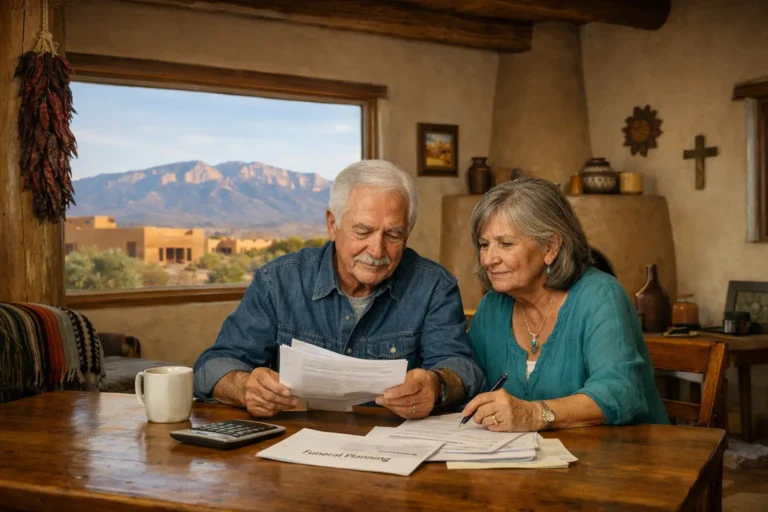
New Mexico sits apart from its neighbors — a state shaped by three cultures, high desert elevation, and communities that stretch from the Rio Grande corridor through the Navajo Nation and down to the oil country of the Permian Basin. Final expense insurance planning here means accounting for realities most states do not face: long distances between rural counties and the nearest funeral home, older Hispanic and Native American families with deep traditions around funerary rites, and retiree enclaves in Santa Fe and Las Cruces where cost of living runs well above the statewide average. Burial insurance gives New Mexico seniors — from Albuquerque’s North Valley to small villages in the Sangre de Cristos — a straightforward way to cover funeral costs without leaving the bill to family.
Funeral and Cremation Costs in New Mexico
Funeral pricing in New Mexico varies more by geography than in most states, largely because of how spread out the state is. The figures below reflect statewide and regional averages drawn from the National Funeral Directors Association, published New Mexico General Price Lists, and consumer funeral pricing surveys. County-specific costs are covered on each county page.
Statewide averages
The table below summarizes typical 2025–2026 costs for the four main service types New Mexico families choose, compared against national medians from the NFDA’s most recent General Price List Study.
| Service Type | New Mexico Range | New Mexico Typical | National Median (NFDA) |
|---|---|---|---|
| Traditional full-service burial | $6,500 – $10,000+ | ~$8,350 (before cemetery) | $8,300 |
| Full-service cremation (with viewing/ceremony) | $4,000 – $7,500 | ~$5,588 | $6,280 |
| Direct cremation (no service) | $995 – $2,500 | ~$1,140 | ~$1,924 |
| Immediate burial (no embalming or viewing) | $1,995 – $3,500 | ~$2,500 | varies |
Cemetery costs — plot, opening and closing the grave, and a grave marker — are not included above and typically add $1,500 to $2,500 for a traditional burial, pushing a full traditional funeral in New Mexico closer to $9,000 or more. Direct cremation is the most common low-cost option, and New Mexico’s statewide average sits below the national average, partly because several Albuquerque-area providers publish direct cremation pricing under $1,200.
Regional cost variation within the state
New Mexico’s geography drives real price differences between regions. The Rio Grande corridor — where most of the population lives — has the most providers and the most price competition. Outside that corridor, costs climb because fewer providers serve larger distances.
| Region | Representative Areas | Cost Pattern |
|---|---|---|
| Central Rio Grande Corridor | Albuquerque, Rio Rancho, Los Lunas, Belen | Most competitive pricing; direct cremation starting near $995 |
| Santa Fe & North Central | Santa Fe, Los Alamos, Española, Taos | Higher than statewide average; full-service cremation averaging around $6,048 in Santa Fe |
| Southern New Mexico | Las Cruces, Deming, Silver City | Generally lower than statewide average; direct cremation often available under $1,000 |
| Southeastern (Permian Basin) | Roswell, Hobbs, Carlsbad, Clovis | Moderate pricing, limited provider count; full-service cremation often starting around $4,000 |
| Four Corners & Northwest | Farmington, Gallup, Grants, tribal lands | Longer transport distances raise totals; fewer providers per capita |
| Mountain & Rural Counties | Catron, Harding, De Baca, Hidalgo | Highest effective costs due to mileage and limited local options |
Cost drivers unique to New Mexico
Several state-specific factors affect what New Mexico families actually pay for final arrangements, regardless of the service type chosen.
Distance and transportation matter more here than in most states. New Mexico is the fifth-largest state by area with one of the lowest population densities in the country, and many rural counties have no funeral home within their borders. Transfer mileage from place of death to the funeral home, and sometimes on to a crematory in Albuquerque or Las Cruces, can add hundreds of dollars to the total.
Medical Examiner involvement is common in unattended deaths. New Mexico operates a centralized Office of the Medical Investigator in Albuquerque, and deaths referred there carry an $85 handling fee plus potential delays before release. A required cremation permit adds roughly $230 to cremation totals statewide.
Cost of living creates a Santa Fe premium. Santa Fe County’s higher real estate and wage costs push funeral home pricing above the state average, and cemetery plot costs in Santa Fe and surrounding areas tend to run higher than in Albuquerque or the southern half of the state.
Cultural preferences shape service selection. Many Hispanic Catholic families across the state choose traditional full-service burial with a rosary or vigil, which keeps average spending on burial services above the national median even as the national cremation rate climbs. Burial insurance written to match the actual cost of the service a family plans to have — rather than a generic round number — tends to protect New Mexico households more completely than underfunded policies sold on premium alone.
Final Expense Insurance Regulations in New Mexico
Life insurance sold in New Mexico — including burial insurance and final expense policies — is regulated at the state level by the New Mexico Office of Superintendent of Insurance (OSI). The rules below summarize the state-specific protections that apply when a New Mexico resident purchases a small whole life policy for funeral expenses. None of this substitutes for reading the policy itself.
The regulator
The OSI oversees every life insurance company and every licensed producer doing business in New Mexico. The agency is headed by the Superintendent of Insurance — currently Alice T. Kane — who is appointed through an independent Insurance Nominating Committee rather than elected, a structure unique among state insurance regulators. OSI’s Life and Health Division reviews every policy form and premium rate before an insurer is allowed to sell it in the state, and the division handles consumer complaints against insurers and agents. The legal framework is set out in Chapter 59A of the New Mexico Statutes (the Insurance Code) and Title 13 of the New Mexico Administrative Code.
Key consumer protections for policyholders
| Protection | New Mexico Rule |
|---|---|
| Free look period | Not mandated by state law; varies by insurer (commonly 10–30 days if offered) |
| Grace period for missed premium | 30 days of continued coverage before lapse |
| Claim payment deadline | Insurer must pay within 60 days of receiving proof of death |
| Guaranty Association coverage | Up to $300,000 death benefit and $100,000 cash value per insured if insurer becomes insolvent |
| Contestability period | Standard 2-year window during which the insurer can investigate the application for material misrepresentation |
The free look rule is the most important item on that table for New Mexico buyers to understand. Most states require insurers to give policyholders a set number of days — often 10 or 30 — to cancel a new life insurance policy for a full refund. New Mexico does not. If an insurer offers a free look anyway (many do), the company must apply it consistently to all similar policyholders, but the length and existence of the period depend entirely on the insurer’s own policy form. Before signing, a New Mexico buyer should confirm in writing what free look window applies to that specific policy.
Replacement rules
If a new final expense policy will replace an existing life insurance policy — including the use of cash value from an old policy to fund a new one — New Mexico’s replacement regulation applies. Under 13.9.6 NMAC, the agent must ask on every application whether the applicant already owns life insurance, present a written replacement notice signed by both the applicant and producer, and identify every existing policy being replaced by carrier and policy number. The replacing insurer must then notify the existing carrier within five business days so the original company can also reach out to the consumer. Withdrawals, surrenders, or policy loans used to pay premiums on a new policy within four months before or thirteen months after the new policy’s effective date are treated as presumed replacements, even if the paperwork calls the transaction something else. These rules exist specifically to slow down churning activity that harms seniors.
Graded death benefits and senior protections
Simplified-issue final expense policies sold in New Mexico commonly include a graded death benefit — a reduced payout during the first two or three policy years if death is from natural causes, returning to full benefit thereafter. New Mexico does not cap graded period length specifically, but every policy form must be filed with OSI and must clearly disclose any graded period in plain language before issue. Accidental deaths are generally paid at full face value from day one regardless of the graded period.
Seniors buying final expense insurance in New Mexico also benefit from 13.9.20 NMAC, the state’s best-interest rule for annuity sales. While this rule formally covers annuities rather than life insurance, it sets the tone OSI expects from agents working with older consumers: recommendations must be suitable to the consumer’s financial situation, producers must complete annuity-specific training, and any “financed purchase” using existing policy values must be documented.
Prearranged funeral plans are separate
Final expense insurance and prearranged funeral plans are two different products under New Mexico law. A final expense policy is a whole life insurance contract that pays cash to the beneficiary, who then chooses how to spend it. A prearranged funeral plan is a contract with a specific funeral home, governed by Chapter 59A Article 49 of the Insurance Code and typically funded through a trust or an assignment of a life insurance policy. Burial insurance gives the family flexibility — they can use any funeral home. Prearranged funeral plans lock in specific goods and services at today’s prices but tie the family to the contracted provider.
Consumers with questions or complaints about a life insurance policy, a specific carrier, or an agent’s conduct can contact OSI’s Life and Health Division directly at 1-855-427-5674 or through the complaint portal on the OSI website.
Funeral and Burial Laws in New Mexico
Funeral services in New Mexico are governed jointly by the New Mexico Board of Funeral Services (formerly the Board of Thanatopractice), which licenses funeral homes, funeral service practitioners, crematories, and direct disposers, and by the New Mexico Department of Health Bureau of Vital Records and Health Statistics, which handles death certificates and disposition permits. The rules below summarize what state law requires — full statutory citations are provided for each item.
Death certificates and disposition authority
| Topic | New Mexico Rule |
|---|---|
| Death certificate filing deadline | Within 5 days of death and before burial or cremation (NMSA § 24-14-20) |
| Who files | The funeral service practitioner, direct disposer, or person in charge of the remains |
| Cost of certified copy | $5.00 per copy (NM Vital Records, Albuquerque) |
| Access to records | Restricted to immediate family for 50 years after death (NMSA § 24-14-27) |
| Authority to authorize disposition | Surviving spouse → majority of adult children → parents → majority of siblings → other adults who played significant caregiving role → next of kin (NMSA § 45-3-701) |
New Mexico also recognizes a Designated Agent for Funeral Arrangements, which is worth noting for unmarried partners. New Mexico does not recognize common-law marriage, so unmarried partners who want authority over a loved one’s final arrangements must complete and sign a Designated Agent form with two witnesses. The form does not require notarization, but without it, the priority list above controls — and a surviving partner has no legal standing.
Burial permits
New Mexico treats burial-transit permits differently from most states. Under NMSA § 24-14-23, no burial-transit permit is required for in-state final disposition if a licensed New Mexico funeral service practitioner or direct disposer handles the body. Permits are only required when the body is transported out of state for disposition, when disposition is handled by someone other than a licensed funeral professional (for example, during a home funeral), or when an out-of-state body is brought into New Mexico for burial or cremation. The state registrar or a local registrar issues the permit.
Embalming
Embalming is not required by state law in most circumstances. Under NMSA § 61-32-20, if final disposition will not occur within 24 hours of death, the body must either be embalmed or stored under refrigeration at or below 40°F. Refrigeration satisfies the requirement, which means families who decline embalming for religious, cultural, or cost reasons can do so legally as long as the funeral home can refrigerate the body. Some funeral homes have internal policies requiring embalming for public viewings, but that is a business decision, not a legal requirement.
Cremation
Cremation in New Mexico operates under a distinctive rule: the New Mexico Office of the Medical Investigator (OMI) — not the county coroner, because New Mexico has no county coroners — issues every cremation permit in the state, regardless of whether the death was natural, accidental, or unattended. This centralizes oversight but can add time when OMI caseload is heavy or when an out-of-area death requires remote investigation.
| Cremation Requirement | New Mexico Rule |
|---|---|
| Cremation authorization form | Required; signed by legal next of kin (or Designated Agent) |
| Cremation permit | Issued by OMI to a licensed funeral service practitioner |
| Mandatory waiting period | None (typical timeline is ~3 days for paperwork) |
| Casket requirement | Not required; a rigid container (cardboard or plywood) is sufficient |
| Scattering of cremated remains | No state law prohibits it; federal rules apply on public lands, and permission is required on private and tribal lands |
Scattering deserves a specific note because of New Mexico’s geography. The Sandia Mountains, portions of the Rio Grande, and large areas of northwestern New Mexico lie within federal land or tribal jurisdiction. Scattering on Forest Service or BLM land is generally allowed without a permit but subject to agency guidance. Scattering on any of the 23 tribal nations within the state — including the Navajo Nation, the Pueblos, and the Mescalero and Jicarilla Apache reservations — requires tribal permission and may not be allowed at all depending on the nation’s cultural protocols.
Home funerals
Home funerals are legal in New Mexico. Families may take custody of a loved one’s body, care for the body at home, file the death certificate themselves, and transport the body to a cemetery or crematory without hiring a funeral home. A burial-transit permit is required when a family handles disposition themselves rather than using a funeral service practitioner. The National Home Funeral Alliance and New Mexico organizations provide practical guidance for families choosing this path.
Green burial
Green burial is legal in New Mexico, and the state is home to La Puerta Natural Burial Ground near Belen in Valencia County — currently the only Green Burial Council–certified conservation burial site in the state. La Puerta occupies roughly 40 acres at the base of the Manzano Mountains and accepts un-embalmed bodies in biodegradable shrouds, soft-wood caskets, or natural-fiber containers. Burial rights start around $450 with opening and closing fees separate. Conventional cemeteries in New Mexico may also accept vaultless burial by policy, though most require a grave liner — families pursuing green burial outside La Puerta should confirm the cemetery’s written rules before purchasing a plot.
Aquamation and human composting
Alkaline hydrolysis (aquamation, water cremation) is not legal for human remains in New Mexico as of 2026. Natural organic reduction (human composting) is also not legal in the state. Legislation has been introduced but has not advanced, so families seeking these options currently must arrange transport to a state where they are authorized. This is a meaningful limitation for New Mexico families whose end-of-life plans include these alternatives and is worth factoring into how final expense coverage is sized — out-of-state transport adds several thousand dollars to the total.
Burial of veterans
New Mexico operates two national cemeteries — Santa Fe National Cemetery and Fort Bayard National Cemetery near Silver City — along with the New Mexico Veterans’ Memorial Cemetery system managed by the state. Burial in a national cemetery is free for eligible veterans and includes the grave, opening and closing, a government headstone, and perpetual care, which meaningfully changes the sizing of final expense coverage for veteran households. Final expense insurance for a veteran and a non-veteran spouse living in the same household may reasonably be written at different face amounts for this reason.
Consumers with complaints against a funeral home, crematory, or licensed practitioner can file directly with the Board of Funeral Services at (505) 476-4622 or through the complaint portal on the RLD website.
Regions and Major Metros in New Mexico
New Mexico divides into six regions using the framework adopted by the New Mexico Economic Development Department and mirrored by the state’s tourism and transportation agencies. The regions reflect genuine differences in geography, culture, and economy — not arbitrary lines on a map — and they track closely with how funeral homes, health systems, and insurance agents organize their own coverage areas. Final expense planning looks different in the Pueblo communities of North-Central New Mexico than it does in the oil-patch towns of the Southeast, and the region framework is the cleanest way to explain why.
Named regions of New Mexico
Central is the Rio Grande corridor anchored by Albuquerque — the state’s only major metro, its largest city, and the commercial and medical hub for roughly a third of all New Mexicans. This is where most funeral homes, crematories, and cemetery options cluster, and pricing runs most competitively.
North-Central is the Santa Fe and Taos country — art colonies, Pueblo communities, the Española Valley, and the Los Alamos national laboratory corridor. Cost of living runs higher here than the state average, particularly in Santa Fe, and funeral costs reflect that.
Northwest is the Four Corners region and the New Mexico side of the Navajo Nation. Farmington is the largest population center. The region is heavily influenced by tribal jurisdictions, energy industry cycles, and long distances between towns.
Northeast is the eastern plains where the Great Plains meet the Sangre de Cristo foothills — Santa Fe Trail country, ranching country, and the most sparsely populated quadrant of the state. Las Vegas, NM and Raton anchor the region.
Southwest extends from the Mexican border up to Socorro and includes the Las Cruces metro — the state’s second-largest city — along with Silver City, Deming, and the Gila Wilderness. The Mesilla Valley and the Bootheel give the region a distinct border-state character.
Southeast covers the Permian Basin oil country, the Llano Estacado plains, and the Sacramento Mountains around Ruidoso. Roswell, Hobbs, Carlsbad, Clovis, and Alamogordo are the major population centers. Military presence at Holloman Air Force Base and Cannon AFB, along with oil and gas employment, shapes the regional economy.
How New Mexico’s 33 counties group into regions
| Region | Counties |
|---|---|
| Central | Bernalillo, Torrance, Valencia |
| North-Central | Los Alamos, Rio Arriba, Santa Fe, Taos |
| Northwest | Cibola, McKinley, San Juan, Sandoval |
| Northeast | Colfax, Guadalupe, Harding, Mora, Quay, San Miguel, Union |
| Southwest | Catron, Doña Ana, Grant, Hidalgo, Luna, Sierra, Socorro |
| Southeast | Chaves, Curry, De Baca, Eddy, Lea, Lincoln, Otero, Roosevelt |
Top metros by population
The top metros below reflect 2024 Census estimates for the municipalities themselves, not the full metropolitan statistical areas.
| Metro | City Population (2024) | County |
|---|---|---|
| Albuquerque | ~560,000 | Bernalillo |
| Las Cruces | ~117,000 | Doña Ana |
| Rio Rancho | ~112,500 | Sandoval (with small portion in Bernalillo) |
| Santa Fe | ~89,000 | Santa Fe |
| Roswell | ~47,600 | Chaves |
| Farmington | ~46,600 | San Juan |
| Hobbs | ~39,000 | Lea |
Beyond city limits, the Albuquerque Metropolitan Statistical Area — which includes Bernalillo, Sandoval, Torrance, and Valencia counties — holds roughly 918,000 residents, about one-third of the state’s population. The broader Albuquerque–Santa Fe–Las Vegas Combined Statistical Area houses around 1.17 million people, or close to 60% of New Mexico. The Las Cruces MSA (Doña Ana County) adds another 214,000, and it functions as part of a binational region with El Paso, Texas.
How counties cluster into metro areas
| Metro Area | Counties Included |
|---|---|
| Albuquerque MSA | Bernalillo, Sandoval, Torrance, Valencia |
| Santa Fe MSA | Santa Fe |
| Las Cruces MSA | Doña Ana |
| Farmington MSA | San Juan |
| Roswell Micro | Chaves |
| Hobbs Micro | Lea |
| Carlsbad-Artesia Micro | Eddy |
| Clovis Micro | Curry |
| Los Alamos Micro | Los Alamos |
State demographic patterns that shape final expense planning
New Mexico has one of the highest Hispanic population shares in the country at roughly 49% statewide, with deep-rooted Spanish colonial heritage in the North-Central region that traces back more than 400 years. Traditional Catholic funeral rites — the rosary, vigil, and full funeral Mass — remain common across Hispanic households, which keeps average spending on burial services above what cremation-dominant national figures would suggest. Burial insurance sized for a cremation-only plan will often fall short for a family that still plans to hold a traditional service.
Native American communities represent roughly 11% of the state’s population — the third-highest share of any state — spread across 23 federally recognized tribal nations including the Navajo Nation, the 19 Pueblos, and the Mescalero and Jicarilla Apache reservations. Funeral and burial customs vary significantly across these communities, and some tribes have specific protocols that affect timing, photography, disposition, and the use of funeral homes. Final expense policies work well for tribal members because the cash benefit goes directly to a named beneficiary without involving tribal trust assets or BIA processes.
The senior population share sits around 19% and is climbing — New Mexico has seen net inmigration of retirees to Santa Fe, Taos, Ruidoso, and the Las Cruces area, and net outmigration of working-age adults to neighboring states. This matters for final expense planning because the retiree inmigration tends to be higher-asset households who want smaller face-amount policies specifically for funeral costs, while the resident senior population skews toward fixed-income households who benefit most from affordable burial insurance that locks in a premium early.
Military retiree density is meaningful in specific pockets — Alamogordo (Holloman AFB), Clovis (Cannon AFB), Albuquerque (Kirtland AFB), and the White Sands Missile Range area — and veterans in these communities may qualify for burial benefits at Santa Fe National Cemetery or Fort Bayard National Cemetery, which changes how much final expense coverage a household actually needs.
Counties We Serve in New Mexico
Palmetto Mutual works with New Mexico families across every county in the state. Each county below has its own dedicated page covering local funeral home pricing, cemetery options, veteran burial benefits, and final expense insurance considerations specific to that area. Use the directory to find the page for your county.
Valencia County
Bernalillo County
Catron County
Chaves County
Cibola County
Colfax County
Curry County
De Baca County
Doña Ana County
Eddy County
Grant County
Guadalupe County
Harding County
Hidalgo County
Lea County
Lincoln County
Los Alamos County
Luna County
McKinley County
Mora County
Otero County
Quay County
Rio Arriba County
Roosevelt County
Sandoval County
San Juan County
San Miguel County
Santa Fe County
Sierra County
Socorro County
Taos County
Torrance County
Union County
Frequently Asked Questions

About the Author
Dvir Mosche is an award-winning independent insurance agent and the founder of Palmetto Mutual, a trusted insurance brokerage specializing in Final Expense Life Insurance. Since entering the industry in 2017, he has been recognized multiple times as a top agent for his dedication to educating and assisting seniors in finding the proper coverage. His mission is to simplify the process, provide honest and personalized guidance, and ensure that every client gets coverage they can depend on for life.


