
Home > Burial Insurance with Pre-Existing Conditions > High Cholesterol
Final Expense Insurance with High Cholesterol

If you have high cholesterol and are looking into final expense insurance, here’s the short version: it rarely stands in your way. High cholesterol is one of the most common health conditions among older adults, and most carriers treat it as a routine part of the application rather than a red flag. This guide walks through whether you can qualify, how insurers actually look at high cholesterol, what you can expect to pay, and how to secure the best rate and coverage available to you.
Can you get final expense insurance with high cholesterol?
Yes. High cholesterol is not a barrier to final expense insurance, and for most people it doesn’t affect coverage at all. It’s one of the most common conditions among older adults, and carriers see it on applications every day. About 86 million U.S. adults have total cholesterol over 200, and insurers expect to see it.
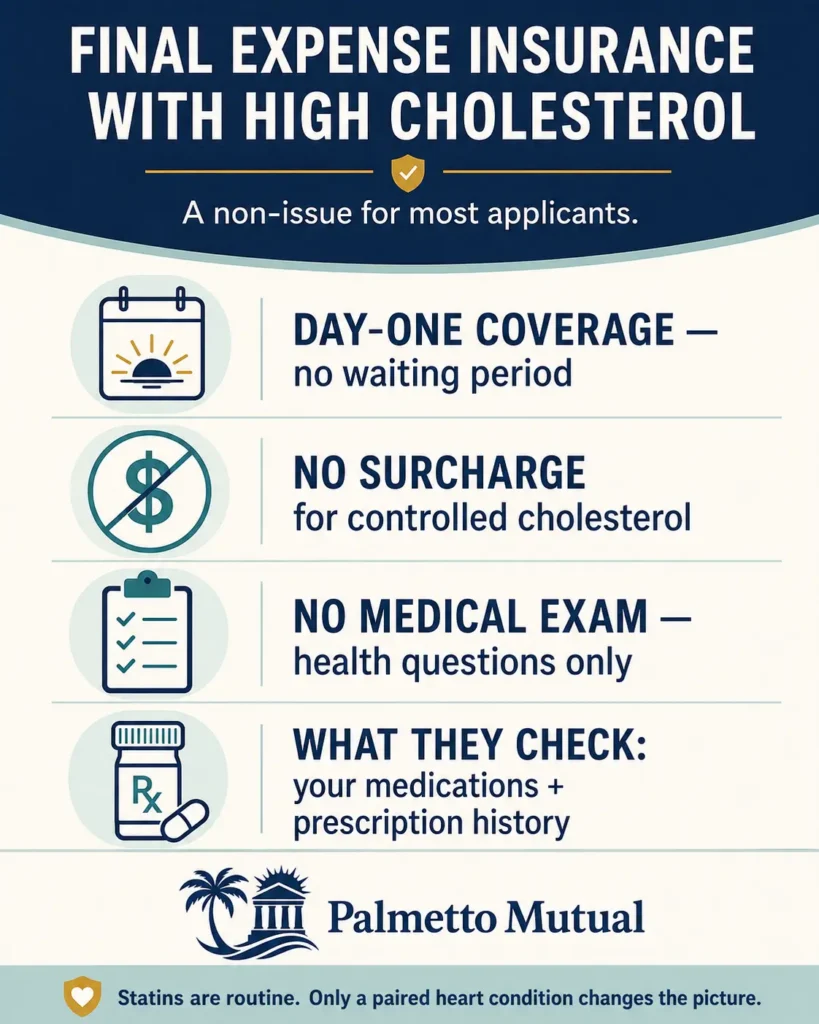
In practice, high cholesterol is a non-issue. You can expect to qualify for a carrier’s best level of coverage, with full benefits starting on day one. There’s no waiting period tied to the condition and no separate price increase just for having it.
That puts high cholesterol in the most favorable group of health conditions. Many conditions push an applicant into graded or guaranteed-issue coverage, where benefits are delayed for the first two years. High cholesterol does not. As long as it’s the main thing on your record, you’re looking at immediate, first-day coverage.
Two quick points keep this in perspective. First, carriers treat managed cholesterol — including cholesterol controlled with a statin or similar medication — as a sign you’re taking care of your health, not as a strike against you. Most people with controlled cholesterol qualify for standard rates or better, and many secure preferred pricing. Second, the picture can change if high cholesterol comes paired with a heart attack, stroke, or other cardiac history — but that’s those conditions doing the work, not the cholesterol itself.
The bottom line: if high cholesterol is your main health concern, burial insurance is well within reach, and it should land you in the top tier with coverage that pays from the start.
How carriers underwrite high cholesterol
Final expense insurance is almost always simplified issue. That means no medical exam, no blood test, and no lipid panel. There’s no nurse visit and no blood or urine sample — you answer a short set of health questions instead. So the cholesterol “ratios” used in traditional life insurance never come into play here.
Instead, carriers build their picture of your high cholesterol from two places: the yes/no health questions on the application, and a check of your prescription history.
On the application, high cholesterol rarely even gets its own knockout question. It’s usually grouped with other common, controlled conditions. If you have high blood pressure or high cholesterol managed with medication, you generally qualify for standard coverage with the full death benefit once you pay your first premium.
Look-back periods work the same way. There’s no waiting window tied to cholesterol itself. The look-back windows carriers care about are for cardiac events — and those belong to other conditions. What final expense carriers really watch for are “knockout” events like a stroke or heart attack within the last 12 to 24 months. If none of those are on your record, high cholesterol stays a non-issue.
Carriers confirm your medications through a prescription history check, often paired with a review of MIB records. The mechanics of how that check works — and what shows up in it — are covered on our prescription history guide, so we won’t repeat them here. What matters for this page is which cholesterol medications carriers notice, and what each one tells them.
Medications underwriters watch for with high cholesterol
Your prescription list is a quiet signal. Most cholesterol medications tell a carrier you’re managing the condition responsibly. A few point to something more — usually not the cholesterol itself, but a heart condition sitting underneath it.
Here’s how the common ones read to an underwriter:
| If you take | Common names | What it signals |
|---|---|---|
| A statin | atorvastatin (Lipitor), rosuvastatin (Crestor), simvastatin (Zocor), pravastatin, lovastatin | Routine, well-managed cholesterol. The most expected medication of all. No concern on its own. |
| A cholesterol absorption blocker | ezetimibe (Zetia), or a statin-and-ezetimibe combination | Your cholesterol needed a bit more than a statin alone. Still ordinary, still well within day-one coverage. |
| A newer injectable or add-on | PCSK9 inhibitors — Repatha (evolocumab), Praluent (alirocumab), inclisiran (Leqvio); or bempedoic acid (Nexletol) | A stronger signal. These are usually reserved for cholesterol that resisted standard treatment, inherited (familial) high cholesterol, or people who already have heart disease. |
That last group is the one to understand clearly. PCSK9 inhibitors are typically added only when high-dose statins plus ezetimibe haven’t brought cholesterol down, or for patients with established cardiovascular disease. The medication isn’t what concerns an underwriter — what they’re really asking is whether a heart condition is the reason you’re on it. If it’s purely treatment-resistant or familial cholesterol with no cardiac history, you can still land in good standing.
If you take one of these medications and want to understand how it’s viewed on its own, each links out to its dedicated medication guide. (Routing note for post-production: link statins, ezetimibe, and PCSK9 inhibitors to their respective medication spokes; this section is not built to rank for “[medication] life insurance.”)
The takeaway for burial insurance: a statin — or even a statin plus ezetimibe — is background noise. A PCSK9 inhibitor isn’t a strike against you either, but it’s the one prompt for the honest conversation about whether anything else is on your heart record.
Best companies and what you’ll pay with high cholesterol
For a condition this routine, the question isn’t really which companies accept high cholesterol — almost all of them do, at their best level of coverage. So “best company” here is less about getting approved and more about price and about the edges of your health picture.
Where carriers actually separate themselves is when high cholesterol travels with something else. If your cholesterol is controlled with medication, most carriers will still give you their best rates — but every carrier weighs a paired condition like a recent heart event differently, which is what makes comparing them worthwhile. One company’s standard approval can be another company’s graded plan for the exact same record.
That’s why shopping more than one carrier matters even for an easy condition. An independent agent can match your specific profile — your medications, and any cardiac history — to the carrier that treats it most favorably.
What you’ll pay
Here’s the part that matters most: high cholesterol adds nothing to your premium on its own. Taking medication for high blood pressure or cholesterol usually won’t even move the needle on your price.
Your rate is set by the same handful of factors that apply to everyone, not by your cholesterol:
| What sets your price | Effect |
|---|---|
| Age | The single biggest factor. Rates are locked in at the age you apply and never rise. |
| Gender | Women generally pay less than men for the same coverage. |
| Tobacco use | A large increase — often 30% to 50% more. |
| Coverage amount | More death benefit means a higher premium. |
Because high cholesterol keeps you in level, day-one coverage, you avoid the two costs that hit harder cases. Guaranteed issue policies cost more per dollar of coverage and carry a two-to-three-year waiting period before the full benefit pays — a penalty you don’t take on when you qualify for a level plan. The only time your cost changes is if cholesterol comes paired with a recent heart attack or stroke — and that’s those conditions setting the price, not the cholesterol.
How to get the best rate and coverage with high cholesterol
Since high cholesterol already puts you in line for level, day-one coverage, getting the best rate isn’t about overcoming the condition. It’s about keeping your application clean, making sure nothing else drags your tier down, and landing with the carrier that fits your full health picture.
A little preparation goes a long way. Before you apply, have these ready:
- Your full medication list, with the name and dose of each cholesterol medication
- What each medication treats, so anything beyond cholesterol is clear up front
- A sense of your recent doctor visits and refill history, which shows your cholesterol is being managed consistently
That last point quietly works in your favor. Steady refills and regular checkups tell a carrier your cholesterol is controlled — and controlled is exactly what earns the best rate.
Be straightforward on the application
Honesty is the simplest tool you have. Carriers verify your medications through a prescription history check, so anything left off the application tends to surface anyway. Prescription history is always double-checked.
There’s no upside to downplaying high cholesterol, and there’s a real downside to misstating your health. If a carrier finds a material misrepresentation during the early contestability window, it can deny the claim and simply refund the premiums — but an honest application means the full benefit is paid. With a condition this routine, full disclosure costs you nothing and protects your family.
The levers that actually move your rate
For high cholesterol, a few things make a real difference:
| Lever | Why it helps |
|---|---|
| Disclose your statin or other medication plainly | It signals active management, which carriers read as a positive, not a negative. |
| Avoid tobacco | The single biggest factor you control — tobacco can raise a premium by 30% to 50%. |
| Let an independent agent shop carriers | Matters most if cholesterol is paired with any cardiac history, where carriers diverge sharply. |
If a recent heart attack, stroke, or other cardiac event sits alongside your high cholesterol, timing becomes the deciding factor in whether you get day-one coverage or a waiting period. The mechanics of how waiting periods work are covered on our no-waiting-period guide, and the question of whether a condition can lead to a decline is covered on our can-you-be-denied guide. For high cholesterol on its own, neither is a concern — funeral insurance is well within reach, and the best rate is mostly a matter of an honest application and the right carrier.
Keep Reading







About the Author
Dvir Mosche is an award-winning independent insurance agent and the founder of Palmetto Mutual, a trusted insurance brokerage specializing in Final Expense Life Insurance. Since entering the industry in 2017, he has been recognized multiple times as a top agent for his dedication to educating and assisting seniors in finding the proper coverage. His mission is to simplify the process, provide honest and personalized guidance, and ensure that every client gets coverage they can depend on for life.


