
Home > Burial Insurance with Pre-Existing Conditions > No Waiting Period Burial Insurance
No Waiting Period Burial Insurance: How to Qualify

Many burial insurance policies make you wait two or three years before they pay the full death benefit. But not everyone has to accept that wait — a lot of people can qualify for coverage that pays in full from the very first day. This guide explains what the waiting period is, who tends to get stuck with one, and the steps you can take to qualify for day-one coverage instead.
What a Waiting Period Is and Why It Exists
A waiting period is the stretch of time at the start of a policy when burial insurance will not pay the full death benefit if you die from natural causes. It usually lasts two years, though some carriers run it three. The clock starts on the day your policy is issued, not the day you apply.
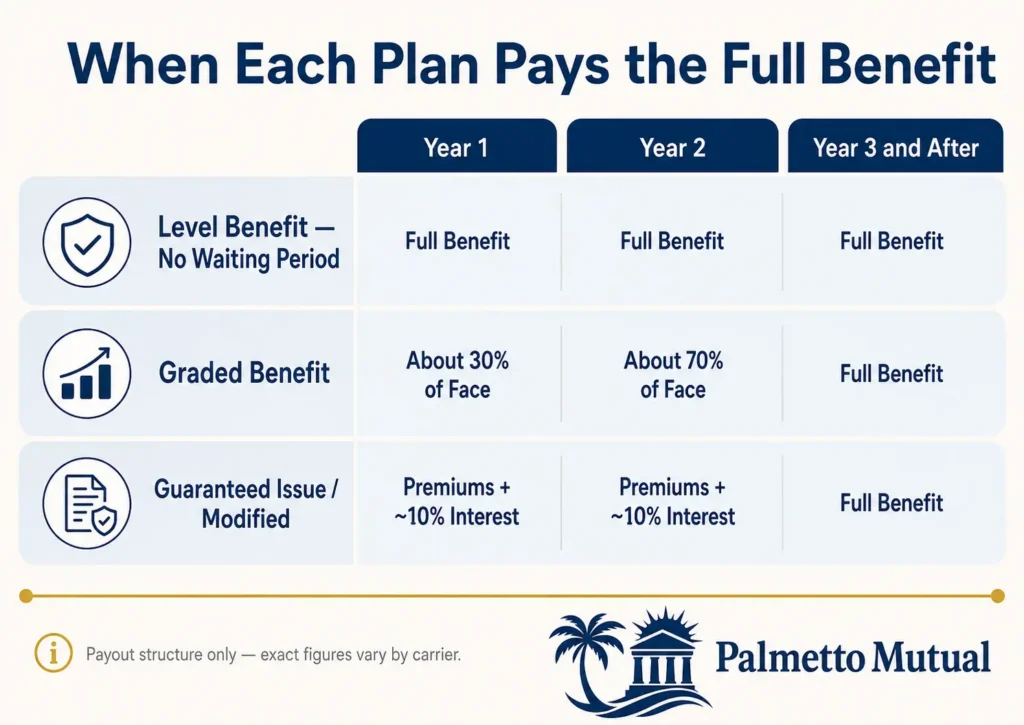
During this window, the policy pays your family a reduced amount instead of the full face value. Carriers use one of two structures to decide that reduced amount.
The two structures work like this:
| Structure | What your family gets in years 1–2 | Common name |
|---|---|---|
| Return of premium plus interest | Every dollar you paid in, plus interest (often around 10%) | Modified benefit |
| Stepped percentage | A growing slice of the face amount — roughly 30% in year 1, 70% in year 2 | Graded benefit |
Here is what that means in real dollars. Say you hold a $15,000 modified policy and pass away from natural causes in year one after paying $1,200 in premiums.
Your family would receive about $1,320 — your $1,200 back plus roughly 10% interest — not the full $15,000. With a level benefit policy and no waiting period, the same death would pay the full $15,000.
After the waiting period ends, both structures pay 100% of the face amount for any cause of death. The limit only applies during those first couple of years.
So why does the waiting period exist at all? The main reason is something carriers call anti-selection, or adverse selection.
Anti-selection is the risk that someone who knows they are seriously ill will buy a policy at the last minute and pass away right after the first payment. The waiting period protects the carrier — and, in turn, every other policyholder — from that imbalance.
It helps to know that the waiting period is not the same as the contestability period, even though both run about two years. The contestability period is a window where the carrier can investigate and deny a claim if you were untruthful on the application.
The waiting period, by contrast, is a built-in limit on the payout amount written right into the contract. One is about honesty on the application; the other is about the structure of the benefit itself. The next section covers who tends to land in one of these waiting-period plans in the first place.
Who Ends Up With a Waiting Period
Not everyone who buys funeral insurance gets a waiting period. Whether you do comes down to your health history and the specific carrier you apply with.
The good news is that many common conditions do not trigger a wait at all. When a condition is controlled and stable, most carriers still offer day-one, level coverage.
Conditions that usually still allow day-one coverage include:
- Controlled high blood pressure or high cholesterol
- Type 2 diabetes that is well managed, without major complications
- Sleep apnea treated with a CPAP machine
- A past heart event from years ago that has stayed stable
- Past tobacco use that meets the carrier’s time guidelines
What tends to push someone into a graded, modified, or guaranteed-issue plan is a condition that is recent, severe, or unstable. Timing matters as much as the diagnosis itself — a heart attack ten years ago is read very differently than one last year.
Conditions that commonly trigger a waiting period:
| Condition | Why it often forces a wait |
|---|---|
| Recent or active cancer treatment | Carriers measure from your last treatment date; recent treatment usually means graded or guaranteed issue |
| Congestive heart failure | A serious, ongoing condition many carriers treat as a knockout |
| COPD requiring oxygen | Mild COPD may still get day-one; oxygen use raises the risk |
| Insulin-dependent diabetes with complications | Complications like kidney issues or amputations shift the rating |
| Dialysis / end-stage renal disease | Generally limits you to guaranteed issue |
| Stroke, aneurysm, or recent serious cardiac event | Often pushes an applicant into a modified plan |
| Dementia or nursing-home confinement | Typically guaranteed issue only |
The single most important thing to understand is that carriers do not agree with one another. One company may grade a condition that another covers from day one.
That difference is exactly why shopping matters, and the next section walks through how to qualify for day-one coverage instead.
How to Qualify for Day-One Coverage Instead
Here is the good news that most of this page builds toward: a waiting period is not the only path. Many people can qualify for a level benefit policy, which pays the full death benefit from the very first day.
The goal is simple. You want a policy that pays in full from day one, and you want to avoid being placed into a graded, modified, or guaranteed-issue plan with a waiting period.
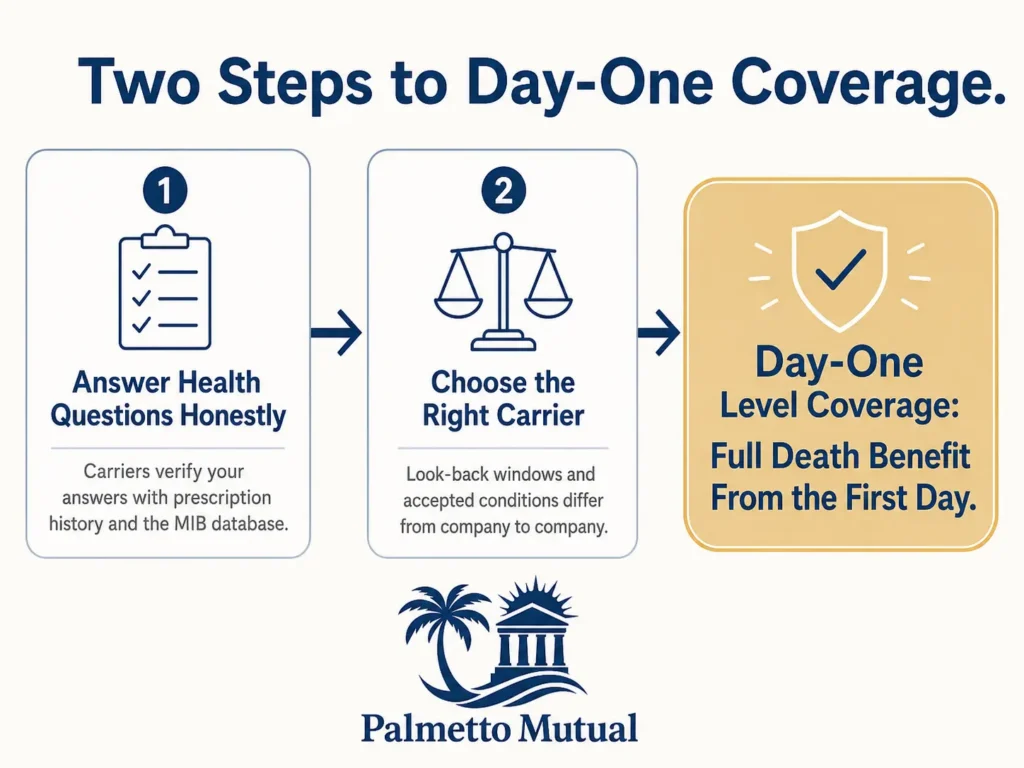
Getting there comes down to two things you can control: telling the truth on your application, and applying with the right carrier for your health. The two sections below cover each one.
Answer the Health Questions Honestly
A level benefit final expense policy does not require a medical exam, but it does ask health questions. Your answers decide which plan you qualify for and whether your coverage starts on day one.
Carriers do not simply take your word for it. They check your prescription history and your file with the Medical Information Bureau, or MIB, to confirm your answers.
This is why honesty protects you. If you say you do not have a condition but your prescription record shows medication for it, the carrier sees the gap right away.
Worse, an inaccurate answer can come back to hurt your family. If the carrier later finds you left something out, it can deny the claim during the first two years and refund only your premiums instead of paying the full benefit.
Honest answers do the opposite. They let the carrier match you to the right plan the first time, which is how stable, well-managed conditions still earn day-one coverage.
Choose the Right Carrier
This is the step most people miss. Carriers do not agree on what triggers a waiting period, so the company you pick can be the difference between waiting two years and being covered today.
The same condition can land you in very different plans depending on where you apply. Look-back windows are a common example.
| Health detail | Carrier A | Carrier B |
|---|---|---|
| Cancer treatment 3 years ago | Asks about the last 4 years — graded | Asks about the last 2 years — day-one |
| COPD, no oxygen | Places you in a graded plan | Offers level coverage |
| A specific maintenance medication | Will not accept it for day-one | Accepts it for day-one |
Because rates and rules vary so widely, applying to a single company is a gamble. One carrier might quote a much higher price, or attach a wait, while another covers you in full for less.
This is where an independent agent helps. Working with someone who can compare many carriers at once — rather than a captive agent tied to one company — lets you find the carrier that views your health most favorably, often over a simple phone call. That is the core of how Palmetto Mutual works on your behalf.
Accidental Death During the Waiting Period
There is one important exception to the waiting period, and it is worth knowing. Even on a graded or guaranteed-issue burial insurance policy, accidental death usually pays the full death benefit from day one.
The waiting period applies to death from natural causes — illness and disease. It does not usually apply to accidents.
So if someone with a two-year graded policy dies in a car accident in month three, their family typically receives the full face amount, not just a refund of premiums.
There is a catch, and it matters. The word “accident” is defined narrowly in the policy, and the definition varies by carrier.
Some companies build accidental coverage into the base policy, while others offer it as an add-on called an accidental death benefit rider. Because the wording and timelines differ, it is wise to confirm exactly how your policy handles accidents before you buy.
Two other limits apply no matter which policy you hold. Most policies will not pay for suicide during the first two years, and the contestability clause still lets the carrier review your application for accuracy during that same window. These are separate from the natural-cause waiting period and apply even to day-one level plans.
Frequently Asked Questions
Keep Reading






About the Author
Dvir Mosche is an award-winning independent insurance agent and the founder of Palmetto Mutual, a trusted insurance brokerage specializing in Final Expense Life Insurance. Since entering the industry in 2017, he has been recognized multiple times as a top agent for his dedication to educating and assisting seniors in finding the proper coverage. His mission is to simplify the process, provide honest and personalized guidance, and ensure that every client gets coverage they can depend on for life.


