
Final Expense Insurance When You’re on Oxygen

If you use supplemental oxygen, you can still qualify for final expense insurance — but the kind of plan you’ll get and what you’ll pay depend on why you’re on oxygen and how well your health is managed. This guide covers whether you’ll be approved, how insurance companies look at oxygen use, which carriers tend to be most flexible, and what coverage typically costs. It also walks through the simple steps that help you land the best rate available for your situation.
Can you get final expense insurance if you’re on oxygen?
Yes. Being on oxygen does not block you from getting final expense insurance. These small whole life policies are built for seniors with health issues, so oxygen by itself will not get you turned away.
What changes is the kind of plan you’ll most likely qualify for. And that comes down to one question every underwriter asks first: why are you on oxygen?
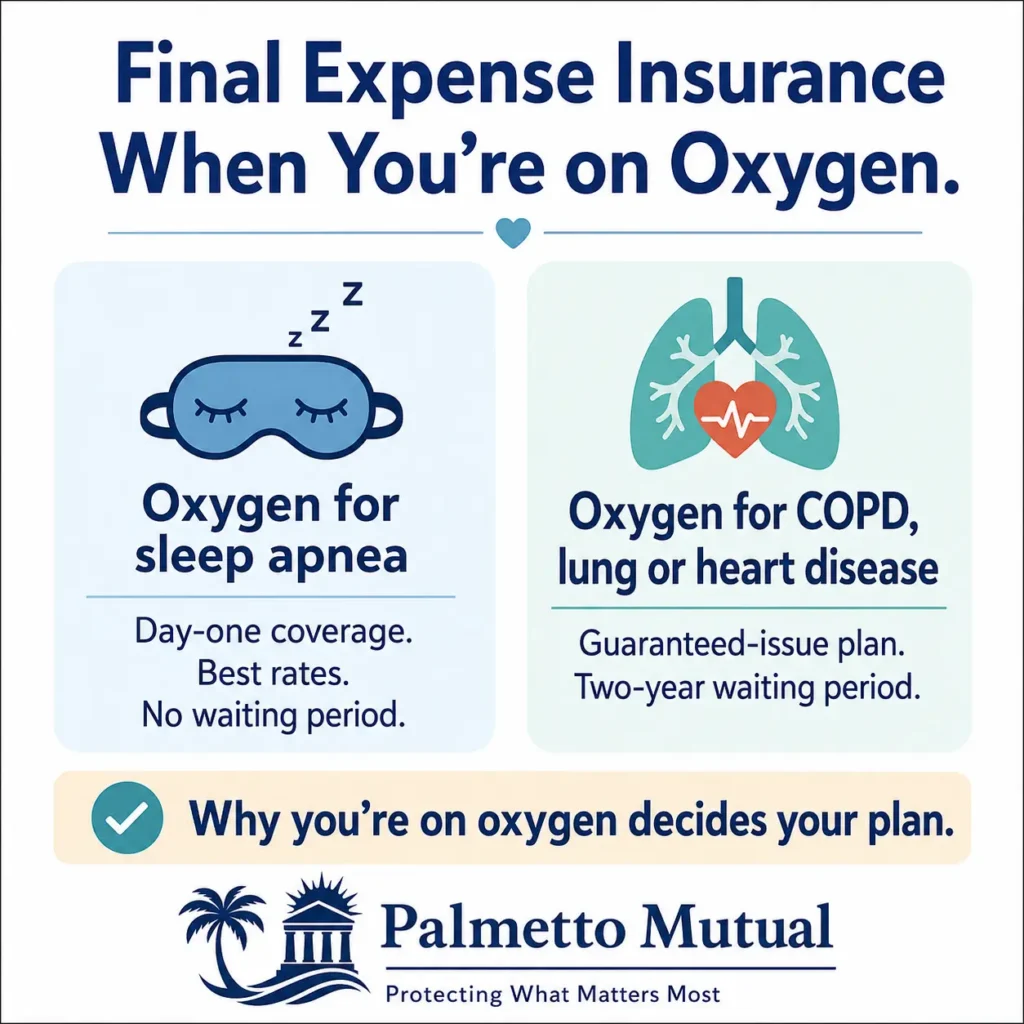
For most people on home oxygen — usually tied to COPD, emphysema, or a heart-related lung condition — day-one coverage is off the table. You can still get a burial insurance policy, but it will typically be a guaranteed-issue plan with a two-year waiting period.
A waiting period means that if you pass away from natural causes in the first two years, your family gets your premiums back plus interest instead of the full benefit. After two years, the full amount is paid.
There is one important exception. If your oxygen is prescribed only for sleep apnea, several carriers will offer their best plan with no waiting period and their lowest rate.
Here’s the bottom line at a glance:
| Why you’re on oxygen | What you can usually expect |
|---|---|
| Sleep apnea only | Day-one coverage, lowest rates, no waiting period |
| COPD, emphysema, or heart-related lung disease | Guaranteed-issue plan with a two-year waiting period |
One more thing worth knowing: being prescribed home oxygen counts even if you rarely use the tank. Underwriters go by the prescription on record, not how often you reach for it.
How carriers underwrite oxygen use
Final expense insurance has no medical exam. Instead of bloodwork or a nurse visit, the carrier reviews a short set of health questions, your prescription history, and the MIB, which is a shared record of past insurance applications.
Almost every application asks about oxygen directly. The wording is plain, usually something like “Are you currently prescribed oxygen for a lung or respiratory disorder?” or “In the past 24 months, have you needed oxygen equipment to help you breathe?”
Many applications ask a separate question about nebulizer use too, since that points to the same kinds of lung conditions.
Timing matters. Most carriers focus on a recent window, often the last 12 to 24 months, and your options tend to widen the longer it has been. One longtime agency notes that many companies only look at oxygen use in the past year, so once you pass that mark, more doors open.
The exact look-back window is set by each carrier and differs from company to company. That is why two insurers can look at the same person and reach very different decisions.
What the carrier is really measuring is severity. Oxygen is one of the biggest dividing lines in their guidelines, because it usually points to a more advanced lung or heart condition.
Alongside oxygen, they weigh recent flare-ups, hospital stays, and how stable your health has been. The steadier your record looks, the better your odds and your rate.
Your prescription history fills in the rest of the story, often before you say a word. How that prescription check and the MIB actually work is covered on our prescription history page. Here, the point that matters is what your medications signal about your oxygen use.
Medications underwriters watch for when you’re on oxygen
Carriers read your medication list like a map. Certain prescriptions tell them why you are likely on oxygen, and how serious the underlying condition is, even if you never bring it up.
Here is how the common ones tend to be read. Find the ones you take to see what they usually point to:
| Medication group | Common examples | What it usually signals |
|---|---|---|
| Daily maintenance inhalers | Spiriva, Trelegy, Symbicort, Advair, Breo | An ongoing lung condition like COPD that is being managed day to day |
| Rescue and flare-up treatments | Oral steroids (prednisone), frequent nebulizer use, repeat antibiotics | Recent flare-ups, or a condition that is not fully stable |
| Heart-related medications | Diuretics such as furosemide (Lasix), plus other heart-failure drugs | The oxygen may be tied to a heart condition, which carriers weigh heavily |
| Advanced lung-disease drugs | Pirfenidone (Esbriet), nintedanib (Ofev) | A serious, progressive lung disease such as pulmonary fibrosis |
A daily maintenance inhaler on its own is the gentlest signal. It simply shows a condition that is being controlled.
Oral steroids like prednisone, frequent nebulizer treatments, or repeat antibiotic courses raise more questions, because they suggest your condition has been flaring. Our page on steroids and prednisone goes deeper into how carriers read those.
Heart-failure medications shift the picture the most. If your oxygen is connected to congestive heart failure rather than your lungs, day-one coverage is much harder to get, and a waiting-period plan is the usual result.
Some people on oxygen also take blood thinners, often after a blood clot in the lungs. Those carry their own underwriting story, which we cover on our blood thinners page.
The takeaway is simple. It is rarely one single drug that decides your outcome. Carriers look at the whole combination to judge how advanced your condition is, and that is what shapes which burial insurance plan you are offered.
Best companies and what you’ll pay when you’re on oxygen
There is no single “best” company for everyone on oxygen. The right carrier depends on why you use oxygen, what else is happening with your health, and which insurer happens to be most forgiving about your exact situation.
One thing stays true across the board. The companies that treat oxygen users best almost never sell straight to the public. The household names advertised on TV, the ones you can buy online or by mail, tend to either turn down oxygen users or offer a high-priced plan with a two-year wait.
The more flexible carriers sell only through independent agents who can shop your health across many companies at once. That matters a great deal here, because two insurers can look at the very same person and land 40 to 60 percent apart on price.
When it comes to oxygen specifically, a good carrier is one that does two things: it asks the right follow-up question about why you use oxygen, and it offers a real day-one plan for sleep apnea users instead of lumping everyone into a waiting period. For oxygen tied to lung or heart disease, only a small number of carriers will even consider day-one coverage, which is exactly why comparing them is worth the effort.
Here is the cost reality, framed around the two paths from earlier in this guide:
| Your situation | Plan type | Cost shape | Waiting period |
|---|---|---|---|
| Oxygen for sleep apnea only | Level, best-rate whole life | Priced like a healthy applicant, with no oxygen surcharge | None |
| Oxygen for COPD, emphysema, or heart disease | Guaranteed issue or graded benefit | Higher premium to offset the added risk | Two years |
A guaranteed-issue plan costs more for a simple reason. The carrier is accepting you without health questions, so it builds that extra risk into the price.
During the two-year window, some plans return your premiums plus interest if you pass from natural causes, while others pay a rising share of the benefit, often around 30 percent in year one and 70 percent in year two before reaching the full amount. Accidental death is usually covered in full from day one.
The good news is that whatever rate you lock in stays put. Funeral insurance premiums on these whole life plans never increase, even if your health changes later.
Most people in this situation choose between about $7,500 and $15,000 in coverage, enough to handle a funeral, which runs roughly $8,000 to $12,000 for a traditional burial in 2026, plus a small cushion.
Your exact premium depends on your age and the coverage amount you pick.
How to get the best rate and coverage when you’re on oxygen
Being on oxygen narrows your choices, but a few simple steps can still move you toward a better plan and a lower price. Most of it comes down to preparation and honesty.
The single most useful thing you can do is be clear about why you use oxygen. An underwriter who sees “oxygen” with no explanation tends to assume the worst case. If yours is prescribed only for sleep apnea, make sure that reason is stated plainly, because it can be the difference between day-one coverage and a two-year wait.
From there, these steps tend to help the most:
| What to do | Why it helps |
|---|---|
| Gather your records | Recent notes showing your condition is stable and well managed work in your favor |
| Apply when you’re steady | If you’ve just had a flare or hospital stay, options usually improve once you’ve been stable for a while |
| List every medication | Carriers check prescription records, so a complete, accurate list prevents delays |
| Compare many carriers | Each company asks different questions and prices oxygen differently |
Honesty here is not just the right thing to do, it protects your family. Carriers confirm your answers against prescription databases and shared insurance records, so downplaying oxygen use or leaving out a hospital stay can cause a claim to be denied later.
Working with an independent agent is the other big lever. One carrier’s application may ask directly about oxygen, while another asks only whether you’ve been in the hospital recently. An agent who knows which company asks what can point you toward the one most likely to say yes.
If a waiting period turns out to be your only path, that is not a dead end, and it helps to understand exactly how those plans pay out. Our no-waiting-period page walks through how the timing works.
And if you have already been turned down somewhere, don’t take it as the final word. One company’s decline says very little about your odds with the next. Our page on whether you can be denied explains what is really going on and what to do about it.
Finally, choose a coverage amount that matches what your family will truly need rather than the most you can qualify for. For most people, a final expense insurance policy in the middle range covers a funeral with a little left over and keeps the monthly premium comfortable.
Keep Reading







About the Author
Dvir Mosche is an award-winning independent insurance agent and the founder of Palmetto Mutual, a trusted insurance brokerage specializing in Final Expense Life Insurance. Since entering the industry in 2017, he has been recognized multiple times as a top agent for his dedication to educating and assisting seniors in finding the proper coverage. His mission is to simplify the process, provide honest and personalized guidance, and ensure that every client gets coverage they can depend on for life.


