
Home > Burial Insurance with Pre-Existing Conditions > Sarcoidosis
Final Expense Insurance with Sarcoidosis

Living with sarcoidosis raises a fair question: can you still qualify for final expense insurance, and what will it cost? This guide answers that directly — how carriers underwrite sarcoidosis, the application questions and medications they weigh, which companies tend to be most lenient for this condition, and what you can do to secure the best rate and coverage.
Can you get final expense insurance with sarcoidosis?
Yes. Sarcoidosis is one of the easier health conditions to get covered, and most people who have it qualify for the best kind of plan.
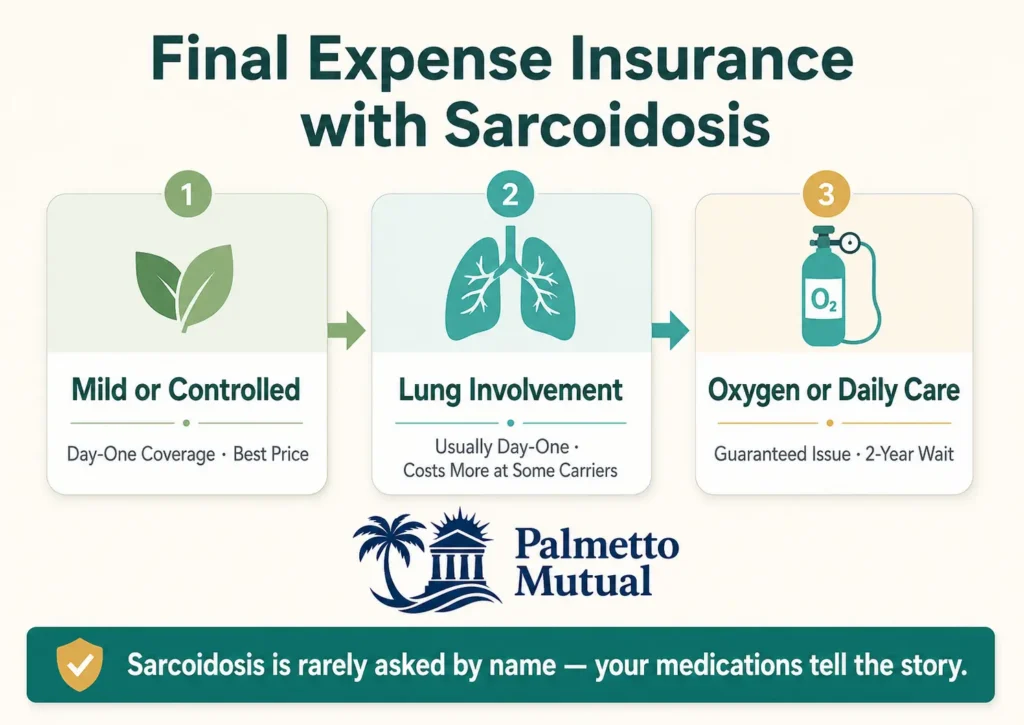
For the majority of applicants, sarcoidosis lands in the top tier. Multiple final expense insurance companies offer no-waiting-period coverage at their lowest price for this condition. That means day-one coverage — your policy pays in full from the very first day — with no extra charge added just because you have sarcoidosis.
This holds true for people with mild or controlled sarcoidosis who take their medication as prescribed and have no other serious health problems.
The picture only changes when sarcoidosis becomes severe or spreads. A few specific situations can move you to a guaranteed-issue plan, which comes with a waiting period instead of immediate protection.
Here is where most people land:
| Your situation | What you can usually get |
|---|---|
| Mild or controlled sarcoidosis, no other major health problems | Day-one coverage at the best price |
| Sarcoidosis plus everyday managed conditions (like high blood pressure) | Day-one coverage, usually still the best price |
| Sarcoidosis that requires home oxygen | Guaranteed-issue plan with a waiting period |
| Sarcoidosis affecting the brain or nervous system, or that requires daily help at home | Guaranteed-issue plan with a waiting period |
The two exceptions come from how carriers treat oxygen and daily-care needs, not from sarcoidosis itself. Being prescribed home oxygen (outside of sleep apnea) pushes you into a waiting-period plan, and most carriers apply a waiting period when someone receives home health care.
So the honest bottom line is a reassuring one. For most seniors, having sarcoidosis does not stand in the way of affordable burial insurance with immediate coverage. The rest of this guide covers how companies review your file, which ones tend to be most forgiving, and how to secure the lowest rate.
How carriers underwrite sarcoidosis
Here is the part that surprises most people: sarcoidosis is rarely asked about by name. Scan a typical final expense application and you usually won’t find the word anywhere. The Foresters PlanRight application, for example, names Parkinson’s, lupus, liver disease, kidney disease, and chronic lung conditions — but not sarcoidosis.
So the condition enters underwriting through two side doors instead: a short list of knockout questions, and the electronic check of your medications.
The application questions that matter
Carriers don’t ask about sarcoidosis. They ask about the things severe sarcoidosis can lead to. These are the questions that decide your tier:
| Application question | Why it matters for sarcoidosis |
|---|---|
| Do you use oxygen equipment to help you breathe (other than for sleep apnea)? | Prescribed home oxygen forces a waiting period — this is the biggest single knockout for pulmonary sarcoidosis |
| Do you need help bathing, dressing, eating, taking medication, or using the bathroom? | A “yes” here makes you ineligible for the day-one plan |
| Do you live in or been advised to enter a nursing home, or receive hospice or home health care? | Another knockout that removes immediate-coverage options |
| Do you use a wheelchair or scooter because of an ongoing illness? | Counts against you when it stems from a chronic disease |
| Any chronic lung condition? | Some applications group lung conditions broadly, so pulmonary sarcoidosis can trip this question at certain carriers and move you to a higher-priced (but still day-one) tier — this varies by company |
If you can answer “no” to all of these, sarcoidosis on its own does not stand in your way.
Look-back windows
Unlike a heart attack or stroke, sarcoidosis has no waiting clock of its own. There is no “wait 12 months and you’re clear” rule tied to the diagnosis, because carriers treat it as a chronic condition rather than a one-time event. The time windows that exist attach to the complications instead — a recent hospitalization or a newly started oxygen prescription, for example.
Beyond the questions, the insurer runs an electronic check of your prescription history to confirm what you’re being treated for and how intensely. How that check works, what databases it pulls from, and what to do if it flags something is covered in detail on our prescription history page.
Medications underwriters watch for with sarcoidosis
Your medication list is the real tell. Because the application rarely names sarcoidosis, your drugs are what show the underwriter how active and how serious your condition is. The general rule: the further up the treatment ladder you go — from antimalarials, to steroids, to steroid-sparing drugs, to biologics — the more serious the disease it points to.
Here is how the common sarcoidosis medications read to an underwriter, from lowest concern to highest:
| Medications | What it usually signals |
|---|---|
| Antimalarials (hydroxychloroquine/Plaquenil, chloroquine), NSAIDs, low-dose maintenance prednisone | Mild or localized sarcoidosis — often skin, joints, or minor involvement that is well controlled. The least concern. |
| Oral corticosteroids at flare doses (prednisone, methylprednisolone) | Active inflammation. A recent high dose or a taper schedule points to a recent flare — recency matters more than the drug itself. |
| Steroid-sparing immunosuppressants (methotrexate, azathioprine/Imuran, leflunomide, mycophenolate/CellCept) | Disease serious enough to need long-term immune-suppressing therapy, or steroids alone weren’t enough. More questions, but often still day-one with the right carrier. |
| Biologics (infliximab/Remicade, adalimumab/Humira) | Severe or treatment-resistant sarcoidosis, often involving the heart or nervous system. The narrowest carrier options. |
Two organ-specific signals sit outside this ladder and carry extra weight on their own: home oxygen (a sign of lung involvement) and heart-rhythm drugs or a pacemaker/defibrillator (a sign of cardiac sarcoidosis). These are read through their own knockout questions, not the medication scan.
The goal here isn’t to memorize the list. It’s to find your own medications and see roughly where you land — that tells you which tier of burial insurance to expect before you ever apply.
Best companies and what you’ll pay with sarcoidosis
There is no single “best” company for sarcoidosis. The best carrier is simply the one whose underwriting happens to line up with your version of the condition — and those rules vary a lot from one insurer to the next. This is exactly where working with an independent agent pays off, because they can compare carriers side by side instead of being stuck with one company’s rulebook.
Why leniency varies so much
Two applicants with the same diagnosis can get very different offers, because carriers weigh sarcoidosis at different pressure points:
- How they word the lung question. Some ask narrowly about COPD and emphysema; others sweep in “any chronic lung condition,” which can pull in pulmonary sarcoidosis.
- Whether home oxygen is an automatic waiting period or one of the rare exceptions. For oxygen equipment, only a small number of carriers will consider immediate coverage at all.
- How they read steroid-sparing drugs and biologics on your prescription check.
- Whether they weigh height and weight, which matters if steroids have caused weight gain.
The result: one carrier can offer day-one coverage at the best price while another routes the identical file to a waiting-period plan. One carrier might be strict about lung issues but lenient elsewhere, and another the exact opposite, which is why comparing several beats any single company’s reputation.
What you’ll actually pay
The key thing to understand about final expense pricing: your condition affects which tier you land in, not a surcharge added on top. Level and preferred plans carry the lowest possible cost, priced on your age, gender, coverage amount, and tobacco use. When controlled sarcoidosis qualifies you for that level tier, you pay the same rate as a healthy applicant of your age and gender — sarcoidosis by itself does not raise the number.
Here is how the cost reality tracks with each scenario:
| Your scenario | Tier | Cost reality |
|---|---|---|
| Mild or controlled sarcoidosis, no other major issues | Level (best) | Standard rates by age, gender, coverage, and tobacco — no surcharge for the condition |
| Pulmonary sarcoidosis caught by a broad lung question | Higher tier at some carriers | Still day-one coverage, modestly higher price at those carriers; a more lenient carrier may still write you at level |
| Home oxygen, daily-care needs, or severe organ involvement | Guaranteed issue | Higher premium plus a two-year waiting period |
That guaranteed-issue jump is real money. Industry data shows a guaranteed issue plan can run about 40% more per month than a comparable simplified issue policy — for a 70-year-old man seeking $10,000, roughly $99 versus $70 — and it pays only a refund of your premiums if you pass away during those first two years. Avoiding that jump, when your health allows, is the single biggest lever on your price.
For a rough sense of scale, final expense coverage of $10,000 averages around $30 a month for a 50-year-old woman and $38 for a man, climbing to roughly $125 and $164 by age 80. Your real number depends on your exact profile, so an average is only a starting point.
To see your actual rate instead of an average, run your details through the rate calculator below and compare day-one options across carriers.
For the full pricing breakdown, see our cost-by-coverage page for rates at each benefit amount ($5,000 through $25,000+) and our cost-by-age page for how premiums move decade by decade.
How to get the best rate and coverage with sarcoidosis
With sarcoidosis, the gap between a great plan and an overpriced one usually comes down to two things you control: how well you prepare, and which carrier you apply to. The diagnosis itself rarely stands in the way — the placement does.
Have your treatment picture ready
You won’t submit medical records for a simplified-issue burial policy, but the phone interview will ask about your history, and your answers need to match what the prescription check shows. Before you apply, know these off the top of your head:
- Your current medications and doses
- When you were diagnosed
- The date of your most recent flare or hospitalization, if any
- Whether you use oxygen, and which organs are involved
Having accurate dates for treatment, hospitalizations, and flare-ups ready strengthens your application.
What actually improves your tier
| Move that helps | Why it helps |
|---|---|
| Being stable on low-dose maintenance, or off treatment entirely | Mild, well-managed sarcoidosis reads as low risk and points to the level tier; a recent high-dose flare points the other way |
| Not using home oxygen | Clears the single biggest knockout for pulmonary sarcoidosis |
| Not using tobacco | Smoking can push your rate to two to three times the normal price and is weighed harder when your lungs are involved |
| Taking medication as prescribed and keeping regular check-ups | Underwriters favor applicants who are proactive about managing the condition |
| Comparing carriers on height and weight | If long-term steroids have changed your weight, some carriers don’t count height and weight at all — a reason to shop rather than settle |
Be accurate on the application
Answer the health questions truthfully. The insurer’s electronic prescription check already reveals your prednisone, methotrexate, or biologic, so your answers should line up with what it finds. Leaving something out can invalidate the coverage later, which defeats the entire purpose of buying it. How declines work and what happens if answers don’t match your record is covered on our can-you-be-denied page.
Match the carrier to your version of sarcoidosis
This is the biggest lever of all. Every carrier weighs conditions differently, so the same file can land at very different tiers depending on where you apply. An independent agent who knows which companies are lenient on skin-and-joint, pulmonary, or cardiac sarcoidosis can place you at the best tier the first time — and getting it right up front matters, since a decline can complicate later applications. If you do end up on a graded plan, how that waiting period works is explained on our no-waiting-period page.
Prepare your details, answer honestly, and apply with the right company, and most people with controlled sarcoidosis secure day-one funeral insurance at the lowest tier available.
Keep Reading







About the Author
Dvir Mosche is an award-winning independent insurance agent and the founder of Palmetto Mutual, a trusted insurance brokerage specializing in Final Expense Life Insurance. Since entering the industry in 2017, he has been recognized multiple times as a top agent for his dedication to educating and assisting seniors in finding the proper coverage. His mission is to simplify the process, provide honest and personalized guidance, and ensure that every client gets coverage they can depend on for life.


