
Home > Tennessee
Final Expense Insurance in Tennessee: A Statewide Guide for Seniors and Families

Tennessee stretches more than 440 miles from the Mississippi River to the Blue Ridge, and the three Grand Divisions — East, Middle, and West Tennessee — still shape how communities live, work, and plan for the end of life. The state is home to a large and growing senior population, with Nashville, Memphis, Knoxville, and Chattanooga anchoring four distinct metro economies and the Tri-Cities region along the Virginia border serving as a major retirement destination. This page walks Tennessee residents through funeral costs, insurance regulations, and burial laws that shape final expense insurance decisions across the Volunteer State.
Funeral and Cremation Costs in Tennessee
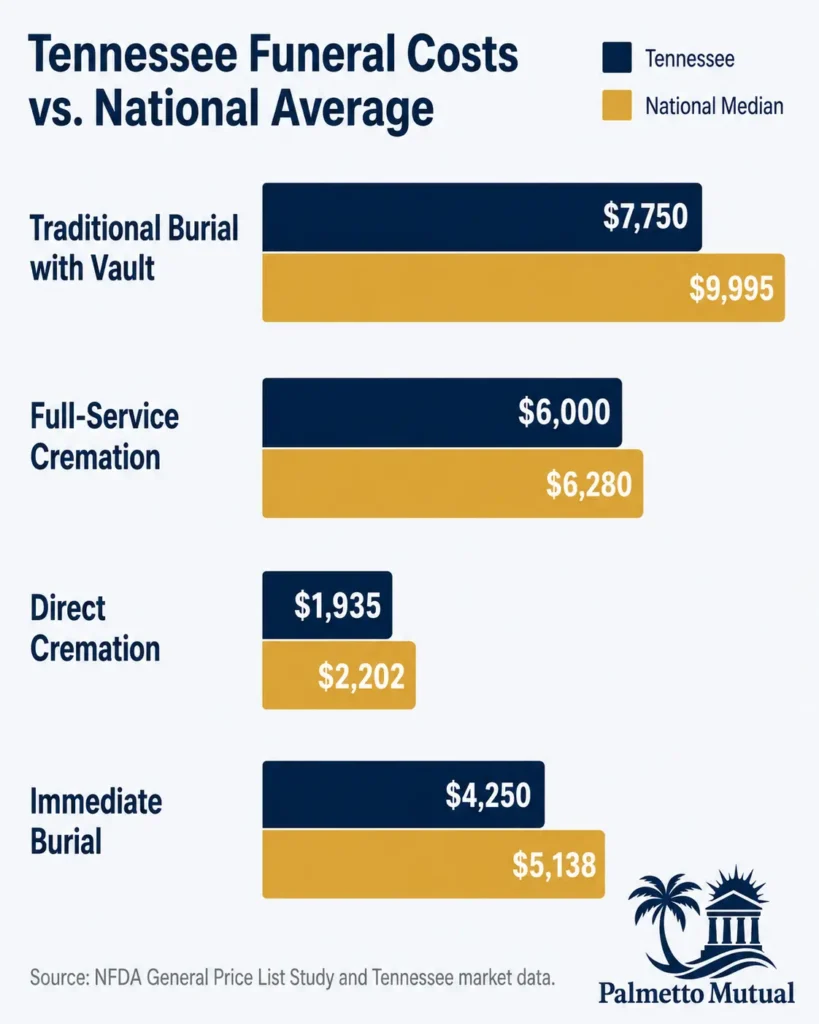
Funeral costs in Tennessee usually run slightly below the national median, but families can still see big price differences depending on where they live.
Costs vary by:
East, Middle, and West Tennessee
Urban areas like Nashville, Knoxville, Chattanooga, and Memphis
Rural counties with lower labor, facility, and cemetery costs
The figures below give Tennessee families a realistic starting point before comparing local funeral homes, cremation providers, and cemetery fees.
Statewide Averages
The most recent NFDA General Price List Study places the national median cost of a funeral with casket and burial at $8,300. When a burial vault is included, the national median rises to about $9,995.
The national median for a funeral with cremation and viewing is $6,280, while a basic direct cremation averages closer to $2,202.
Tennessee generally tracks slightly below those national numbers. Industry pricing data places the average Tennessee funeral around $6,500 to $7,000, which is lower than the broader national range of $7,000 to $12,000.
Direct cremation is much less expensive. Funeralocity’s 2026 data puts the Tennessee average for direct cremation at about $1,935, with many funeral homes offering packages between $895 and $2,500, depending on location and what is included.
| Service Type | Typical Tennessee Range | National Median |
|---|---|---|
| Traditional full-service burial | $6,500 – $9,000 | $8,300 without vault / $9,995 with vault |
| Full-service cremation with memorial | $4,500 – $7,500 | $6,280 |
| Cremation with viewing | $4,000 – $8,500 | N/A |
| Direct cremation | $895 – $2,500 | $2,202 |
| Immediate direct burial | $3,000 – $5,500 | $5,138 |
Cemetery costs are separate from funeral home charges and can change the total bill significantly.
A burial plot in Tennessee may cost as little as $250 in a small public cemetery, but several thousand dollars in a private or historic cemetery. For example, Memphis’s historic Elmwood Cemetery lists casket burials from about $1,500 to $7,000, before adding a $1,300 interment fee.
Regional Variation Across Tennessee
Tennessee’s three Grand Divisions — East Tennessee, Middle Tennessee, and West Tennessee — show clear funeral cost differences.
These differences are mostly shaped by:
Cost of living
Population growth
Urban vs. rural pricing
Local cemetery costs
Funeral home competition
Middle Tennessee has the highest funeral prices in the state. Nashville’s rapid growth and higher cost of living have pushed funeral pricing above the Tennessee average.
Families shopping in the greater Nashville area may see totals around $13,800 for a traditional funeral with a casket and outer container, before cemetery fees are added. Direct cremation in larger Middle Tennessee cities also tends to cost more, often ranging from $1,500 to $3,500.
East Tennessee generally sits in the middle of the state’s funeral cost range. This includes Knoxville, Chattanooga, and the Tri-Cities area.
Direct cremation in Knoxville averages around $1,360, while full-service cremation starts near $5,257. Chattanooga, Johnson City, Kingsport, and Bristol show similar cremation pricing, with direct cremation often landing around $1,360 to $1,375.
West Tennessee is often the most affordable region for cremation services and is generally comparable to East Tennessee for traditional funerals.
Memphis direct cremation starts around $1,282, which is among the lowest major metro prices in Tennessee. Rural West Tennessee counties may be even less expensive, especially for direct cremation and immediate burial.
| Region | Major Metros | Direct Cremation Range | Full-Service Funeral Range |
|---|---|---|---|
| East Tennessee | Knoxville, Chattanooga, Tri-Cities | $1,360 – $2,200 | $6,000 – $9,000 |
| Middle Tennessee | Nashville, Clarksville, Murfreesboro | $1,499 – $3,500 | $8,000 – $13,800 |
| West Tennessee | Memphis, Jackson | $1,282 – $2,000 | $5,500 – $8,500 |
What Drives Tennessee Funeral Costs
Several Tennessee-specific factors affect what families pay for a funeral, burial, or cremation.
Nashville’s population growth and rising cost of living have pushed Middle Tennessee funeral costs well above the state average. Funeral homes in faster-growing metro areas often face higher real estate, staffing, and operating costs.
Rural counties across all three Grand Divisions usually offer lower prices. This is especially true in the Upper Cumberland, the Cumberland Plateau, and the Mississippi Delta lowlands, where facility and labor costs tend to be lower.
Cemetery pricing is another major factor. Historic urban cemeteries in Nashville, Memphis, and Knoxville can charge premium prices for burial plots and interment. Rural church cemeteries and smaller municipal cemeteries are often much cheaper.
Tennessee also charges $15 per certified death certificate. Families usually need several certified copies to settle final affairs, which adds a small but real expense to the total cost.
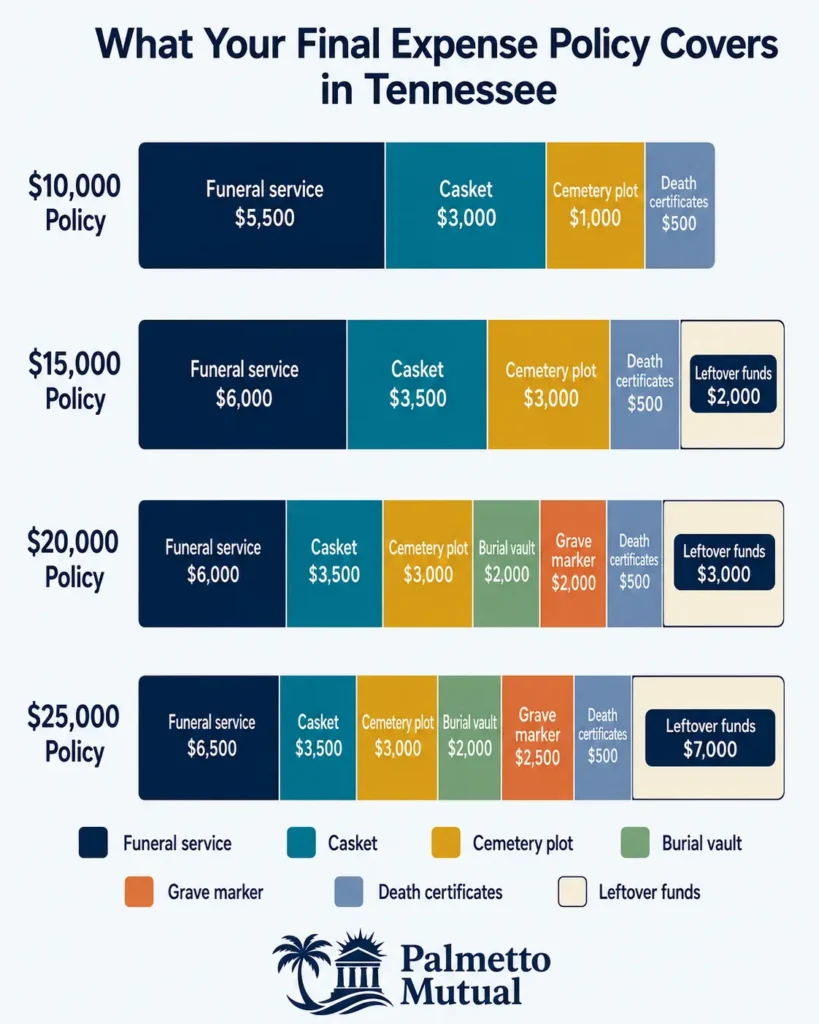
Because of these costs, burial insurance and final expense insurance policies in Tennessee are commonly sized between $10,000
Final Expense Insurance Regulations in Tennessee
Every state regulates life insurance at the state level, and Tennessee has its own rules for how burial insurance and final expense insurance policies are sold, cancelled, and paid.
These rules matter because they affect:
How long you have to review a new policy
What happens if you miss a premium payment
How quickly beneficiaries should be paid
What protections exist if an insurance company fails
What disclosures are required when replacing an old policy
Before buying a funeral insurance policy in Tennessee, seniors should understand the consumer protections built into state law.
The Tennessee Department of Commerce and Insurance
Life insurance in Tennessee is regulated by the Tennessee Department of Commerce and Insurance, often called the TDCI.
The department’s Insurance Division oversees:
Insurance company licensing
Insurance agent licensing
Life insurance policy forms
Consumer complaints
Market conduct and compliance
Tennessee life insurance laws are found in Tennessee Code Annotated Title 56, with life insurance policies governed mainly by Chapter 7.
Before buying a final expense policy, you can verify that the insurance company and agent are licensed in Tennessee through the TDCI license lookup tool on the department’s website.
Tennessee’s 10-Day Free Look Period
Tennessee provides a 10-day free look period after you receive a new life insurance policy.
During those 10 days, you can return the policy and receive a full refund with no fees or penalties.
The important detail is when the clock starts.
The 10-day window begins when you receive the physical policy, not when you sign the application.
That makes Tennessee’s free look period shorter than many other states, where buyers may get 14, 20, or even 30 days to review a policy.
For Tennessee seniors, the best advice is simple: open and review the policy as soon as it arrives.
Grace Period for Missed Premiums
Tennessee requires a 30-day grace period for missed premium payments.
That means if you miss a payment, your life insurance coverage does not immediately lapse. The policy stays in force for 30 days.
If the insured person dies during the grace period, and the claim is otherwise valid, the insurance company must still pay the death benefit.
The company may subtract the missed premium from the final payout, but the policy is still protected during that grace period.
Tennessee Death Claim Payment Rules
Tennessee also has rules for how life insurance death claims are handled.
Insurance companies have 60 days to pay a death claim to the beneficiary.
Tennessee also provides an important interest protection. If the claim is not paid within 15 days from the date of death, the insurance company must pay interest on the benefit amount.
That 15-day interest trigger is more protective than many states, where interest may not begin until after proof of loss is submitted.
For families using a final expense insurance policy to pay for funeral costs, this timing matters. Funeral homes often expect payment quickly, so beneficiaries should file the claim as soon as they have the required paperwork.
Tennessee Life and Health Insurance Guaranty Association
If a life insurance company becomes insolvent, the Tennessee Life and Health Insurance Guaranty Association helps protect policyholders.
In Tennessee, the guaranty association protects up to:
$300,000 in death benefits per person
$100,000 in cash surrender value per person
This protection applies regardless of the size or number of policies owned, subject to state rules and limits.
Most final expense insurance policies in Tennessee are much smaller than these limits. Since many burial insurance policies are between $5,000 and $35,000, the typical policy would fall well within the guaranty association’s protection limits.
Replacement Rules for Existing Policies
Tennessee has specific consumer protections when an agent recommends replacing an existing life insurance policy with a new one.
These rules are found under Tennessee Rule 0780-1-24.
A replacement can happen when a new life insurance policy is purchased and an existing policy will be:
Cancelled
Surrendered
Allowed to lapse
Reduced in value
Borrowed against
Changed in a way that affects the original coverage
When a replacement is involved, the agent must follow specific disclosure rules. These include notifying the existing insurance company, providing required comparison information, and giving the consumer time to review both policies.
These rules are designed to protect seniors from churning, which happens when an agent pushes a policy switch mainly to earn a new commission, even when the replacement may not benefit the client.
Before replacing a final expense policy in Tennessee, seniors should compare the old and new policy carefully.
Pay special attention to:
Monthly premium
Death benefit amount
Waiting period
Graded death benefit rules
Cash value
Contestability period
Whether the new policy resets any early-year limitations
Graded Death Benefits on Final Expense Policies
Most final expense insurance policies sold to seniors use either an immediate death benefit or a graded death benefit.
An immediate death benefit means the full face amount is available from day one, as long as the claim is valid under the policy.
A graded death benefit usually means the policy has a limited payout during the first two or three years for death from natural causes.
In many graded policies, if the insured dies from natural causes during the early policy years, the beneficiary may receive only:
A return of premiums paid
Plus a small amount of interest
Accidental deaths are usually covered in full from day one, but the exact rules depend on the insurance company and policy form.
Tennessee does not impose one statewide graded benefit structure for every final expense policy. These terms vary by carrier and are reviewed by the Tennessee Department of Commerce and Insurance during policy form approval.
Before buying burial insurance in Tennessee, seniors should ask one direct question:
Is this policy level, graded, modified, or guaranteed issue?
They should also confirm in writing what the beneficiary would receive if death occurs during the first two or three policy years.
Key Tennessee Consumer Protections at a Glance
| Protection | Tennessee Rule |
|---|---|
| Free look period | 10 days |
| Grace period for missed premiums | 30 days |
| Deadline to pay death claim | 60 days |
| Interest owed if unpaid | After 15 days from date of death |
| Guaranty association death benefit cap | $300,000 per person |
| Guaranty association cash value cap | $100,000 per person |
| Replacement disclosure required | Yes, under Rule 0780-1-24 |
Tennessee gives seniors several important protections when buying final expense insurance.
You have time to review a new policy, protection if you miss a payment, rules for timely claim payment, and safeguards if an insurer becomes insolvent.
The biggest thing to watch for is the type of death benefit.
A policy may look affordable, but if it has a graded or modified death benefit, your beneficiary may not receive the full face amount during the first few years.
Before signing an application, Tennessee seniors should make sure they understand the premium, death benefit, waiting period, replacement rules, and early-year payout limits.ier to buy burial life insurance with confidence and avoid the pressure tactics that sometimes show up in the senior market.
Funeral and Burial Laws in Tennessee
Tennessee law controls how deaths are documented, how bodies are transported, and what families can do before burial or cremation takes place.
Most Tennessee funeral laws are found in two main parts of state law:
Tennessee Code Title 68, which covers public health and vital records
Tennessee Code Title 62, Chapter 5, which covers funeral directors, embalmers, crematories, and burial services
These laws affect several important parts of the funeral process, including:
Death certificates
Burial transit permits
Embalming
Cremation authorization
Home funerals
Private burial
Green burial
Aquamation
Understanding the legal basics can help Tennessee families avoid unnecessary costs and make more confident funeral decisions.
The Tennessee Board of Funeral Directors and Embalmers
The funeral industry in Tennessee is regulated by the Tennessee Board of Funeral Directors, Embalmers, and Burial Services.
The board operates under the Tennessee Department of Commerce and Insurance and regulates funeral providers under Tennessee Code Annotated Title 62, Chapter 5.
The board licenses and oversees:
Funeral directors
Embalmers
Funeral establishments
Crematories
Burial service providers
Pre-need sales agents
The board also handles consumer complaints against licensed funeral providers.
Death Certificate Filing in Tennessee
In Tennessee, a death certificate must be filed with the Office of Vital Records within five days of death.
It must also be filed before final disposition of the body, meaning before burial, cremation, or another legal method of disposition.
A death certificate may be filed by:
A funeral director
A medical examiner
A physician
The physician who cared for the deceased usually completes the medical certification portion within 48 hours after death under Tenn. Code § 68-3-502.
If the cause of death cannot be determined within 48 hours, the physician or medical examiner must notify the funeral director of the delay. The body generally cannot be buried or cremated until the certification is approved.
Certified copies of a Tennessee death certificate cost $15 each.
Most families need 5 to 10 certified copies to handle final affairs, including:
Life insurance claims
Final expense insurance claims
Estate settlement
Property transfers
Bank accounts
Retirement accounts
Social Security and pension matters
Burial Permit Requirements
Before burial or cremation can take place in Tennessee, a burial transit permit must be obtained from the local registrar of vital records.
This permit is issued after the death certificate has been filed and approved.
The burial transit permit authorizes final disposition by:
A funeral home
A crematory
A cemetery
A family handling private burial arrangements
Transporting or burying human remains without the proper permit is unlawful.
Local governments may also have additional rules. This is especially common for burials within city limits or private cemeteries on family land. Some counties may require zoning, land-use, or health department approval before a private burial ground can be used.
Embalming Is Not Required in Tennessee
Embalming is one of the most common areas of confusion for Tennessee families.
The simple rule is this:
Tennessee law does not require embalming.
The Tennessee Attorney General’s Office has stated that embalming is not required under Tennessee law. Funeral service providers must also tell families this in writing.
That said, a funeral home may still require embalming in certain situations based on its own policies.
For example, embalming may be required if:
You want a public viewing with the body present
The service is delayed for several days
Refrigeration is not available
The body must be transported over a long distance
The family chooses a service package that requires preparation of the body
But embalming is not legally required for every funeral.
Families who do not want embalming may consider:
Direct burial
Direct cremation
Green burial
Home funeral care
Refrigeration instead of chemical preservation
Refrigeration or dry ice can preserve a body for a short period without embalming.
Cremation Authorization and Waiting Period
Tennessee requires a cremation permit before cremation can take place.
This rule is found under Tenn. Code § 62-5-504.
According to Tennessee Department of Health cremation permit instructions, a $25 fee must be submitted to the local health department in the county where the death occurred.
The funeral director or person applying for cremation is also responsible for obtaining authorization from the medical examiner in the county of death.
Tennessee generally requires a 48- to 72-hour waiting period between death and cremation. This gives time for medical examiner review, death certificate processing, and proper authorization.
Authorization to cremate comes from the legal next of kin in the order set by Tennessee law.
That order generally begins with:
Designated agent under a durable power of attorney for health care
Surviving spouse
Adult children
Parents
Siblings
Other next of kin
Because cremation is permanent, funeral homes and crematories are usually very careful about getting the correct written authorization before proceeding.
Home Funerals Are Legal in Tennessee
Home funerals are legal in Tennessee.
Tennessee does not require families to hire a licensed funeral director to make or carry out final arrangements.
Under Tenn. Code § 62-5-102, Tennessee law specifically says the funeral director and embalmer statutes are not meant to prevent families, friends, or neighbors from preparing and burying their dead without charge.
That means a family may legally care for a loved one’s body at home, as long as they follow Tennessee laws on death certificates, permits, transportation, and final disposition.
Families choosing a home funeral still need to arrange for:
Medical certification of death
Death certificate filing
A burial transit permit
Cremation authorization, if cremation is chosen
A legal burial or cremation location
One practical issue is Tennessee’s electronic death registration system. Because access is generally limited to physicians, medical examiners, and morticians, families handling a home funeral may still need help getting the death certificate completed and filed correctly.
Home Burial and Family Cemeteries
Tennessee does not have a statewide law that bans burial on private property.
That means home burial and family cemeteries may be legal in Tennessee, but local rules still matter.
Before burying someone on private land, families should check:
County zoning rules
City or municipal ordinances
Local health department requirements
Land-use restrictions
Property deed restrictions
If a burial takes place on private property, the family should create a clear map showing the burial ground and file it with the property deed.
This helps future property owners, family members, and local officials know where the gravesite is located.
Tennessee law also protects family burial grounds from disturbance or development when the deed indicates the presence of gravesites. This protection is found under Tenn. Code § 46-8-103.
Green Burial in Tennessee
Green burial is legal in Tennessee.
Tennessee funeral law makes green burial relatively straightforward because the state does not require:
Embalming
Metal caskets
Concrete burial vaults
Traditional funeral home services
A green burial usually avoids chemical embalming and uses biodegradable materials, such as a natural wood casket, wicker casket, or burial shroud.
Tennessee has several natural and conservation burial options.
One notable example is Larkspur Conservation in Westmoreland, about 45 minutes northeast of Nashville. It opened in 2018 as Tennessee’s first conservation burial ground.
Another option is Narrow Ridge Natural Burial Preserve in Washburn, located in East Tennessee. It operates as a community cemetery where caskets, embalming, and vaults are not allowed.
For families who want a simpler and more natural funeral, green burial may reduce costs while also matching their values.
Alkaline Hydrolysis, Also Called Aquamation
Tennessee recognized alkaline hydrolysis as an acceptable form of final disposition in 2021.
Alkaline hydrolysis is also called:
Aquamation
Water cremation
Flameless cremation
The process uses water, alkaline chemicals, and heat to reduce human remains to liquid and dry bone residue.
Although aquamation is legal in Tennessee, availability is still limited. Very few funeral homes in the state currently offer it.
Families interested in water cremation may need to travel, ask a provider to coordinate transportation, or work with a funeral home in a neighboring state where the service is available.
Tennessee Funeral Law at a Glance
| Topic | Tennessee Rule |
|---|---|
| Death certificate filing deadline | Within 5 days and before final disposition |
| Medical certification deadline | Usually within 48 hours after death |
| Certified death certificate fee | $15 per copy |
| Burial transit permit | Required before final disposition |
| Cremation permit | Required |
| Cremation permit fee | $25 |
| Medical examiner authorization for cremation | Required |
| Cremation waiting period | Usually 48 to 72 hours after death |
| Embalming required? | No |
| Casket required for burial or cremation? | No |
| Home funerals legal? | Yes |
| Home burial legal? | Yes, subject to local rules |
| Family burial grounds protected? | Yes, under Tenn. Code § 46-8-103 |
| Aquamation legal? | Yes, recognized in 2021 |
Tennessee funeral law gives families more flexibility than many people realize.
The state does not require embalming. It does not require a metal casket. It does not require a concrete burial vault. It also allows home funerals, private burial, green burial, and aquamation, as long as the proper legal steps are followed.
The required items are usually the paperwork:
Death certificate
Medical certification
Burial transit permit
Cremation permit, if cremation is chosen
Next-of-kin authorization, when required
Knowing these rules matters because funeral home policies and Tennessee law are not always the same thing.
A funeral provider may recommend embalming, a premium casket, or a burial vault, but that does not always mean Tennessee law requires those items.
A properly sized final expense insurance or burial insurance policy gives families the flexibility to choose the arrangement that fits their values, budget, and beliefs.being steered into the most expensive default option.
Regions and Major Metros in Tennessee
Tennessee is one of the few states where regional identity is written directly into law.
The state is divided into three Grand Divisions:
East Tennessee
Middle Tennessee
West Tennessee
These three Grand Divisions are defined in Tennessee Code Annotated Title 4, Chapter 1, Part 2. They shape Tennessee’s government, geography, culture, and even how families think about funeral costs, cemetery pricing, and final expense insurance.
This section explains Tennessee’s three Grand Divisions, the state’s major metro areas, and which counties belong to each region.
Tennessee’s Three Grand Divisions
The three Grand Divisions — East, Middle, and West Tennessee — are formally recognized under Tennessee law.
Each county belongs to only one Grand Division.
The three stars on the Tennessee state flag represent these three divisions.
The boundary between East Tennessee and Middle Tennessee follows the Cumberland Plateau and closely tracks the line between the Eastern and Central time zones.
East Tennessee
East Tennessee is Appalachian country.
The region includes:
The Great Smoky Mountains
The Appalachian foothills
The ridge-and-valley region
The Cumberland Mountains
Major population centers include Knoxville, Chattanooga, and the Tri-Cities area of Kingsport, Johnson City, and Bristol.
East Tennessee has a strong mix of:
Retirement communities
Smaller farms
Mountain and lake communities
Healthcare employment
Manufacturing jobs
Tourism around the Smokies
East Tennessee also has one of the state’s highest concentrations of retirees, especially in areas near the Smoky Mountains, the Tri-Cities, and lake communities.
Middle Tennessee
Middle Tennessee is the fastest-growing region in the state.
It includes Nashville, Tennessee’s capital and largest city.
The region is known for:
Rolling hills
Fertile stream valleys
The Nashville Basin
The Highland Rim
Rapid population growth
Expanding suburban counties
Nashville’s 13-county metropolitan area has been Tennessee’s largest metro since the early 1990s. It is also one of the fastest-growing metropolitan areas in the country.
Middle Tennessee includes major growth counties such as Davidson, Williamson, Rutherford, Sumner, Wilson, Maury, and Montgomery.
Because of Nashville’s growth, Middle Tennessee often has higher funeral home costs, cemetery prices, and general cost-of-living pressure than other parts of the state.
West Tennessee
West Tennessee sits between the Tennessee River and the Mississippi River.
It is the lowest-lying of the three Grand Divisions and is part of the Gulf Coastal Plain. The land is generally flatter than East or Middle Tennessee.
Major population centers include Memphis and Jackson.
Outside the Memphis metro area, West Tennessee is mostly rural and agricultural.
The region has long been shaped by:
Cotton farming
Mississippi Delta counties
Small towns
Lower cost of living
Rural healthcare access
Agricultural communities
Memphis is the region’s largest city, while Jackson serves as West Tennessee’s secondary hub.
For final expense insurance and burial insurance planning, West Tennessee often has lower cremation costs and more affordable rural cemetery options than Middle Tennessee.
Major Tennessee Metros
Tennessee’s estimated population as of 2024 is about 7.22 million, making it the 15th most populous state in the country.
The state also has a large senior population. As of the 2020 Census, 17.1% of Tennessee residents were age 65 or older.
Senior populations are especially important for final expense insurance planning because funeral costs, cemetery access, and local provider availability vary by region.
| Metro Area | Approximate Metro Population | Anchor City | Grand Division |
|---|---|---|---|
| Nashville–Davidson–Murfreesboro–Franklin | ~2,000,000 | Nashville | Middle Tennessee |
| Memphis | ~1,300,000 | Memphis | West Tennessee |
| Knoxville | ~900,000 | Knoxville | East Tennessee |
| Chattanooga | ~570,000 | Chattanooga | East Tennessee |
| Tri-Cities | ~515,000 | Johnson City / Kingsport | East Tennessee |
| Clarksville | ~340,000 | Clarksville | Middle Tennessee |
| Jackson | ~180,000 | Jackson | West Tennessee |
Tennessee’s Largest Cities
Nashville is Tennessee’s capital and largest city.
Memphis has more than 630,000 residents and was Tennessee’s largest city until 2016, when Nashville passed it.
Other major Tennessee cities include:
Knoxville, with about 190,000 residents
Chattanooga, with about 180,000 residents
Clarksville, with about 170,000 residents
Murfreesboro, with more than 150,000 residents
The Tri-Cities area — Kingsport, Johnson City, and Bristol — forms another major population center in East Tennessee.
Counties Around Tennessee’s Major Metros
Most of Tennessee’s major metros include several surrounding counties.
The Nashville metro includes Davidson, Williamson, Rutherford, Sumner, Wilson, Maury, Robertson, Cheatham, Dickson, and several smaller surrounding counties.
The Memphis metro in Tennessee centers on Shelby, Tipton, and Fayette counties.
The Knoxville metro includes Knox, Anderson, Blount, Loudon, and Union counties.
The Chattanooga metro includes Hamilton, Marion, and Sequatchie counties in Tennessee, along with counties in North Georgia.
The Tri-Cities metro includes Sullivan, Washington, Carter, Hawkins, and Unicoi counties in East Tennessee.
These metro boundaries matter because funeral homes, cemeteries, cremation providers, hospitals, and senior services often serve families across county lines.
Counties by Grand Division
Tennessee has 95 counties, and each county is assigned by state law to one of the three Grand Divisions.
East Tennessee Counties
East Tennessee includes 33 counties:
Anderson, Bledsoe, Blount, Bradley, Campbell, Carter, Claiborne, Cocke, Cumberland, Grainger, Greene, Hamblen, Hamilton, Hancock, Hawkins, Jefferson, Johnson, Knox, Loudon, Marion, McMinn, Meigs, Monroe, Morgan, Polk, Rhea, Roane, Scott, Sevier, Sullivan, Unicoi, Union, and Washington.
Middle Tennessee Counties
Middle Tennessee includes 41 counties:
Bedford, Cannon, Cheatham, Clay, Coffee, Davidson, DeKalb, Dickson, Fentress, Franklin, Giles, Grundy, Hickman, Houston, Humphreys, Jackson, Lawrence, Lewis, Lincoln, Macon, Marshall, Maury, Montgomery, Moore, Overton, Perry, Pickett, Putnam, Robertson, Rutherford, Sequatchie, Smith, Stewart, Sumner, Trousdale, Van Buren, Warren, Wayne, White, Williamson, and Wilson.
West Tennessee Counties
West Tennessee includes 21 counties:
Benton, Carroll, Chester, Crockett, Decatur, Dyer, Fayette, Gibson, Hardeman, Hardin, Haywood, Henderson, Henry, Lake, Lauderdale, McNairy, Madison, Obion, Shelby, Tipton, and Weakley.
Senior Population Patterns Across Tennessee
Tennessee’s senior population is not spread evenly across the state.
That matters because final expense insurance and burial insurance demand is often strongest in areas with older populations.
East Tennessee has one of the highest shares of retirees. Counties such as Sevier, Blount, Loudon, Cumberland, Sullivan, Washington, and other Tri-Cities counties attract retirees because of the Smokies, lake communities, and Appalachian foothills.
Middle Tennessee has a growing senior population tied to Nashville’s rapid expansion. Williamson, Sumner, Wilson, Rutherford, and Maury counties continue to see growth as the Nashville suburbs expand.
West Tennessee has a different pattern. Seniors are often concentrated in rural agricultural counties where the overall population is stable or declining, and the median age is higher than the state average.
These patterns affect:
Funeral home availability
Cemetery pricing
Cremation provider competition
Senior healthcare access
Demand for burial insurance
Local final expense insurance needs
Bottom Line
Understanding Tennessee’s Grand Divisions is the first step in comparing funeral costs, cemetery prices, and final expense insurance options.
East Tennessee has strong retirement markets, especially near the Smokies, lakes, and Tri-Cities.
Middle Tennessee is the fastest-growing and often most expensive region, especially around Nashville.
West Tennessee is more rural outside Memphis and often has lower-cost cremation and burial options.
For Tennessee seniors, location matters. A final expense insurance policy that works well for a family in rural West Tennessee may not be enough for a traditional burial in the Nashville metro.
That is why families should compare costs locally and choose burial insurance coverage based on the region, county, and type of funeral they actually want.s why Palmetto Mutual builds out a separate page for each Tennessee county.
Counties We Serve in Tennessee
Palmetto Mutual writes final expense insurance policies for seniors across all 95 Tennessee counties, from the Mississippi River bluffs of Shelby and Lauderdale to the Blue Ridge ridges of Johnson and Carter. The county directory below covers every county in the state so you can find dedicated guidance on funeral costs, local cemeteries, and burial insurance options specific to your community. If you don’t see your county listed as a clickable link yet, the page is in production — the complete statewide coverage is being rolled out county by county.
Frequently Asked Questions

About the Author
Dvir Mosche is an award-winning independent insurance agent and the founder of Palmetto Mutual, a trusted insurance brokerage specializing in Final Expense Life Insurance. Since entering the industry in 2017, he has been recognized multiple times as a top agent for his dedication to educating and assisting seniors in finding the proper coverage. His mission is to simplify the process, provide honest and personalized guidance, and ensure that every client gets coverage they can depend on for life.


