
Home > Utah
Final Expense Insurance in Utah — A Complete Guide for Seniors and Families
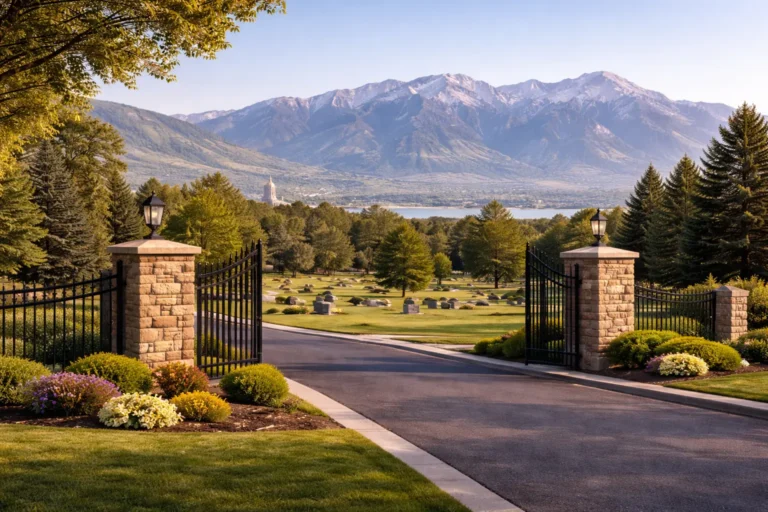
Utah’s final expense landscape reflects a state shaped by the Wasatch Front corridor, where roughly 80% of residents live between Ogden and Provo, and the vast rural stretches of the Uinta Basin, San Juan County, and the West Desert. The state’s deep Latter-day Saint heritage influences funeral traditions here in ways that matter — family-led services, ward-based support, and a strong cultural preference for traditional burial over cremation compared to national averages. Whether you’re planning in St. George’s growing retirement communities, Salt Lake County, or a small town in the Bear River Valley, burial insurance in Utah is designed to cover the real costs families face without leaving loved ones to scramble.
Funeral and Cremation Costs in Utah
Funeral costs in Utah generally track close to the national median, though prices vary meaningfully between the Wasatch Front metros and the rural corners of the state. The figures below reflect statewide averages pulled from industry pricing data and Utah-specific funeral home disclosures, with regional variation noted where it’s significant.
Funeral and Cremation Costs in Utah
Funeral costs in Utah generally run close to — or slightly below — the national median, though prices vary meaningfully between the Wasatch Front metros and Utah’s rural stretches. The figures below reflect statewide averages from the National Funeral Directors Association, the Funeral Consumers Alliance of Utah, and Utah-specific funeral home pricing, with regional variation noted where it shapes what families actually pay. Burial insurance in Utah is typically sized to cover the service plus the cemetery costs that aren’t included in the headline funeral price.
Statewide average costs
| Service type | Typical Utah cost | What’s included |
|---|---|---|
| Traditional full-service burial | $7,000 – $9,500 | Basic services fee, embalming, viewing, ceremony, hearse, median-priced casket. Does not include cemetery plot or vault. |
| Full-service cremation (with viewing and service) | $5,000 – $7,500 | Same services as above, with cremation replacing burial and an urn in place of a casket |
| Direct cremation | $695 – $1,995 | Transfer, paperwork, cremation, return of remains in a basic container. No viewing or service. |
| Immediate (direct) burial | $1,195 – $3,500 | Transfer, basic services, graveside-only disposition. Casket and cemetery costs additional. |
Utah’s traditional burial figures sit slightly under the NFDA’s 2023 national median of $8,300 for a funeral with viewing and burial, while the national median for cremation with viewing was $6,280. Utah direct cremation comes in notably below the national average, with providers across the Wasatch Front offering packages under $1,000.
Cemetery and add-on costs
The prices above generally exclude cemetery costs, which can add several thousand dollars to a traditional burial in Utah. Cemetery plots run roughly $1,000 in rural areas up to $4,000 in Salt Lake County, grave opening and closing typically costs $1,000 to $1,500, vaults or liners range from $1,000 to $2,500, and headstones average $500 to $4,000 depending on material and design. A family choosing full traditional burial with cemetery costs included is often looking at a total closer to $10,000 to $13,000 — which is why burial insurance policies in Utah commonly land in the $10,000 to $15,000 coverage range.
Regional cost variation within Utah
Utah’s cost map is shaped by the concentration of funeral homes along the Wasatch Front and the limited provider count in rural counties.
- Wasatch Front (Salt Lake, Davis, Utah, Weber counties): Higher operational costs but also the most provider competition in the state. Direct cremation is often cheapest here — some Salt Lake County crematories offer packages under $995 — while traditional full-service burial runs at the higher end of the state range.
- St. George and Washington County: Growing retirement population has expanded the provider market, but premium service pricing is closer to Salt Lake than to rural Utah. Direct cremation typically starts around $1,200.
- Cache Valley and northern Utah (Logan area): Moderate pricing, smaller provider pool than the Wasatch Front.
- Rural Utah (Uinta Basin, San Juan County, Sanpete, Sevier, West Desert counties): Fewer providers mean less price competition, and transportation surcharges can apply when a crematory or funeral home is a long distance from the place of death.
What drives cost differences
Utah’s burial rate of roughly 40% is well above the national average of 32%, reflecting the state’s Latter-day Saint heritage and its strong cultural preference for traditional burial. That sustained demand keeps traditional burial pricing stable across most of the state. At the same time, cremation has climbed in Utah — from single-digit rates decades ago to roughly 60% today — and that shift has expanded the low-cost direct cremation market, especially in Salt Lake County.
Embalming is not required by Utah law for most dispositions, which gives families real room to reduce costs when they choose direct burial or direct cremation. Final expense insurance lets Utah families lock in the funds needed for the service they actually want, whether that’s a traditional LDS service with burial at a family cemetery or a simple direct cremation.
Final Expense Insurance Regulations in Utah
Final expense insurance in Utah is regulated at the state level under Title 31A of the Utah Insurance Code, with oversight from the Utah Insurance Department. Because burial insurance is a form of whole life insurance, the same consumer protections that apply to life insurance broadly also apply to final expense policies — though Utah handles a few key provisions differently than most states. The rules below are the ones that most directly affect seniors buying a final expense policy in Utah.
The Utah Insurance Department
The Utah Insurance Department is the regulatory agency that licenses carriers and agents, approves policy forms, and handles consumer complaints. The department can be reached at 801-538-3077 or at insurance.utah.gov. Any company selling final expense insurance in Utah must be licensed by the department, and any agent writing a policy must carry an active Utah producer license.
Free look period
Utah is one of a small number of states that does not have a statutory free look period written into its insurance code for new life insurance policies. In practice, most carriers voluntarily offer a free look period anywhere from seven to 30 days, and many final expense carriers writing in Utah provide a 30-day window by company policy. The exact length is printed on the first page of the policy.
Where Utah law is strict is on replacement policies. Under Utah Administrative Rule R590-93, when a new policy replaces an existing one, the insurer must provide to the policy or contract holder notice of the right to return the policy or contract within 30 days of the delivery of the contract and receive an unconditional full refund of all premiums or considerations paid on it. This matters for seniors who already own a burial or whole life policy and are considering switching — Utah gives a full month to reverse the decision and get every dollar back. Legal Information Institute
Grace period on missed premiums
Utah law requires a 30-day grace period on premium payments. If a senior misses a due date, the policy cannot be canceled for nonpayment until 30 days have passed, and coverage remains in force during that window. This is an important protection for fixed-income policyholders where a late Social Security deposit or a medical event could otherwise cause a lapse.
Graded death benefit policies
Many final expense policies sold in Utah are guaranteed issue or simplified issue plans that include a graded death benefit — meaning the full face amount isn’t paid during the first two policy years if death is from natural causes. During that waiting period, the policy typically returns premiums paid plus interest (often 10%), and accidental death is usually covered in full from day one. Utah does not set a specific statutory maximum waiting period, so terms vary by carrier, which is why comparing the graded schedule across carriers matters as much as comparing premium rates.
Preneed funeral insurance
Utah separately regulates preneed funeral contracts under Rule R590-251 (Preneed Life Insurance Minimum Standards) and through the Utah Department of Commerce, which licenses preneed sellers. Final expense insurance is different from a preneed contract — a final expense policy pays cash to a named beneficiary who can use the funds at any funeral home, while a preneed contract is paid directly to a specific funeral provider. Many Utah seniors prefer final expense insurance for the flexibility, especially when family members may be spread across the Wasatch Front and out of state.
Insolvency protection
Utah policyholders are protected by the Utah Life and Disability Insurance Guaranty Association if their insurer becomes insolvent. The Utah Life And Disability Insurance Guaranty Association will compensate you for up to $300,000 in lost death benefits and up to $100,000 in lost cash surrender per individual life, provided the insurer was licensed in Utah and premiums were current. Because most final expense face amounts fall well below $300,000, this guaranty effectively covers the full death benefit on standard burial insurance policies.
Consumer protections on sales practices
Utah Rule R590-252 (Use of Senior-Specific Certifications and Professional Designations) restricts the misuse of senior-targeted designations by agents — a direct response to deceptive sales practices targeting older adults. Utah Rule R590-93 also prohibits agents from advising applicants to answer “no” to replacement questions in order to avoid notifying the existing insurer, which is a common tactic in abusive replacement sales. Seniors who believe an agent has misrepresented a policy can file a complaint directly with the Utah Insurance Department.
Funeral and Burial Laws in Utah
Utah law governs the handling of human remains, the permits required for burial or cremation, and the licensing of funeral service professionals. The rules below are the ones most likely to affect Utah families arranging a funeral — whether they’re working with a funeral home, planning a home funeral (which is legal in Utah), or pre-planning with a burial insurance policy to cover the costs. Utah’s Funeral Services Licensing Act (Utah Code Title 58, Chapter 9) and the state’s Vital Records statutes (Utah Code Title 26B, Chapter 8) are the primary sources.
Death certificate filing
The death certificate must be filed with the local registrar within five days of death and before the body is buried, cremated, or shipped out of the state. The funeral director fills in the personal data, obtained from the next of kin. Separately, a health care professional in charge of the deceased person’s care for the condition or illness that caused the death fills in the medical section of the certificate. The health care professional has 72 hours to return the completed medical certification to the funeral director. Certified copies can be ordered from the Utah Office of Vital Records and Statistics at $16 for the first copy and $8 for each additional copy — families typically need 8 to 12 copies to close out an estate.
Burial transit permit
A burial transit permit is required before remains can be moved for final disposition in Utah. The permit is issued by the local registrar or county health department. If cremation is the chosen disposition, or if the remains will be transported out of state, a permit must be obtained when family is requesting the decedent be cremated or transported out of state. (Utah Code 26B-8-230) and the Utah Office of the Medical Examiner must review the death certificate before the permit is issued. Reviews are typically completed within a few days.
Embalming rules
Utah is one of the more flexible states on embalming. There is no Utah state law stipulating that embalming is required. However, Utah Administrative Code R436-8-3 requires that a body not be held or in transit more than 24 hours after death unless it is refrigerated at 40 degrees Fahrenheit or below, or embalmed. In practice, this means that refrigeration is an acceptable alternative in nearly any situation where embalming would otherwise be considered. Embalming is only strictly required when a body is being shipped by common carrier (air or rail) without a sealed metal shipping container.
Cremation authorization and waiting period
Before any cremation can occur in Utah, the funeral service establishment must have a signed cremation authorization form from the legal next of kin and must file the death certificate with vital records. Utah Code 58-9-610 adds a specific safety requirement: cremation cannot proceed if a pacemaker or other battery-powered implant remains in the body. Utah does not impose a universal statutory waiting period on cremation — the practical delay is driven by the Medical Examiner’s review process rather than a fixed waiting clock.
Home funerals and family-led care
Utah is a home-funeral-friendly state. Families have the legal right to act as their own funeral director and handle the preparation, transport, and disposition of a loved one without hiring a licensed funeral home. The Utah Office of Vital Records provides the forms needed to file the death certificate as a family member. For Utah seniors who want to keep costs low and services simple — often paired with a modest burial insurance policy to cover the remaining costs of a casket, urn, or cemetery plot — a family-led funeral is a legitimate option.
Burial on private property
Utah state law does not prohibit burial on private land or the establishment of a family cemetery. Before conducting a backyard burial or establishing a family cemetery, check with the county or town clerk for any local zoning laws you must follow. If you bury a body on private land, you should draw a map of the property showing the burial ground and file it with the property deed so the location will be clear to others in the future. Most cities prohibit private-property burial within city limits, and a handful of counties — including Sanpete and Sevier — have ordinances restricting it outside established cemeteries. Rural counties across most of Utah allow it with proper documentation.
Green burial and alkaline hydrolysis
Green burial is legal throughout Utah. State law does not require embalming, a vault, or a metal casket, which means any cemetery can accommodate a green burial by adjusting its own rules. Memorial Mortuaries operates hybrid green burial sections at several Wasatch Front cemeteries, and a handful of other cemeteries will allow a greener burial on request. Utah legalized alkaline hydrolysis (water cremation) in 2018 under Utah Code sections 58-9-613 through 58-9-618, though provider availability remains limited. Natural organic reduction (human composting) is not yet authorized under Utah law — a 2026 bill (S.B. 49) has been introduced to address this.
Scattering ashes
Utah does not restrict where cremated remains may be stored. For scattering, the rules are practical: scattering on private property requires the owner’s consent, scattering in inland waters may require a permit under the Clean Water Act, and scattering at sea is governed by federal EPA rules (typically at least three nautical miles offshore). There are no state laws prohibiting scattering ashes on public lands in Utah, though federal lands — including the state’s five national parks — have their own permit requirements.
Licensing and oversight
Utah funeral service establishments, directors, embalmers, and interns are licensed by the Utah Division of Occupational and Professional Licensing (DOPL) under the Funeral Services Licensing Act. Consumers with complaints about a funeral home can file directly with DOPL at 801-530-6628. Preneed funeral contracts are separately regulated to protect consumer deposits made to funeral homes before death.
Regions and Major Metros in Utah
Utah is geographically one of the most distinct states in the country — divided between three major physiographic provinces (the Rocky Mountains, the Great Basin, and the Colorado Plateau) and culturally organized around the Wasatch Front corridor, where roughly three-quarters of the population lives. For final expense planning, the regional structure matters because costs, provider availability, and service options vary sharply between the population centers along I-15 and the rural plateau and desert counties. The regions below follow the physical and cultural divisions Utahns actually use.
Named regions of Utah
- Wasatch Front: The urban corridor at the western base of the Wasatch Range, running from Brigham City in the north to Nephi in the south. Contains Salt Lake City, Provo, Ogden, and the majority of the state’s population, jobs, and funeral service providers.
- Wasatch Back: The valleys east of the Wasatch Range, including Park City and Heber City. Smaller population, tied economically to resort tourism and the Wasatch Front.
- Northern Utah (Cache Valley): The Logan area and surrounding Bear River Valley, a distinct cultural and agricultural region anchored by Utah State University.
- Uinta Basin (Dinosaurland): Northeastern Utah south of the Uinta Mountains, centered on Vernal and Roosevelt. Oil, gas, and ranching economy with a large Ute Indian Reservation presence.
- Castle Country and the Castle Valley: The central-eastern counties around Price, historically tied to coal mining.
- Central Utah (Sanpete and Sevier Valleys): The agricultural heart of the state, with small towns like Ephraim, Manti, and Richfield.
- West Desert: The sparsely populated Great Basin country west of the Wasatch, including Tooele and Juab counties and the Bonneville Salt Flats.
- Southwestern Utah (Utah’s Dixie): Southwestern Utah is the lowest and hottest spot in Utah. It is known as Utah’s Dixie because early settlers were able to grow some cotton there. St. George is the regional hub and the fastest-growing retirement area in the state.
- Canyon Country (Southeast Utah): The red-rock country around Moab, Monticello, and the five national parks. Tourism-driven economy with very low population density.
- Color Country / South-Central Utah: The high plateau country around Cedar City, Kanab, and the Escalante Basin.
Counties by region
| Region | Counties |
|---|---|
| Wasatch Front | Salt Lake, Utah, Davis, Weber, Box Elder (southern), Juab (northern) |
| Wasatch Back | Summit, Wasatch, Morgan |
| Cache Valley / Northern Utah | Cache, Rich, Box Elder (northern) |
| Uinta Basin | Duchesne, Uintah, Daggett |
| Castle Country | Carbon, Emery, Grand |
| Central Utah | Sanpete, Sevier, Millard, Piute, Wayne, Juab (southern) |
| West Desert | Tooele |
| Southwestern Utah (Dixie) | Washington, Iron |
| Canyon Country | San Juan, Grand, Wayne (eastern) |
| Color Country / South-Central | Kane, Garfield, Beaver |
Top metros in Utah
Utah has three principal metropolitan statistical areas along the Wasatch Front plus the fast-growing St. George metro to the south. The Salt Lake City–Provo–Orem combined statistical area, anchored by an urban corridor along a 120-mile (190 km) segment of the Wasatch Front with a population of approximately 2.8 million, is where most Utah seniors live, work, and receive care.
| Metro area | Population | Counties | Key economic drivers |
|---|---|---|---|
| Salt Lake City MSA | ~1.27 million | Salt Lake, Tooele | Finance, tech, healthcare, government |
| Ogden–Clearfield MSA | ~715,000 | Weber, Davis, Morgan, Box Elder | Aerospace and defense (Hill Air Force Base), logistics |
| Provo–Orem–Lehi MSA | ~730,000 | Utah, Juab | Tech (“Silicon Slopes”), higher education (BYU, UVU) |
| St. George MSA | ~205,000 | Washington | Retirement, tourism, healthcare |
| Logan MSA | ~155,000 | Cache, Franklin (ID) | Agriculture, higher education (Utah State) |
Top Utah cities by population
Utah’s largest cities — Salt Lake City with 208,007, West Valley City at 138,437, West Jordan with 116,692, Provo at 114,766, and St. George with 101,995 — sit almost entirely along the Wasatch Front, with St. George being the only major population center outside the corridor. Other top-10 cities include Lehi, Orem, Sandy, South Jordan, and Ogden, all part of the greater Salt Lake or Utah County metros.
Demographics relevant to final expense planning
Utah is the youngest state in the country by median age (around 31), but that top-line number masks two important senior clusters. The Wasatch Front holds the largest absolute number of Utah seniors simply because of overall population, while Washington County in the Dixie region has one of the highest senior population shares in the state. Washington County’s elderly or the senior population (over 65 age) was 21.44% as compared to 16.04% nationwide, driven by retirees relocating from California, the Pacific Northwest, and the Wasatch Front itself for the warmer climate and lower winter costs. St. George has a well-developed retirement infrastructure with dozens of 55+ communities including SunRiver, Regency at Desert Color, and Bloomington Knolls.
A few other patterns shape final expense demand across Utah:
- The Latter-day Saint cultural majority (roughly 60% of the state identifies with the LDS Church) means traditional burial remains the most common choice, and many families plan around ward-based support, temple clothing for burial, and family cemetery plots.
- Veterans are a meaningful share of the senior population, especially around Hill Air Force Base in Davis and Weber counties and in the St. George retirement corridor. The Utah Veterans Cemetery and Memorial Park in Bluffdale provides no-cost interment for eligible veterans and spouses.
- Rural Utah — the Uinta Basin, San Juan County, and the central plateau counties — has fewer providers, longer distances to funeral homes, and a higher reliance on pre-planning because families often need to arrange transportation from remote areas.
Burial insurance in Utah is used differently depending on the region. On the Wasatch Front, it commonly covers a traditional LDS service and burial. In St. George and southwestern Utah, it often covers a lower-cost service with cremation or simple burial paired with a memorial at a retirement community. In rural counties, it’s frequently sized to also cover body transportation from a remote location back to a family cemetery.
Counties We Serve in Utah
Palmetto Mutual serves seniors and families across every county in Utah, from the densely populated Wasatch Front to the most remote corners of the Uinta Basin, West Desert, and canyon country. The directory below lists all 29 Utah counties. Select your county to find local cost data, nearby funeral homes, cemetery information, and burial insurance guidance specific to your area.
- Beaver County
- Box Elder County
- Cache County
- Carbon County
- Daggett County
- Davis County
- Duchesne County
- Emery County
- Garfield County
- Grand County
- Iron County
- Juab County
- Kane County
- Millard County
- Morgan County
- Piute County
- Rich County
- Salt Lake County
- San Juan County
- Sanpete County
- Sevier County
- Summit County
- Tooele County
- Uintah County
- Utah County
- Wasatch County
- Washington County
- Wayne County
- Weber County
Frequently Asked Questions

About the Author
Dvir Mosche is an award-winning independent insurance agent and the founder of Palmetto Mutual, a trusted insurance brokerage specializing in Final Expense Life Insurance. Since entering the industry in 2017, he has been recognized multiple times as a top agent for his dedication to educating and assisting seniors in finding the proper coverage. His mission is to simplify the process, provide honest and personalized guidance, and ensure that every client gets coverage they can depend on for life.


