
Home > Wisconsin
Final Expense Insurance in Wisconsin — Coverage for Families Across the Badger State
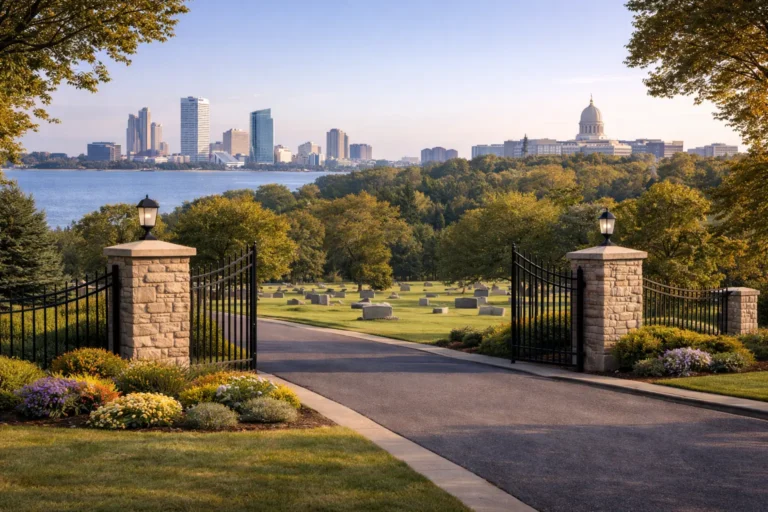
Wisconsin’s 5.9 million residents live across a state shaped by Lake Michigan shoreline, the Driftless Area’s unglaciated bluffs, the Northwoods lake country, and the dairy belt that runs through the central farmland. Final expense insurance helps Wisconsin seniors — from Milwaukee and Madison to small towns in Door County and the Chippewa Valley — cover funeral costs, burial or cremation expenses, and other end-of-life bills without leaving the burden to family. The state’s aging population is concentrated in rural northern counties and retirement-friendly communities along the lakes, where access to affordable burial life insurance matters most.
Funeral and Cremation Costs in Wisconsin
Funeral pricing in Wisconsin runs close to the national median, with meaningful variation between the Milwaukee and Madison metros, the Fox Valley corridor, and the smaller towns of the Northwoods and Driftless Area. The figures below reflect statewide averages and typical regional ranges — county-level pricing varies based on local funeral home competition and cemetery costs. All Wisconsin funeral homes are required by the Federal Trade Commission’s Funeral Rule to provide a written general price list on request, so families can compare costs directly before committing.
Wisconsin statewide averages
| Service type | Typical Wisconsin cost | What’s included |
|---|---|---|
| Traditional full-service burial | $7,300 – $8,500 | Basic services fee, embalming, viewing, ceremony, hearse, casket |
| Cremation with memorial service | $4,000 – $7,500 | Viewing or memorial, ceremony, cremation, basic urn or container |
| Direct cremation | $1,200 – $2,200 | Transfer, cremation, return of remains — no ceremony |
| Immediate burial | $3,500 – $5,000 | Transfer, basic container, graveside interment — no viewing |
Cemetery costs — plot, opening and closing, vault, and grave marker — are billed separately and typically add $3,000 or more to a traditional burial.
How Wisconsin compares to the national median
The National Funeral Directors Association’s 2023 General Price List Study put the national median for a funeral with viewing and burial at $8,300, and a funeral with viewing and cremation at $6,280. Wisconsin’s statewide averages sit slightly below both national medians, reflecting lower cost-of-living figures outside the Milwaukee and Madison metros and a dense network of roughly 800 funeral homes across the state that keeps pricing competitive.
Regional cost variation within Wisconsin
- Milwaukee metro and Madison. The highest pricing in the state. Direct cremation typically runs $1,500 to $3,500, and cremation with services can reach $7,500 at the upper end. Traditional burials trend toward the $7,400–$8,500 range.
- Fox Valley and Green Bay. Moderate pricing. Green Bay, Appleton, and Oshkosh generally run slightly below Milwaukee and Madison, with direct cremation starting closer to $1,200 and traditional burials in the $7,100–$7,500 range.
- Northwoods, Driftless Area, and rural counties. The lowest pricing in Wisconsin. Smaller towns in counties like Vilas, Bayfield, Sawyer, Crawford, and Vernon often come in below the state average for both burial and cremation services, driven by lower overhead and long-established family-run funeral homes.
- Lake Michigan shoreline south of Milwaukee. Kenosha, Racine, and Sheboygan pricing tracks closely with the statewide average, though proximity to the Illinois border introduces some competitive pressure from cross-border providers.
What drives Wisconsin funeral costs
Wisconsin’s cremation rate has overtaken its burial rate, following the national trend, and cremation remains the most affordable path by a wide margin. Rural cemetery costs in the Northwoods are generally lower than in the Milwaukee and Madison metros, where plot scarcity pushes pricing up. Winter burial timing can also affect costs in northern counties — frozen ground in December through March sometimes requires vault storage or delayed interment, which funeral homes price separately. Families choosing burial life insurance in Wisconsin typically aim for coverage in the $10,000 to $15,000 range to cover a full traditional service, while those planning cremation often carry smaller policies in the $5,000 to $8,000 range.
Final Expense Insurance Regulations in Wisconsin
Insurance in Wisconsin is regulated at the state level under Titles 600 through 655 of the Wisconsin Statutes, with the Office of the Commissioner of Insurance (OCI) serving as the primary enforcement agency. Final expense and burial life insurance policies sold in Wisconsin are classified as small whole life policies and must follow the same consumer protection rules as larger life insurance contracts. The regulatory framework described below applies to every final expense insurance policy issued to a Wisconsin resident, regardless of which carrier writes the coverage.
The Wisconsin Office of the Commissioner of Insurance
The OCI was created by the legislature in 1870 and is one of the oldest insurance regulatory agencies in the country. It oversees more than 2,000 licensed insurers, monitors the financial solvency of companies writing business in Wisconsin, licenses agents, and handles consumer complaints. The Commissioner is appointed by the Governor and confirmed by the Senate. The OCI’s consumer affairs division is the first stop for any Wisconsin senior who has a question about a policy, a concern about an agent, or a dispute with a carrier — their consumer hotline is (800) 236-8517, and complaints can be filed online at oci.wi.gov.
Free look period
Wisconsin law gives buyers of a new final expense or whole life policy at least 10 days — often 20 or 30 days depending on the policy type — to review the contract after delivery and cancel for a full refund. The free look period begins when the policy is delivered to the buyer, not when the application is signed. For policies that replace an existing life insurance contract, Wisconsin administrative code (Ins 2.07) requires a 30-day free look on the replacement policy, giving seniors who are switching carriers an extended window to compare the new contract against the old one. This is one of the more consumer-friendly replacement rules in the country.
Replacement rules and consumer protections
Wisconsin has detailed replacement disclosure requirements under Ins 2.07 of the administrative code. When an agent proposes replacing an existing policy with a new one, the agent must provide a written disclosure comparing the two policies, and the new insurer must notify the existing insurer of the replacement. If the replacing insurer and the existing insurer are the same company or affiliates, the replacing insurer must give credit for time already elapsed under the original policy’s contestability and suicide exclusion periods — an important protection for seniors who are effectively upgrading an existing policy rather than starting fresh.
Graded death benefit and contestability
Most final expense policies sold in Wisconsin fall into one of two underwriting categories — immediate (or level) benefit policies for applicants who can pass simplified health questions, and graded benefit policies for applicants with more significant health conditions. Graded benefit policies typically pay only a return of premiums plus interest (or a small percentage of face value) if the insured dies within the first two or three policy years from natural causes; accidental death is generally covered from day one. Wisconsin does not set a specific statutory cap on graded benefit waiting periods, but all policy terms must be clearly disclosed before the contract is issued. The contestability period is two years under Wisconsin law — after two years of premium payments, the carrier cannot challenge the death benefit except in cases of outright fraud.
Timely claim payment and the Insurance Security Fund
Under Wisconsin Statute 628.46, insurers must pay death benefit claims within 30 days of receiving proof of death. Claims that take longer than 30 days to settle accrue interest payable to the beneficiary, starting from the date of the claim. If the insurance company writing a Wisconsin resident’s burial insurance policy becomes insolvent, the Wisconsin Insurance Security Fund — established under Chapter 646 of the Wisconsin Statutes — guarantees up to $300,000 in death benefits per insured life, well above the typical $5,000 to $25,000 face amount of a final expense policy. The Fund is administered at 2820 Walton Commons Lane in Madison and is funded by assessments on every licensed insurer doing business in the state.
State Life Insurance Fund
Wisconsin is the only state in the country that operates its own state-run life insurance program. The State Life Insurance Fund was created in 1911 and is administered by the OCI. It offers low-cost whole life policies up to $10,000 in face value directly to Wisconsin residents, with no agent commissions built into the premium. The Fund is small and limited in the products it offers compared to private carriers, but it exists as a historical consumer-protection measure and remains an option for Wisconsin seniors looking for a straightforward small whole life policy. Most final expense buyers still go through private carriers for broader product selection and higher coverage limits, but the Fund’s existence reflects Wisconsin’s long tradition of active consumer protection in the life insurance market.
Funeral and Burial Laws in Wisconsin
Wisconsin’s funeral and burial laws are found primarily in Chapter 69 (death records), Chapter 157 (disposition of human remains), Chapter 445 (funeral directors), and Chapter 154 (control of final disposition) of the Wisconsin Statutes, with supporting administrative code in DHS 135 and 136. The Wisconsin Funeral Directors Examining Board under the Department of Safety and Professional Services (DSPS) licenses funeral directors and regulates funeral establishments, while the Cemetery Board regulates cemetery operators. Understanding these rules helps Wisconsin families make informed end-of-life decisions and avoid surprises during an already difficult time.
Death certificates and burial authorization
When a death occurs in Wisconsin, the funeral director (or, if no funeral director is involved, a member of the immediate family) must present a completed death certificate to the local registrar within nine days of the pronouncement of death, under Wis. Stat. § 69.18 and DHS 135.03. The attending physician, coroner, or medical examiner has five days to mail in the medical certification portion, or six days to give it to the funeral director for filing. No human corpse may be buried or otherwise finally disposed of in Wisconsin unless accompanied by a Report for Final Disposition, which serves as the state’s burial authorization document. Families typically order at least 10 certified copies of the death certificate to handle life insurance claims, Social Security, veterans benefits, and property transfers.
Embalming rules
Wisconsin has no law requiring embalming in most circumstances. Refrigeration serves the same purpose for short-term preservation and is the standard practice when no public viewing is held. Embalming is required only when a body is shipped out of state by common carrier, or in limited cases involving communicable disease. Funeral homes may set their own policies requiring embalming for open-casket viewings, but that is a business decision, not a state law requirement. Families choosing direct cremation, immediate burial, or green burial can decline embalming entirely.
Cremation authorization and the 48-hour waiting period
Under Wis. Stat. § 979.10, no person may cremate a body within 48 hours after the death unless the death was caused by a contagious or infectious disease. Cremation also requires a written cremation permit issued by the coroner or medical examiner of the county where the death occurred. This permit is county-specific and cannot be used outside the issuing county. The 48-hour delay gives the medical examiner time to confirm the cause of death and rules out later questions about the circumstances, which is why it cannot be waived in most situations.
Home funerals and family-directed burials
Wisconsin is one of the more permissive states for home funerals. A member of the decedent’s immediate family may legally prepare the body for burial, transport the remains, and conduct the final disposition without hiring a licensed funeral director, under Wis. Stat. § 69.18 and DHS 135.05. The family member handling the arrangements is still responsible for filing the death certificate, obtaining the Report for Final Disposition, and (if cremation is chosen) obtaining the cremation permit. The National Home Funeral Alliance and the Wisconsin Department of Health Services both publish guidance for families choosing this path. Home funerals remain uncommon in Wisconsin but are fully legal when handled correctly.
Home burial on private property
Wisconsin does not have a statewide law prohibiting burial on private land, but local zoning and health ordinances often do. Before conducting a private burial, families must check with the town or county clerk and the local health department for any applicable rules. The Department of Health Services recommends filing a map of the burial location with the property deed so the site remains identifiable to future owners. A Report for Final Disposition is still required, just as it would be for a cemetery burial.
Green burial and Wisconsin’s early role
Wisconsin was an early adopter of green burial practices. Greenwood Cemetery in Milwaukee, through its Prairie Green section, became the first Green Burial Council-certified cemetery provider in Wisconsin and remains one of the most established green burial grounds in the Upper Midwest. Other notable green burial sites include Natural Path Sanctuary in Verona near Madison, and dedicated natural burial sections at municipal cemeteries like Waukesha’s Prairie Home Cemetery. Green burial is fully legal in Wisconsin — there is no state requirement that bodies be embalmed, placed in a vault, or interred in a non-biodegradable casket. State law does require that 15% of a cemetery plot’s sales price go into a permanent endowment for land care.
Alkaline hydrolysis and natural organic reduction
Wisconsin has not yet legalized alkaline hydrolysis (also called water cremation or aquamation), though the Wisconsin Funeral Directors Association has noted that legislation on the topic is under review. Natural organic reduction (human composting) is also not legal in Wisconsin as of the latest NFDA tracking. Families interested in either option currently need to arrange transport to a state where the practice is authorized, which adds significant cost and logistical complexity.
Burial at sea and scattering ashes
Wisconsin has no ocean coastline, so traditional burial at sea is not an option within the state. Scattering ashes in the Great Lakes or inland Wisconsin waters is regulated under the federal Clean Water Act, and a permit from the state agency managing the waterway may be required. Scattering ashes on private property is legal with permission of the landowner, and most Wisconsin cemeteries offer scattering gardens. Cremated remains may be placed in a grave, niche, crypt, or scattered under Wis. Stat. § 440.80.
Separation of funeral homes and cemeteries
Wisconsin has a long-standing statutory separation between funeral homes and cemeteries under Wis. Stat. § 445.12(6). No licensed funeral director or funeral establishment may operate a mortuary within or directly connected to a cemetery, and funeral directors are prohibited from receiving commissions or kickbacks from cemetery operators on plot sales. This consumer protection — unusual among states — was designed to prevent funeral directors from steering families toward specific cemeteries for their own financial benefit.
Regulatory contacts
The Wisconsin Funeral Directors Examining Board at the Department of Safety and Professional Services (dsps.wi.gov) handles funeral director licensing, investigates complaints against funeral homes, and enforces Chapter 445. The Wisconsin Cemetery Board, also under DSPS, regulates cemetery operators, preneed sellers, and cemetery salespersons. Consumer complaints about funeral pricing or Funeral Rule violations can also be filed with the Federal Trade Commission, which enforces the federal Funeral Rule under 16 CFR 453.during that early period, the beneficiary often receives the premiums back, sometimes with added interest, instead of the full face amount. After the waiting period ends, the full benefit becomes available. That is why modified coverage can still help, but it does not protect a family the same way a level-benefit plan does from day one. In real life, modified plans are often used when health history closes off better options, not because they are the ideal fit.
Regions and Major Metros in Wisconsin
Wisconsin’s 72 counties divide naturally into several distinct regions, each with its own geography, economy, and demographic character. The state’s population is concentrated along the Lake Michigan shore in the southeast, in the south-central Madison corridor, and along the Fox River Valley running from Oshkosh through Appleton to Green Bay. The northern third of the state — the Northwoods — is the most sparsely populated and the most heavily retired. Understanding these regions helps Wisconsin seniors and their families recognize how final expense insurance planning varies from metro to metro and from rural north to urban south.
Named regions of Wisconsin
- Southeast Wisconsin. Anchored by Milwaukee and stretching south to the Illinois border, this is the state’s largest population center and industrial heartland. Manufacturing, healthcare, and finance drive the economy.
- South Central Wisconsin. Centered on Madison and the capital region, with a mix of state government, University of Wisconsin-Madison, healthcare, and biotech. The fastest-growing region in the state.
- Fox Valley (Northeast Wisconsin). The Fox River corridor from Oshkosh through Appleton to Green Bay, with a strong manufacturing base (paper, food processing, insurance) and significant suburban growth.
- Southwest Wisconsin / Driftless Area. The unglaciated region of ridges, bluffs, and river valleys in southwestern Wisconsin. Heavily rural, with dairy farming, small towns, and a concentrated Amish population in some counties.
- Northwest Wisconsin / Chippewa Valley. Centered on Eau Claire and extending to the Twin Cities border and Lake Superior, blending agriculture, manufacturing, and some commuter ties to Minneapolis-St. Paul.
- Northwoods / North Central Wisconsin. The forested, lake-studded northern third of the state — Vilas, Oneida, Price, Sawyer, Bayfield, Ashland, Iron, and surrounding counties. Tourism-driven, seasonally populated, and the most heavily retired region of Wisconsin.
- Central Wisconsin. The Wausau-Stevens Point-Wisconsin Rapids corridor and the sand plains south of the Northwoods, with insurance, healthcare, and cranberry production.
- Door Peninsula and Lake Michigan Shore. Door County, Kewaunee, Manitowoc, and Sheboygan — coastal, tourism-heavy, and a significant retirement destination.
Counties by region
| Region | Counties |
|---|---|
| Southeast Wisconsin | Milwaukee, Waukesha, Ozaukee, Washington, Racine, Kenosha, Walworth |
| South Central Wisconsin | Dane, Columbia, Dodge, Green, Iowa, Jefferson, Rock, Sauk |
| Fox Valley / Northeast | Brown, Outagamie, Winnebago, Calumet, Kewaunee, Oconto, Shawano, Waupaca, Marinette, Menominee, Door |
| Southwest / Driftless | Crawford, Grant, Lafayette, Richland, Vernon, Monroe, La Crosse, Trempealeau, Buffalo, Pepin, Jackson, Juneau |
| Northwest / Chippewa Valley | Eau Claire, Chippewa, Dunn, Pierce, St. Croix, Polk, Barron, Rusk, Burnett, Washburn, Douglas |
| Northwoods / North Central | Vilas, Oneida, Forest, Florence, Lincoln, Langlade, Taylor, Price, Sawyer, Ashland, Bayfield, Iron |
| Central Wisconsin | Marathon, Portage, Wood, Adams, Waushara, Marquette, Green Lake, Clark |
| Lake Michigan Shore | Sheboygan, Manitowoc, Fond du Lac |
Major Wisconsin metros by population
| Metro Area | 2024 Population | Counties Included |
|---|---|---|
| Milwaukee-Waukesha-West Allis MSA | ~1,574,000 | Milwaukee, Waukesha, Ozaukee, Washington |
| Madison MSA | ~707,000 | Dane, Columbia, Green, Iowa |
| Green Bay MSA | ~335,000 | Brown, Kewaunee, Oconto |
| Appleton MSA | ~245,000 | Outagamie, Calumet |
| Oshkosh-Neenah MSA | ~172,000 | Winnebago |
| Racine MSA | ~197,000 | Racine |
| Eau Claire MSA | ~172,000 | Eau Claire, Chippewa |
The Milwaukee MSA is by far the largest in Wisconsin, accounting for roughly 26% of the state’s total population, with manufacturing, healthcare, and finance as the dominant sectors. The Madison MSA is the second largest and the fastest-growing, driven by state government, the University of Wisconsin, healthcare, and a growing biotech cluster. The Green Bay and Appleton metros anchor the Fox Valley and together form one of the densest concentrations of manufacturing employment in the Midwest. The broader Appleton-Oshkosh-Neenah Combined Statistical Area — what locals refer to as the Fox Cities — totals roughly 415,000 residents across Outagamie, Winnebago, and Calumet counties.
Wisconsin’s senior population and retirement patterns
Wisconsin’s population of residents 65 and older is about 19% statewide — slightly above the national figure of 17.7%. That figure is heavily skewed toward the rural north. Iron County, Vilas County, Bayfield County, and Sawyer County have consistently posted the oldest median ages in the state, with senior populations approaching or exceeding 25% of total residents. These Northwoods counties are classic retirement destinations — lake cabins turned full-time residences, with residents who aged in place after retiring from jobs in Milwaukee, Chicago, or the Twin Cities. By 2035, some northern Wisconsin counties are projected to have senior populations between 35% and 42%. Door County on the Lake Michigan peninsula follows a similar pattern, with roughly 38% of adults already at retirement age.
The Milwaukee and Madison metros, by contrast, have younger populations driven by universities, immigration, and working-age families — though both metros still contain substantial senior populations in aggregate numbers because of their size. This geographic split shapes how final expense insurance demand varies across Wisconsin. Rural northern counties have smaller senior populations in raw numbers but a much higher concentration by percentage, while the southeastern metros have larger total numbers of seniors planning for end-of-life expenses. Burial life insurance demand reflects both patterns — Milwaukee County alone has more seniors than the entire Northwoods combined, but a household in Vilas or Bayfield County is statistically far more likely to include someone actively planning for final expenses.
Counties We Serve in Wisconsin
Palmetto Mutual works with seniors and families across all 72 Wisconsin counties — from the Milwaukee metro and Madison capital region down to the smallest rural counties in the Northwoods and Driftless Area. Every county below has its own dedicated page with local cost data, funeral home context, and coverage guidance tailored to that area. Select your county to see final expense insurance information specific to where you live.
- Adams County
- Ashland County
- Barron County
- Bayfield County
- Brown County
- Buffalo County
- Burnett County
- Calumet County
- Chippewa County
- Clark County
- Columbia County
- Crawford County
- Dane County
- Dodge County
- Door County
- Douglas County
- Dunn County
- Eau Claire County
- Florence County
- Fond du Lac County
- Forest County
- Grant County
- Green County
- Green Lake County
- Iowa County
- Iron County
- Jackson County
- Jefferson County
- Juneau County
- Kenosha County
- Kewaunee County
- La Crosse County
- Lafayette County
- Langlade County
- Lincoln County
- Manitowoc County
- Marathon County
- Marinette County
- Marquette County
- Menominee County
- Milwaukee County
- Monroe County
- Oconto County
- Oneida County
- Outagamie County
- Ozaukee County
- Pepin County
- Pierce County
- Polk County
- Portage County
- Price County
- Racine County
- Richland County
- Rock County
- Rusk County
- Sauk County
- Sawyer County
- Shawano County
- Sheboygan County
- St. Croix County
- Taylor County
- Trempealeau County
- Vernon County
- Vilas County
- Walworth County
- Washburn County
- Washington County
- Waukesha County
- Waupaca County
- Waushara County
- Winnebago County
- Wood County
Frequently Asked Questions

About the Author
Dvir Mosche is an award-winning independent insurance agent and the founder of Palmetto Mutual, a trusted insurance brokerage specializing in Final Expense Life Insurance. Since entering the industry in 2017, he has been recognized multiple times as a top agent for his dedication to educating and assisting seniors in finding the proper coverage. His mission is to simplify the process, provide honest and personalized guidance, and ensure that every client gets coverage they can depend on for life.


