
Home > Wyoming
Final Expense Insurance in Wyoming — Burial Coverage for Cowboy State Seniors
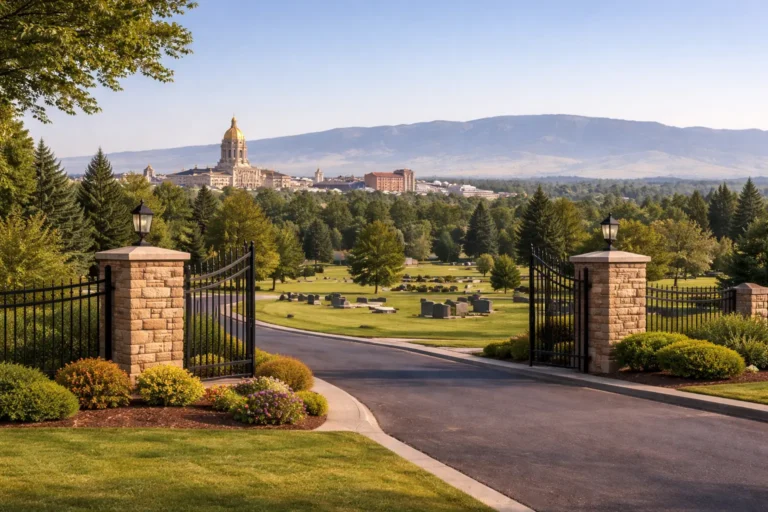
Wyoming is the least populated state in the country, yet its geography covers everything from the Wind River Range and Yellowstone’s eastern gateway to the High Plains around Cheyenne and the energy corridors of the Powder River Basin. Nearly one in five residents is 65 or older, and the state’s small-town spread — Cheyenne, Casper, Laramie, Gillette, Rock Springs — means most families plan final arrangements across long driving distances and limited local funeral options. Final expense insurance gives Wyoming seniors a straightforward way to cover burial, cremation, and end-of-life costs without leaving the bill to loved ones.
Funeral and Cremation Costs in Wyoming
Wyoming is the most affordable state in the country for end-of-life services, according to a nationwide analysis of NFDA pricing data. Blended burial and cremation costs average around $5,349 statewide, well below the national figure of roughly $7,028. The numbers below give Wyoming families a working picture of what to expect and where the real cost drivers come from.
Statewide averages
| Service type | Wyoming average | National median (NFDA) |
|---|---|---|
| Traditional funeral with burial | $7,000–$12,000 | $8,300 (or $9,995 with vault) |
| Full-service cremation | $2,700–$5,200 | $6,280 |
| Direct cremation | $900–$2,400 (upper-$1,000s to $3,000+ common) | $2,800–$3,000 |
| Immediate burial | Varies; often $4,000–$6,000 without ceremony | — |
The Wyoming Funeral Directors Association last published statewide cost data in 2012, reporting an average of $7,075. Adjusted for inflation, that figure lands near $9,790 today. A Rawlins funeral director recently told Cowboy State Daily that a full-service bundle — transport, embalming, casket, headstone, and cemetery fees — typically runs between $7,000 and $12,000 in central Wyoming.
Wyoming also holds the lowest cremation cost of any state in the country at roughly $5,219 for a full cremation service, according to analysis of NFDA regional data. Direct cremation can come in far lower, with Casper-area providers publishing GPL prices in the $2,490–$2,665 range.
Regional cost variation within the state
Wyoming’s geography splits roughly into four cost zones. Southeast Wyoming — Cheyenne, Laramie, and the I-80 corridor — sits closest to national medians because of higher population density and proximity to Colorado markets. Central Wyoming, including Casper and Riverton, runs mid-range, with Casper acting as the state’s largest funeral service hub. Northwest Wyoming — Cody, Jackson, and the Yellowstone gateway counties — tends to price higher on full-service burial because of cost-of-living pressure in resort and tourism economies. Northeast and the Powder River Basin — Gillette, Sheridan, and Buffalo — generally sit on the lower end for direct cremation but can run up in transport fees when the death occurs in a remote location.
What drives cost in Wyoming
Transport distance is the single biggest variable. Wyoming has only a handful of crematories serving the full state, which means mileage fees often get added when a death occurs far from a provider. Cremation has become the dominant choice — Western states lead the country in cremation rates, and some Wyoming funeral homes report more than half of all services are now cremations. That shift pulls the statewide blended average down. Cemetery costs also run lower here than in most states, particularly at municipal and rural cemeteries, and Wyoming’s openness to natural and home burial trims expenses for families who choose those routes.
Burial insurance in Wyoming typically covers $5,000 to $25,000 in benefits — enough to handle cremation comfortably at any price point in the state, or a traditional burial in most regions without stretching the family budget. Funeral life insurance policies pay out directly to the beneficiary, so families can apply the funds wherever they’re needed most: the funeral home, the cemetery, the headstone, or outstanding medical bills.
Final Expense Insurance Regulations in Wyoming
Wyoming regulates life insurance at the state level through Title 26 of the Wyoming Statutes — known as the Wyoming Insurance Code. A handful of Wyoming-specific rules directly affect how burial insurance policies are sold, reviewed, and paid out, and seniors shopping for coverage should understand them before signing anything.
Who regulates insurance in Wyoming
The Wyoming Department of Insurance, headed by Insurance Commissioner Jeffrey P. Rude, oversees every licensed insurer and producer operating in the state. The department handles consumer complaints, license enforcement, market conduct reviews, and rate filings. The agency’s authority comes directly from Title 26 of the Wyoming Statutes, and its website at doi.wyo.gov is the primary resource for verifying an agent’s license or filing a complaint.
Free look period
Wyoming is one of the few states that does not legally require a free look period on newly issued life insurance policies. Most companies voluntarily offer a review window of seven to 30 days, but the length varies by carrier. Policyholders should confirm the free look period in writing before paying a premium.
Replacement policies are the exception. Under Wyoming Administrative Code Chapter 12, when a new life insurance policy replaces an existing one, the policyholder is guaranteed a 30-day unconditional refund period. This matters for final expense buyers because seniors are frequently pitched replacement policies that swap out existing coverage.
Grace period for late premiums
Wyoming law guarantees a 30-day grace period on missed premium payments. During that window, the policy stays in force and the insurer cannot cancel coverage or deny a death claim for non-payment. This protects beneficiaries when a check gets lost in the mail or a payment is late by a few days.
Guaranty association protections
Wyoming policyholders are backed by the Wyoming Life and Health Insurance Guaranty Association if their insurer becomes insolvent. Coverage limits are $300,000 in death benefits per insured and $100,000 in cash surrender value per insured. These limits apply regardless of policy size or how many policies a person holds with the insolvent company. For most final expense buyers, whose policies typically range from $5,000 to $35,000, this protection fully covers the face amount.
Replacement rules
Wyoming’s replacement regulation — Agency 044, Chapter 12 — is modeled on the NAIC model rule and requires agents to provide a signed disclosure notice, the free look period noted above, and full documentation of the transaction when an existing policy is being replaced. Seniors who already own a small whole life or burial insurance policy should ask any agent proposing a new policy whether it qualifies as a replacement and request the Chapter 12 disclosure in writing.
Claim payment timing
Wyoming law does not set a specific deadline for claim settlement, but insurers are required to pay death benefits without unreasonable delay. Under W.S. 26-16-112, if a claim takes longer than 45 days to settle, the insurer must pay interest on the benefit beginning from the date of death. Wyoming does not tolerate stall tactics — unexplained delays can trigger fines and department action.
Prepaid funeral contracts
Wyoming also regulates prepaid and prearranged funeral contracts separately under Title 26, Chapter 32. This is worth noting because some seniors confuse burial insurance with a prepaid funeral contract sold directly by a funeral home. The two products are regulated differently and pay out differently — burial insurance pays cash to a named beneficiary, while a prepaid contract locks in services with a specific funeral home. Final expense insurance generally offers more flexibility, especially for Wyoming families who may relocate or whose preferred funeral provider may not exist decades later.
Funeral and Burial Laws in Wyoming
Wyoming gives families unusually wide latitude in how they handle final arrangements — home funerals are legal, alkaline hydrolysis is authorized, and there is no statewide embalming mandate. At the same time, the state has clear paperwork and timing rules that must be followed for any burial, cremation, or chemical disposition. The rules below come from Title 33 (funeral service), Title 35 (vital records), and the administrative rules of the Wyoming State Board of Funeral Service Practitioners.
Death certificate filing
Under Wyo. Stat. § 35-1-418, a death certificate must be filed with the local registrar in the district where the death occurred within three days of the death and before the body is removed from the state. The funeral service practitioner who first takes custody of the body is responsible for filing. The medical certification portion — cause of death — must be signed by the primary health care provider who treated the deceased within a reasonable time after death. If the death was unattended or appears unnatural, the case is referred to the county coroner.
Families should request at least 10 certified copies of the death certificate at the time of filing. Insurance companies, banks, the Social Security Administration, and county probate courts each typically require their own certified copy.
Burial-transit permits
Wyoming requires a burial-transit permit before any final disposition — burial, cremation, or chemical disposition — under Wyo. Stat. § 35-1-420. The permit is issued by the local registrar only after the death certificate has been filed, and the funeral service practitioner (or person acting as such) must obtain it within 72 hours after death. The same permit is required before the body can be removed from the state. Crematories and chemical disposition facilities are specifically barred from accepting remains until the permit is in hand.
Embalming rules
Wyoming does not require embalming as a matter of routine. Under 035-4 Wyo. Code R. § 4-5, if a body will not be buried, cremated, or chemically disposed within 36 hours of death, the funeral establishment must either embalm or refrigerate it. Refrigeration is a legal and widely used alternative, which matters to families who want to avoid embalming for religious, environmental, or cost reasons. No state law requires embalming solely because of a viewing or service — that requirement, when it exists, comes from the individual funeral home’s policy.
Cremation authorization and waiting period
Wyoming’s administrative rules impose a minimum 24-hour waiting period before cremation can take place, unless the county coroner provides written permission to proceed sooner. The burial-transit permit from the local registrar doubles as authorization for cremation. Any implanted medical devices, such as pacemakers, must be removed before cremation. Next-of-kin or an authorized designee must sign the cremation authorization form before the crematory can proceed.
Home funerals
Home funerals are legal in Wyoming. Families have the right to care for their own dead, including washing, dressing, and keeping the body at home before disposition. The paperwork obligations still apply — the death certificate must be filed within three days, and a burial-transit permit must be obtained before burial or cremation — but families are not required to hire a funeral director to carry out these steps. This is meaningful in rural Wyoming where the nearest funeral home may be well over an hour away.
Home and private property burial
Burial on private property is generally permitted in Wyoming, but subject to county and municipal zoning. Before digging, families should check with the county clerk or county planning office for setback requirements, well and water-source distances, and any local restrictions. The burial location should be recorded on a map filed with the property deed so the site is documented for future owners.
Alkaline hydrolysis (chemical disposition)
Wyoming is one of the states that has legalized alkaline hydrolysis — sometimes called water cremation or aquamation — as “chemical disposition” under Title 33, Chapter 16. The state defines chemical disposition as reducing a body to powder using materials other than heat and evaporation. A dedicated Chemical Disposer license and a permitted Chemical Disposition Facility are required to perform the process. Availability is limited given Wyoming’s population, but the legal framework exists for families who prefer this greener alternative.
Scattering ashes
Wyoming has no state law restricting where cremated remains can be scattered, kept, or buried. Ashes can be stored at home, buried in a cemetery plot, or placed in a columbarium niche without additional permits. Scattering on private land requires the landowner’s permission; scattering on public land often requires a permit. Scattering in Yellowstone and Grand Teton National Parks is allowed only under specific park rules and usually requires a free permit from the park — families should confirm current requirements directly with the park service.
Green burial
Wyoming law does not prohibit green burial. The flexibility built into state embalming and casket rules — refrigeration in lieu of embalming, no casket mandate, and no vault requirement at the state level — makes the state naturally accommodating to natural burial. Whether a specific cemetery accepts unembalmed remains, shrouds, or biodegradable caskets is a cemetery-by-cemetery question, and the Green Burial Council’s provider map is the most reliable starting point for certified natural burial grounds in the state.
The Wyoming State Board of Funeral Service Practitioners
The Wyoming State Board of Funeral Service Practitioners regulates funeral service in the state. Originally established as the Board of Embalming in 1915, the board was renamed and restructured in 2014 under Title 33, Chapter 16, Article 5 — the Funeral Service Practitioners Act. The board licenses funeral service practitioners, apprentices, crematory operators, chemical disposers, and funeral establishments; writes the administrative rules that govern day-to-day operations; adopts the FTC Funeral Rule by reference; and handles consumer complaints against funeral homes. The board’s website at fspboard.wyo.gov is the place to verify a funeral home’s or practitioner’s license and to file a complaint.
Burial insurance pays out in cash to the named beneficiary, which means a Wyoming family can apply the proceeds to any legal disposition choice — traditional burial, cremation, home funeral, chemical disposition, or green burial — without being locked into a single provider or method.
Regions and Major Metros in Wyoming
Wyoming’s geography splits naturally into five regions used by the state’s own Department of Workforce Services for administrative and labor market analysis. With just 23 counties spread across nearly 98,000 square miles, most Wyoming counties stand alone rather than cluster into traditional metro areas. Understanding the regional layout helps seniors identify where burial insurance agents, funeral homes, and cemetery options are concentrated.
Named regions of Wyoming
The state officially recognizes five geographic regions: Northwest, Northeast, Southwest, Southeast, and Central. Each has a distinct economic character and population pattern that affects how funeral services are priced and delivered.
The Northwest Region is Yellowstone and Grand Teton country — high mountains, tourism-driven economy, and the Wind River Indian Reservation shared by the Eastern Shoshone and Northern Arapaho tribes.
The Northeast Region is the Powder River Basin and Black Hills foothills — coal, oil, and methane gas country centered on Gillette, plus the ranching and retirement destinations around Sheridan and Buffalo.
The Southwest Region covers the Green River Basin, the I-80 corridor, and the resort economy of Jackson Hole — an unusual mix of mining towns and the wealthiest county in the state.
The Southeast Region is high plains agriculture, state government, and the Front Range spillover from Colorado — home to the state capital Cheyenne, the University of Wyoming in Laramie, and F.E. Warren Air Force Base.
The Central Region is the state’s geographic heart along the North Platte River — Casper is the regional hub, and the region sits at the crossroads of every major north-south and east-west route in Wyoming.
Counties by region
| Region | Counties |
|---|---|
| Northwest | Big Horn, Fremont, Hot Springs, Park, Washakie |
| Northeast | Campbell, Crook, Johnson, Sheridan, Weston |
| Southwest | Lincoln, Sublette, Sweetwater, Teton, Uinta |
| Southeast | Albany, Goshen, Laramie, Niobrara, Platte |
| Central | Carbon, Converse, Natrona |
Top metros in Wyoming
Wyoming has no metropolitan area above 100,000 people. The five largest cities handle the majority of the state’s professional services, including funeral homes, cemeteries, and the agents who sell burial insurance to Wyoming seniors.
| City | 2024 population | Region | County |
|---|---|---|---|
| Cheyenne | 65,239 | Southeast | Laramie |
| Casper | 58,839 | Central | Natrona |
| Gillette | 33,431 | Northeast | Campbell |
| Laramie | 32,234 | Southeast | Albany |
| Rock Springs | 23,127 | Southwest | Sweetwater |
| Sheridan | ~19,000 | Northeast | Sheridan |
| Evanston | ~11,500 | Southwest | Uinta |
Cheyenne anchors the Southeast Region and is the closest Wyoming metro to Denver, which pulls some funeral and burial service activity across the Colorado line. Casper serves as the default regional hub for Central Wyoming and much of the northern half of the state, since it sits at the junction of I-25 and the major east-west corridors. Gillette is the economic engine of the Powder River Basin. Jackson, while smaller in population, is the service center for Teton County and the wealthiest ZIP codes in the state.
Senior demographics
Wyoming is aging faster than any other state in the country. Residents 65 and older make up roughly 19.7 percent of the state population as of 2024, up from 99,786 people in 2020 to 115,668 in 2024 — a 15.9 percent increase in just four years. The population 65+ is projected to grow another 10 percent between 2024 and 2030.
Several Wyoming counties have senior shares well above the state average, which concentrates demand for final expense insurance and funeral services:
- Hot Springs County — 31.1 percent age 65+ (the oldest county in the state, median age 49.8)
- Johnson County — 28.7 percent
- Niobrara County — 28.6 percent
- Platte County — 28.5 percent
- Sheridan County — 23.9 percent (noted retirement destination)
Retirement destination factors
Wyoming ranked third nationally in Bankrate’s 2025 Best States to Retire study. No state income tax, no tax on retirement income, and low property taxes (averaging about $1,306 per year) make the state particularly attractive to retirees relocating from higher-tax states. Sheridan has emerged as a named retirement destination thanks to its healthcare infrastructure, access to the Bighorn Mountains, and small-town character. Cody and Jackson draw wealthier retirees from the outdoor and national park crowd.
Military presence
F.E. Warren Air Force Base in Cheyenne is home to the 90th Missile Wing and contributes a notable concentration of military retirees to the Southeast Region. The state’s overall veteran population runs roughly 45,000 to 47,000, skewing older and — as projected — increasingly female. Veterans and their surviving spouses are frequent buyers of funeral life insurance to supplement the limited VA burial benefit.
What this means for coverage
Wyoming’s funeral home network is thin by national standards — the state has fewer than 50 licensed funeral establishments serving an area larger than the United Kingdom. That concentration makes regional and metro orientation unusually important when planning final arrangements. Final expense insurance works well in this environment because the cash benefit is paid directly to the beneficiary, not tied to a specific funeral home — a Wyoming family in Lusk or Dubois has the same flexibility as one in Cheyenne or Casper.
Counties We Serve in Wyoming
Palmetto Mutual serves every county in Wyoming. The directory below lists all 23 Wyoming counties in alphabetical order — from the Powder River Basin in the northeast to the Green River country of the southwest, from the Bighorn Mountains to the High Plains. Use this as your entry point to county-specific information on funeral costs, local cemetery options, and burial insurance in your community.
- Albany County
- Big Horn County
- Campbell County
- Carbon County
- Converse County
- Crook County
- Fremont County
- Goshen County
- Hot Springs County
- Johnson County
- Laramie County
- Lincoln County
- Natrona County
- Niobrara County
- Park County
- Platte County
- Sheridan County
- Sublette County
- Sweetwater County
- Teton County
- Uinta County
- Washakie County
- Weston County
Frequently Asked Questions

About the Author
Dvir Mosche is an award-winning independent insurance agent and the founder of Palmetto Mutual, a trusted insurance brokerage specializing in Final Expense Life Insurance. Since entering the industry in 2017, he has been recognized multiple times as a top agent for his dedication to educating and assisting seniors in finding the proper coverage. His mission is to simplify the process, provide honest and personalized guidance, and ensure that every client gets coverage they can depend on for life.


