
Home > Level vs. Graded vs. Modified Final Expense Insurance > Level Benefit Final Expense Insurance
Level Benefit Final Expense Insurance: How It Works and Who Qualifies

If you have been told you qualify for level benefit final expense insurance, you are looking at the strongest option of the three coverage tiers. Level benefit pays the full death benefit from the very first day, with no waiting period for natural-cause deaths, and it comes with the lowest premiums of the three tiers. This page explains what level benefit means when a claim is filed, how the payout actually works, which carriers accept which health conditions for level placement, and what specific factors could move an applicant down into a lower tier.
What Level Benefit Actually Means at Claim Time
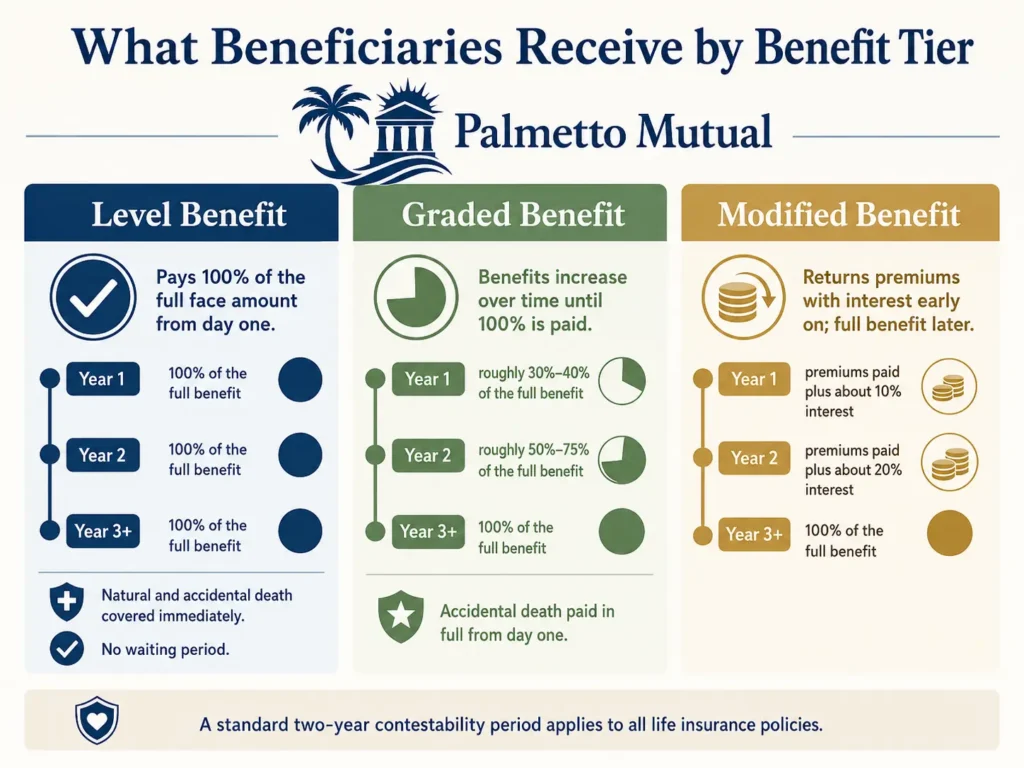
Level benefit is the strongest tier of final expense insurance. When the insured passes away, the policy pays the full face amount to the beneficiary. There is no waiting period, which sets level apart from the other tiers. The payout does not shrink based on how long the policy was held, and it does not get replaced by a refund of premiums.
This is what makes level the tier most applicants hope to qualify for. The coverage is full, the cost is the lowest of the tiers, and the claim is simple for the family to handle.
The Contractual Definition of “Level Benefit”
The word “level” points to a level death benefit. From the first day the policy is active, the death benefit is the full amount written on the policy, and it stays at that amount for life.
This is different from the other two health-based tiers. A graded plan pays only a portion of the death benefit if death happens in the first two years, often around 30 to 40 percent in year one and 50 to 75 percent in year two, with the full amount payable after that. A modified plan instead returns the premiums paid plus a set percentage during its waiting period, such as premiums plus 10 percent in year one and premiums plus 20 percent in year two, with the full benefit payable in year three.
Level benefit has none of those step-ups. The face amount is the face amount, start to finish.
What Beneficiaries Actually Receive Under a Level Policy
With a level policy, the answer to “how much will my family receive” does not change month to month or year to year. Whether death occurs in month 6, month 18, year 5, or year 20, the beneficiary receives the full face amount.
The one thing worth understanding is the contestability period, which applies to every life insurance policy, not just level final expense. For ordinary individual life insurance, this period is generally two years in all 50 states and Washington, D.C. During those first two years, the insurer can review the original application, and after the period ends the policy becomes incontestable, meaning the claim cannot be challenged over application details unless fraud is involved or premiums went unpaid.
Here is the key point for an honest applicant: contestability is not a graded waiting period. If the application was accurate, the beneficiary receives the full death benefit; the review can simply add time before the funds are released. So in plain terms, a level policy pays the full amount in every scenario after the policy is in force, as long as the application was truthful and premiums were kept current.
Why Level Benefit Is Considered the Gold Standard of Final Expense
Three things make level the tier most applicants want. First, the coverage is full from day one for natural-cause death, with no graded reduction period to wait out. Second, level plans cost the least of the tiers because they are written for the healthiest applicants. Third, the claim is the simplest for a grieving family, because there is no percentage formula or premium-refund math to sort through.
Put together, level benefit gives a beneficiary the most money, the soonest, with the least friction. That is why most applicants and most agents aim for level placement whenever the applicant’s health allows it. The next section walks through how that day-one coverage actually works when a claim is filed.
Day-One Coverage: How Your Beneficiary Gets Paid
Day-one coverage on a level policy is not a marketing slogan. It is a contractual feature: there is no graded waiting period reducing the payout in the early years. This section explains what the carrier checks when a claim comes in, how long payment usually takes, and the limited situations that can slow or stop a payout.
The short version is that level final expense is highly reliable. The cases where a claim is delayed or denied are narrow and, for an honest applicant who keeps the policy active, mostly avoidable.
What the Carrier Checks at Claim Time
When a claim is filed on a level burial insurance policy, the carrier is generally confirming two things. The first is whether the policy was in force, meaning premiums were current and the policy had not lapsed. The second is whether the death falls inside the contestability period, which would prompt a closer look at the original application.
Once the contestability period has passed, the policy is incontestable, and the insurer can no longer challenge the claim over application information unless there was fraud or unpaid premiums. So for a level policy past the two-year mark, the practical check is simply whether the policy was active and premiums were paid.
The Standard Claim Payout Timeline
The clock on a claim does not really start until the carrier has the paperwork it needs. The process begins once the insurer receives the completed claim form and a certified death certificate.
From there, payment is usually quick. Many claims are paid within about two to six weeks, and sometimes sooner when the claim is filed electronically and there are no complications. A few things can speed it up or slow it down:
- How fast the claim form and certified death certificate are submitted
- Whether the names, policy number, and other details match exactly, since mismatches can trigger a manual review
- The payment method chosen, since direct deposit is generally faster than a mailed check
- Whether the policy recently lapsed or was reinstated, which can require extra verification
Deaths that occur within the first two years may take longer because the carrier may review the application more closely before approving payment.
What Could Delay or Prevent Payment on a Level Policy
Level benefit is dependable, but no life insurance policy pays in every possible scenario. The honest picture is that a small number of situations can delay or block a claim, and it helps to know them.
The most common is material misrepresentation discovered during the contestability period. If the insured dies within the first two years and the carrier finds that a health condition was left off the application that would have changed the underwriting decision, the contract can be treated as void, with premiums refunded instead of the death benefit paid. This is the single strongest reason to answer every application question honestly, especially since carriers can pull prescription history through the MIB and often already know an applicant’s medications.
Two other situations matter. Most carriers include a suicide clause separate from contestability, stating that death by suicide within the first two years results in a denied claim with premiums returned. And a policy that lapses for unpaid premiums becomes inactive, so keeping payments current is what keeps the coverage in force. Note that reinstating a lapsed policy can also restart the contestability clock.
For an applicant who answers the application truthfully and keeps premiums paid, a level funeral insurance policy is about as reliable as final expense coverage gets.
Carrier-by-Carrier Level Benefit Underwriting: Which Companies Accept Which Health Conditions
This is where working with the right broker pays off. Two applicants with the same health history can land in two different tiers depending on which carrier reviews the file. Knowing which company is friendly to which condition is the core skill behind getting someone placed at level on a final expense or burial insurance policy.
The carrier names below are current, real-world examples drawn from broker underwriting sources. They are meant to show how the market behaves, not to serve as a fixed list. Underwriting guidelines change often and vary by state, so any specific carrier-condition pairing should be confirmed at the time of application.
Why Carriers Underwrite the Same Condition Differently
Every carrier writes its own underwriting rulebook. Each one sets its own health questions, its own lookback windows, and its own tolerance for specific conditions and medications.
The result is that the same applicant can be a level case at one company and a graded case at another. One carrier might see daily inhaler use for COPD and route the person straight to its guaranteed issue product at the highest rate, while another confirms there has been no hospitalization in two years and approves full day-one coverage at a much lower premium.
This is the whole reason a multi-carrier broker exists. A decline or a downgrade at one company does not mean a person is uninsurable; it often just means the application went to a carrier that was not a good match for that profile.
Carriers That Accept Insulin-Dependent Diabetes for Level Placement
Diabetes alone is usually not what decides the tier. Most diabetic applicants, including many insulin-dependent Type 2 applicants, can qualify for level day-one coverage at the right carrier, because carriers do not treat diabetes by itself as a tier-determining condition. What moves a diabetic applicant down a tier is usually a paired complication, not the insulin.
A few carriers are known in the field for handling insulin users well. Aetna is often cited for a strong balance of price and underwriting flexibility for both Type 1 and Type 2 diabetics, American Amicable Life for generous acceptance of insulin users with lenient lookback periods, and Life for approving applicants with a long diabetes history and minor complications. Mutual of Omaha is widely used for seniors but tends to have a higher decline rate, so brokers approach it carefully for diabetic cases.
The key knockouts to watch are complications, not the diagnosis. Applicants with diabetic neuropathy or recent insulin adjustments may be routed to graded benefits rather than level.
Carriers Most Lenient on Heart Medications and Cardiac History
Routine heart medications usually do not knock an applicant out of level. Final expense carriers expect seniors to have some issues, and taking medication for high blood pressure or cholesterol usually does not move the price; what they watch for are knockout events like a stroke or heart attack within the last 12 to 24 months.
What separates carriers is the lookback window on cardiac events and surgeries. Some companies look back only one year on heart surgeries, so an applicant who had a stent, bypass, or angioplasty outside that window can still qualify for a first-day benefit plan. Several carriers are also relaxed about arrhythmia and atrial fibrillation, with some not asking about AFib at all, allowing most of those applicants to get a level, first-day-coverage plan.
For named examples, broker sources point to carriers like Aetna Accendo and American Amicable Life as having condition niches that include heart attack, stroke, heart surgery, and AFib once the event falls outside the lookback window. One commonly cited product accepts heart attack and stroke histories that are more than one year old.
Carriers With the Most Forgiving COPD and Respiratory Underwriting
For COPD, the single biggest dividing line is supplemental oxygen. Many carriers will write COPD applicants for day-one coverage as long as the person is not using oxygen; once oxygen is involved, the options usually narrow to graded, modified, or guaranteed issue.
Severity drives the rest. Mild COPD with occasional inhaler use is often approved at simplified issue with full day-one benefits, moderate COPD on daily medication still qualifies with several carriers at higher premiums, and severe COPD with oxygen use or frequent hospitalizations is where day-one coverage typically falls away.
A practical underwriting note brokers rely on: on-time inhaler refills signal good medication compliance, and a recent hospitalization for a severe flare-up usually triggers a temporary postponement rather than a permanent decline. Sending a COPD case to a carrier like Mutual of Omaha is generally a poor fit, which is why matching the condition to a more lenient carrier matters.
How an Independent Broker Identifies the Right Carrier for Your Profile
The broker’s job is matchmaking. The broker reviews the specific profile, including conditions, current medications, how recent any major medical events were, and which lookback windows have already passed.
That profile is then measured against each carrier’s underwriting rules to find the company most likely to issue level for that exact person. This is niche underwriting in action: certain companies are simply more lenient with specific conditions, and knowing which is which is what produces a level placement instead of a downgrade.
A captive agent who represents one company can only offer that company’s answer. An independent advisor can pre-screen the profile and submit it to the carrier that is the best match, which is the difference between a decline and an approval for many applicants. This carrier-matching role is exactly what Palmetto Mutual provides as an independent broker.
What Could Knock You Out of Level Benefit Placement
The previous section looked at conditions from the carrier’s side. This section flips it to the applicant’s side: the specific health factors, medications, and medical events that move someone from level down to graded or modified on a funeral insurance policy.
Understanding these triggers helps set realistic expectations and shows where a different carrier, or a little time, can change the outcome.
Recent Major Health Events That Disqualify Level Placement
The clearest level knockouts are big, recent cardiac and cancer events. A stroke or heart attack within the last 12 to 24 months is the classic knockout event for level placement.
What counts as “recent” depends on the carrier’s lookback window, and that is the important part. Because some carriers look back only one year on heart surgeries while others look back two, the same event can be a knockout at one company and a non-issue at another whose window has already closed. Cancer carries a similar pattern, with most carriers using a two-year minimum lookback and reserving their best tier for applicants whose remission has lasted at least that long.
Medication Combinations That Trigger Automatic Downgrades
Carriers check a prescription database during underwriting, and certain medication patterns flag a hidden or active health event even when the application does not mention it. Insurers pull prescription history through the MIB and often already know an applicant’s medications.
The signal is usually a combination, not a single drug. A medication list that points to an active or recently active health event, or to multiple stacked conditions such as diabetes with neuropathy and kidney involvement, is what pushes a file out of level. Some examples of patterns that draw scrutiny:
- Insulin paired with cardiac medications, which can suggest diabetes plus heart disease
- Blood thinners alongside recent cancer treatment drugs
- Multiple medications that together point to a more serious or unstable condition
The takeaway is that the prescription check can reveal the combination even if the applicant does not connect the dots on the application, so honest disclosure is always the safer path.
Uncontrolled Chronic Conditions That Push You to Graded
For many chronic conditions, the line between level and graded is control, not the diagnosis itself. A condition that is well-managed often qualifies for level, while the same condition out of control gets routed to graded.
Common examples include diabetes with a high A1C, blood pressure that stays elevated despite medication, and COPD that has worsened to the point of needing oxygen. COPD is a clear case: not using oxygen often keeps an applicant eligible for day-one coverage, while oxygen use typically moves them to graded, modified, or guaranteed issue.
So the practical lesson for many applicants is that managing the condition well can be the difference between level and graded.
Severe Conditions That Push You All the Way to Modified
A more severe group of conditions skips graded and lands an applicant in modified, the highest-risk tier a carrier will still issue. These are tied to immediacy and severity.
Carriers place dialysis, active cancer treatment, end-stage renal disease, hospice care, ALS, or a terminal diagnosis within 12 months into this most serious tier. A stroke in the last six months or a current cancer diagnosis often leaves a graded or guaranteed issue policy as the only path.
The difference from the level-to-graded triggers is severity and timing. Dialysis in particular is a hard one, with many carriers declining outright and the rest offering only graded or modified coverage with a waiting period.
What to Do If You’re Knocked Out of Level at One Carrier
Being knocked out of level at one company is not the end of the road. A decline or downgrade at one carrier often just means the application went to a company that was not the right match, and an independent advisor can pre-screen the profile and route it to a better-fitting carrier.
There are a few practical moves beyond shopping carriers:
- Wait out a lookback window, since an event that is a knockout today may clear in a year or two
- Improve a controllable factor where possible, such as getting an A1C down, which can re-open level eligibility
- Accept a graded placement strategically when full day-one coverage is not available, since it still pays out far more than premiums alone during the early years
For genuinely serious, recent events, a graded or guaranteed issue policy may simply be the realistic path for now. Either way, the only way to know a true best tier across the whole market is to have an independent broker shop the profile, which is the core of what Palmetto Mutual does.
Frequently Asked Questions
Keep Reading







About the Author
Dvir Mosche is an award-winning independent insurance agent and the founder of Palmetto Mutual, a trusted insurance brokerage specializing in Final Expense Life Insurance. Since entering the industry in 2017, he has been recognized multiple times as a top agent for his dedication to educating and assisting seniors in finding the proper coverage. His mission is to simplify the process, provide honest and personalized guidance, and ensure that every client gets coverage they can depend on for life.


