
Home > Funeral Cost > Burial vs. Cremation
Burial vs. Cremation: Full Cost Comparison

Choosing between burial and cremation is one of the biggest decisions families make when planning ahead, and cost is often part of that choice. This guide compares the full price of each path — starting with the headline numbers, then breaking the costs down line by line. It also explains why cremation usually costs less, the situations where that gap narrows, and the religious, cultural, and personal factors that can matter more than price. Knowing what each option costs can help you decide how much final expense insurance you may need to cover it.

Burial vs. Cremation Cost Comparison
Check the items you expect to include and see how the two paths compare.
See how affordable a policy can be for the coverage you need.
Figures are national averages based on NFDA and cemetery cost data and are for general comparison only. Actual prices vary by provider and location.
The Cost Difference at a Glance
When families compare burial and cremation, the gap usually comes down to a few thousand dollars at the basic level — and much more once extras are added. The most-cited national numbers come from the National Funeral Directors Association (NFDA), which tracks median funeral costs across the country.
Here are the headline figures for a funeral that includes a viewing and service:
| Path | Median Cost (with viewing & service) |
|---|---|
| Burial | $8,300 |
| Cremation | $6,280 |
| Difference | $2,020 |
So at the basic, like-for-like level, cremation runs about $2,020 less than burial. That is real money, but it is a smaller gap than many people expect.
The gap widens fast once you add the things the NFDA median leaves out. The burial figure above does not include a cemetery plot, a headstone, or grave-opening fees.
Add a burial vault and the burial median rises to about $9,995. Add a plot, marker, and opening-and-closing fees, and a full traditional burial commonly lands between $11,000 and $16,000.
Cremation also has a much cheaper version. A direct cremation — no viewing, no embalming, no ceremony — averages roughly $2,000 to $2,300 nationally, and can dip under $1,000 in competitive markets.
That is why the honest answer to “how big is the gap” is “it depends on what you choose.” The table below sets the range:
| Comparison | Burial | Cremation | Gap |
|---|---|---|---|
| Basic (viewing + service) | $8,300 | $6,280 | $2,020 |
| Mid-range (with vault / urn) | ~$9,995 | ~$6,500 | ~$3,500 |
| Full traditional vs. direct | $11,000–$16,000 | $2,000–$2,300 | $9,000–$13,000+ |
Knowing where your wishes fall on this range matters for planning. It also helps you size a final expense insurance policy so the payout actually matches the path you choose.
Side-by-Side Cost Breakdown
The headline numbers hide a lot of moving parts. This section lines up the major cost components for each path so you can see exactly where the money goes — and where cremation skips a charge entirely.
The figures below are national medians and typical ranges. Your local prices will vary, and the standalone burial-cost and cremation-cost guides go deeper on each line item.
| Cost Component | Burial | Cremation |
|---|---|---|
| Basic services fee (non-declinable) | $2,100–$2,500 | $2,100–$2,500 |
| Transfer of remains | Included in service | Included in service |
| Embalming | $500–$1,000 | Often skipped |
| Other body prep (dressing, cosmetics) | ~$275 | Optional |
| Viewing / visitation | $400–$800 | Optional |
| Ceremony (facilities & staff) | $400–$800 | $400–$800 |
| Hearse | $300–$500 | Often not needed |
| Service vehicle | $150–$350 | Optional |
| Memorial printed package | Included | Included |
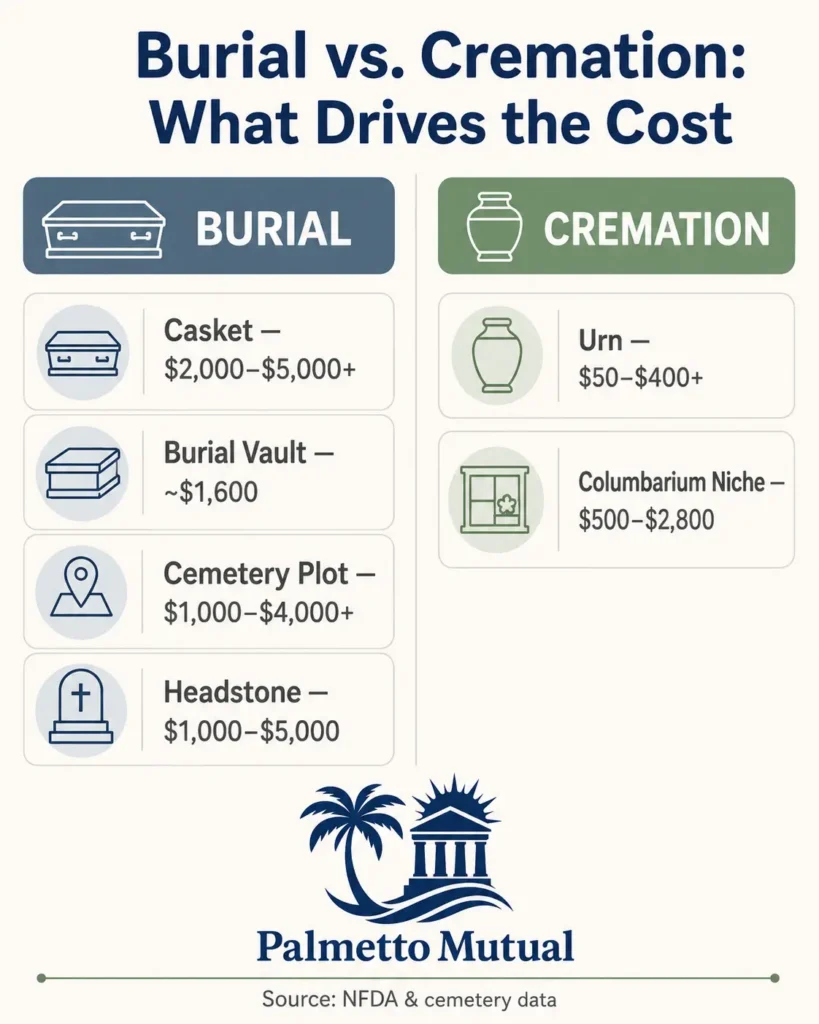
| Casket | $2,000–$5,000+ | Not required |
| Cremation fee | — | Included |
| Alternative cremation container | — | Included |
| Urn | — | $50–$400+ |
A few line items deserve a closer look because they drive most of the gap.
The basic services fee is the one charge you cannot decline, and it is the same whether you pick burial or cremation. It covers the funeral director’s coordination, permits, and overhead.
The casket is usually the single largest item in a burial, and cremation removes it. A mid-range metal casket runs about $2,500, and premium models climb past $5,000.
Embalming is another swing item. It is not required by law in most states and is usually only needed for an open-casket public viewing, so cremation families often skip it and save $500 to $1,000.
Cemetery costs sit outside the funeral home bill and apply mostly to burial:
| Cemetery Component | Typical Cost |
|---|---|
| Burial plot | $1,000–$4,000+ |
| Burial vault / grave liner | ~$1,600 |
| Opening and closing | $500–$1,500 |
| Headstone or marker | $1,000–$5,000 |
One fair note: cremation families who want a permanent resting place may still pay some cemetery charges, such as a niche in a columbarium or an urn burial plot. When that happens, the gap between the two paths narrows — a point the next section picks up.
Either way, a funeral insurance policy can be matched to the line items you actually expect, rather than to a national average that may not fit your plan.
Why Cremation Costs Less — and When It Doesn’t
Cremation is usually the cheaper path, but the reason has less to do with the cremation itself and more to do with what cremation lets a family skip. Understanding those skipped items helps you see both why the savings are real and why they can shrink.
What Drives the Lower Cost
The biggest savings come from items a burial requires that a cremation does not. A traditional burial needs a casket, and often a burial vault and a cemetery plot — three of the largest costs on the bill.
Here is what cremation typically removes from the picture:
| Item Burial Often Requires | Typical Cost Removed |
|---|---|
| Casket | $2,000–$5,000+ |
| Burial vault / grave liner | ~$1,600 |
| Cemetery plot | $1,000–$4,000+ |
| Embalming (when skipped) | $500–$1,000 |
Embalming is part of the savings too. It is not required by law in most states and is mainly needed for an open-casket public viewing, so cremation families often leave it off.
Add those removed items together and you can see why a simple cremation can cost many thousands less than a full burial. This is also why a smaller burial insurance policy can still fully cover a cremation when it would only partly cover a burial.
When the Gap Closes
The “cremation is always cheaper” idea breaks down once a family adds services and memorial items back in. A full-service cremation with a viewing, a ceremony, a nice urn, and a permanent resting place can climb close to the cost of a modest burial.
The two pieces that close the gap most are the urn and the niche. A display urn can run from about $50 to $400 or more, and a columbarium niche — a compartment in a wall that holds the urn — commonly costs $500 to $2,800.
| Cremation Choice | Added Cost |
|---|---|
| Direct cremation (no service) | Baseline, ~$2,000–$2,300 |
| Add viewing and ceremony | +$800–$1,600 |
| Add display urn | +$50–$400+ |
| Add columbarium niche | +$500–$2,800 |
Stack those on top of a basic cremation and the total can reach $6,000 or more — within reach of a modest burial. So the honest takeaway is that cremation is cheaper by default, but the savings depend entirely on how much service the family chooses to add back.
Beyond Cost: Religious, Cultural, and Personal Factors
For many families, price is not the deciding factor at all. Religious teaching, cultural tradition, and personal feeling often outweigh the dollars — and final expense insurance can fund either path, so the choice stays with the family.
Religious Doctrine
Faith traditions take very different positions on cremation, and for observant families this can settle the question entirely. Some require burial, some prefer or even mandate cremation, and many leave it to personal choice.
| Tradition | General Position on Cremation |
|---|---|
| Roman Catholic | Permitted since 1963; burial still preferred. Ashes must be kept in a sacred place, not scattered, divided, or kept at home |
| Eastern Orthodox | Forbidden |
| Mainline Protestant | Generally accepted as a personal choice |
| Orthodox / Conservative Judaism | Prohibited; burial required |
| Reform Judaism | Increasingly accepted, though often still discouraged |
| Islam | Forbidden; burial required, traditionally soon after death |
| Hinduism | Preferred and traditional; infants, young children, and some holy figures are exceptions |
| Buddhism | Commonly chosen but varies by sect; burial also permitted |
| Sikhism | Cremation generally preferred |
| Bahá’í | Cremation prohibited; burial required |
Positions can vary within a single faith, especially across denominations and individual congregations. When religion is a factor, the safest step is to ask a local clergy member how their community handles it.
Cultural Tradition
Culture shapes the choice even when formal religion does not. Some communities have buried their dead the same way for generations, and family expectations carry real weight.
In some countries cremation is nearly universal — Japan cremates almost everyone — while in others burial remains the deep-rooted norm. Families with strong cultural ties often feel that honoring the customary practice is part of honoring the person.
These traditions can also blend in mixed-heritage or interfaith families. A common solution is to follow one practice for the disposition and bring everyone together for a shared memorial gathering afterward.
Personal Preference
When neither faith nor culture decides the matter, it comes down to what feels right. Some people want a permanent place their family can visit; others prefer the simplicity of cremation or the idea of scattering in a meaningful spot.
Comfort with the process matters too. One person may find a traditional burial more fitting, while another may prefer cremation for its flexibility in how and where remains are kept.
There is no wrong answer here, and writing wishes down ahead of time spares loved ones from having to guess. A funeral insurance policy supports whichever choice is made, so the decision can rest on meaning rather than money.
The Shift Toward Cremation: Trends and Data
For most of American history, burial was the default. That has changed in a single generation, and cremation is now the clear majority choice — a shift that helps explain why funeral insurance buyers increasingly plan around cremation costs.
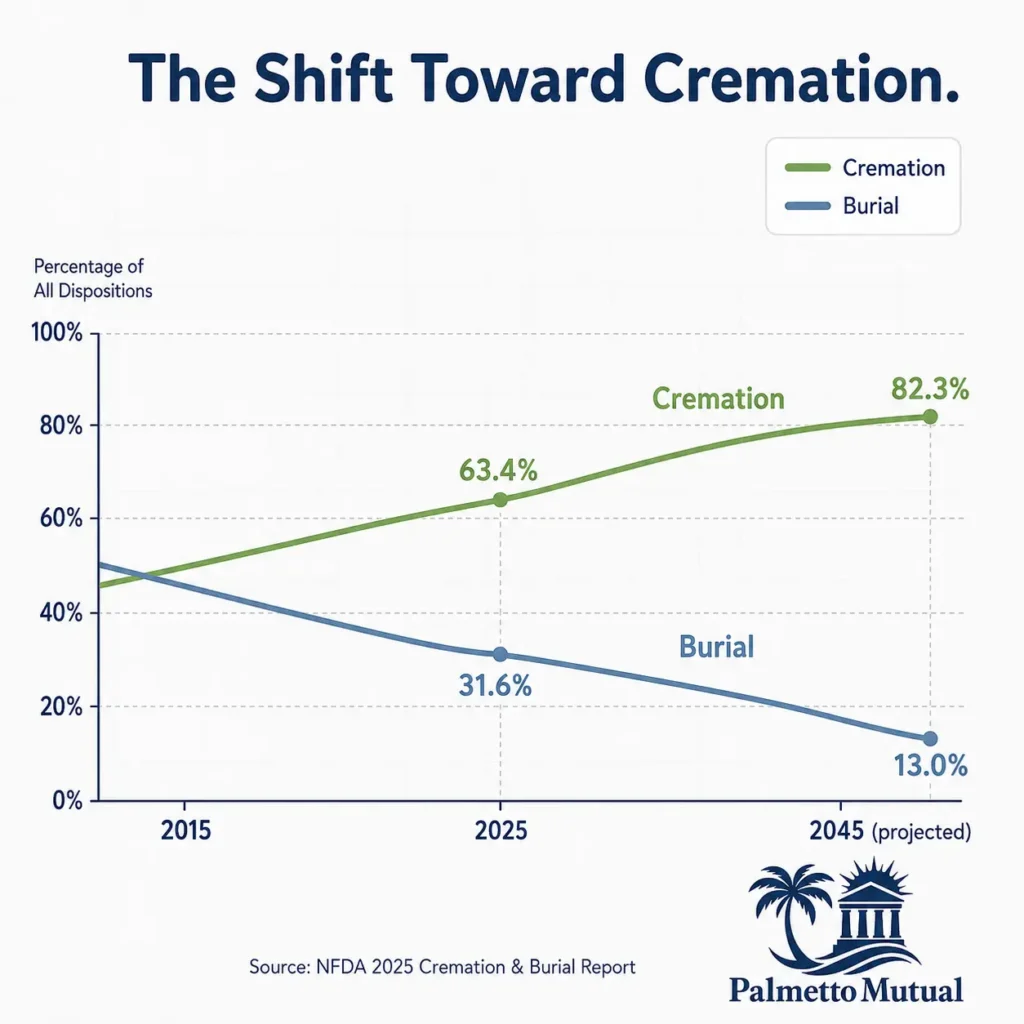
The turning point came in 2015, the first year more Americans chose cremation than burial. The gap has widened every year since.
Here is where the numbers stand and where they are headed, according to the National Funeral Directors Association (NFDA):
| Year | Cremation Rate | Burial Rate |
|---|---|---|
| 2025 | 63.4% | 31.6% |
| 2045 (projected) | 82.3% | 13.0% |
By 2045, the NFDA projects cremation will outpace burial by more than six to one. The Cremation Association of North America (CANA) reported a similar rate of 61.8% for 2024.
The trend is national, not regional. The NFDA projects that by 2035, every state and the District of Columbia will pass a 50% cremation rate.
That said, the starting points differ widely by region. Western states like Nevada, Washington, and Oregon have led for years, while many Southern states still favor burial — though the South is expected to see the fastest growth ahead.
Several forces are driving the change at once:
- Cost. Cremation is generally cheaper, especially the direct option.
- Flexibility. Families want services not tied to one cemetery plot, and relatives are often spread across the country.
- Fewer religious barriers. The share of Americans who identify as non-religious rose to 28% in 2023, up from 16% in 2007.
- Environmental concerns. Interest in simpler and greener options continues to grow.
The takeaway for planning is simple. Cremation is now the path most families take, but “cremation” covers everything from a bare-bones direct service to a full ceremony with a niche — and the cost range is wide. Sizing a burial insurance policy to the specific choice you expect keeps the payout matched to the real bill.
Frequently Asked Questions
Keep Reading






About the Author
Dvir Mosche is an award-winning independent insurance agent and the founder of Palmetto Mutual, a trusted insurance brokerage specializing in Final Expense Life Insurance. Since entering the industry in 2017, he has been recognized multiple times as a top agent for his dedication to educating and assisting seniors in finding the proper coverage. His mission is to simplify the process, provide honest and personalized guidance, and ensure that every client gets coverage they can depend on for life.


