
Home > Final Expense Insurance Scams > Independent vs. Captive vs. Buying Direct
Independent vs. Captive vs. Buying Direct: How to Shop for Final Expense Insurance

When you shop for final expense insurance, who you buy it from can matter as much as the policy itself. There are three common ways to get covered: through an independent agent who works with many companies, through a captive agent who represents just one, or directly from a TV or mail offer. This guide walks through how each option works, and how your choice can affect your price, your approval, and how long you wait for coverage to begin.
Why an Independent Broker Can Shop the Entire Market
An independent broker does not work for one insurance company. Instead, they hold contracts with many carriers at the same time. That means they can compare final expense insurance quotes from a whole list of companies for you.
This matters because every carrier prices the same policy differently. For one $15,000 burial policy, one company might charge $80 a month while another charges $120 for the same coverage.
The gap can be large. Some sources put the spread between the highest and lowest quote on the same coverage at several hundred dollars a year.
A broker who can see the whole market finds the low number, not just one number. You give your information once, and the broker checks it against many carriers at the same time.
Health history is where this really pays off. Each company has its own rulebook for conditions like diabetes, heart history, or lung problems. One carrier may charge you more for a past health issue while another barely notices it.
An independent broker knows these differences. They can steer you toward the company most likely to say yes at the best price, and away from the one likely to decline you or make you wait.
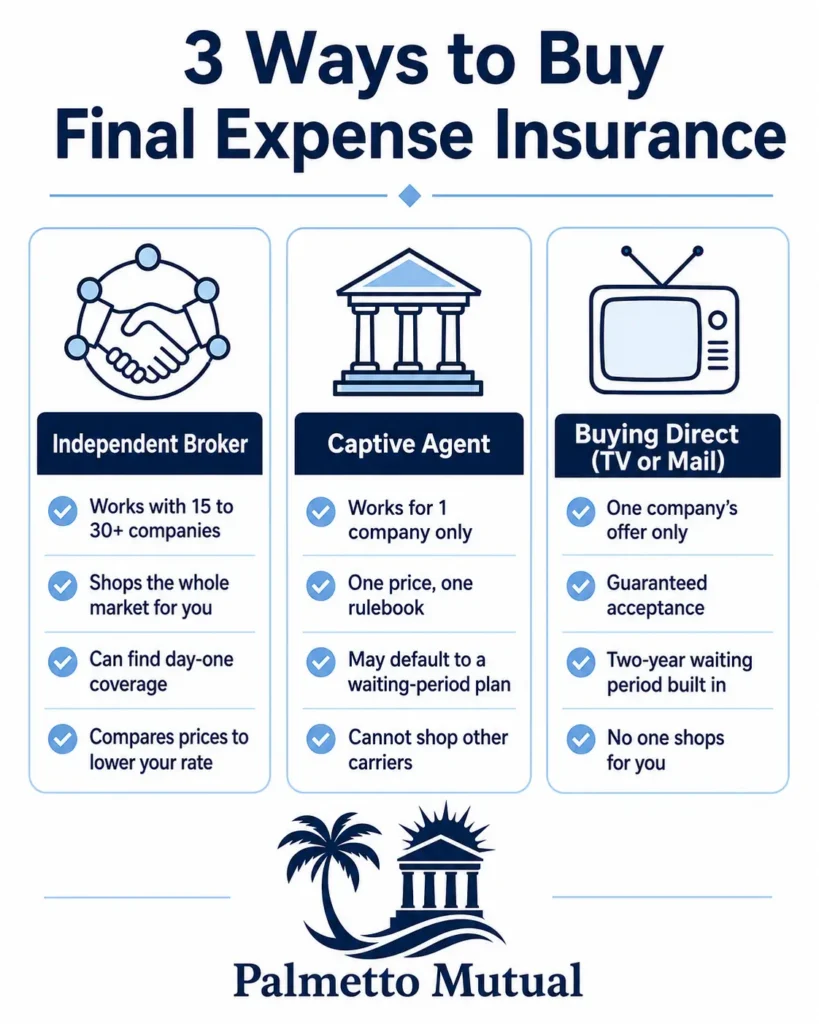
| How you shop | Number of carriers | What you see |
|---|---|---|
| Independent broker | Many (often 15 to 30 or more) | Multiple quotes, matched to your health |
| Captive agent | One | A single price from a single company |
| Direct (TV or mail) | One | One offer, usually with a waiting period |
The takeaway is simple. When one company can shop the whole market for you, your odds of a lower price and faster approval go up.
Day-One Approval With COPD, Insulin Diabetes, or Neuropathy
Many people assume that conditions like COPD, insulin-dependent diabetes, or nerve damage (neuropathy) mean they cannot get real coverage. That is often not true. With the right carrier, many people with these conditions still qualify for burial insurance that pays in full from day one.
“Day-one” coverage means the full benefit is available right away for natural death, with no two-year wait. The catch is that approval depends on the details of your condition and on which company you apply to.
Why Carrier Access Decides Your Waiting Period
Every final expense company draws its lines in a different place. One carrier may decline someone for insulin use, while another has no problem with it at all.
That single difference decides whether you get coverage today or wait two years. If you apply to the wrong company, you may be pushed into a plan with a waiting period even though a better option existed somewhere else.
This is why carrier access is the key. A person tied to one company only sees one answer. If that company says “wait two years,” there is nowhere else to go.
A broker with many carriers can do the opposite. They review each company’s health rules first, then send your application to the one most likely to approve you for immediate coverage.
The result is that two people with the very same condition can end up with very different outcomes — one waiting two years, one covered on day one — based only on which company they applied to.
Conditions That Usually Qualify for Immediate Coverage
The table below shows how these three conditions are often reviewed. Keep in mind that “usually” is not “always.” Your medications, how long you have had the condition, and any complications all play a role.
| Condition | Often qualifies for day-one coverage when… | Usually triggers a waiting period when… |
|---|---|---|
| COPD | Breathing is stable and no home oxygen is used | You are prescribed or use home oxygen, even sometimes |
| Insulin diabetes | Insulin use is stable with no major complications | There is recent insulin shock, diabetic coma, or a diabetes-related amputation, often within the last 24 months |
| Neuropathy | It is mild and blood sugar is under control | It comes with other complications like kidney disease, eye damage, or amputations |
A real example helps show this. One 72-year-old man with type 2 diabetes had used daily insulin for years with steady checkups. Instead of a waiting period, a broker matched him to a carrier friendly to stable insulin use, and he was approved for a level, day-one plan.
The lesson is that diabetes, COPD, or neuropathy alone does not decide the outcome. Stability, complications, and carrier choice do. Honest answers on the application matter too, since carriers check your responses against prescription and medical records.
If your condition is advanced — for example, end-stage COPD or diabetes with several complications — a day-one plan may not be available. In that case, a broker can still find you the best structure, such as a graded plan or a guaranteed-issue policy with a waiting period.
The Captive Agent Problem: When One Company Is the Only Option
A captive agent works for a single insurance company. They can only sell that one company’s final expense insurance, at that one company’s price, under that one company’s rules.
For many people, that is fine. If you happen to fit that company’s ideal customer, you may get a good rate.
The problem shows up when your health does not fit. If that single company charges a high price for your condition — or declines you outright — the captive agent has nowhere else to turn.
They cannot call a competitor. They cannot shop your file. Their hands are tied to the one menu they are allowed to sell from.
This is the quiet cost of a captive agent. It is not that they are dishonest or unskilled. It is that the structure limits what they can do for you.
The Modified-Plan Default
Here is what often happens next. When the captive company does not like your health, the agent cannot decline you and move on. Instead, they slot you into that same company’s fallback plan — usually a graded or modified plan with a waiting period.
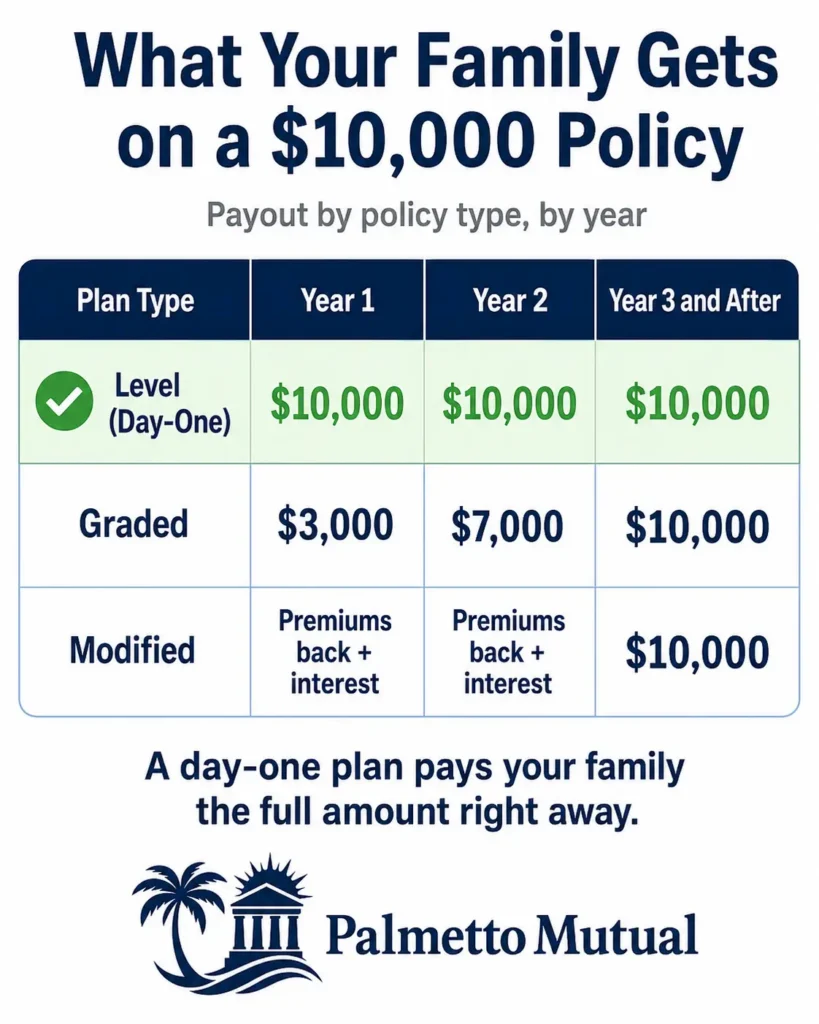
These fallback plans pay less in the early years. The table below shows how each one typically works on a $10,000 policy.
| Plan type | Year 1 payout | Year 2 payout | Year 3 and after |
|---|---|---|---|
| Level (day-one) | Full $10,000 | Full $10,000 | Full $10,000 |
| Graded | About 30% ($3,000) | About 70% ($7,000) | Full $10,000 |
| Modified | Premiums paid back, plus interest | Premiums paid back, plus interest | Full $10,000 |
The modified plan is the strictest of the three. If you pass away from natural causes in the first two years, your family gets back only what you paid in, plus a little interest — not the full benefit.
The trouble is that this becomes the default answer. With only one company to work with, a modified plan may be the best the captive agent can offer. Yet a different carrier might have approved you for a level, day-one plan for the same money.
That is the heart of the captive agent problem. You may be placed in a waiting-period plan not because it was your only option in the market, but because it was the only option that one company had.
Buying Direct From TV or Mail: The Two-Year Wait Built Into the Channel
You have likely seen the ads. A friendly host offers burial coverage for a low monthly price, with no health questions and guaranteed acceptance. These offers arrive on late-night TV and in mailbox postcards.
These are real policies from real companies. But the way they are built almost always includes a two-year waiting period.
Here is why. When a company asks no health questions and accepts everyone, it takes on a lot of unknown risk. To protect itself, it adds a waiting period to nearly every policy.
That means if you pass away from natural causes in the first two years, your family usually gets back only the premiums you paid, plus interest — not the full benefit. Death from an accident is typically covered in full from day one.
A few well-known direct offers show the pattern:
| Direct offer | How it is sold | The catch |
|---|---|---|
| Colonial Penn $9.95 “unit” plan | Guaranteed acceptance, TV and mail | Two-year waiting period; each $9.95 “unit” buys less coverage as you age |
| Globe Life | TV and mail, “starts at $1” | First month is $1, then rates can rise every five years |
| AARP / New York Life | Group plans for members | Guaranteed acceptance option carries the standard two-year wait |
To be fair, guaranteed acceptance funeral insurance serves a real purpose. If your health is serious enough that no company will approve you through health questions, it can be the right safety net.
The catch is for people who are healthier than they think. If you could have qualified for a day-one plan, buying a guaranteed-acceptance policy directly means you pay more for a waiting period you never needed.
The direct channel also gives you no one to shop for you. You get one company’s offer, take it or leave it. If that offer is not your best fit, there is no agent comparing other carriers on your behalf.
How to Tell Which Kind of Agent You’re Talking To
You do not have to guess who you are dealing with. A few simple checks tell you fast whether someone can shop the whole market for you or just sell one company’s plan.
The most direct method is to ask one plain question: “How many insurance companies do you represent?” A captive agent names one. An independent agent can rattle off a list.
Another quick check is the name. If the agency name and the insurance company name are the same, you are likely with a captive agent. If the agency name is different from the carrier that ends up on your policy, you are likely with an independent one.
The table below sums up the tells.
| What to check | Captive or direct | Independent |
|---|---|---|
| “How many companies do you represent?” | One | Many (often 15 to 30 or more) |
| Agency name vs. carrier name | Same name | Different names |
| Website or signage | One company’s logo | Lists several carriers, or says “independent” |
| Came from a TV or mail ad | Usually one company, direct | You are shopping the company directly, with no agent comparing others |
One more sign is what happens when there is a problem with your health. A captive or direct source can only offer their own answer. An independent broker can say, “That carrier is strict on your condition, but this other one is not.”
Agents are generally required to tell you their status if you ask, so there is no harm in asking plainly.
The goal is not to decide that one type of person is good and another is bad. It is to know, before you buy burial insurance, whether the person in front of you can actually shop the market — or is limited to a single shelf.
Frequently Asked Questions
Keep Reading







About the Author
Dvir Mosche is an award-winning independent insurance agent and the founder of Palmetto Mutual, a trusted insurance brokerage specializing in Final Expense Life Insurance. Since entering the industry in 2017, he has been recognized multiple times as a top agent for his dedication to educating and assisting seniors in finding the proper coverage. His mission is to simplify the process, provide honest and personalized guidance, and ensure that every client gets coverage they can depend on for life.


