
Final Expense Insurance with Lupus

If you have lupus, you can still get final expense insurance. How carriers view your application depends mostly on how well your lupus is controlled, which medications you take, and whether you’ve had recent flares, hospital stays, or organ involvement. This guide walks through where lupus usually lands with carriers, how they underwrite it, what you’re likely to pay, and which companies tend to be the most lenient. Everything here is specific to lupus, so you can find your real options without sorting through general coverage explanations.
Can you get final expense insurance with lupus?
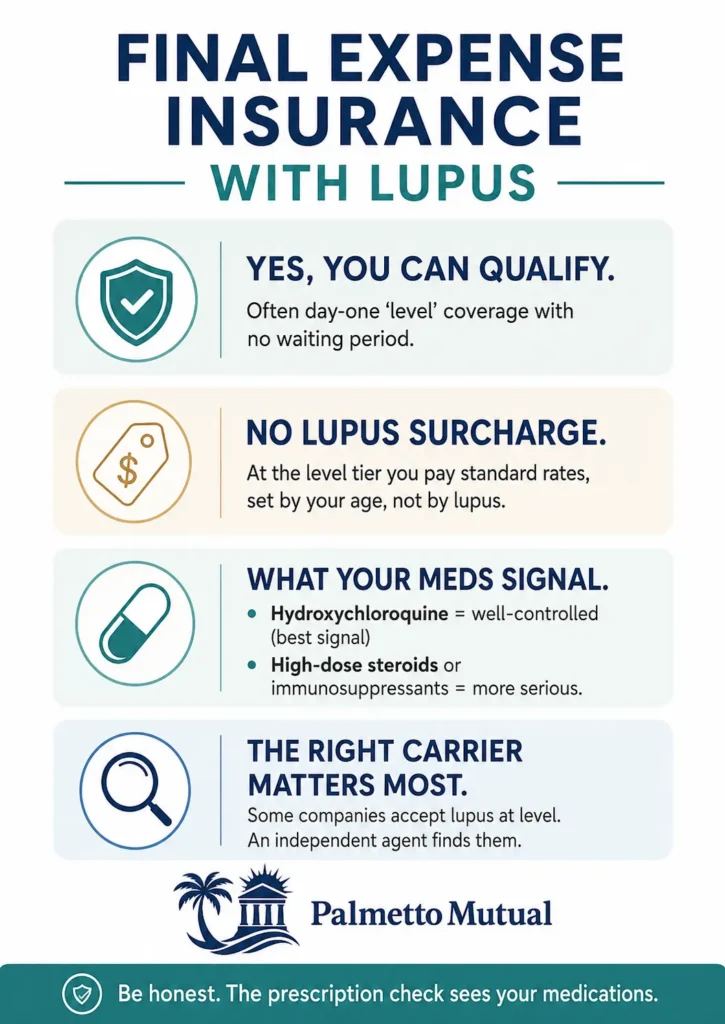
Yes. Lupus is not a condition that shuts you out, and in most cases you can qualify for a policy that covers you from the first day — no waiting period, and the lowest price the company offers.
That first-day option is called a “level” plan. It is the top tier, and lupus is eligible for it with the right carrier. You are not forced into a guaranteed-issue plan with a two-year wait unless your situation is unusually complicated.
Here is the honest part: not every company treats lupus the same way. Some burial insurance carriers barely react to it, while others ask more questions and may steer you toward a slower plan. That is why the company you apply with matters more than the diagnosis itself.
What moves you within that range comes down to a few specifics:
- How well controlled your lupus is right now
- Which medications you take, and at what strength
- Whether you have had a recent flare, hospital stay, or organ involvement affecting the kidneys, lungs, or heart
If your lupus is stable and managed, you are in a strong position for level, first-day coverage. If you have had recent complications, immediate coverage is often still possible, but your list of accepting companies gets shorter. Either way, real funeral insurance coverage is available to you.
How carriers underwrite lupus
With final expense insurance, underwriting lupus comes down to two things: the health questions on the application, and the prescription check that runs quietly in the background. There is no medical exam and no bloodwork. That is what makes these plans reachable when fully underwritten policies are not.
The lupus question is the first lever, and the wording decides a lot. Carriers phrase it in one of two ways:
- A look-back window, such as “in the past two years, have you been diagnosed, treated, or taken medication for lupus?” If your diagnosis and treatment are older than that window, you can honestly answer no.
- An “ever” version, with no time limit at all. Because lupus is lifelong, you answer yes, and then it comes down to whether that particular carrier still offers you a level plan with a yes.
A few carriers do not ask about lupus at all. With those, you are underwritten like anyone else, at the same price. Finding them is the whole game, and it is where an experienced agent earns their keep.
Beyond that one question, expect a short set of follow-ups about complications: whether lupus has affected an organ, whether you have had a recent hospital stay, and whether the disease is active or stable right now. Answer honestly. The prescription check will show your treatment either way, so the goal is for your answers and your medication record to tell the same story.
That prescription record is the second lever, and it does more work than the questions. Even at a carrier whose look-back you clear, the medications you fill still paint a picture of how serious your lupus is. The exact mechanics of the prescription database and the MIB check — what they see, how far back they reach, and why a drug you stopped years ago can still appear — are covered in full on our prescription history page.
Medications underwriters watch for with lupus
There is no single “lupus drug.” What you take, and whether it has stayed steady, tells an underwriter more than the diagnosis alone. A stable regimen you have been on for a year or more is the strongest signal; frequent changes or added drugs suggest the disease is harder to control. Here is what the common medications communicate:
| Medication or drug class | What it signals to underwriters |
|---|---|
| Hydroxychloroquine (Plaquenil) | First-line, standard treatment. Points to milder, well-controlled lupus. Usually the most favorable signal. |
| Low-dose or short-term steroids | Managing an occasional flare. Not alarming on its own. |
| Ongoing high-dose steroids | Long-term, higher-dose use points to active or harder-to-control disease and weighs against you. |
| Immunosuppressants (methotrexate, azathioprine, mycophenolate) | The disease needs stronger control than a first-line drug provides. Frequent switching between these signals poor control. |
| Biologics (such as belimumab) | More significant systemic disease requiring targeted therapy. |
| Blood thinners | May point to lupus-related clotting problems (antiphospholipid), which carry their own underwriting story. |
| Anti-seizure medications | Sometimes used for lupus-related nerve or seizure activity, pointing to nervous-system involvement. |
| Diuretics, blood pressure drugs, bone-strengthening drugs | Usually treat complications or steroid side effects rather than lupus itself, but still fill in the picture. |
If your funeral insurance profile is hydroxychloroquine alone with no recent changes, you look about as good as a lupus applicant can. The more the list moves toward long-term steroids, multiple immunosuppressants, or biologics, the shorter your list of level-coverage carriers becomes.
Best companies and what you’ll pay with lupus
Here is the part that surprises most people. When a carrier accepts your lupus at the level tier, the lupus itself does not raise your price. You pay the same rate as someone your age without it. There is no “lupus surcharge.”
Your premium is set by the ordinary factors: your age, whether you are a man or woman, how much coverage you buy, tobacco use, and your state. The diagnosis only changes the price if it pushes you out of the level tier and into a guaranteed-issue plan.
Which companies are most lenient with lupus
The most forgiving final expense insurance carriers help you in one of three ways: the application does not ask about lupus at all, it uses a look-back window your diagnosis already clears, or it accepts a “yes” and still gives you level, first-day coverage.
No single company is best for everyone, because each one draws its lupus line in a different place. That is why comparing several carriers matters, and why working with an independent agency that represents many of them beats applying to one on your own.
What it costs
If you land at level, you pay standard burial insurance rates. Most $10,000 policies run about $50 to $100 a month, and your exact price depends on the factors above. Age moves the number more than anything else.
Here are sample non-tobacco rates for $10,000 in coverage:
| Age | Woman | Man |
|---|---|---|
| 50 | about $30/mo | about $38/mo |
| 75 | about $87/mo | about $113/mo |
| 80 | about $125/mo | about $164/mo |
The rate you lock in stays the same for life, so the price is largely a function of your age on the day you apply. The increase is steepest between ages 75 and 80, close to 45 percent.
If your lupus is severe or recent enough that only a guaranteed-issue plan fits, expect a higher premium and a two-year waiting period before the full benefit is payable. For lupus, that is the exception, not the rule.
Full pricing by age and by coverage amount lives on our cost-by-age and cost-by-coverage pages.
How to get the best rate and coverage with lupus
Getting the best outcome with lupus is less about your health changing and more about applying the right way, at the right company, with the right facts ready. A few simple habits are the difference between a level, first-day policy and an avoidable decline.
Before you apply, get your details straight:
- Know your diagnosis date, your exact medications and doses, the date of your last flare, and any hospital stays. You will be asked these things, and clear answers help match you to the right carrier the first time.
- Be specific about severity. If your lupus is skin-only or well controlled, say so plainly. Do not let a carrier assume organ involvement just because the application says “lupus.”
When you apply:
- Disclose everything, especially your medications. The prescription check will show steroids and immunosuppressants whether you mention them or not, and leaving them off looks like a red flag. Honesty here is strategy, not just principle.
- Lean on stability. A steady, unchanged treatment regimen and time since your last flare are the strongest levers you have with a burial insurance underwriter. If you have just had a flare, a hospital stay, or a medication change, giving it a little time before applying can widen your list of level-coverage carriers.
- Apply where your profile fits. The wrong company can hand you a decline you did not need, which then shows up when the next carrier checks your history. Matching the carrier to your situation is exactly what an independent agency does for you.
Two related topics live on their own pages so this one stays focused. How the waiting period and graded benefit actually work is covered on our no-waiting-period page. What happens if you are declined, and how to recover, is covered on our can-you-be-denied page.
The bottom line stays the same: with lupus that is stable and managed, most people reach level, first-day funeral insurance simply by applying in the right place with honest, well-prepared answers.
Keep Reading







About the Author
Dvir Mosche is an award-winning independent insurance agent and the founder of Palmetto Mutual, a trusted insurance brokerage specializing in Final Expense Life Insurance. Since entering the industry in 2017, he has been recognized multiple times as a top agent for his dedication to educating and assisting seniors in finding the proper coverage. His mission is to simplify the process, provide honest and personalized guidance, and ensure that every client gets coverage they can depend on for life.


