
Home > Final Expense Insurance Cost > 10,000 Final Expense Insurance
$10,000 Final Expense Insurance: Cost & Options For 2026

A $10,000 final expense policy is a small whole life plan built to cover funeral costs, burial or cremation, and other end-of-life bills, with the payout going straight to your family in cash. Of all the coverage amounts people choose, $10,000 is the most common. It’s close to the average funeral cost nationally, so it tends to be the “default” starting point for burial insurance shoppers. Monthly premiums vary based on your age, sex, health, and whether you use tobacco, which is why this guide walks through each plan type and rate tier separately. Because $10,000 is the most common amount sold, it’s worth a close look to make sure it actually fits your situation rather than just following the crowd.
| Carrier | Monthly | Annual | Plan Details |
|---|
Rates shown are estimates for a $10,000 level/preferred whole life final expense policy, for comparison purposes only. Actual premiums may vary based on health underwriting. Not all companies are available in all states. Contact Palmetto Mutual for exact pricing and eligibility.
Is a $10,000 Final Expense Policy the Right Fit for Your Situation
A $10,000 policy is the amount most people buy, but the most popular choice is not automatically the right choice for you. This section helps you decide whether $10,000 of burial insurance matches your real needs, or whether you’d be better served sizing up or down.
Why $10,000 Is the Most Common Final Expense Coverage Amount
Ten thousand dollars sits in a natural middle ground. It lands above the cost of a simple cremation and close to the cost of a basic traditional funeral, so it covers the most common end-of-life expense without paying for coverage you may not use.
The price also stays reasonable for most working and retired seniors. Industry pricing puts a $10,000 final expense policy in the range of roughly $50 to $100 a month for many applicants, depending on age and health
Carriers tend to compete hardest in this range, too. Because $10,000 is sold so often, many companies build their sharpest rates and their main whole life product around this exact amount. When you choose $10,000, you’re picking a well-traveled, well-priced tier.
Who $10,000 of Coverage Suits Best
This amount fits several common situations well. The strongest matches tend to be:
- Seniors planning a modest traditional funeral, or a fuller cremation with a memorial service
- Applicants who want to cover the funeral plus a small cushion for leftover medical bills or debts
- Retirees on a fixed income who can comfortably pay the monthly premium without strain
- Applicants in their 60s and early 70s, who lock in the best long-term value at this tier before rates climb sharply in later years
The common thread is a person who wants the funeral handled and a little breathing room left over, at a premium that fits the monthly budget for life.
When $10,000 Falls Short
For some readers, $10,000 leaves a real gap. You should think about more coverage if any of these describe you:
- You’re planning a higher-end traditional burial with full services, a premium casket, or a vault and upgraded plot
- You carry significant credit card debt or expect sizable outstanding medical bills
- You have specific final wishes that run above national averages, such as a mausoleum, a destination service, or a premium casket
- You live in a higher cost-of-living region, where funeral prices can run well above the national norm
In the Northeast and on the West Coast, a full traditional funeral can reach $14,000 or more once cemetery and add-on costs are included, which can leave a $10,000 policy short of the full bill
When $10,000 Is More Than You Need
It’s just as honest to say that some readers don’t need this much. You may be better served by a smaller policy if:
- You’re specifically planning a direct cremation, which costs a small fraction of a traditional funeral
- You already have savings set aside that are earmarked for final expenses
- Your family plans to handle the costs directly, and you only want a modest supplement
There’s a budget point here that matters. A reader who is struggling to afford $10,000 may be better off with $5,000 of coverage they can comfortably pay every month for the rest of their life, since a policy only protects your family if it stays in force.
What Can $10,000 Actually Cover When Funeral Bills Add Up
A $10,000 death benefit comes a lot closer to “covering it” than a $5,000 policy does, but the gap still depends on what kind of service you want and where you live. This section walks through what the money realistically pays for, so you can size your funeral insurance with clear eyes.
The True Cost of a Traditional Funeral in 2026
It helps to separate two numbers that often get blurred together. The first is the funeral home’s own charge for a service with viewing and burial; the second is the all-in total once the cemetery and extras are added.
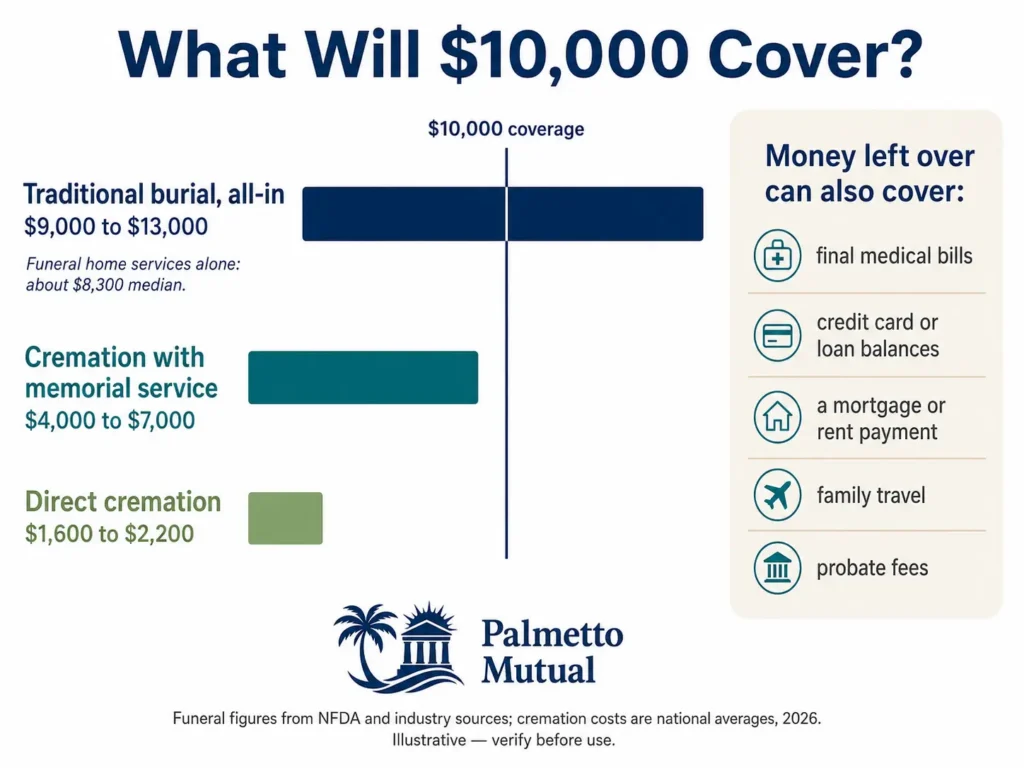
For the funeral home’s services alone, the national median for a funeral with viewing and burial is about $8,300, and roughly $9,995 once a burial vault is included. These figures do not cover the cemetery plot, headstone, flowers, obituary, or reception.
Once those add-ons are included, the all-in cost of a traditional burial typically ranges from $9,000 to $13,000 nationwide. The major cost pieces break down roughly like this:
| Cost component | Typical range |
|---|---|
| Funeral home services (viewing + burial) | $8,300 median |
| Burial vault | adds ~$1,700 (brings total to ~$9,995) |
| Cemetery plot | $1,000–$5,000+ |
| Headstone or grave marker | $1,000–$3,000 |
| Flowers, obituary, reception, certificates | $2,000–$5,000 |
Region drives a lot of the spread. Funerals in the Northeast and on the West Coast routinely top $14,000, while many Southern and Midwestern states run closer to $8,000–$10,000
How $10,000 Stacks Up Against a Traditional Burial
At this tier, the math gets interesting. Measured against an all-in traditional burial of roughly $9,000–$13,000, a $10,000 policy covers 80%-110% of the cost, depending on your region and the choices you make.
That means many readers find $10,000 covers the funeral itself but leaves little or nothing for other bills. The death benefit can be fully spent on the service, with nothing left for outstanding debts, family travel, or final medical costs.
So the real decision often comes down to a fork. You can buy $10,000 to cover the funeral alone, or step up to $15,000–$20,000 to cover the funeral plus a financial buffer for everything that comes after.
What $10,000 Covers for Cremation Services
If you’re leaning toward cremation, $10,000 is generous. A direct cremation runs about $1,600–$2,200 on average nationally, within a broader $1,000–$3,500 range
A cremation with a memorial service or fuller add-ons typically runs around $4,000–$7,000. Even at the higher end of that range, a $10,000 policy covers the entire cremation and still leaves roughly $3,000 or more for other final expenses.
For a cremation-focused buyer, that leftover cushion is the real value of choosing $10,000 over a smaller amount.
Other Common Uses for the $10K Death Benefit
The payout is paid to your beneficiary in cash, and it isn’t restricted to funeral costs. Your family can use it for whatever needs are most pressing at the time.
Common uses beyond the funeral include:
- Final medical bills, which can be substantial; one in ten traditional Medicare beneficiaries spent over $10,000 on health care in a single year
- Outstanding credit card balances or personal loans
- A mortgage or rent payment to keep a surviving spouse stable in the home
- Travel costs for family members coming to the funeral
- Probate-related fees and final paperwork costs
This flexibility is part of why $10,000 appeals to so many buyers: it can serve as a funeral fund, a debt-cleanup fund, or a mix of both, decided by the family in the moment.
Monthly Costs for a $10,000 Whole Life Policy (Non-Tobacco)
For most healthy applicants, a $10,000 burial insurance policy is priced as level benefit whole life, with a fixed premium that never changes. This section breaks down what non-tobacco applicants typically pay and why the number on your quote depends so heavily on your age and sex.
How $10,000 Whole Life Pricing Is Calculated
Carriers set your premium based on four main inputs: your age at policy issuance, your sex, your tobacco status, and your health tier. Once the policy is issued, the premium is locked and never increases.
The $10,000 amount tends to hit a pricing sweet spot. It’s large enough that the fixed costs of issuing a policy are spread across more coverage, so the cost per dollar is a bit lower than at $5,000, but small enough that simplified underwriting (a few health questions, no medical exam) stays quick and straightforward.
Two facts shape every rate table for this product. Women pay less than men at every age because they tend to live longer, and the premium climbs faster the older you are when you apply
$10,000 Whole Life Monthly Rates by Age
The table below shows average monthly premiums for a $10,000 level benefit final expense policy, non-tobacco, by age and sex. These are cross-carrier averages; your own quote will vary by health, state, and carrier.
| Age | Male (monthly) | Female (monthly) |
|---|---|---|
| 50 | $31 | $24 |
| 55 | $36 | $28 |
| 60 | $44 | $33 |
| 65 | $56 | $41 |
| 70 | $75 | $53 |
| 75 | $100 | $72 |
| 80 | $140 | $98 |
| 85 | $193 | $136 |
Sample monthly rates for non-tobacco applicants at $10,000 of coverage. Applying does not guarantee approval.
Why $10,000 Whole Life Rates Vary Significantly Between Carriers
Two applicants with nearly identical profiles can get $10,000 quotes that differ by 20% to 40% from one carrier to the next. The averages in the table hide that spread.
The reason is that each carrier has its own underwriting niches. One company may price aggressively for healthy applicants in their 60s, another may be the better deal for older applicants, and a third may offer the friendliest rules for a specific health condition, such as controlled diabetes.
At $10,000 of coverage, those percentage gaps turn into real dollars every month for the rest of your life. This is exactly where shopping multiple carriers, rather than buying the first quote, pays off most — and it’s the core advantage of working through an independent broker who can place you with the carrier whose niche fits your profile rather than a single company’s one-size product.
What Tobacco Users Pay for $10,000 Whole Life Coverage
Tobacco use raises the price of final expense insurance, sometimes steeply, but the rules around what counts as “tobacco” and how long it follows you vary more than most buyers expect. This section covers what smokers and other tobacco users can expect to pay for $10,000 of coverage and where the carrier you choose makes the biggest difference.
How Tobacco Status Changes Your $10,000 Premium
As a rule of thumb, tobacco rates run somewhere around 30% to 60% above non-tobacco rates for the same age, sex, and coverage amount, though the gap can be wider at some carriers. For one published example, a 65-year-old female smoker averages about $63 a month for $10,000 versus roughly $50 for a non-smoker, about a 26% difference
The definition of “tobacco user” varies from place to place. Some carriers count cigars, pipes, chewing tobacco, and vaping; others apply the tobacco rate only to cigarettes.
Look-back periods differ, too. Many carriers ask whether you’ve used tobacco in the past 12 months, while others use a 24-month window. Because the $10,000 difference is meaningful, shopping for a carrier with tobacco-friendly definitions and a shorter look-back period is one of the most valuable steps a tobacco-using applicant can take.
$10,000 Whole Life Tobacco Rates by Age
The table mirrors the non-tobacco section, showing average monthly premiums for a $10,000 level benefit policy for tobacco users by age and sex.
| Age | Male (monthly) | Female (monthly) |
|---|---|---|
| 50 | $41 | $31 |
| 55 | $50 | $39 |
| 60 | $61 | $46 |
| 65 | $76 | $58 |
| 70 | $99 | $72 |
| 75 | $132 | $95 |
| 80 | $182 | $135 |
| 85 | $258 | $211 |
Sample monthly rates for tobacco applicants at $10,000 of coverage. Applying does not guarantee approval.
Re-Rating to Non-Tobacco Status After Quitting
Here’s a detail most competitor pages skip. Many carriers will re-rate a policy to non-tobacco pricing after the insured has been tobacco-free for a set period, commonly 12 to 24 months.
On a $10,000 policy held for many years, switching from tobacco to non-tobacco pricing can save thousands of dollars over the policy’s life. The savings compound because the premium is locked at the lower level for good once you requalify.
If you’ve recently quit, or plan to, it’s worth asking each carrier directly about its re-rating policy before you buy, since the rules are not uniform across the market.
Special Cases — Cigar Users, Vapers, and Smokeless Tobacco
The tobacco question gets more nuanced once you move past cigarettes, and this is where carrier choice really matters. A few patterns hold across the market.
- Occasional cigar users, meaning not daily, sometimes qualify for non-tobacco rates with certain carriers, though this is far from universal
- Vapers are increasingly treated as tobacco users industry-wide, but a small number of carriers still draw a distinction
- Smokeless tobacco, such as chewing tobacco, is almost always rated as tobacco use
Because no two carriers handle these cases the same way, an applicant who is a cigar smoker or a vaper can sometimes find a meaningfully better rate simply by being matched to the right carrier. This is another spot where comparing multiple companies, rather than accepting the first quote, directly affects the monthly price.
$10,000 Graded Benefit Plan Pricing by Age
When health issues keep you from qualifying for level benefit pricing, a graded benefit plan is often the next step. It still offers real coverage from day one, just at reduced amounts during the first couple of years. This section explains how graded works on a $10,000 burial insurance policy and what it costs.
How Graded Benefit Works on a $10,000 Policy
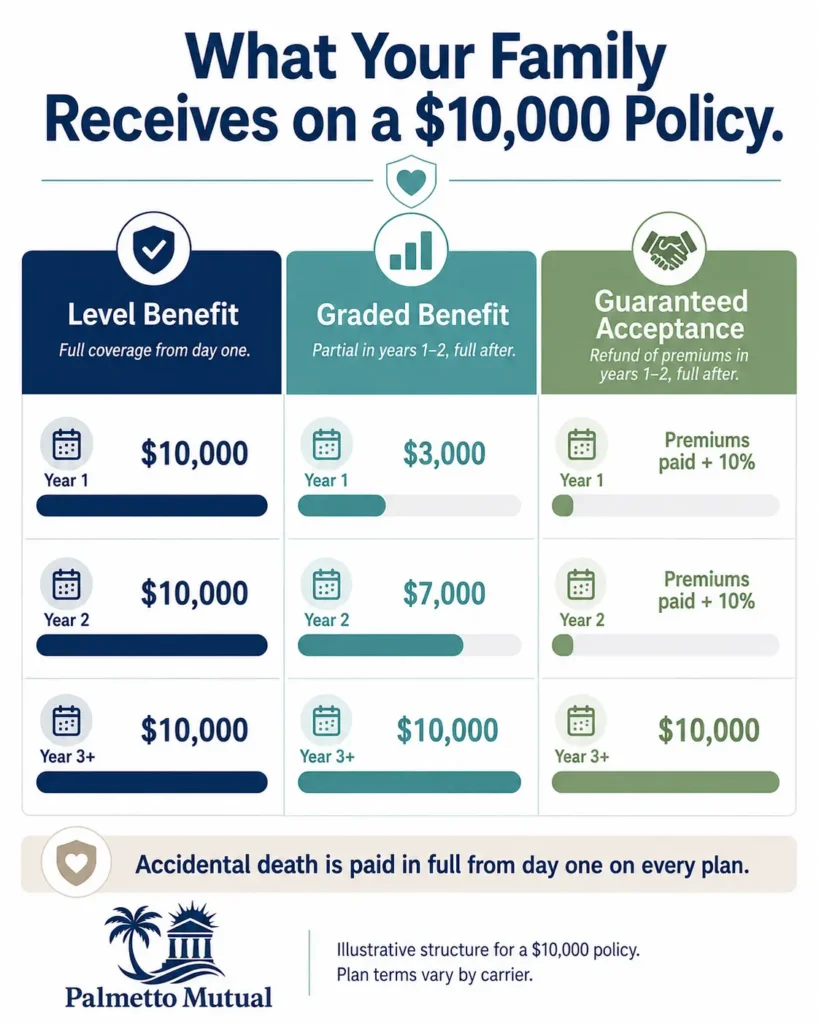
A graded benefit plan pays out only part of the death benefit if you die from natural causes during the first two years. The most common structure pays 30% in year one and 70% in year two, with the full benefit available from year three onward.
On a $10,000 policy, that schedule works out to a clear set of numbers:
| If death from natural causes occurs | Beneficiary receives |
|---|---|
| During year one | $3,000 (30%) |
| During year two | $7,000 (70%) |
| Year three and after | $10,000 (full benefit) |
Some carriers use a different approach, returning your premiums paid plus interest during the first two years instead of a percentage of the benefit. Either way, accidental death is typically covered in full from the first day.
The key thing to understand is that graded still gives you first-day protection at reduced amounts. That is meaningfully better than a plan with a true zero-benefit waiting period for natural death.
$10,000 Graded Benefit Monthly Rates by Age
Graded benefit premiums typically run about 15% to 30% higher than level benefit rates for the same age and coverage, reflecting the additional risk the carrier assumes. The table below applies that range to the non-tobacco level rates shown earlier in this guide.
| Age | Male (monthly) | Female (monthly) |
|---|---|---|
| 50 | $38 | $30 |
| 55 | $49 | $38 |
| 60 | $59 | $46 |
| 65 | $76 | $59 |
| 70 | $105 | $79 |
| 75 | $149 | $79 |
| 80 | $226 | $163 |
Sample monthly rates for $10,000 of coverage. Graded plans pay a reduced benefit during the first two policy years. Applying does not guarantee approval.
Who Falls Into the Graded Benefit Tier at $10,000
Graded is generally for applicants whose health is a concern but not severe enough to rule out a partial first-day benefit. Common profiles that land here include:
- A health diagnosis that is recent, roughly one to two years out
- A controlled chronic condition that crosses the threshold for level benefit but isn’t disqualifying
- Certain medications that get flagged in a carrier’s prescription history check
- Some heart conditions, severe COPD, or diabetes with complications
One honest note worth making: many people assume their health pushes them into graded when they could actually qualify for level benefit at a better price with the right carrier. Because each company draws these lines differently, it’s worth checking more than one before settling for graded.
$10,000 Guaranteed Acceptance Policy Rates (No Health Questions)
Guaranteed acceptance is the plan tier for people who can’t qualify for level or graded coverage. It approves everyone within the age range, but that certainty comes at the highest price per dollar and with a two-year limit on natural-cause payouts. This section covers how it works, what it costs, and the honest math on whether it’s the right call.
How Guaranteed Acceptance Works at $10,000 of Coverage
A guaranteed acceptance, or guaranteed issue, policy asks no health questions, requires no medical exam, and runs no prescription or medical-database check. Approval is guaranteed for anyone within the carrier’s age range, which is typically 45-50 to 80-85.
In exchange, every guaranteed acceptance policy carries a two-year limit on natural-cause deaths. If you die of natural causes within the first two years, your beneficiary receives the premiums you paid, plus interest at around 10%, rather than the full $10,000.
Accidental death is the exception and is usually covered in full from day one. Because the carrier takes on the most risk with this product, accepting applicants sight unseen, it’s the most expensive plan tier per dollar of coverage.
$10,000 Guaranteed Acceptance Monthly Rates by Age
Guaranteed acceptance rates are typically 40% to 80% higher than level benefit rates for the same profile. As one published data point, a 70-year-old man pays roughly $99 a month for $10,000 of guaranteed issue, about 42% more than a comparable simplified-issue final expense policy
| Age | Male (monthly) | Female (monthly) |
|---|---|---|
| 50 | $61 | $42 |
| 55 | $67 | $51 |
| 60 | $74 | $59 |
| 65 | $99 | $72 |
| 70 | $115 | $87 |
| 75 | $163 | $126 |
| 80 | $225 | $206 |
Sample monthly rates for guaranteed acceptance coverage at $10,000. Guaranteed acceptance policies include a two-year waiting period; death from natural causes during the first two years returns premiums paid plus interest rather than the full benefit. Applying does not guarantee approval.
The Real Cost of $10,000 Guaranteed Acceptance Over Time
This is the math a buyer deserves to see plainly. At older ages, the monthly premium on a guaranteed acceptance policy is high enough that the total you pay in over time can approach or even exceed the $10,000 benefit, if you live long enough.
Take an 80-year-old paying roughly $250 a month. Over about three and a half years, that’s around $10,500 paid in, already more than the death benefit, with premiums continuing for life.
This is not a reason to dismiss the product. For some applicants in their late 70s or 80s, guaranteed acceptance is still the right choice because no other coverage is available to them. The point is that the buyer should see this math up front and make the decision with full information, not discover it later.
When $10,000 Guaranteed Acceptance Is the Right Choice — And When It Isn’t
Guaranteed acceptance is reserved for a specific group: applicants who genuinely can’t qualify for level or graded coverage. That includes people with recent serious health events, a terminal diagnosis, or specific disqualifying conditions, where $10,000 of immediate-ish coverage simply isn’t available any other way.
It’s the wrong choice when someone who could qualify for level or graded benefit gets steered into guaranteed acceptance anyway. That happens through rushed underwriting, high-pressure sales, or TV-advertised products that skip health questions because that’s the whole pitch.
Here’s a direct warning worth heeding. If you’re being told that guaranteed acceptance is your only path to $10,000 of coverage, and no one has asked you a single health question, get a second opinion before you sign. An independent broker who can run your profile across multiple carriers will often find you level or graded coverage at a meaningfully lower price.
Frequently Asked Questions
Keep Reading







About the Author
Dvir Mosche is an award-winning independent insurance agent and the founder of Palmetto Mutual, a trusted insurance brokerage specializing in Final Expense Life Insurance. Since entering the industry in 2017, he has been recognized multiple times as a top agent for his dedication to educating and assisting seniors in finding the proper coverage. His mission is to simplify the process, provide honest and personalized guidance, and ensure that every client gets coverage they can depend on for life.


