
Home > Final Expense Insurance Scams
Final Expense Insurance Scams: How to Spot and Avoid Them

Final expense insurance is a real and regulated product that many families use to plan for end-of-life costs. Like any industry, though, it has a few bad actors who use misleading sales tactics to take advantage of older shoppers. This guide explains how these scams tend to work, the warning signs worth watching for, and where to turn if something already feels wrong.
Is Final Expense Insurance Itself Legitimate?
Yes. Final expense insurance is a real, regulated type of small whole life insurance. It is sold by licensed companies and agents, and it works the same way any whole life policy does: you pay a premium, and when you pass away, your beneficiary receives a tax-free death benefit to cover funeral, burial, or other final costs.
Every insurance company must get a license from your state’s Department of Insurance before it can sell a policy there. To get that license, the company has to file its rates and prove it holds enough money in reserve to pay every claim.
The National Association of Insurance Commissioners, or NAIC, helps set shared standards across all 50 states. Independent firms like A.M. Best also rate each company’s financial strength, separate from the government.
So the product is sound. The problem is not the insurance itself. The problem is that a small number of dishonest sellers use misleading tactics, and one label in particular gets used to confuse people.
One thing worth knowing: there is no free, government-run burial insurance for the general public. Mailers advertising a “state-regulated life insurance program” or “government final expense benefit” are using official-sounding words to make you think the state is behind the offer. Every insurer is technically “state-regulated,” so the phrase is true but designed to mislead.
The Predatory Practices That Give This Industry a Bad Name
Most burial insurance agents are honest and do good work for their clients. But a few bad actors use tricks that have earned the whole industry a poor reputation among seniors. Knowing how these tactics work is the best way to protect yourself.
The three practices below come up again and again in consumer complaints and regulator warnings.
Bait-and-Switch Pricing and Fake “Approvals”
This tactic starts with a price or a promise that sounds great, then quietly changes once you are signed up. The low rate an ad shows is often the “best health” rate that very few people actually qualify for.
A common version works like this: the agent quotes you one plan, but the company only approves you at a worse one. Instead of telling you clearly, the agent keeps your monthly price the same and secretly lowers your coverage or adds a waiting period, so your bank statement looks like what you expected.
Another version swaps in an accidental death policy or rider. Accident-only coverage is very cheap, but it pays nothing if you die of natural causes like a heart attack, stroke, or cancer. Here is how that switch can look:
| What you were told | What you actually got |
|---|---|
| “$20,000 in coverage for about $80/month” | $10,000 natural-death coverage plus a $10,000 accidental-death rider |
| Pays out no matter how you pass away | Only pays the full $20,000 if death is caused by an accident |
| Covered from day one | May include a two- or three-year waiting period for natural death |
The word “guaranteed” is also used to mislead. A no-questions-asked policy is real, but it almost always has a two- to three-year waiting period. If you die of an illness during that window, your family gets back only the premiums you paid plus a little interest, not the full benefit.
High-Pressure Tactics Aimed at Seniors
Older shoppers are targeted on purpose because they are often researching this exact product. Scam mailers and robocalls lean on urgency and fear to push a quick decision.
Watch for language like “Last Notice,” “Response Required Immediately,” or claims that an offer disappears if you do not act within a set number of days. That pressure is the tactic.
Some sellers push a more expensive plan than you need, or pile on extra riders you did not ask about, simply to earn a bigger commission. A trustworthy agent gives you time to think and read the paperwork. A pushy one wants a signature and a payment on the spot.
It also helps to know how you ended up on their list. When you return a “more information” card, your details often become a sales lead that gets sold to many agents over months, which is why the calls and door knocks keep coming.
Policy Churning
Churning happens when an agent talks you into replacing a burial insurance policy you already own with a new one, mostly so they can collect a fresh commission. The new policy offers little or no real improvement.
Replacing a policy can quietly cost you. You may restart the waiting period, restart the two-year contestability period, and lose the level rate you locked in at a younger age.
A classic warning sign is being told to switch after only a year or two, with no change in your health or needs to justify it. Most states have adopted the NAIC’s replacement rules, which require agents to give you disclosures and a side-by-side comparison before you replace a policy.
The good news: most states give you a free-look period of about 10 to 30 days on any new policy, so you can cancel for a full refund if a replacement turns out to be a bad deal.
Red Flags Before You Sign
Most warning signs show up before you ever sign a form or hand over a payment. If you know what to look for, you can spot a bad deal early and walk away.
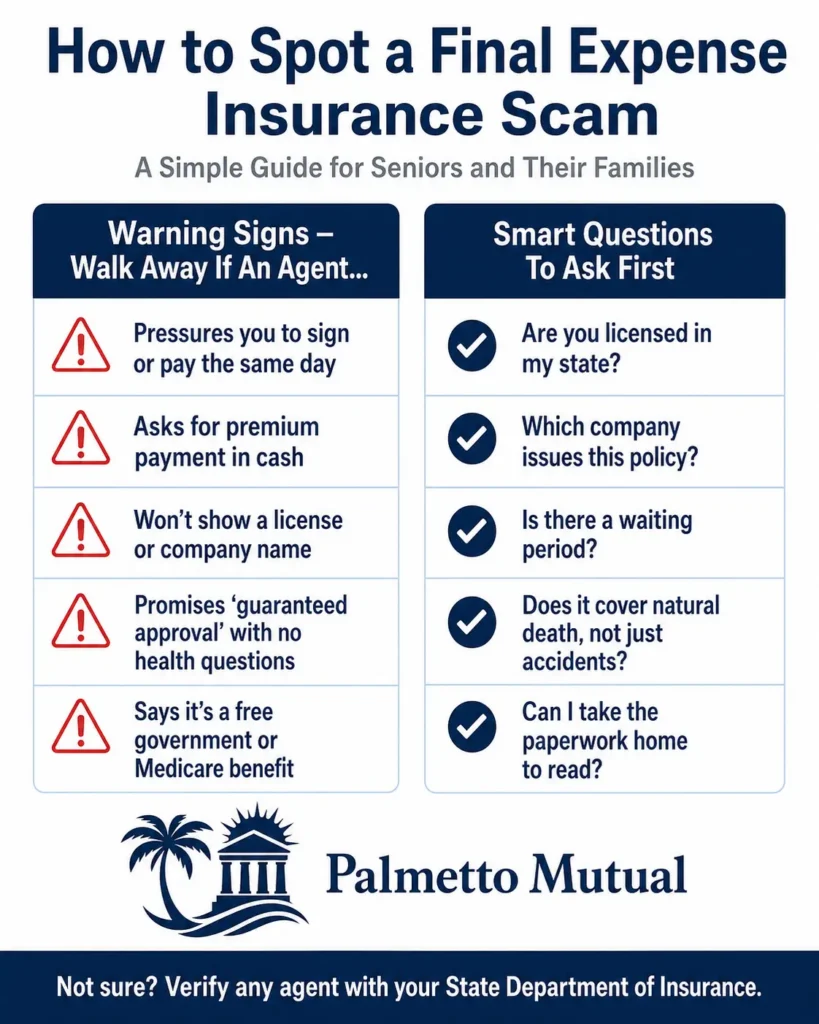
The two lists below give you a simple way to check any burial insurance offer: what a good agent should never do, and what to ask before you commit.
What a Trustworthy Agent Never Does
A reputable agent earns your business by being clear and patient. If any of these things happen, treat it as a reason to slow down or stop:
- Pressures you to sign or pay the same day, or says the offer disappears if you do not act right now.
- Asks for premium payment in cash, or wants payment before you have seen the actual policy.
- Refuses to show you their license, or gets vague when you ask which company they represent.
- Promises “guaranteed approval” or a rock-bottom price without asking a single health question, then glosses over the waiting period.
- Tells you final expense insurance is required by Medicare, or that it is a free government benefit. Neither is true.
- Pushes you to replace a policy you already own without giving you a written side-by-side comparison.
- Won’t put answers in writing, or brushes off your questions instead of explaining.
An honest agent welcomes your questions. Legitimate coverage holds up to scrutiny, so a good agent is glad to slow down and let you verify everything.
Questions to Ask Any Agent Before You Buy
You do not need to be an insurance expert to protect yourself. A few plain questions will tell you most of what you need to know about the agent and the funeral insurance they are offering.
| Question to ask | What a good answer sounds like |
|---|---|
| Are you licensed to sell insurance in my state? | Yes, and here is my name and license number so you can verify it with the state. |
| Which insurance company actually issues this policy? | A clear company name you can look up, not a vague program name. |
| Is this level coverage, or is there a waiting period? | A direct answer. If there is a waiting period, exactly how long it lasts and what my family gets if I pass away during it. |
| Does this pay for any cause of death, or only accidents? | Confirms whether natural causes like illness are fully covered. |
| Will my premium or my benefit ever change? | With whole life final expense, the premium and benefit are fixed and should not change. |
| Can I take the paperwork home to read before I decide? | Yes, take your time. There is no rush. |
Two answers matter most: whether the agent is licensed, and whether the policy covers natural death from day one or after a waiting period. You can confirm any agent’s or company’s license yourself by calling your state Department of Insurance or using the NAIC’s search tools before you buy.
Most new policies also come with a free-look period of about 10 to 30 days. Even after you sign, you can cancel for a full refund during that window if something does not sit right.
If Something Already Feels Wrong: Where Each Problem Gets Handled
If you think you have been misled or already bought a policy that is not what you were promised, you have real options. The right place to turn depends on the type of problem, so the guide below matches common situations to the agency that handles them.
Before anything else, try to resolve it directly with the agent or the insurance company first. If that does not work, or if you suspect fraud, escalate using the table below.
| Your situation | Where to turn | What they can do |
|---|---|---|
| An agent or company treated you unfairly, or you want to check a license | Your state Department of Insurance | Investigate complaints, verify licenses, and take enforcement action against agents or companies |
| You suspect insurance fraud (a fake policy, a bogus agent, hidden terms) | State DOI fraud bureau or the NAIC Online Fraud Reporting System | Refer and investigate suspected insurance fraud |
| A deceptive offer or scam arrived in your mailbox | U.S. Postal Inspection Service | Investigate mail fraud and act against deceptive mailers |
| A scam, robocall, or unwanted solicitation more generally | Federal Trade Commission at ReportFraud.ftc.gov | Take reports and track large-scale fraud patterns |
| Someone misused your Social Security number or opened a policy in your name | IdentityTheft.gov (FTC) | Create an official Identity Theft Report and give you a recovery plan |
| You want an extra layer of consumer help | Your state Attorney General’s office | Review deceptive trade practices and, in some cases, take legal action |
A few tips make reporting more effective. Keep the mailer, policy, or paperwork, and write down every call and reference number you receive, since cross-reporting to more than one agency often speeds things up.
Remember your state Department of Insurance cannot force a company to pay a claim or act as your personal lawyer, but it can investigate unfair practices and explain your options. For deeper help, nonprofit groups like the Coalition Against Insurance Fraud also offer reporting resources for people targeted by scams.
The takeaway is simple: burial life insurance is a legitimate way to protect your family, and the same system that regulates it also gives you clear places to turn if something goes wrong.
Frequently Asked Questions

About the Author
Dvir Mosche is an award-winning independent insurance agent and the founder of Palmetto Mutual, a trusted insurance brokerage specializing in Final Expense Life Insurance. Since entering the industry in 2017, he has been recognized multiple times as a top agent for his dedication to educating and assisting seniors in finding the proper coverage. His mission is to simplify the process, provide honest and personalized guidance, and ensure that every client gets coverage they can depend on for life.


