
Home > Final Expense Insurance Scams > Scam Calls Seniors
Life Insurance Scam Calls Targeting Seniors

Phone scams that use life insurance as the hook are common, and they often target older adults. A caller might say your policy is about to lapse, claim you owe money on a burial insurance plan you never signed up for, or push a fake government program. This guide explains how these scams work, how to tell a real call from a fake one, and how to stop the calls for good.
The Most Common Scam Scripts — and How to Recognize Them
Most life insurance scam calls follow a small set of scripts. Scammers reuse them because they work. Once you know the pattern, the calls get much easier to spot.
The goal of these calls is almost never to sell you real insurance. It is to get your money, your Social Security number, or your bank details. Legitimate final expense insurance companies rarely cold call, and they never ask for sensitive information to “confirm” something out of the blow.
Here is a quick look at the three scripts you are most likely to hear, followed by a closer look at each.
| Scam script | What the caller claims | What they really want |
|---|---|---|
| Policy lapse | Your policy will be canceled unless you act now | A payment or your Social Security number |
| Fake beneficiary | You are owed a death benefit from someone who passed | Your personal and bank information |
| State burial program | Your state has a new burial benefit for you | Your contact info, to sell and resell as a lead |
“Your Policy Is About to Lapse”
In this script, the caller says your life insurance policy is about to lapse or be canceled. They create a sense of panic, then offer a quick fix — usually a payment or a “verification” step.
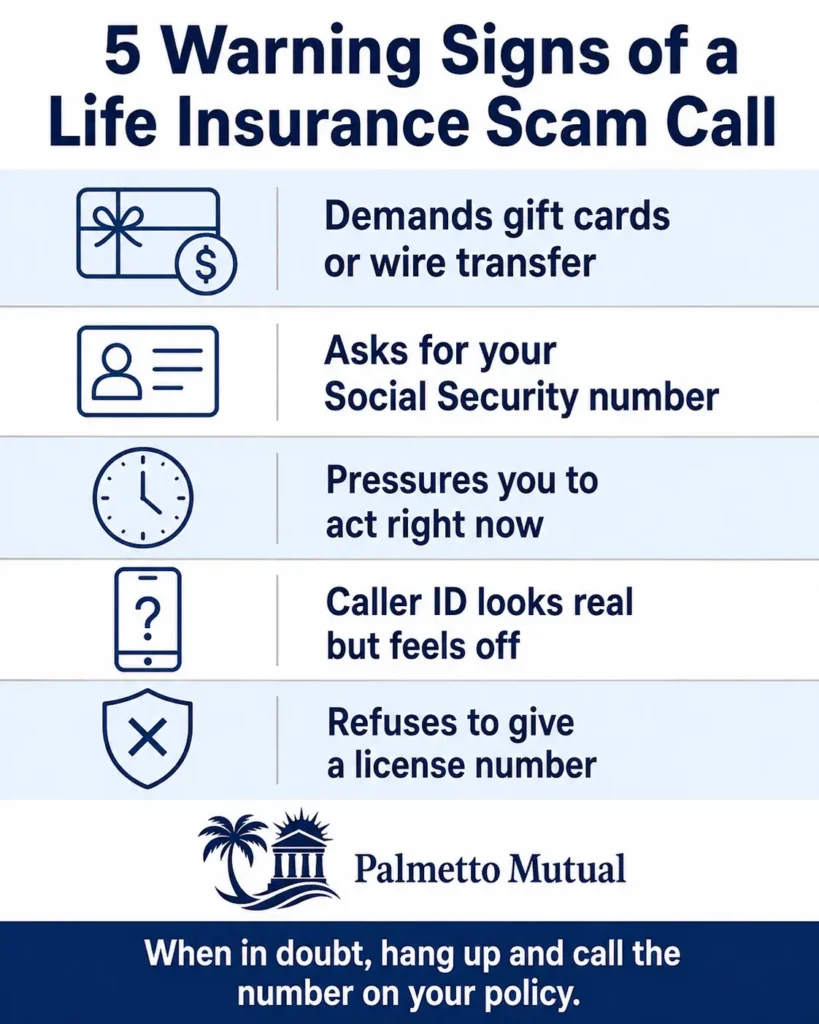
The tell is the request that follows. Scammers ask you to pay by wire transfer, gift card, money order, or cash to keep the policy active. Real insurers accept checks and electronic payments, which leave a record. A demand for gift cards or wire transfers is one of the clearest signs of a scam.
Another version asks for your Social Security number to “confirm your identity” or process a change to your policy. Scripts include lines like the terms of your policy have changed and they need your Social Security number first. Do not give it. A real company that holds your burial insurance policy already has your file.
If you get a call like this, hang up. Then call your insurance company using the number printed on your policy documents or their official website — not any number the caller gives you. Legitimate insurers do not contact you by phone to collect a missed payment.
Fake Beneficiary and Death Benefit Claims
This script preys on grief and surprise. The caller says someone you know has passed away and named you as the beneficiary of a life insurance policy — and all they need is your Social Security number or bank details to release the money.
A crueler version targets recent widows and widowers. The caller claims your late spouse secretly bought a large policy, but a final premium is owed before the payout can be released. They ask you to wire the money or send gift cards first. The policy does not exist. It is a scam.
The same trick appears by mail and email as a “long-lost relative” or inheritance notice. The Federal Trade Commission is direct about it: that inheritance or life insurance policy does not exist, and the goal is your money or your identity. The FTC’s advice is simple — do not respond, and report it at ReportFraud.ftc.gov.
Real beneficiary payouts do not work this way. You never have to pay a fee to receive a life insurance death benefit, and a real insurer will not call out of nowhere asking for your Social Security number to hand you money. If you think a relative may have had a policy, you can use the free Life Insurance Policy Locator from the National Association of Insurance Commissioners (NAIC) to check.
The “State-Regulated Burial Program” Pitch
This one blurs the line between a scam and aggressive marketing, so it is worth understanding clearly. You get a call or an official-looking mailer about a “new state-regulated life insurance program” or a “state burial benefit” for seniors in your area. The wording is designed to sound like a government benefit.
Here is the truth. No state or federal government offers, funds, or endorses free or discounted burial insurance. The phrase “state-regulated” is technically true of every insurance policy, because all insurers must follow state law — but marketers use it to imply government backing that does not exist.
The only real government help with funeral costs is small. Social Security pays a one-time death benefit of $255 to an eligible surviving spouse or child. Some states offer limited burial assistance through Medicaid, but these amounts are small and do not replace a private policy.
So what is the pitch really doing? Most of the names on these mailers are not insurance companies at all — they are lead generators using official-sounding names to collect your name, address, and phone number. Once you respond, your information is sold to agents, and the calls and door knocks begin. Regulators including the Florida Office of Insurance Regulation, the Pennsylvania Attorney General, and the Texas Department of Insurance have all warned consumers about these misleading mailers.
This does not mean every agent who contacts you is a criminal. Many sell real policies from real insurers. But an outfit that has to disguise itself as a government program to earn your trust is telling you something about how it does business. That leads directly to the next question — why these calls never seem to stop.
Why the Calls Won’t Stop: The Lead Resale Machine
If you have ever wondered why answering one insurance offer triggers weeks of calls, the answer is the lead resale machine. Understanding it is the key to understanding why funeral insurance calls are so persistent — and how to shut them off, which we cover later.
When you fill out an online quote form, respond to a mailer, or press a button on a robocall, you become a “lead.” Your contact information is now a product that can be bought and sold, often many times over.
Here is how the money flows. A company called a lead generator or aggregator collects consumer information through quote websites, social media ads, and direct mail. It then sells that information to insurance agents who want people to call.
The resale is the part that surprises most people. A single lead is frequently sold to multiple agents at once, and then resold again later as an “aged lead” at a lower price. Some discount sellers resell the same lead eight to fifteen times. That is why the calls come in waves and from different agents — your information keeps changing hands.
| Lead type | Roughly how it’s sold | Why you keep getting calls |
|---|---|---|
| Real-time exclusive | Sold once, to one agent | Fewer calls, but still active |
| Shared | Sold to several agents at the same time | Multiple agents call within minutes |
| Aged | Resold 30–120+ days later, sometimes many times | New waves of calls months after you inquired |
Aged leads are cheap on purpose. They can sell for as little as a few cents to a few dollars each, which is why one old inquiry can keep generating calls long after you have moved on. Even if you bought a policy already, your data may still be in circulation.
There are laws meant to limit this. The Telephone Consumer Protection Act (TCPA) restricts robocalls and automated texts, generally requiring your prior written consent, and violations can cost callers $500 to $1,500 per call. The federal Do Not Call registry adds another layer of protection.
But enforcement is imperfect. In early 2025 a federal appeals court struck down the FCC’s “one-to-one consent” rule, which had been designed to make lead generators get your permission for each individual company before selling your information. The broader TCPA framework still stands, but the resale model remains very much alive.
The practical takeaway is this. The calls are not random, and they are not a sign that you did something wrong. They are the predictable result of your information being treated as a resellable product. Because the source is your data in circulation, the fix is to cut off that circulation and block the calls — which is exactly what the later sections of this guide walk through.
How to Confirm a Call Really Came From Your Insurance Company
You do not have to figure out whether a call is real while you are still on the phone. The safest move is simple: hang up and call back a number you trust.
Here is why. Scammers use a trick called caller ID spoofing to make their number show up as your insurance company — even the exact name and number on your policy. Do not trust the caller ID. The name and number can be faked.
The FCC’s advice is the gold standard. If someone calls claiming to be your insurer, hang up and dial the number on your account statement, your policy documents, or the company’s official website — not any number the caller gives you.
There is one more useful clue. A legitimate company will usually send you a written notice by mail before calling about something serious like a payment or a policy change. A phone call that comes out of nowhere, with no letter first, is a reason to be cautious.
A few things a real insurer or licensed agent will never do:
- Demand your Social Security number to “verify” a policy they supposedly already hold
- Ask for payment by gift card, wire transfer, or cryptocurrency
- Pressure you to decide right now or lose your coverage
- Refuse to give a license number when you ask
That last point is worth using. Every real agent has a license number, sometimes called a National Producer Number, for each state they work in. Ask for it, then check it against your state’s Department of Insurance registry. If the caller hesitates or refuses, that is a strong sign of a scam.
One real-world example shows how convincing spoofing can be. Blue Cross Blue Shield has warned that scammers spoof its national “Call Blue” customer-service line — but that number only receives calls and is never used to make them. So if it appears on your caller ID as an incoming call, BCBS says the call is fake and you should not answer. The lesson applies to any insurer: when in doubt, you make the call.
If you would like a final expense insurance policy or want to check on one you already have, you can always reach out to a licensed agency directly on your own terms. That way you know exactly who is on the other end of the line.
Stopping the Calls for Good
Cutting down on funeral insurance scam calls takes a two-part approach. First, tell legitimate telemarketers to leave you alone. Second, use call blocking to catch the illegal callers who ignore the rules. Neither one alone is enough, but together they make a real difference.
It helps to know the split. Law-abiding telemarketers will honor a do-not-call request. Scammers and illegal robocallers will not — they operate overseas, spoof their numbers, and ignore U.S. law. That is why the two sections below tackle each group differently.
Do-Not-Call and List Opt-Outs
Start with the National Do Not Call Registry. It is free, registration is permanent, and it covers both cell phones and landlines. You can sign up at donotcall.gov or by calling 1-888-382-1222 from the phone you want to register.
Be clear about what it does. The registry tells legitimate telemarketers not to call you, and it can noticeably reduce those calls. But it does not block scammers, who ignore it entirely.
There is a gap worth knowing about. A company you have done business with in the past 18 months, or one you asked for a quote from in the last 3 months, can still call you under an “existing business relationship.” If you responded to a burial insurance mailer or quote form, this is often why the calls started. You can tell that company directly to stop, and it must honor your request.
Two more steps close the loop:
- Check whether your state has its own do-not-call list. Some states, including Florida, Texas, and Pennsylvania, offer separate registries with extra protections. Your state attorney general’s website will have details.
- Opt out at the source when you can. When a form has a pre-checked box granting permission to call, uncheck it. And avoid giving out your number unless it is required.
One important warning. If you get an illegal robocall, do not press any buttons — not even the “press 2 to be removed” option. Pressing a key tells the scammer your number is live and usually leads to more calls. Just hang up.
Call Blocking That Actually Works
Because scammers ignore the do-not-call list, call blocking is your real front-line defense. The good news is that the strongest tools are free and built into your phone service.
Every major carrier offers free call blocking and labeling that works at the network level, catching many illegal robocalls before your phone rings. Here is a quick reference:
| Carrier | Free tool | What it does |
|---|---|---|
| AT&T | ActiveArmor | Blocks and labels suspected spam and fraud calls |
| T-Mobile | Scam Shield | Flags “Scam Likely” and blocks known scam calls |
| Verizon | Call Filter | Screens, labels, and blocks unwanted calls |
| U.S. Cellular | Call Guardian | Filters spam, unwanted, and illegal calls |
Source: FCC Call Blocking Resources.
If you want an extra layer, third-party apps like Nomorobo, Hiya, and RoboKiller add real-time spam detection. Nomorobo is especially useful for internet-based (VoIP) home phones.
Traditional landlines have options too. You can buy a small call-blocking device that plugs into the phone. Some use databases of known scam numbers; others let you build your own block list or set quiet hours when calls go straight to voicemail.
A simple habit backs all of this up: let calls from unknown numbers go to voicemail. Real callers will leave a message. Scammers usually will not. Screening this way costs nothing and stops most unwanted calls from ever reaching you.
Protecting a Parent From Phone Scams
If you are reading this for an aging parent, your involvement matters more than any single tool. Seniors are targeted heavily — the FBI reports older adults are the most affected group, and AARP estimates adults 60 and older lose tens of billions of dollars each year to financial exploitation.
The most important thing to know: this is not about intelligence or weakness. As AARP’s fraud prevention director puts it, these criminals have a playbook that works against anyone, regardless of age or education. Approaching the topic with respect, not blame, keeps your parent willing to talk to you.
Start the conversation early and gently. One approach that works well is to make it about everyone, not just them — for example, “I almost fell for a scam call last week, so I’ve been reading up on it.” Sharing real news stories tends to land better than lecturing.
You can set up practical protections together:
- Turn on caller ID and free carrier call blocking, and agree that unknown numbers go to voicemail. Give your parent a simple, guilt-free exit line for pushy callers, such as “I don’t make decisions over the phone — send it in writing.”
- Ask their bank about adding you as a “trusted contact.” This does not give you access to their money, but it lets the bank alert you if they spot suspicious activity.
- Set up account alerts for withdrawals or large purchases so problems get caught early.
- If cognitive decline is a concern, talk with an elder-law attorney about a durable power of attorney while your parent is still able to grant it.
Teach the red flags that apply to burial insurance and funeral insurance scams specifically. Remind your parent that a real insurer will not call out of the blue demanding a Social Security number, will not ask for gift cards or wire transfers, and will not threaten that their policy vanishes unless they act this second. When in doubt, the rule is always the same: hang up and call back a known number.
Watch for warning signs during your regular visits and calls. A noticeable jump in phone calls, mail, or packages, new secrecy about money, unexplained withdrawals, or purchases of gift cards can all signal that someone is being targeted. A sudden change in how a normally careful parent handles finances can also be an early sign of cognitive decline.
If your parent has already been scammed, respond with support rather than frustration. Report it to the FTC at ReportFraud.ftc.gov, and consider the National Elder Fraud Hotline at 833-FRAUD-11 (833-372-8311). You can also place a fraud alert on their credit and report Medicare or Social Security scams to those agencies directly. Shame keeps victims silent, so your patience is part of the protection.
Frequently Asked Questions
Keep Reading







About the Author
Dvir Mosche is an award-winning independent insurance agent and the founder of Palmetto Mutual, a trusted insurance brokerage specializing in Final Expense Life Insurance. Since entering the industry in 2017, he has been recognized multiple times as a top agent for his dedication to educating and assisting seniors in finding the proper coverage. His mission is to simplify the process, provide honest and personalized guidance, and ensure that every client gets coverage they can depend on for life.


