
Home > Funeral Cost > Funeral Financial Assistance
Funeral Financial Assistance: Help Paying for a Funeral

Paying for a funeral is one of the hardest costs a family can face, and many people are surprised by how much help is actually out there. This guide walks through the real sources of funeral financial assistance — from Social Security and veterans benefits to county programs, charities, and crowdfunding — so you can see the full menu of options in one place. It also explains why these sources rarely cover everything on their own, and how planning ahead with final expense insurance can ease that burden for the people you leave behind.
Who Pays When There’s No Money to Cover a Funeral?
When there is no money set aside, the deceased will still be cared for. No family is ever left with nowhere to turn, and there is almost always a path forward — even if it is a modest one.
The first thing to know is that the law requires every person to be handled with respect, paid for or not. If no one can cover the cost, the county will step in to make sure burial or cremation still happens.
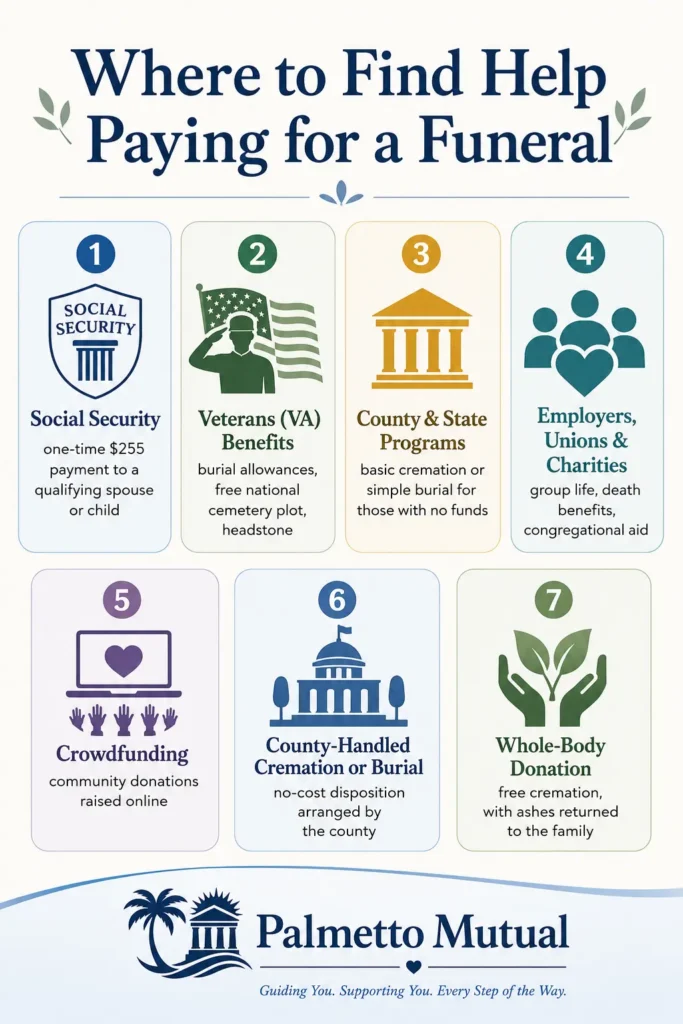
Before working through each option in detail, here is the full menu of help a family can draw from. The rest of this guide covers each one in turn.
| Source of help | What it typically offers |
|---|---|
| Social Security | One-time $255 payment to a qualifying spouse or child |
| Veterans (VA) benefits | Burial allowances, a free national cemetery plot, headstone |
| County and state programs | A basic cremation or simple burial for those with no funds |
| Employers, unions, charities | Death benefits, group life, congregational or nonprofit aid |
| Crowdfunding | Money raised from friends, family, and community online |
| County-handled cremation or burial | A no-frills disposition arranged by the county |
| Whole-body donation programs | Free cremation, with ashes returned to the family |
Two of these deserve a plain word here, because they are the lowest-cost paths and are often misunderstood.
The first is a county-handled cremation or burial. If a family signs the proper form with the county coroner or medical examiner’s office, the county will arrange a simple cremation or burial at no cost. The trade-off is that the family gives up most say over where and how it happens.
The second is whole-body donation. Through accredited nonprofit programs, a person’s body can be donated to medical research and education, and in return the program covers cremation at no charge and returns the ashes to the family if requested.
These are honest, dignified options. They exist so that cost is never the reason a loved one goes uncared for, and many families use them every year.
For families who want to avoid this scramble entirely, planning ahead with a small final expense insurance policy is the part they can control — a point this guide returns to at the end.
Social Security’s $255 Death Benefit
When a worker who paid into Social Security dies, their family may qualify for a one-time payment of $255. This is called the lump-sum death payment, and it is separate from the monthly survivor benefits a spouse or child may also receive.
Only two kinds of people can receive it: a surviving spouse or an eligible child. Parents, siblings, and other relatives do not qualify, no matter how close they were.
Here is who qualifies, in the order Social Security looks for them.
| Priority | Who receives the $255 |
|---|---|
| 1 | A surviving spouse who lived with the worker at the time of death |
| 2 | A surviving spouse living apart, if already getting or newly eligible for benefits on the worker’s record |
| 3 | An eligible child, if there is no qualifying spouse |
A few practical notes matter. The family must apply within two years of the death, and if more than one child qualifies, the $255 is split equally among them.
Now the honest part. The $255 figure was capped in 1954 and has never been adjusted for inflation.
That means it has lost almost all of its buying power. In today’s dollars, that 1954 amount would be worth roughly $2,900 — so the real value has dropped by more than 90 percent over seven decades.
Against today’s funeral costs, which commonly run $7,000 to $9,000 or more, the $255 is a token, not a solution. It is worth claiming, but no family should plan around it.
This is one reason many people look at burial insurance: a small policy is built to cover the gap that Social Security leaves wide open.
Veterans (VA) Burial Benefits
If the person who died served in the military, the Department of Veterans Affairs may help cover burial costs. These benefits are real, but most of them work as a reimbursement — the family pays first, then files a claim and gets paid back.
This section covers every VA burial benefit in one place so families do not have to hunt for the pieces. It is worth saying plainly: VA help is meaningful, but it rarely covers a full funeral, which is one reason many veterans still carry a small burial insurance policy.
Burial and Plot Allowances
The VA pays a set dollar amount toward burial and funeral costs. The amount depends on whether the death was tied to the veteran’s military service.
A “service-connected” death means the veteran died from an illness or injury linked to their service. A “non-service-connected” death is any other cause.
There is also a separate plot or interment allowance. This helps pay for the gravesite when the veteran is buried somewhere other than a national cemetery.
Here are the current amounts for deaths on or after October 1, 2025.
| Benefit | Amount |
|---|---|
| Service-connected death allowance | Up to $2,000 |
| Non-service-connected death allowance | Up to $1,002 |
| Plot or interment allowance (private cemetery) | Up to $1,002 |
| Headstone or marker (when not furnished by VA) | Up to $441 |
One honest note: scam ads sometimes claim much higher payouts. The figures above are the real ones, and the VA warns families to ignore offers promising more.
Eligibility
To qualify, the veteran must have been discharged under conditions other than dishonorable.
Beyond that, at least one of these must be true. The veteran died from a service-connected cause, was receiving VA pension or compensation, would have received it but took military retired pay instead, or died while in VA care.
The person filing is usually the surviving spouse, but a surviving partner, a child, or the estate’s representative may also qualify. In many cases, an eligible surviving spouse on record is paid automatically once the VA is notified of the death.
Burial in a National Cemetery
Burial in a VA national cemetery is free to the family. This is separate from the cash allowances above and is one of the most valuable benefits available.
A national cemetery burial includes the gravesite, opening and closing of the grave, perpetual care, a government headstone or marker, a burial flag, and a Presidential Memorial Certificate.
To arrange it, the family or funeral home contacts the National Cemetery Scheduling Office at 800-535-1117. Gravesites cannot be reserved ahead of time, so it helps to keep the veteran’s discharge papers (the DD-214) where family can find them.
Government-Furnished Headstones and Markers
Even when a veteran is buried in a private cemetery, the VA will provide a headstone or marker at no charge. The VA also offers a medallion that attaches to a privately bought headstone to show the person was a veteran.
This benefit is requested using a VA form, and combat service is not required to qualify. A funeral director can help the family file for it.
County and State Burial Assistance Programs
When there is no money and no other benefit covers the cost, the county or state becomes the help of last resort. This is the program many counties run for people who die with no funds, and it makes sure every person receives a lawful, respectful disposition.
You may hear this called an “indigent burial” or a “pauper’s burial.” Those are the official terms for a basic, government-arranged cremation or burial for someone without the means to pay.
What these programs provide is modest. In most places it is a simple cremation or a minimal burial, usually with no formal service, and the county chooses the funeral home and the timing.
For a family in crisis, the most useful thing is knowing exactly who to call first. Start with these three.
- The county coroner or medical examiner’s office, which often oversees the program
- County social services or human services, which usually handles the application
- The funeral home, which often knows the local process and can connect families to county aid
Eligibility is based on financial need. Families typically must show that the deceased left no assets and no life insurance, and that the next of kin cannot pay.
One practical tip from people who run these programs: speak up early. If a family wants a burial rather than a cremation, asking before the county has already arranged a cremation gives a much better chance of getting it.
This safety net exists so cost is never the reason a loved one goes uncared for. Still, the help is basic — which is part of why families who want more say often plan ahead with funeral insurance.
Other Sources: FEMA, Employers, Unions, and Charities
Beyond Social Security and the VA, families can often pull together help from a patchwork of smaller sources. None of these covers a full funeral on its own, but together they can close part of the gap that burial insurance is built to handle.
FEMA Disaster-Related Funeral Assistance
FEMA can help pay for a funeral, but only in a narrow situation: when the death is tied to a federally declared disaster, such as a major hurricane or flood.
When it applies, FEMA reimburses the person who paid for the funeral. The family pays first, then files a claim with receipts and documentation.
One important update: the special COVID-19 Funeral Assistance program is now closed. FEMA stopped taking new applications for COVID-related deaths, so it should not be counted on as an open option today.
For all other disaster-related deaths, the regular program still runs through DisasterAssistance.gov when a disaster is declared.
Employer, Union, and Membership Benefits
Many people carry a small life insurance benefit through their job without thinking of it as funeral money. A workplace group life policy or an employer death benefit can often be put toward final costs.
Unions and fraternal groups sometimes offer their own death or burial benefits to members and their families. It is worth checking the person’s membership records and asking the benefits office or local chapter directly.
The key step is simple: gather the deceased’s paperwork and ask each organization what, if anything, is payable. These benefits are easy to overlook in the rush after a death.
Religious and Nonprofit Assistance
Churches, synagogues, mosques, and other faith communities often help their members with funeral costs, sometimes through a benevolence fund or donated services.
A number of nonprofits also focus on specific situations. Groups like the TEARS Foundation and Final Farewell, for example, help families cover funeral costs after the loss of a baby or child.
To find local help, a good starting point is calling 211 (the United Way help line), which can point families to charities and agencies in their area. A funeral director often knows which local groups give this kind of aid as well.
Crowdfunding a Funeral
When other help falls short, many families turn to online fundraising to ask their community for support. Sites like GoFundMe have made this one of the most common ways people cover funeral costs today.
It helps to understand the fees before starting. On GoFundMe, it is free to set up a fundraiser, but each donation has a payment processing fee of about 2.9% plus 30 cents, and donors are also asked for an optional tip to the platform.
The honest part is what families actually raise. On GoFundMe, the average funeral fundraiser brings in around $2,640 — helpful, but well short of a typical funeral bill.
It is also worth knowing that about one in three campaigns never reach their goal, and the money often arrives slowly, in small amounts over time.
The fundraisers that do best are usually shared by close family and friends, with a clear story and a real photo. Crowdfunding can be a real help, but it works best as one piece of the plan rather than the whole plan.

Why These Sources Rarely Cover the Whole Cost
Every source in this guide can help. But there is an honest pattern worth naming: added together, they usually still leave a gap.
The math is the reason. The national median cost of a funeral with viewing and burial was about $8,300, and a cremation with a service was about $6,280.
Against that, Social Security pays $255, the VA reimburses a limited allowance after the fact, county programs cover only a bare-bones disposition, and a typical online fundraiser brings in a few thousand dollars. None of these was designed to pay for a full, dignified funeral on its own.
There is also a timing issue that matters more than people expect. Almost all of this help is for a death that has already happened, and much of it pays the family back after they have already covered the bill.
This is the part to be clear about. Final expense insurance cannot reach back and pay for a funeral that is happening right now — it only helps when a policy was already in place before the death.
So if you are reading this in the middle of a loss, the sources above are your real path, and they do work when combined. There is no shame in using every one of them.
But if you are here for a different reason — because you do not want your own family to face this same scramble — then the one lever you actually control is planning ahead. A small burial insurance policy, put in place now, is built to hand your loved ones money quickly when they need it, instead of leaving them to piece together help from a dozen places.
That is simply the honest trade-off worth knowing. Whether you plan ahead is your decision to make, on your own timeline.
Frequently Asked Questions
Keep Reading







About the Author
Dvir Mosche is an award-winning independent insurance agent and the founder of Palmetto Mutual, a trusted insurance brokerage specializing in Final Expense Life Insurance. Since entering the industry in 2017, he has been recognized multiple times as a top agent for his dedication to educating and assisting seniors in finding the proper coverage. His mission is to simplify the process, provide honest and personalized guidance, and ensure that every client gets coverage they can depend on for life.


