
Home > Funeral Cost > Plot Costs
Cemetery Plot Costs
A cemetery plot is often one of the biggest costs in a burial, and the price can swing a lot depending on where you live and the kind of cemetery you choose. This guide covers what plots cost across the country, the extra fees that come on top of the plot itself, and what to know about buying one ahead of time. Understanding these costs can help you plan, whether you pay out of pocket or use a burial insurance policy to help cover them.
Cemetery Plot Prices, High to Low
A cemetery plot can cost as little as a few hundred dollars or as much as a luxury car. Most fall somewhere in the middle, but the spread is wide, so it helps to see the full picture from the top down.
Across the country, the average single plot runs about $1,000 to $4,000, with many sources placing the typical figure near $2,600. Here is the full range, from the most expensive settings to the least:
| Where the plot is | Typical price for one person |
|---|---|
| Prestige private cemeteries in major cities (New York, Los Angeles, San Francisco) | $20,000 to $75,000 or more |
| Standard private cemeteries | $5,000 to $10,000 |
| Public or city cemeteries in urban areas | $2,000 to $5,000 |
| Public or city cemeteries in small towns and rural areas | $500 to $2,000 |
| Cremation or urn plots | $350 to $2,000 |
| National (veterans) cemeteries, for those who qualify | Free |
At the very top end, single graves at New York City’s Green-Wood Cemetery run roughly $21,000 to $30,000 each in 2025, with premium single graves reaching $40,000.
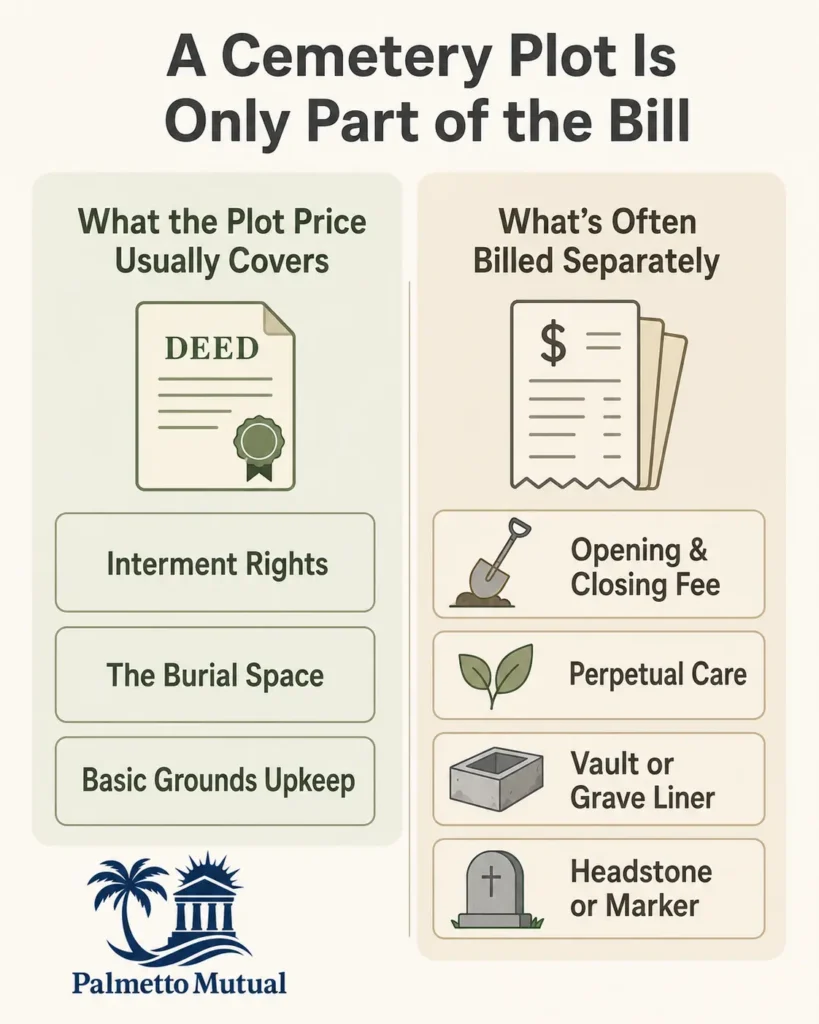
One important note: these prices are for the plot only. They do not include opening and closing the grave, a vault, or a headstone, which we cover later in this guide.
Costs like these are part of why many families look at a burial insurance policy. The payout can be used however the family chooses, including buying a plot, so the money is ready when it is needed.
Why Plot Prices Vary So Widely: Location and Cemetery Type
Two things explain most of the gap between a $500 plot and a $50,000 plot: where the cemetery sits and what kind of cemetery it is. Once you understand these two drivers, the wide price range starts to make sense. Knowing them also helps when you compare options or decide how much funeral insurance might be useful.
Location
A cemetery plot is a piece of land, so it follows the same rules as any other real estate. Land in a crowded city costs far more than land in the countryside, and plot prices reflect that.
In a small-town cemetery, a plot might cost $1,000. The same space in a large city can cost ten or twenty times more. A plot in Manhattan can run $20,000 or more, while a comparable plot in a small town in the same state might be $1,000.
Region matters too. The South and Midwest tend to be the most affordable, the Northeast sits higher, and the West Coast, especially California, runs highest of all:
| Region | Typical single-plot range |
|---|---|
| South and Midwest | $1,000 to $3,000 |
| Northeast | $2,000 to $5,000 |
| West Coast (California) | $4,000 to $10,000 or more |
Within a single cemetery, location still counts. Plots near a pond, under a shade tree, along a main walkway, or in a section with a nice view usually cost more than plain interior plots.
Cemetery Type
The kind of cemetery you choose can change the price more than almost anything else. Here is how the four main types compare:
| Cemetery type | Who runs it | How the price tends to land |
|---|---|---|
| Public / municipal | A city, county, or township | Lowest, because tax dollars help fund it; often under $2,000 |
| Private | A company or association | Highest, often 2 to 5 times a comparable public plot |
| Religious | A church, synagogue, or faith group | Varies; members may get a lower rate, non-members pay more |
| Veterans (national) | The U.S. Department of Veterans Affairs | Free for those who qualify |
Public cemeteries keep prices down because they are partly funded by local government and meant to serve all residents. Some require proof that you live in the area, and a few charge non-residents a higher rate.
Private cemeteries set their own prices and receive no public funding. In exchange for the higher cost, they often offer manicured grounds, more plot choices, and added amenities. Nonprofit church-run cemeteries are sometimes meaningfully cheaper than corporate-owned ones.
Religious cemeteries serve a specific faith community. Many offer reduced rates to active members and charge more, or restrict burial entirely, for non-members.
Veterans cemeteries are the one exception to all of this. Eligible veterans can be buried in a national cemetery at no cost for the plot. We cover who qualifies and the broader free and low-cost options later in this guide.
Single, Double, and Family Plots
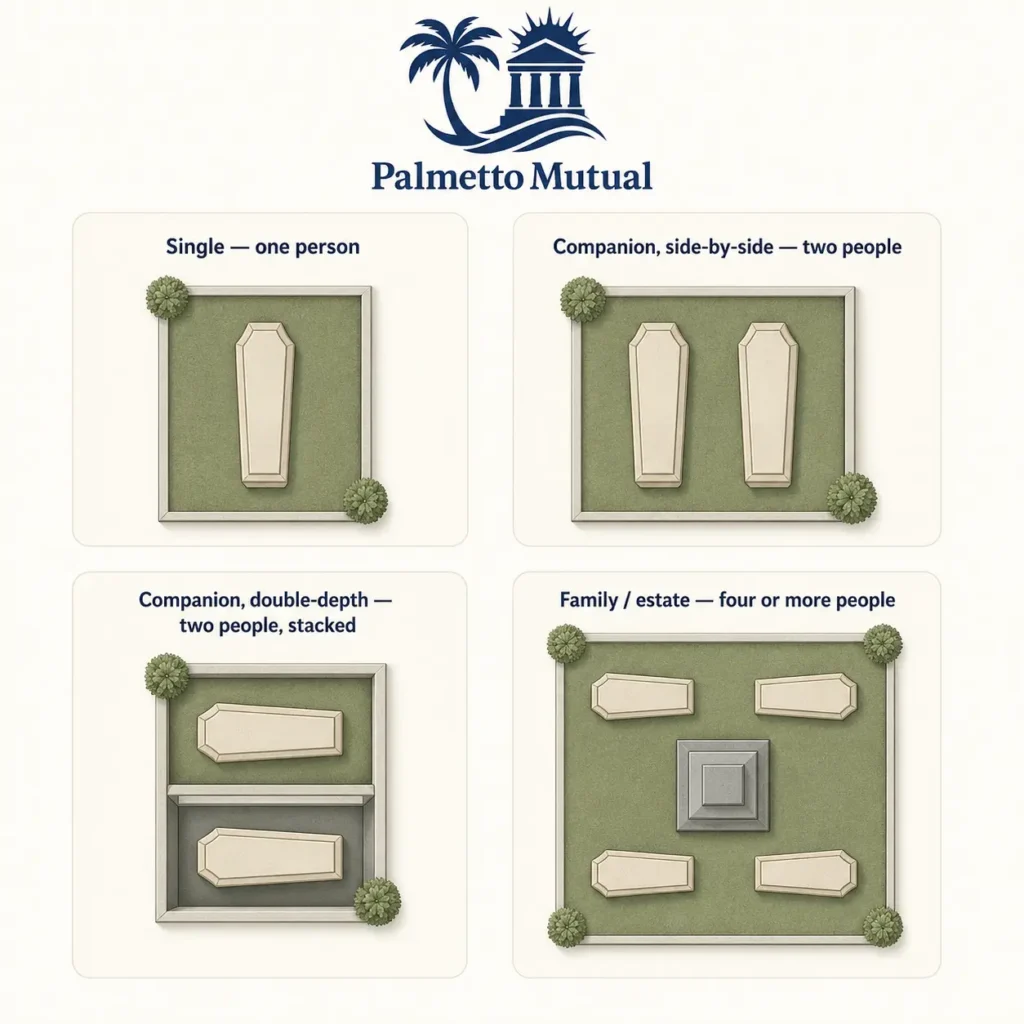
Cemeteries sell plots in a few standard sizes, and the right one depends on how many people will be buried there. The more space you need, the more you pay, but buying for two or more at once can lower the cost per person.
Here are the common plot types and what each usually costs:
| Plot type | Who it holds | Typical price |
|---|---|---|
| Single | One person | $1,000 to $5,000 at a public cemetery; $5,000 to $10,000 at a private one |
| Companion, side-by-side | Two people, next to each other | $5,000 to $15,000 |
| Companion, double-depth (stacked) | Two people, one casket above the other | $3,000 to $8,000 |
| Family / estate | Four or more people | Starts around $20,000; can pass $100,000 at prestige cemeteries |
| Cremation / urn | One or more urns | $350 to $3,000 |
A single plot is the most common and least costly choice. It holds one casket, or in many cemeteries one or more urns.
A companion plot is for two people, usually a married couple. It comes two ways: side-by-side, or double-depth, where the caskets are stacked one above the other.
Double-depth plots usually cost less than side-by-side because they use one space instead of two, and only one outer container is needed. Side-by-side companion plots tend to run close to twice the price of a single.
Family or estate plots set aside room for four or more burials, often across generations. Buying several spaces at once often earns a discount per plot, which is why some families purchase decades in advance.
For families weighing these choices, a burial insurance policy can help cover the type of plot they choose, since the payout can be used for any final cost.
The Hidden Costs: Opening/Closing and Perpetual Care
Buying the plot is only part of the bill. Two more charges almost always come with a burial, and they catch many families by surprise. Knowing about them ahead of time is one of the reasons people plan early, sometimes with funeral insurance set aside to cover the full cost.
Opening and Closing Fees
When you buy a plot, you are buying the right to be buried there, not the labor to actually do it. The opening and closing fee, sometimes called the interment fee, is a separate charge for that work.
It covers more than just digging. The cemetery confirms who owns the plot, marks the exact spot, excavates the grave, lowers the casket or urn, refills the soil, and restores the surface.
For a full casket burial, this fee usually runs $1,000 to $2,500. For cremated remains, it is lower, often $300 to $800.
Where you are changes the number. In big cities like New York, Los Angeles, or Boston, the fee can top $3,000, while a small rural or church-run cemetery may charge as little as $300.
A few extra charges can push the bill higher:
| Extra charge | When it applies | Typical amount |
|---|---|---|
| Weekend or holiday surcharge | Burial on Saturday, Sunday, or a holiday | $200 to $800 |
| Winter or frost fee | When frozen ground must be broken | $100 to $250 |
| Late-arrival or overtime fee | Service runs past normal hours | $120 or more |
One thing to remember: with a double-depth plot, you pay an opening and closing fee for each burial, not just once.
Perpetual Care and Maintenance Fees
Perpetual care, sometimes called endowment care, is the money that keeps the cemetery grounds maintained over the long term. It pays for mowing, landscaping, road upkeep, and general repairs.
Most often this is a one-time fee added to the plot price, not a yearly bill. The Funeral Consumers Alliance reports it usually runs about 5 to 15 percent of the plot cost.
Many states require the cemetery to place that money into a protected trust fund, so the grounds stay cared for even far into the future. At some cemeteries the fee is already built into the plot price, while a few bill families a separate annual maintenance charge instead.
Because the rules differ from one cemetery to the next, it helps to ask directly whether perpetual care is included in the plot price or billed on its own. That one question can prevent a surprise later.
Buying a Plot in Advance
Many people buy a cemetery plot years before it is needed, a choice often called pre-need planning. It can save money and spare your family hard decisions later, but it is worth weighing carefully. Some families pair this step with a final expense insurance policy so the money for the plot and related costs is set aside ahead of time.
Weighing the Pros and Cons
The main reason people buy early is price. Cemetery plot costs have risen faster than general inflation, with yearly increases of about 3 to 7 percent common, so locking in today’s price can save money down the road.
Buying ahead has other upsides too, but there are real trade-offs. Here is a side-by-side look:
| Advantages | Drawbacks |
|---|---|
| Locks in today’s price before future increases | You pay now for something you may not need for years |
| More choice of cemetery and exact plot location | If you move, the plot may no longer be convenient |
| Spares your family from deciding under stress | Plans can change, such as choosing cremation instead |
| Payment plans are often available, spread over 3 to 5 years | The cemetery could close or change ownership |
One caution: a price lock may not cover everything. Many cemeteries guarantee the plot price but still bill opening and closing, the vault, and the marker at future rates, and those can add up to more than the plot itself.
The fix is simple. Ask for any price guarantee in writing, and confirm exactly which goods and services it covers before you sign.
Transferring or Reselling a Plot
If your plans change, you can usually sell or transfer a plot, but it is harder than selling other property. Remember that you bought the right to be buried there, not the land itself, so the cemetery has a say in any transfer.
First, check your contract and your state’s rules. In some states, such as New York, you must offer the plot back to the cemetery in writing before selling it to someone else, which is called the right of first refusal.
Selling back to the cemetery is the simplest path but usually pays the least. Many cemeteries that buy back plots offer only about 10 to 20 percent of the retail price, and some will not buy them back at all.
A private sale tends to bring more, but it takes patience. Because more people are selling plots than buying them, resale plots often sell for 25 to 50 percent below the cemetery’s current price, and finding a buyer can take months or even years.
A few practical points to keep in mind:
- Expect a transfer fee from the cemetery, commonly $50 to $400, to update ownership records.
- Plots in national veterans cemeteries generally cannot be resold, since they are granted by service eligibility, not purchased.
- If a plot will not sell, some owners donate it to a church, a veterans group, or another charity, which may allow a tax deduction with a proper appraisal.
Free and Low-Cost Plot Options
A plot does not have to cost thousands of dollars. There are several ways to find a free or lower-cost burial space if you know where to look.
The biggest free option is for veterans: eligible veterans, and often their spouses, can be buried in a national cemetery at no cost for the plot. We cover who qualifies, along with the wider set of free and low-cost help with funeral costs, on our financial assistance page.
For everyone else, here are the most affordable plot options:
- Public or municipal cemeteries. Run by city or county governments and partly tax-funded, these are usually the lowest-priced, sometimes under $1,500, and residents may pay even less.
- Religious cemeteries. Some churches and faith communities offer reduced plot prices to active members.
- Pre-owned (resale) plots. Plots sold by private owners often run 25 to 50 percent below a cemetery’s current price.
- Cremation or urn plots. Because they need far less space, these are among the cheapest spaces, often $350 to $3,000.
- Green burial sections. Plots run about $1,000 to $4,000, and families save more by skipping the vault and a costly casket.
A little comparison shopping goes a long way. Prices can vary widely even between cemeteries in the same town, so it pays to call a few and ask for an itemized price list.
Frequently Asked Questions
Keep Reading







About the Author
Dvir Mosche is an award-winning independent insurance agent and the founder of Palmetto Mutual, a trusted insurance brokerage specializing in Final Expense Life Insurance. Since entering the industry in 2017, he has been recognized multiple times as a top agent for his dedication to educating and assisting seniors in finding the proper coverage. His mission is to simplify the process, provide honest and personalized guidance, and ensure that every client gets coverage they can depend on for life.


