
Home > Funeral Cost > Prepaid Funeral Plan
What Is a Pre-Paid (Pre-Need) Funeral Plan?

A pre-paid funeral plan, also called a pre-need plan, is an arrangement where you choose and pay for your funeral services ahead of time through a specific funeral home. Many families weigh these plans against other ways to cover end-of-life costs, including final expense insurance. This guide walks through how pre-paid plans work, what they cover, the funding and risk tradeoffs to understand, and how they stack up against other options.
Which Option Fits You Best?
Answer four short questions to see whether a pre-paid funeral plan or final expense insurance tends to fit your situation. This is general guidance, not a quote.
What Is a Pre-Paid (Pre-Need) Funeral Plan?
A pre-paid funeral plan, also called a pre-need plan, is a written contract with one specific funeral home where you choose your funeral services now and pay for them now, so they are ready when the time comes. You pick the details — burial or cremation, the casket or urn, the type of service — and the funeral home agrees to provide them later.
This is different from burial insurance. A pre-need plan is tied to one funeral home and one set of arrangements, not a pool of cash your family can spend however they need.
When you sign, you are agreeing to two things at once. The first is the plan itself — the list of goods and services you want. The second is how you will pay for them, either all at once or over time.
The money usually does not go straight into the funeral home’s pocket. In most states it is held by a third party, either in a trust account or through an insurance policy, until the funeral is needed.
Here is the part that surprises many families. A pre-need plan is an agreement with that one funeral home — it is not a portable fund that follows you wherever you go.
| What a pre-need plan is | What a pre-need plan is not |
|---|---|
| A contract with one specific funeral home | A flexible cash fund your family can use anywhere |
| A locked-in list of chosen goods and services | A guarantee that every cost is covered |
| Money set aside in a trust or insurance policy | Money the funeral home can usually spend right away |
| Tied to the arrangements you selected | Easy to move to a new provider without tradeoffs |
That distinction matters most when life changes — when you move, change your mind, or the funeral home changes hands. We cover each of those situations later in this guide.
What Pre-Paid Funeral Plans Cost
The cost of a pre-paid funeral plan depends on what you choose. A simple cremation costs far less than a full burial with a viewing, a casket, and a graveside service.
For context, the national median cost of a funeral with a viewing and burial was about $8,300 in 2023, and a funeral with cremation and a viewing was about $6,280. Most pre-paid plan amounts fall somewhere in this range, often quoted between roughly $10,000 and $25,000 once a vault, cemetery costs, and extras are added in.
How you pay: lump sum or installments
You can pay for a pre-need plan in one payment up front, or you can spread it out over months or years.
Each path has tradeoffs worth knowing before you sign.
| Payment method | What to know |
|---|---|
| Lump sum (pay all at once) | You pay only what the plan costs, with no added interest. Often the cleanest option if you can afford it. |
| Installments (pay over time) | Spread over about 3 to 10 years. May include interest or fees, so the total you pay can end up higher than the plan price. |
Watch for setup and yearly fees too. Some plans charge a setup fee of $100 to $200, and some add ongoing maintenance fees of $50 to $150.
What happens if you die before the plan is paid off
This is the question most guides skip, and the honest answer is: it depends on how your plan is funded and what your contract says.
If you pay in installments directly to a funeral home or into a trust, and you die before it is paid off, your family usually faces a choice. They can pay the remaining balance so the funeral goes ahead as planned, or take a refund of what was paid so far and make their own arrangements.
There is a real catch with that second choice. If your family pays the balance, the funeral home generally honors the price you locked in. If they take the refund instead, that frozen price is lost, and they may pay more at today’s rates.
Insurance-funded plans can work differently. If the policy is fully in force and you were in good health when you bought it, the death benefit may cover the full cost even if you had not finished paying, and your family owes nothing.
But if your health placed you in a waiting period, or you die during the policy’s contestable window, the family may only receive the premiums paid plus a little growth — and then has to cover the gap. The lesson is simple: ask exactly what happens if you die early, and get the answer in writing before you sign.
What These Plans Do and Don’t Cover
A pre-paid plan does not lock in every cost. Some items have a price the funeral home promises to honor, and some items have a price that can still rise between now and the funeral.
Knowing which is which is the difference between real peace of mind and a surprise bill for your family. This is also where a pre-paid plan works differently from burial insurance, which simply pays cash that can be used for any cost.
Guaranteed vs. non-guaranteed items
A guaranteed item is one where the funeral home agrees to provide it at no extra charge later, even if its own prices go up. These are usually the funeral home’s own services and products.
A non-guaranteed item is one where only the money you set aside is applied, and your family pays any difference if the real cost is higher when the time comes.
| Often guaranteed (price locked) | Often non-guaranteed (price can rise) |
|---|---|
| Funeral director and staff services | Cemetery opening and closing fees |
| Use of the funeral home facilities | Death certificate fees |
| Basic preparation, such as embalming | Obituary notices |
| The casket or urn you selected | Clergy, musician, or officiant fees |
| Transportation handled by the home | Flowers and other third-party items |
The single most important step is to ask the funeral home to write down, line by line, which items are guaranteed and which are not. A plan that just says “funeral service” without itemizing is a warning sign.
Cash-advance items and where the gaps appear
Cash-advance items are costs the funeral home pays to an outside party on your behalf, then bills back. Common examples are flowers, the obituary, clergy fees, and death certificates.
The gap shows up because the funeral home does not set these prices — outside vendors and government offices do. So even a “guaranteed” plan usually leaves these items unlocked.
The increases can be real. One funeral home’s records showed a cemetery opening-and-closing fee listed at $640 in the original contract but charged at $1,344 by the time of need — more than double.
These third-party charges are governed by the FTC’s Funeral Rule, which sets out how funeral homes must disclose them. We cover those rights in detail on our, so we won’t repeat them here. For pre-need planning, the takeaway is simple: build a cushion for cash-advance items, because they are the most likely source of an unexpected bill.
How Your Money Is Held: Trust vs. Insurance-Funded
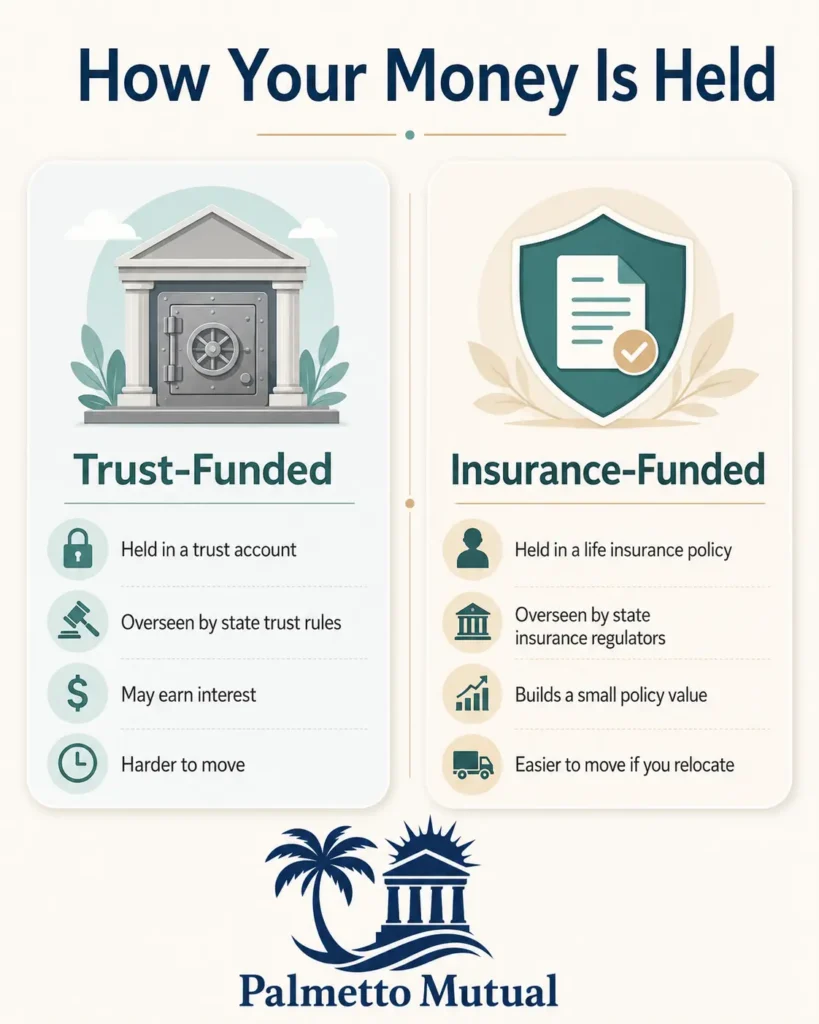
When you pre-pay, your money usually goes into one of two places: a trust account or an insurance policy. The difference affects how safe your money is, how much you can get back, and how easily the plan moves if your life changes.
This is one area where the structure matters more than the sales pitch. The same is true when comparing a pre-paid plan to funeral insurance — the mechanics decide what your family actually receives.
| Feature | Trust-funded | Insurance-funded |
|---|---|---|
| Where money sits | Trust account, often held by a bank or trustee | A life insurance policy with the funeral home named to receive the benefit |
| Oversight | State trust and banking rules | State insurance commissioner |
| Growth | May earn interest; who keeps it varies by state | Policy may build a small fixed value |
| Portability | Can be harder to move | Generally easier to move |
| If you cancel | Revocable trusts may refund; irrevocable usually cannot | Cash-out value is usually far less than paid in |
Trust-funded plans
With a trust-funded plan, your payments are placed in a trust account and held until the funeral is needed. In some setups a bank or independent trustee holds the money; in others the funeral director serves as trustee, which gives the home more control.
State rules vary widely, and that is the catch. Most states require a large share — often 70% to 100% — of your money to be held in trust, but protections differ from state to state. New York requires 100% to be deposited in trust and allows a full refund with interest on a revocable plan.
A trust may earn interest, but who keeps that interest depends on your state and contract. In many states the seller is allowed to withdraw some of the interest each year.
Your refund depends on the trust type. A revocable trust can usually be canceled for a refund, while an irrevocable trust cannot be cashed out — though it can often be reassigned to a different funeral home.
One more point families miss: if a trust-funded plan is not a guaranteed-price plan and the trust does not cover the full bill, the family owes the difference.
Insurance-funded plans
With an insurance-funded plan, a life insurance policy is purchased and the funeral home is named to receive the payout. When you die, the insurance company pays the benefit toward your funeral.
These plans are overseen by your state’s insurance commissioner. They are also generally easier to move than trust money, which is one reason some families prefer them when a move may be in the future.
There are tradeoffs to understand. Many policies pay only a limited benefit in the first year or two — sometimes just your premiums paid plus a small amount of interest — rather than the full amount.
The cash-out value is another weak spot. If you cancel, the amount you get back is almost always much less than what you paid in. And over many years, the premiums you pay can add up to more than the policy pays out at the end.
The Real Risks of Pre-Paying
A pre-paid plan can work as promised. But when it goes wrong, it usually goes wrong in one of four ways, and they are worth knowing before you sign anything.
We have put these in order of how often they actually cause families trouble — starting with the most common regret. This is also where the contrast with burial insurance becomes clearest, because most of these risks come from tying your money to one funeral home.
What happens if you move
Your plan is tied to one specific funeral home. If you move across town or across the country, that arrangement does not simply follow you.
This is the single most common regret with pre-need plans. You can often transfer the plan to a new funeral home, but the transfer usually moves only the cash value as a credit — not your locked-in price.
So if the new funeral home charges more, your family may owe the difference. Insurance-funded plans tend to be easier to move than trust money, which is one reason portability is worth asking about up front.
What happens if the funeral home closes, sells, or goes bankrupt
If the funeral home is sold, the new owner usually takes over existing contracts and honors them. If it closes, state rules generally require that you be notified and helped to move your funds to a new provider.
Your money is usually safe — but only if it was actually placed in a separate trust or insurance policy, as the law requires. That “if” is the whole problem.
The largest case shows what is at stake. National Prearranged Services collapsed in 2008 after operating as a Ponzi-like scheme; federal prosecutors said it cost roughly 97,000 to 150,000 customers across 16 states an estimated $450 million to $600 million, because the money was never safely held as required.
If a funeral home goes bankrupt, federal law gives your prepaid deposit only a limited priority — up to $3,800 per person for services never delivered — which may not return everything. Your exposure depends heavily on how the plan was funded and whether the money truly reached a protected account.
Inflation on non-guaranteed items
A “locked-in price” only locks the guaranteed items. The non-guaranteed and cash-advance items keep drifting upward with the market between now and the funeral.
Over ten or twenty years, that drift adds up. The part of your plan that is not guaranteed can quietly erode the savings you thought you secured.
This is why the “guaranteed” label can give a false sense of completeness. The promise is only as strong as the share of the bill that is actually locked.
Cancellation and refund limits
Whether you can get your money back depends on two things: the type of plan and your state’s law.
A revocable plan can usually be canceled, but the refund varies widely. An irrevocable plan generally cannot be canceled or refunded at all, because that is what makes it Medicaid-exempt.
| State example | What you get back if you cancel |
|---|---|
| New York (revocable) | Full refund of principal plus interest, no penalty |
| Georgia | Full refund before death, paid within three business days |
| Texas (trust-funded) | Amount paid, minus 10% of the total face value |
| West Virginia | Seller may keep 10% of the prepaid money |
| Some states | Funeral home may keep up to 30% as fees |
For an insurance-funded plan, canceling usually gets you only the policy’s cash surrender value, which is almost always far less than you paid in. Always ask, in writing, exactly what a cancellation would return before you sign.
Pre-Paid Plans vs. Final Expense Insurance
This is the choice most families are really weighing. Both aim to cover end-of-life costs, but they work very differently — and the differences are what decide which one fits.
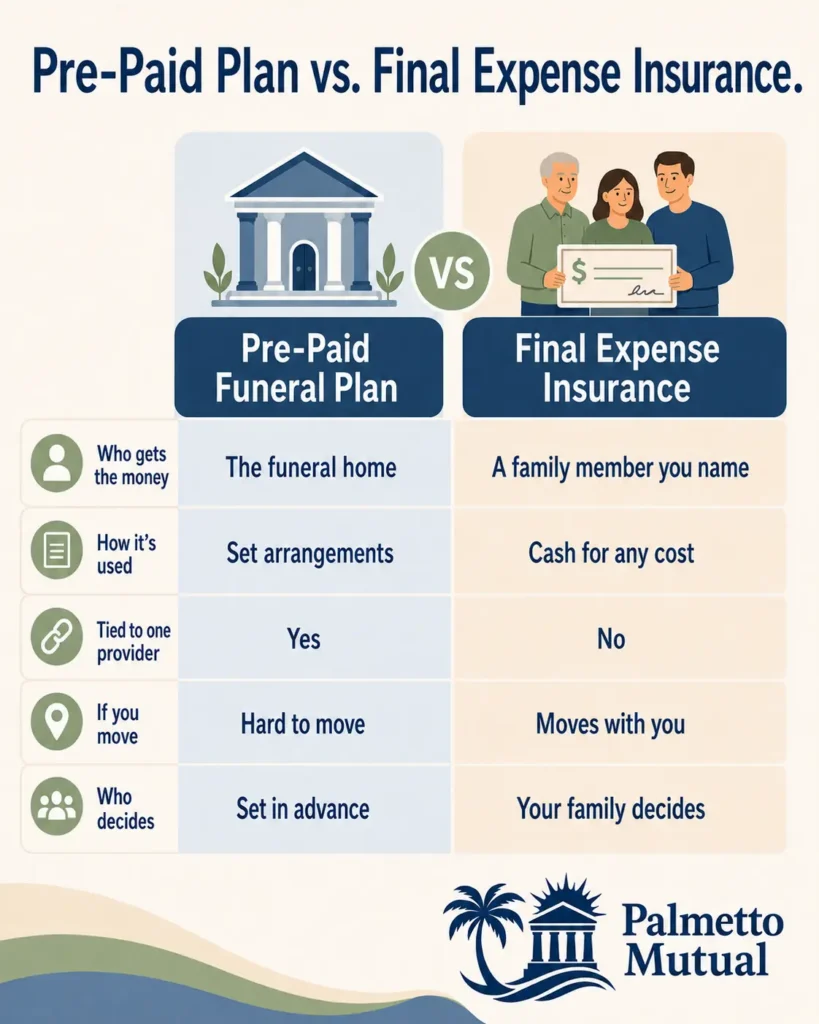
A pre-paid plan is a contract with one funeral home that pays that home directly. Final expense insurance is a small whole life policy that pays cash to a person you choose, who can use it for anything.
| What decides it | Pre-paid funeral plan | Final expense insurance |
|---|---|---|
| Who gets the money | The funeral home | A beneficiary you name (family member) |
| How it’s paid out | Applied to your chosen arrangements | Cash, usable for any cost |
| Tied to one provider? | Yes — one specific funeral home | No — family can use any funeral home |
| If you move | Hard to move; price lock often lost | Moves with you; nothing to transfer |
| Who controls choices | Set in advance with the home | Your family, at the time of need |
| Price lock on services | Possible on guaranteed items | No price lock; family shops freely |
| Main oversight | State pre-need and trust rules | State insurance regulators |
The biggest practical difference is control. With burial insurance, the cash goes to your family, so they are free to shop for the funeral, change their minds, or handle other bills like unpaid medical costs.
Because the policy is not tied to one funeral home, you also avoid the closure and portability risks covered earlier.
What a comparison table cannot show is the actual monthly cost for your age and health — that depends on your profile. You can see real numbers for your situation using the on this page.
When Pre-Paying Makes Sense — and When It Doesn’t
Pre-paying is not always the wrong move. There are real situations where it is a reasonable choice, and being honest about them matters more than making a blanket case against it.
Pre-paying can make sense when a few things are all true at once. You are settled and not planning to move, you have a specific funeral home you know and trust, and you want certain arrangements locked in now.
It can also make sense for Medicaid planning. An irrevocable funeral trust or pre-need contract is a recognized way to set aside funeral money without it counting against Medicaid’s asset limit — often the one clear reason to pre-pay. If that is your situation, talk to an elder law attorney first.
| Pre-paying may fit when… | Final expense often fits better when… |
|---|---|
| You are settled and unlikely to move | You might move or live in two places |
| You have a trusted local funeral home | You want your family to choose the home |
| You want specific details locked in now | You want cash flexibility for any cost |
| You need Medicaid-exempt funeral funds | You want your family to control the money |
For most families, though, the flexibility of insurance wins. After years of seeing how these arrangements play out, the pattern is clear: plans tied to one funeral home tend to cause trouble when life changes, and life usually changes.
The honest takeaway is simple. Pre-planning your wishes is almost always a gift to your family. Pre-paying through a single funeral home is the part to weigh carefully — and for many people, funeral insurance that pays cash directly to loved ones does the same job with fewer ways to go wrong.
Frequently Asked Questions
Keep Reading







About the Author
Dvir Mosche is an award-winning independent insurance agent and the founder of Palmetto Mutual, a trusted insurance brokerage specializing in Final Expense Life Insurance. Since entering the industry in 2017, he has been recognized multiple times as a top agent for his dedication to educating and assisting seniors in finding the proper coverage. His mission is to simplify the process, provide honest and personalized guidance, and ensure that every client gets coverage they can depend on for life.


