
Home > Guaranteed Issue Life Insurance
Guaranteed Issue Life Insurance: How It Works and Who Should Actually Buy It

Guaranteed issue life insurance is a type of whole life policy that accepts you based on your age, with no health questions and no medical exam. It is most often used as a form of final expense insurance, which means it helps cover funeral costs, burial or cremation, and other end-of-life bills. This guide explains how the coverage works, what your family would receive at each stage of the policy, and who should — and should not — buy it.
What Guaranteed Issue Life Insurance Actually Means
Guaranteed issue life insurance is a type of whole life coverage you cannot be turned down for, as long as you fall inside the carrier’s age range. There is no medical exam and there are no health questions. Approval is based on age alone.
Because the policy never reviews your health, it is built for people who have trouble qualifying anywhere else. It is one form of final expense insurance, sized to cover funerals, burial or cremation, and small final debts rather than to replace income.
The trade-off for that easy approval shows up in two places: the price and the early payout rules. We cover both in detail further down the page. This section explains what the product is and how it differs from health-based final expense coverage.
The Core Promise: No Health Questions, No Medical Exam, Automatic Acceptance
The defining feature of guaranteed issue is right in the name. You are guaranteed to be issued a policy if you meet the age requirement, with no health screening of any kind.
Eligibility comes down to age and a few basic application details, not your medical history. The carrier does not order a medical exam, does not ask whether you smoke, and does not pull your prescription records to score your health.
This is what separates guaranteed issue from every other kind of life insurance. Most policies decide your price, or whether to cover you at all, based on your health. Guaranteed issue removes that step entirely.
That matters most for people who have already been declined elsewhere. A serious diagnosis, ongoing treatment, or a recent hospital stay does not block a guaranteed issue policy, because none of it is ever asked about.
How Guaranteed Issue Differs From Underwritten Final Expense (Level/Graded/Modified)
Most final expense insurance is “underwritten,” which means the carrier reviews your health before issuing the policy. You answer health questions, and the carrier often checks prescription history and the Medical Information Bureau, a shared industry database of past applications and claims.
Based on what that review finds, the carrier places you into a tier. The table below shows the basic difference.
| Type | Health questions | Health/Rx review | Who it fits |
|---|---|---|---|
| Level benefit | Yes | Yes | Healthier applicants; full benefit from day one |
| Graded benefit | Yes | Yes | Moderate health issues; partial benefit early |
| Modified benefit | Yes | Yes | Serious recent health events; premiums returned early |
| Guaranteed issue | None | None | Anyone in the age range, regardless of health |
The key point is that the difference is mainly in the enrollment path, not always in how a claim pays. If you can qualify for level or modified burial coverage, you will usually get full benefits sooner and at a lower cost. Guaranteed issue is the fallback when health rules those out.
We compare the actual claim mechanics in the next section, because guaranteed issue and the modified tier can look very similar at claim time even though you reach them in completely different ways.
Typical Age Ranges and Coverage Limits
Guaranteed issue is built for older adults, so the age windows sit later in life than most insurance. Most carriers offer it to people roughly ages 50 to 85, with a few starting at 40 or extending to 90.
Coverage amounts are smaller than traditional life insurance on purpose, since the product is meant for final costs, not income replacement. Face amounts commonly run from about $5,000 to $25,000. A few carriers reach up to $50,000 through special arrangements.
The table below shows the general ranges. Exact numbers vary by carrier and by state.
| Feature | Typical range |
|---|---|
| Issue age | About 50 to 85 (some 40 to 90) |
| Coverage amount | About $5,000 to $25,000 |
| Upper coverage (select carriers) | Up to $50,000 |
| Premiums | Fixed for life; no tobacco rating |
One practical note: because coverage caps are low, some buyers combine policies from more than one carrier to reach a higher total amount. An independent broker can help structure that if your needs exceed a single carrier’s limit.
How the Guaranteed Issue Waiting Period and Payout Structure Works
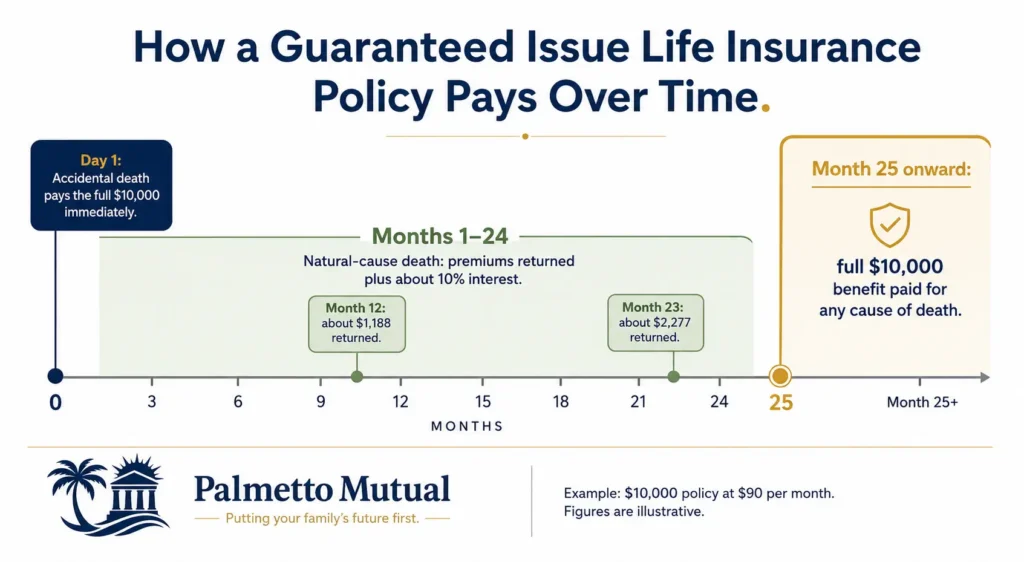
The price of skipping health questions is a waiting period before the full benefit is available. This is called a graded death benefit, and it usually lasts two to three years.
During that window, a death from natural causes does not pay the full face amount. Instead, the carrier returns the premiums you paid, usually with interest. After the window closes, the full benefit applies for any cause of death.
There is one important exception that protects you from day one: accidental death. We walk through each piece below with real dollar examples so you know exactly what your family would receive at any point.
The 24-Month Return-of-Premium Mechanic
The most common structure is a 24-month waiting period, though some carriers use 36 months. The carrier keeps a running total of every premium dollar you pay from the policy’s start date.
If you die from natural causes during that period, your beneficiary receives the premiums you paid back, plus interest — commonly around 10 percent. The exact rate and how it is calculated differ by carrier.
It is worth knowing that “premiums plus interest” is one common way to describe this, but not the only one. Some carriers instead pay a set percentage of premiums that grades up over time — for example one major carrier returns premiums plus an extra 30 percent, while others pay roughly 110 percent in year one and 120 percent in year two. A broker can tell you which formula a specific carrier uses before you apply.
What Beneficiaries Receive During the Waiting Period (With Dollar Examples)
The math is easier to see with numbers. Say you buy a $10,000 policy at $90 a month and the carrier pays 10 percent interest during the waiting period.
| When death occurs (natural causes) | Premiums paid | Plus ~10% interest | Beneficiary receives |
|---|---|---|---|
| End of month 6 | $540 | +$54 | About $594 |
| End of month 12 | $1,080 | +$108 | About $1,188 |
| End of month 18 | $1,620 | +$162 | About $1,782 |
| End of month 23 | $2,070 | +$207 | About $2,277 |
The pattern is steady: early in the policy, the payout is close to what you have paid in, not the full $10,000. The longer the policy is in force, the more your family gets back, but it stays far below the face amount until the waiting period ends.
These figures are examples to show the shape of the payout. Your real numbers depend on your premium, your carrier’s interest rate, and your coverage amount.
The Cliff Edge at Month 25 and Full Benefit Activation
The end of the waiting period is the single most important moment in a guaranteed issue policy. Once it ends, the policy pays the full death benefit for death from any cause, as long as the policy is still active.
The jump is dramatic. Using the example above, a natural-cause death in month 23 pays your family roughly $2,277. The same death in month 25 pays the full $10,000.
That two-month difference is worth more than four times as much to your beneficiary. This is why surviving the waiting period is the central financial event of the policy, and why buying sooner rather than later matters so much for this product.
The Accidental Death Exception
The waiting period applies only to natural-cause deaths. Accidental death is typically covered in full from day one, no matter where you are in the graded period.
An accident means something like a car crash or a fall, rather than a death from illness such as cancer or a heart attack. If death is accidental, your family receives the entire face amount immediately.
This exception is standard across guaranteed issue and the underwritten tiers alike. It exists on virtually every guaranteed issue product on the market, so the full coverage amount is effectively in force from the first day for any accidental cause
Who Should Actually Buy Guaranteed Issue (And Who Shouldn’t)
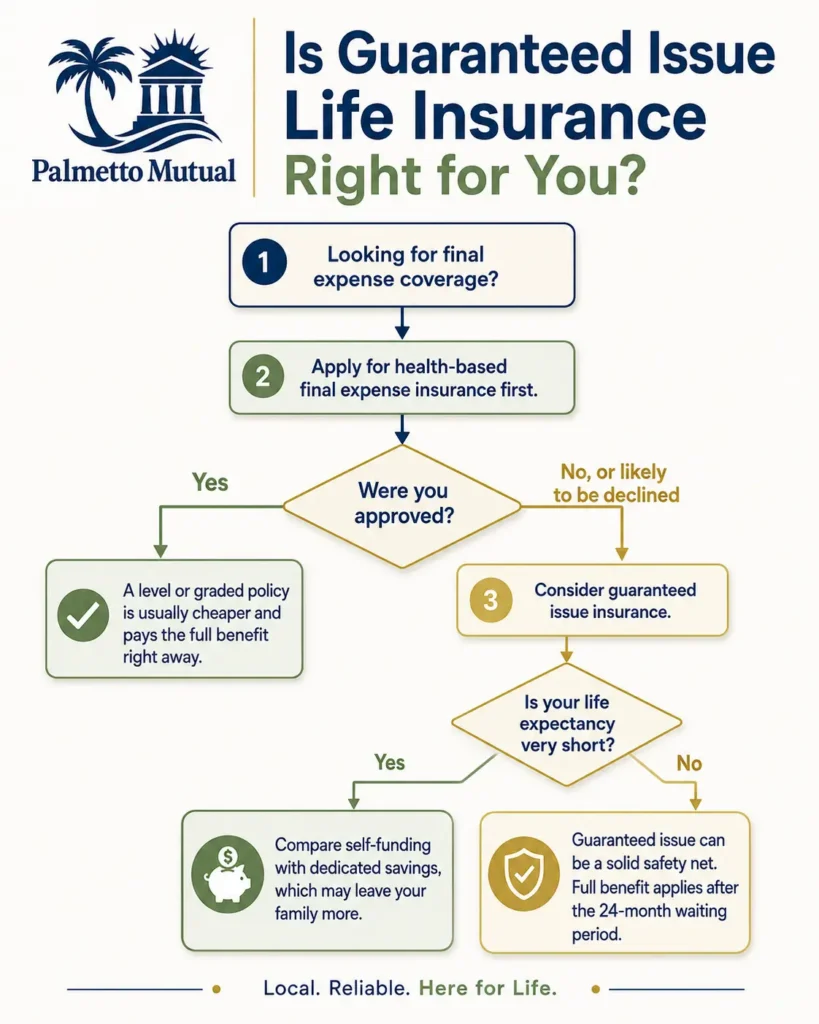
Guaranteed issue is the right product for some people and the wrong one for others. The honest answer depends on your health, your other options, and the simple math of what you pay versus what your family receives.
Because acceptance is guaranteed, it is easy to reach for first. But easy is not the same as best. Within the insurance field, “guaranteed” is generally treated as a last resort rather than a better deal.
This section walks through when guaranteed issue genuinely fits, when a health-based policy is worth trying first, and when buying no policy at all is the smarter choice. The goal is to help you decide, not to push you toward a sale.
When Guaranteed Issue Is the Right Choice
Guaranteed issue earns its place when no other coverage is realistically available. That includes people with serious or terminal health conditions, anyone recently declined for a simplified issue or fully underwritten policy, and those who need burial coverage with the easiest possible approval.
It also fits when acceptance simply matters more than price. If you have a condition that would lead to a decline at every health-based carrier, a guaranteed issue policy is one of the few routes left to leave your family something.
A third case is urgency tied to a known, worsening condition. If your health is declining and you want coverage in force now, guaranteed acceptance removes the risk of being turned down.
In all of these, the value is certainty. You trade higher cost and a waiting period for the guarantee that you will be covered at all.
When You Should Try Underwritten Final Expense First
Many people assume their health rules them out when it does not. A lot of seniors who expect to be declined are surprised to qualify for simplified issue coverage.
Conditions that feel disqualifying often are not. Well-managed issues like controlled diabetes, high blood pressure, or a heart issue from several years back may still qualify, sometimes at adjusted rates. The same is often true for depression and sleep apnea.
The reason to try first is real money. Guaranteed issue premiums can run roughly 50 to 80 percent higher than simplified issue, and if you qualify for the simplified route you typically get more coverage at a lower cost — sometimes around half the price.
Just as important, a health-based policy usually pays the full benefit from day one, with no waiting period. Guaranteed issue is best understood as the option reserved for people who cannot qualify any other way. The practical rule is to shop the underwritten market before defaulting to guaranteed acceptance.
When Self-Funding Beats Buying Guaranteed Issue
There is a point where the math turns against the policy. If your life expectancy is short enough that you would likely die during the waiting period, your family would receive only your premiums back plus interest, not the face amount.
In that situation, you can end up paying in more than your beneficiary would ever collect. The policy becomes an expensive way to hand back your own money.
For someone in that position, setting the same dollars aside in a dedicated savings account can leave the family with more. The savings are available immediately and in full, with no waiting period and no cause-of-death rules.
This will not apply to everyone. But if a serious diagnosis makes the 24-month wait close to a certainty, self-funding deserves an honest look before you buy.
The Honest Calculation: When Premium Costs Exceed Expected Payouts
The way to test this is simple. Compare the total premiums you expect to pay against the benefit your family would realistically receive.
The table below shows the idea using a $10,000 policy at $90 a month. It is illustrative, not a quote.
| Scenario | Time in force | Premiums paid | Family receives | Result |
|---|---|---|---|---|
| Dies in waiting period | 12 months | $1,080 | ~$1,188 (premiums + ~10%) | Roughly breaks even |
| Dies just after waiting period | 26 months | $2,340 | $10,000 | Strong value |
| Lives many years | 10 years | $10,800 | $10,000 | Pays in more than face amount |
The pattern is the heart of the decision. Guaranteed issue pays off most when you outlast the waiting period but do not live long past it. If your health makes an early natural-cause death likely, the return-of-premium outcome may not justify the cost. If you are healthy enough to live well past the waiting period, a health-based policy would usually have been the better buy.
You can run these same two numbers — expected premiums versus expected payout — against your own age, coverage amount, and health. That is the framework, and it is the same one a good broker should walk through with you.
Which Carriers Offer Guaranteed Issue and How Their Plans Compare
Not every final expense company sells a guaranteed issue product. Some carriers offer only health-based policies, so the list of options is shorter than it first appears.
The carriers that do offer it differ in three things that matter: the interest they pay during the waiting period, the ages they accept, and how much coverage they allow. Those differences can change what your family receives and what you pay.
This section names the players, compares their terms, and explains how an independent broker narrows the field to the best fit for your situation.
Carriers That Offer Guaranteed Issue as a Standalone Product
Several established carriers offer guaranteed acceptance coverage.
Others sell guaranteed issue alongside their health-based plans. Mutual of Omaha, for example, offers a guaranteed issue path up to $25,000 for applicants who cannot qualify medically, with a two-year graded death benefit. Colonial Penn also operates largely as a guaranteed acceptance option and requires no medical exam or health questions.
The takeaway is that you are not shopping the whole market — you are shopping the subset of carriers that offer this product line at all. Knowing which companies are even in play is the first step.
Differences in Interest Rates Paid During the Waiting Period
The interest a carrier pays on returned premiums varies, and it directly affects what your family gets if you die during the waiting period. Companies like AIG, Gerber, and Mutual of Omaha commonly pay back premiums plus about 10 percent during the waiting period.
The range is wider than that, though. Colonial Penn returns all premiums paid plus 7 percent compounded annually, which is lower than the common benchmark. At the other end, some carriers return premiums plus 30 percent for a natural-cause death in the first two years.
| Carrier | Waiting-period return (natural causes) |
|---|---|
| AIG, Gerber, Mutual of Omaha (common) | Premiums + ~10% |
| Colonial Penn | Premiums + 7% compounded |
| Select carriers (e.g., AAA Life structure) | Premiums + 30% |
The rate is easy to overlook because it only matters if you die during the waiting period. But for a buyer whose health makes that a real possibility, the difference between 7 percent and 30 percent is meaningful money for the family.
Differences in Age Ranges and Maximum Coverage Amounts
Age limits and coverage caps also differ by carrier, and they decide whether a company can serve you at all. Most carriers issue guaranteed coverage to roughly ages 50 to 85, with a few starting at 40 or reaching 90.
Coverage maximums vary as well. Guaranteed acceptance face amounts are generally capped at $30,000 or less. Mutual of Omaha, for instance, sets its limits between $2,000 and $25,000, or $5,000 to $25,000 in Washington.
| Carrier | Issue ages | Coverage range |
|---|---|---|
| Mutual of Omaha (guaranteed) | Up to 85 | $2,000–$25,000 (varies by state) |
| Gerber Life | ~50–80 | $5,000–$25,000 |
| AIG (Corebridge) | ~50–80 | $5,000–$25,000 |
| Category typical | ~50–85 | Up to ~$30,000 |
If you fall outside a given carrier’s age window or need more than its cap, that carrier is simply out for you — which is exactly why comparing several matters.
How an Independent Broker Identifies the Best Guaranteed Issue Carrier for Your Situation
Because the terms differ carrier by carrier, the best choice depends on your specific profile: your age, the coverage amount you want, and your monthly budget. An independent broker starts there.
From that profile, the broker matches you against the carriers that actually accept your age and offer the amount you need, then compares the interest rate and premium each one charges. The result is the single carrier offering the best combination for you, rather than whichever company you happened to see advertised.
This is the core advantage of a multi-carrier broker over a single-company agent. A captive agent can only show you one company’s terms. An independent agent represents many carriers and can lay your options side by side.
For guaranteed issue specifically, that comparison is where the real savings and the better waiting-period terms come from, since the products look similar on the surface but differ in the details that affect your family.
Frequently Asked Questions
Keep Reading







About the Author
Dvir Mosche is an award-winning independent insurance agent and the founder of Palmetto Mutual, a trusted insurance brokerage specializing in Final Expense Life Insurance. Since entering the industry in 2017, he has been recognized multiple times as a top agent for his dedication to educating and assisting seniors in finding the proper coverage. His mission is to simplify the process, provide honest and personalized guidance, and ensure that every client gets coverage they can depend on for life.


