
Home > Burial Insurance with Pre-Existing Conditions > Bypass Surgery
Final Expense Insurance After Bypass Surgery

A history of bypass surgery does not shut you out of final expense insurance. Most people who have had the procedure can still find coverage — though the timing of your surgery shapes which options are open to you. This guide explains how carriers review a bypass history, what your coverage is likely to cost, and which companies tend to be the most flexible. You’ll also find practical steps for improving your rate and getting the best policy you can.
Can you get final expense insurance after bypass surgery?
Yes. A bypass behind you does not make you uninsurable, and in most cases it won’t even push you into the most limited kind of policy. What shapes your options more than anything else is how much time has passed since your surgery.
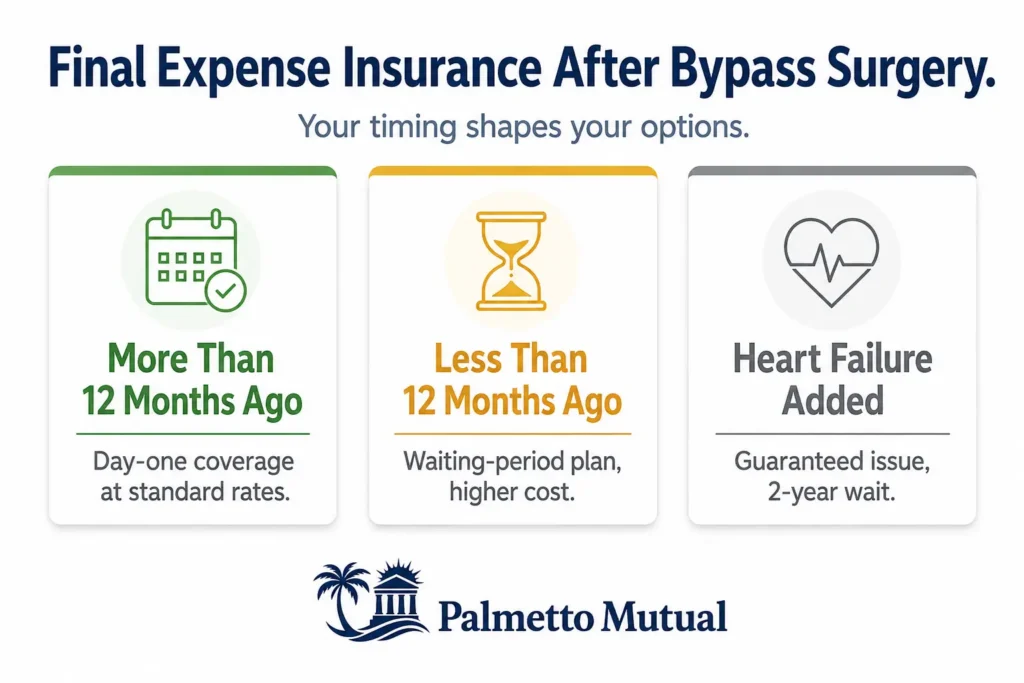
The line that matters most is twelve months.
| Time since your bypass | What you can usually get |
|---|---|
| More than 12 months ago | A plan with no waiting period — full coverage starts day one |
| Less than 12 months ago | A plan with a waiting period, at a higher price |
If your surgery was more than a year ago, you can typically qualify for immediate, day-one coverage at a company’s standard pricing for the plan. If it was less than a year ago, most carriers will place you on a waiting-period plan instead, where the full benefit isn’t available right away.
There is one important exception to keep in mind. Bypass surgery by itself is treated as a timing question. But if you also live with a heart condition that carriers consider high-risk on its own — congestive heart failure is the most common one — that condition can override the timing rule and require a waiting period no matter how long ago your surgery was.
So the honest bottom line is this: most people shopping for burial insurance after a bypass can get full, day-one coverage, as long as enough time has passed and no separate serious heart condition is in the picture. The sections below walk through how carriers actually review your history and what you can expect to pay.
How carriers underwrite bypass surgery
When you apply for a no-exam final expense policy, the company does not send a nurse to your home. Instead, it builds a picture of your heart history from three things: the health questions on the application, a review of your prescription record, and a check of your past insurance applications.
Almost every burial insurance application asks some version of the same question: in the past 12 to 24 months, have you had heart surgery, a heart attack, a stent or other circulatory surgery, or a stroke? Your bypass falls squarely under the “heart surgery” part of that question.
The exact look-back window varies by company. Some look back 12 months, others 24, which is why the same surgery date can earn day-one coverage at one carrier and a waiting period at another.
A few carriers also ask a second kind of question, such as whether you’ve been hospitalized two or more times in the past two years. A “yes” there can move you off a first-day plan even when your surgery date alone would have cleared.
After the questions, the carrier reviews your prescription record and application history to confirm your answers line up. If you report no heart condition but cardiac medications appear on file, that mismatch raises a flag. We walk through exactly how the prescription and MIB checks work on our prescription history page — the point here is simply that your medication list is part of how a bypass gets underwritten, even on a no-exam policy.
Medications underwriters watch for after bypass surgery
After a bypass, nearly everyone goes home on a standard set of heart medications, and underwriters know this. So the goal here is not to alarm you — it’s to help you see what your own prescriptions may be telling a carrier.
The list below runs from the most routine and reassuring medications down to the ones that can point to a more serious picture. Find the ones you take to get a sense of how they read.
| Medication (common examples) | What it usually signals to an underwriter |
|---|---|
| Antiplatelets — aspirin, clopidogrel (Plavix), ticagrelor (Brilinta) | Routine care to keep your grafts open. Expected, not a red flag. |
| Statins — atorvastatin (Lipitor), rosuvastatin (Crestor) | Standard cholesterol control. Shows the underlying disease is being managed. |
| Beta-blockers and ACE inhibitors/ARBs — metoprolol, carvedilol, lisinopril, losartan | Routine heart and blood-pressure protection after surgery. |
| Anticoagulant blood thinners — warfarin (Coumadin), apixaban (Eliquis), rivaroxaban (Xarelto) | Usually points to a separate issue like atrial fibrillation or a clot, which carries its own underwriting. |
| Antiarrhythmics — amiodarone, sotalol | Suggests an irregular heartbeat alongside the bypass. |
| Nitrates — nitroglycerin, isosorbide (Imdur) | Can signal ongoing chest pain, meaning symptoms may not be fully resolved. |
| Water pills (loop diuretics) — furosemide (Lasix) | Can signal fluid buildup from weakened heart function — a bigger concern. |
The reassuring news is that the top of this list — antiplatelets, statins, beta-blockers, and blood-pressure medicines — is exactly what carriers expect to see after a bypass. These are the guideline-standard medications nearly all patients take, so their presence confirms you are following normal care, which works in your favor.
The medications further down the list are the ones to understand. Nitrates for chest pain or a water pill like furosemide can suggest your heart disease is still active or that heart function is reduced, and those are the prescriptions most likely tied to a waiting period.
One group deserves its own note: anticoagulant blood thinners like warfarin or Eliquis. These usually point to a separate condition such as atrial fibrillation rather than the bypass itself. Because blood thinners come up across so many conditions, we cover them in depth on our blood thinners page rather than rehashing them here.
Best companies and what you’ll pay after bypass surgery
Here is the part that surprises most people: once your bypass is far enough behind you, it does not add a special surcharge to your premium. If you qualify for a day-one plan, you pay that company’s normal rate for your age, gender, and coverage amount — the same rate someone without a bypass would pay for that same plan.
What you pay tracks the lane you fall into, and those lanes come straight from the timing rules covered earlier.
| Your situation | Plan type | What you’ll generally pay |
|---|---|---|
| Bypass more than 12 months ago, otherwise stable | Level (day-one) coverage | The carrier’s standard rate for your age — no added bypass surcharge |
| Bypass less than 12 months ago | Graded / waiting-period plan | A higher premium, with only partial benefit for roughly the first two years |
| A high-risk condition layered on top, such as congestive heart failure | Guaranteed issue | The highest premium, with a full two-year waiting period |
So for most bypass survivors who have passed the timing mark, the real question is not “how much extra will the bypass cost me.” It’s simply finding the carrier with the best base rate for your age and the coverage you want.
As a broad anchor, burial insurance generally costs about $50 to $100 a month for $10,000 in coverage, with the price rising as age goes up. Your exact number depends on your age, gender, state, tobacco use, and how much coverage you buy. For the full breakdowns, see our cost-by-coverage and cost-by-age pages.
How to get the best rate and coverage after bypass surgery
A bypass is something underwriters see every day, and a few simple steps on your end can make the difference between a day-one plan at a good price and an avoidable waiting period. None of this requires a medical exam. It comes down to applying at the right time, with the right company, and answering the health questions accurately.
The first thing to check is the calendar. Crossing the 12-month mark after surgery is what moves many applicants from a waiting-period plan to full day-one coverage, so if you’re only a month or two short of a year, it can be worth waiting. Just weigh that against the fact that premiums also rise with each birthday. How waiting-period plans actually pay out is covered in full on our no-waiting-period page.
Before you apply, it helps to have a few facts at your fingertips so you (or your agent) can answer accurately and target the right carrier:
- The date of your surgery and what type it was (for example, a single, double, or triple bypass)
- Any hospital stays in the last two years
- Your current medications
- Any other heart conditions you’ve been told you have, such as atrial fibrillation or congestive heart failure
A couple of these can quietly affect your options. Some carriers ask whether you’ve been hospitalized two or more times in the past two years, and a “yes” can move you off a first-day plan. Finishing cardiac rehab and keeping up with your follow-up appointments helps here in a practical way: staying stable keeps you out of the hospital, which protects your eligibility for day-one coverage.
It also pays to tend to the things scored separately from the surgery itself. Blood pressure, cholesterol, blood sugar, weight, and tobacco use all affect your rate independently of your bypass history, and tobacco in particular moves you into a higher rate class on its own.
Be straightforward about your history. You must disclose the bypass no matter how long ago it was, and trying to hide it risks the policy being voided if it surfaces during a claim. The prescription check and application history will reveal a cardiac history anyway, so honest answers simply match you to the carrier most likely to approve you — what happens when an application is declined is covered on our can-you-be-denied page.
Finally, don’t apply to one company and hope. An experienced independent agency can get informal feedback from underwriters before a formal application goes in, steering you toward the carrier most likely to offer day-one coverage on your situation and helping you avoid unnecessary declines.
Keep Reading







About the Author
Dvir Mosche is an award-winning independent insurance agent and the founder of Palmetto Mutual, a trusted insurance brokerage specializing in Final Expense Life Insurance. Since entering the industry in 2017, he has been recognized multiple times as a top agent for his dedication to educating and assisting seniors in finding the proper coverage. His mission is to simplify the process, provide honest and personalized guidance, and ensure that every client gets coverage they can depend on for life.


