
Home > Burial Insurance with Pre-Existing Conditions > ADL Limitations
Final Expense Insurance with ADL Limitations

Needing help with everyday tasks like bathing, dressing, or getting out of bed changes how life insurance companies look at your application. Most burial insurance companies ask about activities of daily living right on the application, and your answer often decides whether you qualify for day-one coverage or a guaranteed issue policy with a waiting period. This guide covers where ADL limitations usually land you, how carriers underwrite them, which companies are most forgiving, and what you can do to get the best coverage available to you.
Can You Get Final Expense Insurance If You Need Help With Daily Activities?
Yes, you can get coverage. But for most people, the only plan available is a guaranteed issue policy with a two-year waiting period.
This is one of the few health situations in final expense insurance where the answer is that firm. Almost every burial insurance company treats a “yes” to the ADL question as a knockout — an automatic decline for any plan with day-one coverage, no matter how healthy you are otherwise.
Industry guidance is blunt about it: essentially every burial insurance company will deny an applicant who needs help with activities of daily living, with rare exceptions. Those exceptions exist, but they are limited to a small number of carriers, and they can change year to year.
What counts as “help”
The word carriers use is assistance. That word does more work than most applicants realize.
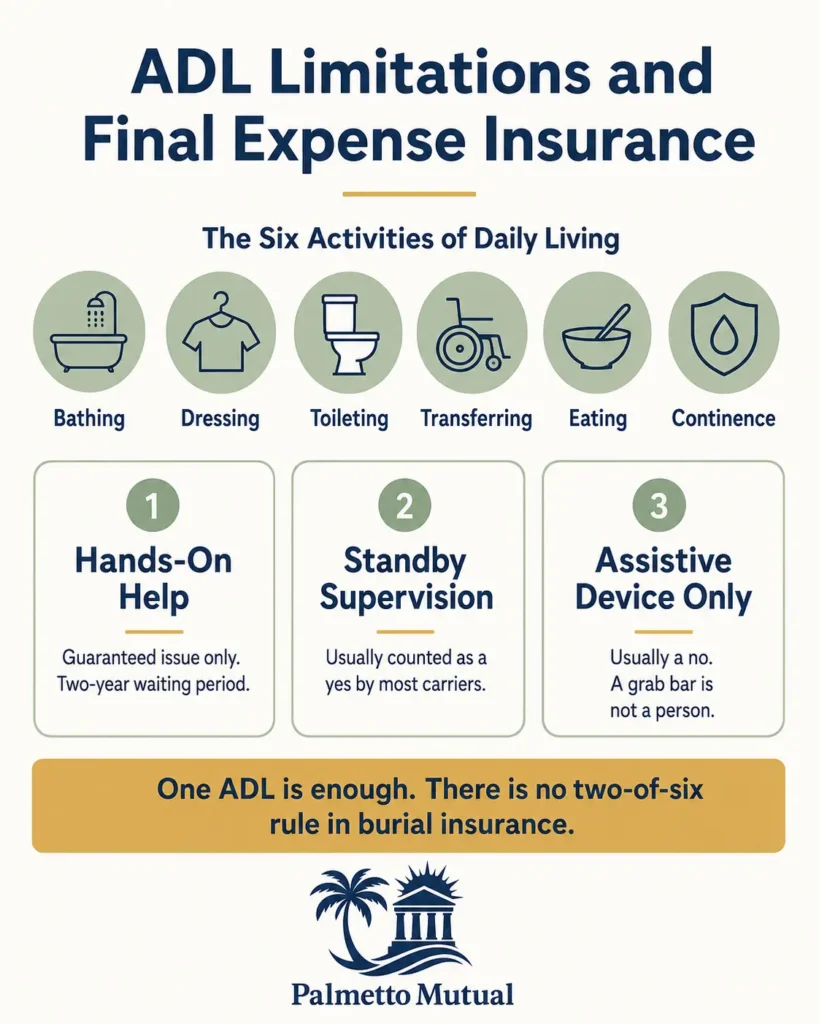
The six standard ADLs are bathing, dressing, toileting, transferring (getting in and out of a bed or chair), eating, and continence. Underwriters are not asking whether these tasks are hard for you. They are asking whether another person has to help you do them.
That distinction is where most people land in the wrong tier by accident. Here is how carriers generally read the three situations:
| Your situation | What it usually means for coverage |
|---|---|
| Another person physically helps you (hands-on assistance) | Guaranteed issue only, two-year waiting period |
| Another person stands by, watches, or reminds you (standby supervision or cueing) | Usually treated as a “yes” — most carriers count supervision as assistance |
| You use a grab bar, shower chair, walker, or reacher and do the task yourself | Usually a “no” — an assistive device is not another person |
If you use equipment to stay independent, you are generally not answering yes to the ADL question. If a spouse, child, or aide steps in, you are.
The tier this usually lands in
One ADL is enough. Needing help with a single activity of daily living is an automatic decline for most simplified issue plans, and guaranteed issue burial insurance becomes the remaining option. Carriers do not use a “two of six” threshold the way long-term care insurance does. In funeral insurance, one yes is a yes.
A guaranteed issue policy has no health questions at all. Every guaranteed acceptance policy carries a two-year waiting period, and there are no exceptions — no company offers a plan with no questions and no waiting period. If you die from natural causes during those first 24 months, the company refunds your premiums plus a small amount of interest. After two years, the full death benefit is payable for any cause of death.
That is the reality. It is not a good reason to wait. Most people who need help with one ADL and are otherwise stable will outlive a two-year waiting period, and the policy pays in full from that point forward for the rest of their life.
How Carriers Underwrite ADL Limitations
Burial insurance underwriting has no medical exam. There are no labs, no blood or urine samples, and no nurse visit — you answer health questions, and the insurer electronically reviews your medication history.
For ADL limitations, the health questions do almost all of the work. The ADL question sits near the top of nearly every simplified issue application, in the section underwriters use to screen applicants out before anything else is considered.
How the question is worded
Every carrier phrases it slightly differently, but the substance is the same. Applications typically ask whether you need assistance performing daily living activities such as dressing, eating, bathing, transferring, toileting, or continence.
Most applications do not stop there. They surround the ADL question with related questions that catch the same situation from a different angle. Common companions include whether you currently use a wheelchair due to chronic illness or disability, whether you receive home health care or received it more than three separate times in the last 24 months, and whether you are currently confined to a nursing home or assisted living facility.
This matters because a person who needs help transferring will often also be receiving home health care. Answering no to the ADL question while the home health care question catches you does not help you. The application is designed to close that loop.
| Related question on the application | Why underwriters ask it |
|---|---|
| Do you use a wheelchair because of an illness or disease? | Wheelchair use tied to a chronic illness or disease means a waiting period; wheelchair use for another reason may still qualify for immediate coverage |
| Do you receive home health care? | Most carriers decline or offer a two-year waiting period to people receiving home health care, though a very small number will still write immediate coverage |
| Are you confined to a nursing home or assisted living? | Confinement is a hard knockout at essentially every carrier |
| Are you receiving hospice care? | Hospice is a hard knockout at every carrier |
Adult day care generally does not carry the same weight as home health care, because it is often social rather than custodial. But if the application asks, answer it accurately.
The look-back windows
Home health care questions usually reach back 24 months, not just to today. Some applications ask whether you received home health care more than three separate times during that window. Nursing home and hospice questions are almost always framed in the present tense — are you currently — which means a past stay that has ended may not trigger the same decline.
This is the one place where timing works in your favor. A rehab stay after a hip replacement is not the same thing as ongoing custodial care, and carriers do distinguish between the two.
How carriers verify your answer
Insurers do not simply take your word for it. Every simplified issue funeral insurance application runs your prescription history and checks industry databases before a decision is issued. Medications tell a story about function, and underwriters read that story carefully.
Medications Underwriters Watch For With ADL Limitations
Underwriters are not reacting to individual drug names. They are reading drug classes as signals about how much function you have lost. The groups below are organized by what they signal, not alphabetically, so you can find where your own prescriptions fall.
Group 1 — Hard-stop signals
These medications end the conversation about day-one coverage on their own, whether or not you answer yes to the ADL question.
| Drug class | Common examples | What it signals |
|---|---|---|
| Memory and dementia medications | Donepezil, memantine, rivastigmine, galantamine | Cognitive impairment. A single fill of a memory medication makes an applicant ineligible for any plan with health questions, even without a formal diagnosis and even if the medication was never taken |
| Hospice and comfort medications | Liquid morphine, scopolamine, haloperidol used for end-of-life care | Active end-of-life care |
Group 2 — Functional decline signals
These are strongly tied to the loss of mobility, transferring, or self-feeding. They do not automatically decline you, but they draw immediate attention to how you answered the ADL question.
| Drug class | Common examples | What it signals |
|---|---|---|
| Parkinson’s medications | Carbidopa-levodopa, pramipexole, ropinirole, entacapone | Progressive movement disorder. Parkinson’s alone can qualify for immediate coverage with some carriers, but Parkinson’s plus a wheelchair means a waiting period |
| Muscle relaxants and spasticity drugs | Baclofen, tizanidine, dantrolene | Stroke aftermath, MS, spinal cord injury |
| Long-term opioid therapy | Oxycodone, morphine, fentanyl patch | Severity of the underlying condition, not the pain itself |
Group 3 — Supporting signals
On their own, these are common and rarely change anything. They matter mostly when they appear alongside a yes on the ADL question, because they confirm the picture.
| Drug class | Common examples | What it signals |
|---|---|---|
| Bladder and continence medications | Oxybutynin, tolterodine, mirabegron | Continence issues, usually minor by themselves |
| Nerve pain medications | Gabapentin, pregabalin | Neuropathy affecting balance or grip |
| Blood thinners | Warfarin, apixaban, clopidogrel | The event behind them — often stroke — matters more than the drug |
| Steroids | Prednisone, long-term oral courses | Chronic inflammatory disease severity |
If you take something in Group 3 and nothing in Groups 1 or 2, your prescriptions are almost certainly not the thing standing between you and level coverage. Your answer to the ADL question is.
Best Companies and What You’ll Pay With ADL Limitations
Here is the part most guides get wrong: with ADL limitations, there is no “cheapest carrier” hunt in the usual sense.
Because a yes to the ADL question knocks you out of level coverage at nearly every company, the shopping question changes. You are not comparing which insurer rates you most favorably. You are comparing guaranteed issue prices — and those prices vary a lot.
Who to look at first
There are two paths, and which one you’re on depends entirely on the exception.
Path one — the rare carrier that will still write level coverage. A very small number of final expense companies do not treat ADL assistance as an automatic decline. If one of them will take you, that is the whole ballgame: day-one coverage, no waiting period, and a much lower premium.
Path two — guaranteed issue. If no carrier will write you level, you are shopping guaranteed acceptance policies, and price is the main lever you control.
What guaranteed issue actually costs
Guaranteed acceptance premiums are set by your age, gender, state, and coverage amount. Your health does not factor in at all, because the company never asks.
That produces a strange result: two people in identical health can pay wildly different premiums for the same coverage simply because they applied to different companies. Analysis of guaranteed acceptance carriers found a spread of about $44 per month between the cheapest and most expensive provider for a 65-year-old man buying $15,000 — roughly $524 a year for the exact same policy and the exact same two-year waiting period.
That gap is the single biggest thing you control. Nothing about your ADL status changes it.
| What you’re comparing | What to look for |
|---|---|
| Monthly premium | The spread between carriers on identical coverage is large; compare several |
| Coverage cap | Most guaranteed issue plans cap at $25,000; a few go to $30,000 |
| What the waiting period refunds | Some carriers return premiums plus 10%; others return 130% of premiums paid |
| Accidental death | Accidental death is covered in full from day one on nearly all guaranteed issue policies |
| Age limits | Most guaranteed acceptance plans run ages 50 to 85; above 85, no guaranteed issue exists |
Guaranteed issue burial insurance also costs more than a simplified issue plan for the same face amount, because the insurer is covering a life it knows nothing about. Expect to pay more per month than a healthy applicant would for identical coverage. Depending on age and amount, monthly premiums for guaranteed acceptance funeral insurance run anywhere from around $10 to several hundred dollars.
If you need more coverage than one company’s cap allows, you can stack policies from two different guaranteed issue carriers.
How to Get the Best Rate and Coverage With ADL Limitations
You have less room to maneuver here than with most health conditions. But the room you do have matters, and a few mistakes are expensive.
Answer the question accurately — and know what it is really asking
The most common error is not lying. It is answering yes when the honest answer is no.
Plenty of people who use a shower chair, a walker, a raised toilet seat, or a grabber tool tell an agent they “need help getting around.” They do not. Nobody is helping them. They are using equipment and doing it themselves.
Before you answer, walk through each of the six activities and ask one question: does another person physically help me, stand by while I do it, or remind me how? If the answer is no across all six, you answer no — and a different tier opens up.
Be equally careful in the other direction. If your spouse steadies you every time you get out of the tub, that is assistance, even though it feels like ordinary married life.
Do not let an agent answer for you
You are not the one who marks the boxes. The agent is. Whether the application is done in person, over the phone, or electronically, the agent records every yes and no.
Some agents mark a yes as a no because they know a yes means a higher price or a waiting period, and they want the sale to close. That is not a favor. It is a setup.
Every policy has a two-year contestability period. If the insured dies during those first 24 months, the insurer can pull medical and prescription records and compare them against the application. A material misrepresentation — one that would have changed the decision or the price — lets the company deny the claim, reduce the payout, or void the policy entirely, even when the misstatement had nothing to do with the cause of death.
An ADL answer is about as material as it gets. Read the application before you sign it. If a yes was marked as a no, do not sign.
Time the application around recovery, not around a crisis
ADL limitations are not always permanent. Someone recovering from a hip replacement, a stroke, or major surgery may need help bathing and dressing for eight weeks and then need none.
If you are in a temporary period of assistance and your doctor expects you to regain independence, waiting until you are back to answering no on all six activities can be the difference between a guaranteed issue policy and day-one coverage. That is one of the few situations in burial insurance where waiting is the right call.
Watch the home health care look-back, though. Some applications ask about home health care received in the previous 24 months, which means a rehab period can follow you for two years even after you’ve recovered. Ask before you assume.
And if the assistance is permanent, do not wait. Health rarely improves with time at this stage, and the two-year clock on a guaranteed issue policy only starts once the policy is in force.
What to have ready before you apply
- A complete list of current medications, with doses
- The name and date of any home health care agency you have used in the last two years
- The reason for any wheelchair or mobility device use, since illness-related use is treated differently than injury-related use
- Dates of any nursing home, rehab, or assisted living stay, and whether it has ended
If you are a caregiver applying for a loved one
Read this part carefully, because it surprises almost everyone.
Power of attorney does not let you buy life insurance for another person. Even guaranteed acceptance carriers require the insured to consent to the policy and personally sign the application. A POA does not waive that requirement.
If your loved one can still understand the transaction and sign their own name, you can help them shop, gather records, and sit with them on the call. If they cannot — if cognitive decline has progressed past the point of legal consent — there is no policy available to them from any company. This is the reason final expense insurance for a parent with ADL limitations should be handled sooner rather than later, while capacity is intact.
Keep Reading







About the Author
Dvir Mosche is an award-winning independent insurance agent and the founder of Palmetto Mutual, a trusted insurance brokerage specializing in Final Expense Life Insurance. Since entering the industry in 2017, he has been recognized multiple times as a top agent for his dedication to educating and assisting seniors in finding the proper coverage. His mission is to simplify the process, provide honest and personalized guidance, and ensure that every client gets coverage they can depend on for life.


