
Home > Burial Insurance with Pre-Existing Conditions > Denied Final Expense Insurance
Can You Be Denied Final Expense Insurance?

If you’ve worried about being turned down for final expense insurance, you’re not alone — and the honest answer depends on the type of policy you apply for. Some plans can decline you for certain health conditions, while others accept every applicant. This guide walks through what can cause a denial, how to apply in a way that lowers your chances of being turned down, and what your options are if you’ve already been declined.
Can you be denied, and what causes it
Whether you can be turned down depends entirely on the kind of policy you apply for. Most people picture one big “yes or no” decision, but final expense insurance does not work that way. Two applicants with the same health can get very different answers depending on which product they choose.
Can you actually be denied?
The honest answer is: it depends on the type of plan.
With a simplified-issue policy, yes, you can be denied. This is the most common kind of final expense insurance, and it asks a short list of health questions. If your answers show a very serious condition, the carrier can turn you down.
With a guaranteed-acceptance policy, no, you cannot be denied for your health. These plans ask no health questions at all. As long as you meet the age limits (usually 50 to 85) and live in a state where the plan is sold, you are approved.
So a turn-down on a simplified-issue plan is never the end of the road. A guaranteed-acceptance plan exists as a backstop, and we cover that fully later on this page.
One more point worth knowing: a decline is almost always about health, not age by itself. The main age-based limit is the upper cutoff. Past about 85, most carriers stop offering new coverage of any kind.
What causes an outright decline
An outright decline on a simplified-issue burial insurance plan comes from a short list of very serious conditions. The industry calls these “knockout” conditions. If one applies to you, that single answer usually ends the application, no matter how healthy you are otherwise.
These questions exist to spot situations where someone is likely very close to the end of life. The most common knockout conditions across carriers include:
| Condition | Why it usually triggers a decline |
|---|---|
| Terminal illness diagnosis | Signals a short life expectancy |
| Currently in hospice or nursing-home care | Signals serious, late-stage decline |
| Currently bedridden or hospitalized | Same reason as above |
| On dialysis / kidney failure | High near-term risk |
| Currently being treated for cancer | Active, serious condition |
| Had or waiting for an organ transplant | High risk; cornea transplants usually excluded |
| HIV or AIDS diagnosis | Listed on most applications |
| Stroke in the past 12 months | Recent, high-risk event |
| Alzheimer’s or dementia | Affects life expectancy and consent |
| Use of oxygen for a lung or breathing disorder | Signals advanced respiratory disease |
Two things matter here. First, the exact list and wording change from one carrier to the next, which is why one company may decline you while another says yes. Second, the carrier can check your answers against outside records, including a prescription-history check and the MIB (Medical Information Bureau), a shared database insurers use to confirm what you reported.
A key takeaway: most common conditions are not knockouts. Controlled diabetes, treated high blood pressure, and many past heart issues do not cause an outright decline with the right carrier.
Knockout questions vs. rate-tier questions
This is one of the most useful things to understand about funeral insurance, and almost no one explains it plainly. The health questions on an application are not all the same. They do two completely different jobs.
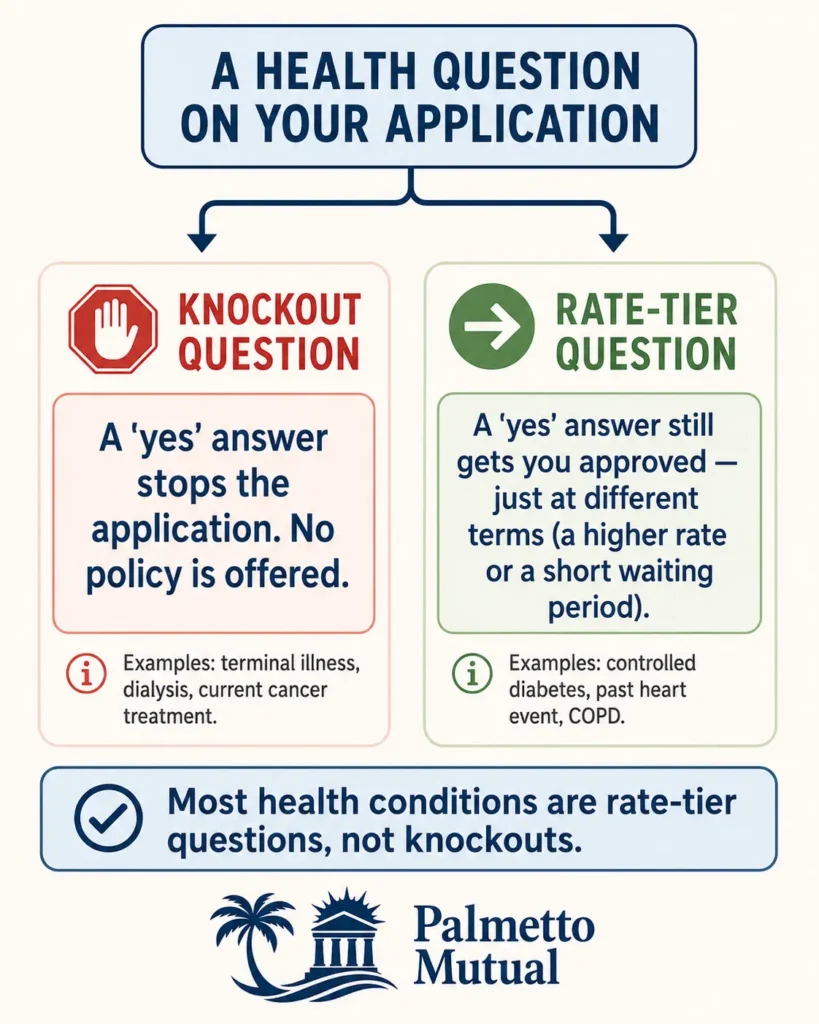
A knockout question decides whether you get covered. Answer “yes” to one of these, and the application stops. There is no rate to offer because the carrier will not write the policy at all.
A rate-tier question decides how you get covered, not whether. Answer “yes” to one of these, and you are still approved. You simply land in a different pricing tier, which may mean a higher monthly cost, a short waiting period before the full benefit is payable, or both.
Here is the difference side by side:
| Knockout question | Rate-tier question | |
|---|---|---|
| What it decides | Whether you’re covered | How you’re covered |
| A “yes” answer means | Application declined | Still approved, different terms |
| Affects your rate? | No policy offered | Yes, may cost more |
| Affects waiting period? | N/A | Possibly a short waiting period |
| Example trigger | Terminal illness, dialysis | Controlled diabetes, past heart event, COPD |
The reason this matters so much: a lot of people assume any “yes” to a health question means rejection. It usually does not. Most health conditions are rate-tier questions, not knockouts.
So a condition like well-managed diabetes or a heart event from years ago rarely ends your application. More often, it just moves you to a different tier with a slightly higher premium or a short waiting window, while many applicants in good health qualify for full coverage from day one.
Knowing which questions are which changes how you should shop. The goal is not just “get approved.” It is to land in the best tier your health allows, with a carrier that treats your specific conditions as rate-tier questions rather than knockouts. We cover how to do that in the next section.
How to apply so you don’t get denied
A decline is not bad luck. Most of the time, it comes from applying to the wrong company or filling out the form in a way that creates problems. You have more control over the outcome than you might think, and two simple habits make the biggest difference.
Apply to the right carrier first
This is the single most important step. Every final expense carrier sets its own health rules, so the same condition can be a knockout at one company and a routine rate-tier question at another.
That means a person with diabetes, a past heart event, or a breathing condition might be declined by Company A and approved with full day-one coverage by Company B. The health did not change. Only the company did.
The goal is to match your specific health history to the carrier most likely to say yes, before you ever submit an application. Guessing and hoping is what leads to avoidable declines.
This is where an independent broker helps. Because an independent agency works with many carriers instead of just one, it can look at your conditions and point you toward the company whose rules fit you best. A broker can often pre-check your situation informally so you apply where you are most likely to be approved. At Palmetto Mutual, this matching is done by phone, so you can talk through your health before anything is submitted.
Answer the application questions honestly
It can be tempting to leave something off the form, especially if you worry it will raise your rate. This almost always backfires, and it is the second-biggest cause of avoidable problems.
Final expense burial insurance has no medical exam, but the carrier still checks your answers against outside records. The two main checks are a prescription-history database, which shows the medications you have filled, and the MIB, a shared system insurers use to compare what you reported on past applications.
If your answers do not match those records, the application can be slowed, declined, or placed in a worse tier. Worse, a serious misstatement can let the company deny the claim later, when your family needs the money most. Insurers can treat a false answer as “material misrepresentation,” which may void the policy.
The honest answer protects you twice. It helps you land in the correct tier now, and it keeps the policy solid so it pays out the way it should. When you are unsure how to describe a condition, that is exactly the kind of thing to talk through with your agent before you answer.
What to do if you’ve already been declined
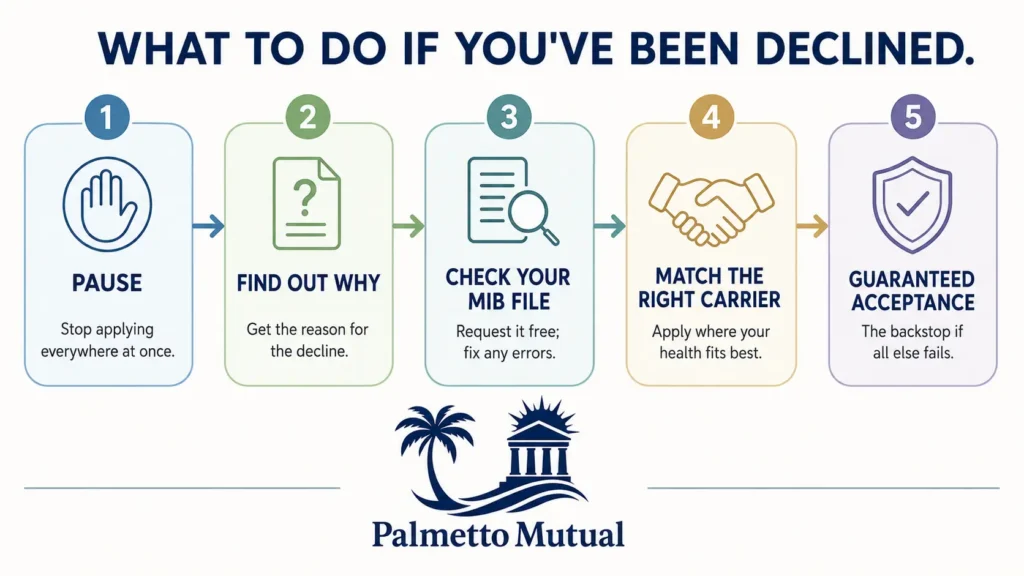
A decline feels final, but it rarely is. Different companies weigh the same health history differently, so being turned down by one carrier does not mean every carrier will say no. The key is knowing what to do next, and what not to do.
Does a past denial follow you?
This is the worry almost everyone has, and the honest answer is reassuring: not in the way most people imagine. There is no shared blacklist that bans you from future coverage.
Here is how it actually works. When you apply, carriers may report coded flags about your health conditions to the MIB, a shared insurance database. But the MIB stores only short codes, not your full medical records, and a future carrier usually cannot even tell from a code whether you were approved or declined. The code points to a topic to look into, not a verdict.
A few facts that take the fear out of it:
| Common worry | The reality |
|---|---|
| “A blacklist follows me everywhere” | No such list exists; MIB stores coded flags, not denials |
| “My medical records are shared” | Only short codes are shared, never full charts or lab results |
| “An MIB code can deny me” | A code alone cannot; carriers must underwrite independently |
| “It’s on my file forever” | MIB entries are removed after 7 years |
| “I probably have a file” | Only about 20% of applicants do; many seniors have none |
You can request your own MIB file free once a year and correct any errors before you apply again. Many simplified-issue final expense plans also lean on the MIB lightly or not at all, which is part of why they work well for people with health concerns.
The one place a past decline truly does follow you is the application itself. Most applications ask directly whether you have ever been declined, postponed, or rated, and you must answer honestly.
That leads to the most important rule after a decline: do not fire off applications to a bunch of companies hoping one sticks. Each formal application adds to your record, and a string of declines makes the next underwriter more cautious. The better move is to pause, find out why you were declined, and let an agent steer your next application to a carrier that fits.
Guaranteed-acceptance coverage as a fallback
If you have truly run out of simplified-issue options, guaranteed-acceptance coverage is the backstop that is always there. No one with a serious health condition is left with nothing.
A guaranteed-acceptance plan asks no health questions and cannot turn you down for your health. As long as you are within the age limits and live where the plan is sold, you are approved.
The trade-offs are worth understanding before you choose it:
| Feature | What to expect |
|---|---|
| Health questions | None |
| Can you be declined for health? | No |
| Waiting period | Usually 2 years for natural-cause death |
| If you pass in the waiting period | Beneficiary gets premiums back plus interest (often about 10%), not the full benefit |
| Accidental death | Full benefit paid from day one |
| Cost | Higher than simplified issue for the same coverage |
Because it costs more and makes your family wait for the full benefit, guaranteed acceptance is best treated as a last resort, not a first stop. It is the right answer only after a real simplified-issue search has come up empty.
If that is where you are, the path is simple: secure the guaranteed-acceptance policy now so coverage is in place, and know that you and your family are protected. Funeral insurance of this kind exists precisely for the people other plans turn away.
Frequently Asked Questions
Keep Reading







About the Author
Dvir Mosche is an award-winning independent insurance agent and the founder of Palmetto Mutual, a trusted insurance brokerage specializing in Final Expense Life Insurance. Since entering the industry in 2017, he has been recognized multiple times as a top agent for his dedication to educating and assisting seniors in finding the proper coverage. His mission is to simplify the process, provide honest and personalized guidance, and ensure that every client gets coverage they can depend on for life.


