
Home > Burial Insurance with Pre-Existing Conditions > Obesity
Final Expense Insurance with Obesity

Carrying extra weight does not shut you out of final expense insurance. Most people with obesity can still get covered — your weight mainly affects which carriers will take you and what you’ll pay, not whether coverage exists at all. This page gives you the bottom line for your situation: whether you qualify, how companies weigh your height and weight during underwriting, and which carriers tend to be the most forgiving. You’ll also find practical steps to land the best rate and coverage available to you.
Can you get final expense insurance with obesity?
Yes. For most people carrying extra weight, the answer is a clear yes — and usually with first-day, full coverage, not a stripped-down plan. Burial insurance is built for exactly this kind of applicant.
Weight matters far less here than it does with regular life insurance. Final expense policies are simplified issue, which means lenient build limits and no medical exam. In fact, some of the most forgiving carriers use no height-and-weight chart at all, so a high number on the scale does not raise your price or block approval.
What actually decides your outcome is not the weight itself. It’s whether your weight has started to limit your daily life — weight alone rarely causes a decline in this market. The trouble usually starts only when extra weight brings other problems along with it.
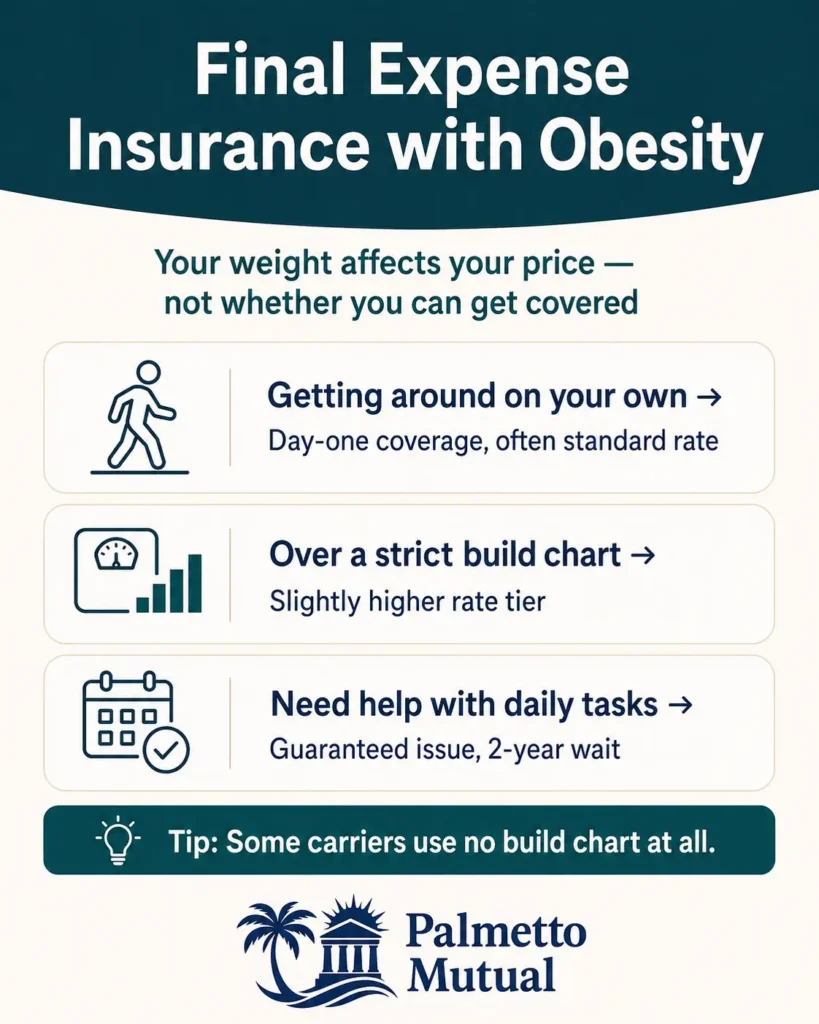
Here is how the three common situations tend to land:
| Your situation | Likely outcome |
|---|---|
| Overweight or obese, getting around fine on your own | Level (day-one) coverage, often at a standard rate |
| Heavier build plus a controlled condition like high blood pressure | Level coverage, sometimes at a slightly higher rate tier |
| Weight severe enough that you need help with daily tasks like walking, bathing, or dressing | Guaranteed-issue plan with a two-year waiting period |
So the honest bottom line: obesity by itself almost never shuts the door on funeral insurance. The one situation that pushes you into a waiting-period plan is when your weight has reached the point of needing help with everyday activities. For most readers, the real question is not whether you can get covered — it’s which company fits your build best, which the sections below walk through.
How carriers underwrite obesity
With burial insurance, there is no medical exam and no doctor visit. Instead, carriers size up obesity through three things: a short list of yes/no health questions, your height and weight, and a check of your prescription history.
The build chart comes first. Carriers that use one compare your height and weight against a maximum, while some of the most lenient companies skip the build chart entirely. Where a chart exists, going over the limit usually moves you to a higher-priced tier or a waiting-period plan rather than a flat “no.”
The questions that matter most are not about the weight itself. They are about whether your weight has changed how you function day to day. Expect to be asked whether you need help with tasks like walking, bathing, dressing, or eating, and whether you use a wheelchair or have lived in a nursing home. A “yes” to those is the usual trigger that moves you to a guaranteed-issue plan.
The health questions are also framed by time. Some ask about your entire history (“have you ever…”), while others only look back a set number of months or years at things like recent hospital stays, heart procedures, or weight-loss surgery. The exact look-back windows differ by carrier, so the same history can mean a day-one plan at one company and a waiting period at another.
Weight-loss surgery gets its own attention. A recent bariatric procedure can lead a carrier to wait until your weight has settled, while a surgery several years back with steady weight since often reads as a good sign.
Finally, every yes/no answer is checked against a prescription-history database — that is how carriers confirm what you have actually been treated for. The full mechanics of that check are covered on our prescription history page, so we won’t repeat them here. The short version: answer honestly, because the database will tell on you.
Medications underwriters watch for with obesity
Your prescription list often tells an underwriter more than your weight does. The drugs tied to obesity fall into two groups: ones showing you are managing your weight, and ones showing your weight has started to cause other problems. Here is how to read your own medicine cabinet.
| What you take | What it signals to an underwriter |
|---|---|
| Weight-loss / GLP-1 drugs — semaglutide (Ozempic, Wegovy), tirzepatide (Mounjaro, Zepbound), phentermine | Active weight management; a steady, documented weight-loss trend often helps your case |
| Blood pressure medications | Weight may have led to high blood pressure — common and usually controllable |
| Cholesterol medications (statins) | Part of the same metabolic picture; usually mild on its own |
| Diabetes medications, especially insulin | A stronger severity signal; insulin points to longer-standing or harder-to-control diabetes |
| Water pills (diuretics) or blood thinners | May point to heart strain or clotting issues, which carry more weight in underwriting |
One medication from this list rarely changes much. It is the stack that matters — several of these together form the pattern underwriters price for, and it is the real reason two people at the same weight can land in different tiers.
Weight-loss drugs deserve a special note. A large 2025 industry analysis found that GLP-1 users had lower overall death rates than non-users, so carriers increasingly view documented use with real weight loss as a plus. But because these same drugs treat diabetes, a GLP-1 showing up on your record can also reveal a diabetes diagnosis to the underwriter — so it can cut both ways.
Several of these medications and the conditions behind them have their own dedicated guides on this site. We link out to those for the detail rather than repeating it here.
Best companies and what you’ll pay with obesity
There is no single “best” final expense company for obesity — only the best one for your build and your health. The right carrier depends on whether you fit its build chart, whether your weight has brought other conditions along, and how that company treats those conditions.
The biggest lever is the build chart itself. A handful of carriers use no build chart at all, and with those companies your height-to-weight ratio does not affect your eligibility or your price in any way. Others use a generous chart that leaves plenty of room before your weight changes anything. The most forgiving carriers also tend to be the ones that approve common weight-related conditions like controlled diabetes and high blood pressure with no waiting period.
What you will actually pay comes down to which tier your weight lands you in. For most readers, the takeaway is reassuring: obesity by itself usually adds nothing to your premium.
| Where your weight lands you | What it does to your price |
|---|---|
| Level / day-one plan (no build chart, or within the chart) | Standard rate for your age, gender, coverage amount, and tobacco use — no extra charge for your weight |
| Higher rate tier (over a stricter carrier’s chart) | A modest premium increase, sometimes with reduced benefits in the first year or two |
| Guaranteed-issue plan (mobility or daily-activity knockout) | Higher cost per dollar of coverage, plus a two-year waiting period before the full benefit pays |
This is exactly why comparing more than one company matters so much. The same person can be a standard-rate, day-one approval at a no-build-chart carrier and a higher-priced or waiting-period offer at a stricter one — for the very same weight.
Most people buy enough burial insurance to cover a funeral and a few final bills. The average U.S. funeral ran about $9,420 in 2025, so coverage in the $10,000 to $20,000 range is common. Your exact premium depends on your age and how much you buy — the cost-by-coverage and cost-by-age pages carry the full rate tables, so we point you there rather than repeating them here.
How to get the best rate and coverage with obesity
The single most powerful move is also the simplest: match the company to your build before you apply, not after. Because every carrier reads height and weight differently, the same person can be a standard day-one approval at one company and a higher-priced or waiting-period offer at another. Applying blind to the wrong carrier is how people end up overpaying.
This is where an independent agent earns their keep. A good one knows which carriers use no build chart, which have generous charts, and which forgive weight-related conditions — and can often run an informal check before any formal application lands on your record.
A few things genuinely move your result:
- Be completely honest about your height and weight. There is no exam to fool with burial insurance, but your prescription history paints the real picture, and a mismatch can sink an otherwise easy approval. Honesty is always the better play here.
- Manage and document the complications, not just the weight. Controlled blood pressure, steady blood sugar, and treated sleep apnea matter more to an underwriter than the number on the scale.
- Show steady weight. Carriers like stability, and large swings raise questions; if you have lost weight, a doctor’s note tying it to a program or a GLP-1 drug helps it count in your favor.
- Mind the timing after weight-loss surgery. Some carriers postpone for about a year after bariatric surgery while others will cover you sooner, so carrier choice matters even more if your surgery was recent.
- Have your basics ready. Your current height and weight, your medication list, and the names of any conditions you treat will speed the whole process up.
On the bigger timing question: if your weight is stable and you have no coverage today, applying now usually wins. You will never be younger, and insurers reward earlier applications with lower age-based premiums. Waiting really only makes sense if you are mid-weight-loss and can hold the lower number for about a year — and even then, check with an agent before you delay.
Two situations have their own playbooks. If your build pushes you toward a plan with a waiting period, our no-waiting-period page walks through how those waiting periods actually work and how to sidestep one. And if you have already been turned down, our page on whether you can be denied explains what a decline really means and what to do next. We send you there rather than repeating the details here.
Keep Reading







About the Author
Dvir Mosche is an award-winning independent insurance agent and the founder of Palmetto Mutual, a trusted insurance brokerage specializing in Final Expense Life Insurance. Since entering the industry in 2017, he has been recognized multiple times as a top agent for his dedication to educating and assisting seniors in finding the proper coverage. His mission is to simplify the process, provide honest and personalized guidance, and ensure that every client gets coverage they can depend on for life.


