
Home > Burial Insurance with Pre-Existing Conditions > Neuropathy
Final Expense Insurance with Neuropathy

Living with neuropathy does not shut you out of final expense insurance. Most people with nerve damage can still qualify, though the type, cause, and severity of your neuropathy shape which policy and price you’ll get. This guide walks through how carriers look at neuropathy, what coverage tends to cost, and which companies are usually the most flexible — plus a few simple steps that can help you land the best rate.
Can you get final expense insurance with neuropathy?
Yes. In most cases, people with neuropathy can get final expense insurance, and many qualify for a policy that pays the full benefit from day one. Neuropathy by itself rarely closes the door. What changes is which company says yes, what you pay, and whether there is a waiting period.
The two things that move the needle most are the cause of your neuropathy and how much it affects your daily life. Nerve damage tied to a well-managed cause looks very different to an underwriter than nerve damage that limits how you move or care for yourself.
Here is the general picture of where most applicants land:
| Your situation | What you can usually expect |
|---|---|
| Mild or stable neuropathy, and you get around and care for yourself on your own | Level (first-day) coverage with the full death benefit payable immediately — the best tier |
| Neuropathy from a harder-to-control cause, or you take stronger nerve or pain medications | Approval is still common, sometimes at a higher rate after a closer look at your records |
| Neuropathy that limits daily living — you need help bathing, dressing, or moving, or you use a wheelchair or are bedbound | Guaranteed acceptance coverage, which carries a waiting period of about two years |
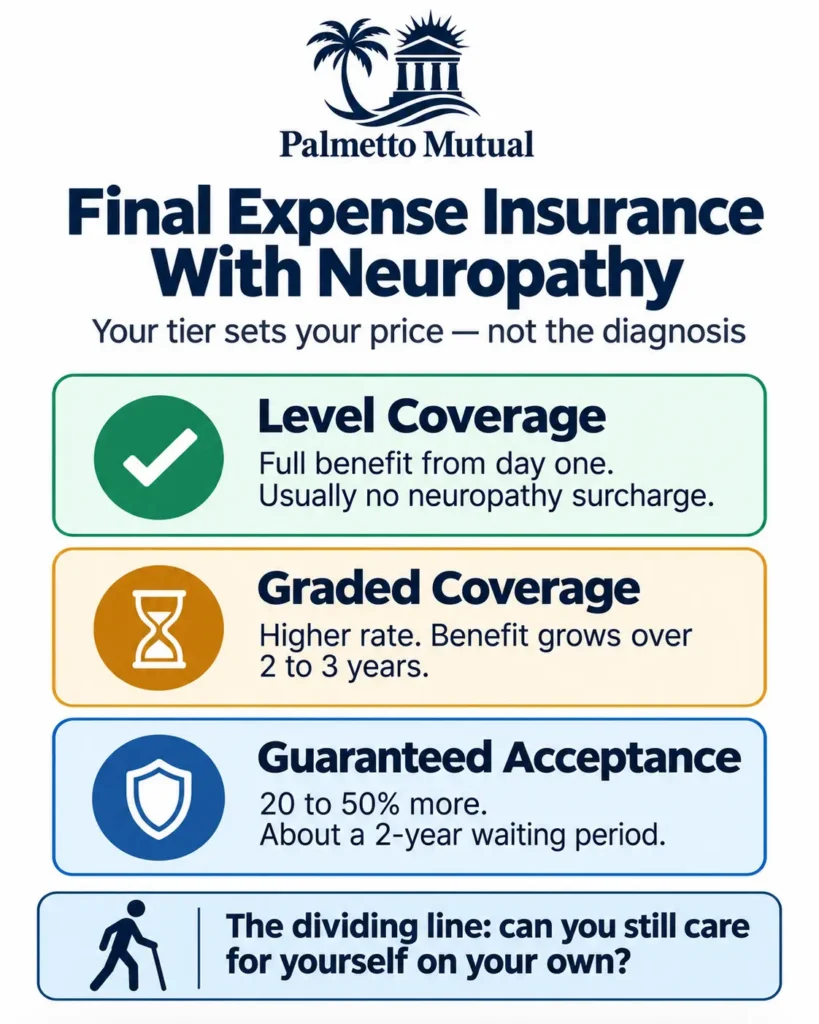
The clearest dividing line is whether you can still handle everyday tasks on your own. Applicants who are independent usually reach the top tier with no waiting period. Applicants who need regular help are most often steered toward a guaranteed acceptance plan.
One more point worth knowing up front: with the right company, many people with neuropathy pay rates close to what they would pay without it. The outcome depends heavily on the carrier, because each one treats neuropathy differently — so the bottom line is less about whether you can get burial insurance and more about finding the company that fits your situation.
How carriers underwrite neuropathy
There is no medical exam for final expense insurance. Instead, a carrier decides where you fit using two tools: the health questions on the application, and a quiet check of your prescription history.
Most companies do not ask about neuropathy on its own line. They usually fold it into a larger question, and how that question is worded changes your outcome. Two question styles matter most:
- A diabetes-complications question, such as whether you have had neuropathy, retinopathy, kidney problems, or an amputation tied to diabetes. This links your nerve damage back to its cause.
- A mobility and daily-living question, such as whether you use a wheelchair or need help with bathing, dressing, eating, or toileting. This measures how far your neuropathy has progressed.
A few carriers do list neuropathy by name as an automatic decline. Many others only “see” it through the diabetes question. That difference is the main reason the same person gets a yes from one company and a no from another.
Look-back periods vary by question. Some health questions only ask about the last 12, 24, or 36 months. Diabetes-complication questions often have no time limit at all — they ask whether it ever happened. An amputation caused by diabetes is one of the more common hard declines across carriers.
The prescription check confirms what you actually take. A filled prescription is treated as proof you have a condition, even if you answered “no” on the application. The full mechanics of that database check — including the prescription and medical-record systems carriers pull from — are covered on our prescription history page, so this page stays focused on neuropathy itself.
Medications underwriters watch for with neuropathy
Your medication list tells an underwriter a story about how severe your neuropathy is. The drugs below are the common ones tied to nerve damage, grouped by what they usually signal. If you take one, you can find your row and see roughly how a carrier reads it.
| Medication | What it usually signals to an underwriter |
|---|---|
| Topical patches and creams — lidocaine patches, capsaicin cream | Milder, localized nerve pain; the lightest signal |
| Low-dose amitriptyline or nortriptyline | Nerve pain managed with an older, low-cost option; usually a mild signal |
| Gabapentin (Neurontin), pregabalin (Lyrica), duloxetine (Cymbalta) | Active, ongoing nerve-pain treatment; very common and usually fine on its own |
| Tramadol (Ultram) or a stronger opioid for nerve pain | More severe or harder-to-control pain; a stronger signal that invites a closer look |
| Several nerve medicines taken together, or insulin alongside them | More advanced neuropathy, or diabetic neuropathy with insulin use; the underwriter digs deeper |
A key point: these medications matter for what they reveal about your neuropathy, not as a separate strike against you. Taking gabapentin does not “cost” you anything by itself — it simply confirms you are being treated for nerve pain.
Best companies and what you’ll pay with neuropathy
There is no single best company for neuropathy. The best carrier is simply the one that reads your neuropathy most favorably — and because each company writes its rules differently, the spread is wide. The same applicant can be quoted standard rates by one company and pushed into a waiting period by another for identical coverage.
What separates a neuropathy-friendly carrier from a strict one comes down to a few habits:
- It treats neuropathy as part of diabetes, rather than listing it as a standalone decline.
- It reads your nerve and pain medications by how long you’ve taken them, instead of declining the moment it sees one.
- It saves the wheelchair and daily-help knockout for real mobility loss, not milder cases.
- It offers day-one coverage to controlled, stable conditions.
A carrier with all four habits is where someone with manageable neuropathy usually lands the best burial insurance rate. A carrier missing them is where the same person gets rated up or delayed.
What you’ll actually pay
Your price is set almost entirely by which tier you reach, not by the neuropathy itself. Here is how the three tiers compare:
| Tier you reach | What you pay | When the full benefit pays |
|---|---|---|
| Level (first-day) coverage | Standard rates for your age, gender, and tobacco use — neuropathy usually adds nothing | From day one |
| Graded coverage | A higher rate, with a partial payout that grows over the first two to three years | Full benefit after the graded period |
| Guaranteed acceptance | Roughly 20–50% more than a level policy | After a two-year wait; premiums plus about 10% interest are returned if death is from natural causes during that window |
The takeaway for most readers is encouraging. If your neuropathy is controlled and you can still care for yourself, the right carrier treats you like any other applicant your age — there is no separate “neuropathy surcharge” on a level policy. The extra cost only shows up when a condition forces you into graded or guaranteed acceptance coverage.
How to get the best rate and coverage with neuropathy
Your neuropathy is already part of your history, but how you present it is still in your hands. A few simple steps before you apply can be the difference between day-one coverage at a fair price and a higher-cost plan with a waiting period.
- Get the underlying cause documented and steady. For diabetic neuropathy, that means stable blood sugar and regular checkups. For other causes, a recent note from your doctor showing things are stable does the same job. Underwriters reward a record that shows your condition is managed, not moving.
- Be ready to answer the daily-living question honestly. The single biggest tier-mover is whether you use a wheelchair or need help with bathing, dressing, or eating. If you are still independent, that truthful “no” is often what keeps you in the top tier.
- Know your medications and how long you’ve taken them. A nerve medicine you’ve filled steadily for a year or more reads as routine upkeep. Applying right after a brand-new prescription, a dose change, or a hospital stay can look like a fresh problem, so letting things settle for a few months can help.
- Tell the whole truth on the application. Leaving out a complication can void the policy later or cause a claim to be denied when your family needs it most. Honesty also lets your agent place you with the right company the first time.
- Tidy up what you can around the neuropathy. Blood pressure, cholesterol, weight, and tobacco all stack on top of nerve damage. Improving any one of them strengthens the overall picture an underwriter sees.
- Apply through an independent agent who knows neuropathy. This matters more than anything else on the list. One company may decline neuropathy outright while another offers funeral insurance at day-one rates, and an agent who knows the difference keeps you from applying blindly and collecting needless declines.
If you do end up in a plan with a waiting period, that is not the same as being shut out. Our no-waiting-period page explains exactly how the wait works and which situations let you skip it, so there is no need to guess.
And a “no” from one carrier is not a verdict from all of them. Because every company weighs neuropathy differently, a decline often just means the wrong door was knocked on first. Our page on whether you can be denied walks through what a decline actually means and the steps to take next.
The honest bottom line: most people with neuropathy who prepare a little and apply through the right company end up with solid, fairly priced coverage. The work is in the matching, not in whether coverage exists.
Keep Reading







About the Author
Dvir Mosche is an award-winning independent insurance agent and the founder of Palmetto Mutual, a trusted insurance brokerage specializing in Final Expense Life Insurance. Since entering the industry in 2017, he has been recognized multiple times as a top agent for his dedication to educating and assisting seniors in finding the proper coverage. His mission is to simplify the process, provide honest and personalized guidance, and ensure that every client gets coverage they can depend on for life.


