
Home > Funeral Cost > Cremation Costs
Cremation Costs: Complete Breakdown

Cremation has become the most common end-of-life choice in the United States, in large part because it usually costs much less than a traditional burial. Even so, the price can range widely depending on the type of service you choose, where you live, and the decisions you make along the way. This guide breaks down what cremation actually costs — from a simple direct cremation to a full service with a viewing, plus urns, interment, and scattering. Knowing these numbers ahead of time makes planning easier, whether you’re paying out of pocket or using a burial insurance policy to cover the cost.

Cremation Cost Estimator
Answer three quick questions to see an estimated cost range. These are 2026 national figures, not a price quote.
Choose your options above and your estimated range will appear here.
Cremation Costs at a Glance
If you want one quick answer, here it is: in 2026, cremation in the United States runs anywhere from about $1,000 on the low end to $8,000 or more on the high end. What you pay depends almost entirely on the type of service you choose, which the next section breaks down.
The single number you'll see quoted most often is the median for a cremation that includes a viewing and a memorial service.
| What you're looking at | Typical 2026 figure |
|---|---|
| Low end (simplest arrangement) | ~$1,000 |
| High end (with viewing and full service) | $8,000+ |
| Commonly cited median (with viewing and memorial service) | $6,280 |
The National Funeral Directors Association puts the median cost of a cremation that includes a memorial service and body viewing at $6,280. But most families today pay far less, because most now choose a simpler option rather than a full service.
Because the gap between the low end and the high end is so wide, many people plan ahead for this expense. Some set money aside, and others cover it with a small final expense insurance policy so the bill never lands on family.
Types of Cremation
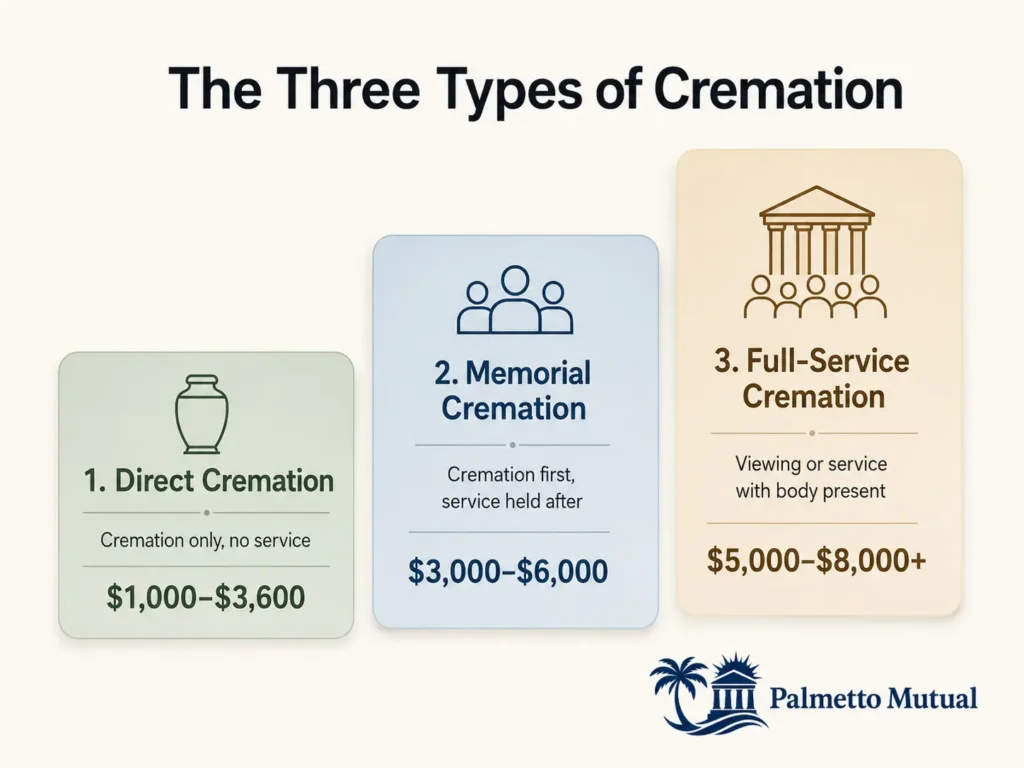
Cremation is not one fixed service with one fixed price. There are three common levels, and the price climbs as you add a service, a viewing, or both. Picking the level that fits your family is the biggest single thing that decides what you'll pay.
| Cremation type | What it includes | Typical 2026 cost |
|---|---|---|
| Direct cremation | Cremation only — no viewing, no service | ~$1,000–$3,600 (average ~$2,200) |
| Memorial cremation | Cremation first, service held afterward (no body present) | ~$3,000–$6,000 |
| Full-service cremation | Viewing or service with the body present, then cremation | ~$5,000–$8,000+ (median ~$6,280) |
Direct Cremation
Direct cremation is the lowest-cost route. It covers the essentials only — transportation, permits, and the cremation itself — with no embalming, viewing, or memorial service. The ashes are returned to the family in a simple container, usually within a couple of weeks.
The national average for direct cremation in 2026 sits around $2,200, though prices range widely by provider and state — from a few hundred dollars in competitive markets to well over $3,000 elsewhere. Families who want to plan ahead sometimes cover this cost with a small burial insurance policy.
Memorial Cremation
A memorial cremation flips the usual order: the cremation happens first, and the gathering comes afterward, with no body present. The urn may be there, but there is no viewing of the deceased, which is what keeps the cost down compared to a full service.
A cremation with a memorial service generally runs $3,000 to $6,000. The added cost on top of the base cremation covers the funeral director's time, a space to gather, and often small touches like printed programs or flowers. Because the timing is flexible, families can hold the service later, at a place that works for everyone — a funeral home, a place of worship, or even a restaurant or community room.
Full-Service Cremation
Full-service cremation is the top of the range. Here the body is present for a viewing or formal service first, and the cremation happens afterward in place of a burial.
This option commonly costs $5,000 to $8,000 or more, with a median around $6,280. What pushes the price up are the added pieces of a traditional funeral: embalming and body preparation, use of the facility for the viewing and service, and a cremation casket. In short, you're paying for nearly everything a traditional funeral includes, minus the cemetery plot and headstone.
What's Included in a Cremation Package
A full-service cremation package bundles many separate charges into one price. Knowing the line items helps you see where the money goes and what you can skip. The breakdown below is for a full-service cremation — the kind with a viewing and ceremony before the cremation.
| Line item | What it covers | Typical 2026 cost |
|---|---|---|
| Basic services fee | The funeral director's staff, planning, and paperwork coordination. This fee cannot be declined | ~$2,300–$2,500 |
| Embalming and body prep | Preserving and preparing the body for viewing | ~$850, plus ~$275 for cosmetic prep |
| Viewing and facility use | The room and space for the visitation and service | ~$450–$550 |
| Ceremony and staff | Director and staff present for the service | ~$500–$600 |
| Cremation fee | The cremation itself and the crematory charge | Varies; often bundled into the package |
| Casket for viewing | A rental casket or a purchased one for the viewing | Rental ~$500–$2,000 |
| Transportation | Moving the body to the funeral home and crematory | ~$350–$600 (extra mileage may add $1–$3 per mile) |
| Permits and paperwork | The cremation permit, authorization form, and death certificates | Certificates ~$10–$25 each |
| Return of remains | A basic temporary container for the ashes | Usually included |
The basic services fee is the one charge a funeral home cannot waive — it averages around $2,300 to $2,500 and covers the director's coordination, permit filing, and staff.
Federal law works in your favor here. The FTC Funeral Rule requires every provider to give you an itemized price list, and it lets you decline any service or item you don't want except the basic services fee.
Beyond the core package, families often add optional extras. Common ones include:
- A permanent urn (covered in the next section)
- A witness cremation, where family is present
- Printed programs, a register book, or an obituary placement
- Flowers and other personal touches
- An oversized handling fee, which some providers charge for individuals over about 250–300 pounds
- Removal of a pacemaker or similar implant before cremation, which can add about $100–$300
Seeing these line items laid out also makes it easier to size a burial insurance policy, since you can match the coverage to the parts of the package you actually plan to use.
Urn Costs by Material and Type
The temporary container that comes with a cremation is basic by design. A permanent urn is a separate choice, and the price swings widely based on material, size, and craftsmanship. The good news is this is one cost a family fully controls.
| Urn type or material | Typical 2026 price range |
|---|---|
| Keepsake (small, holds a portion of ashes) | $25–$150 |
| Cultured or synthetic stone | $25–$250 |
| Biodegradable (for scattering or eco-burial) | $50–$260 |
| Ceramic | $50–$500+ |
| Wood | $60–$800 |
| Metal (basic up to bronze) | $100–$3,000 |
| Glass (artisan) | up to ~$1,500 |
| Companion (holds two people's ashes) | $200–$1,200+ |
Standard wood, metal, ceramic, and stone urns mostly fall in the $50 to $300 range, while designer and artisan pieces — hand-thrown ceramic, blown glass, carved marble, or heavy bronze — climb well past $1,000. Biodegradable urns made for scattering or eco-burial typically run about $70 to $260.
What drives the price up is mostly the material and the handwork. Mass-produced urns cost less, while engraving, custom artwork, premium metals, and artisan finishes raise both the price and the wait time. A useful middle-of-the-road benchmark: the National Funeral Directors Association reported a national median urn cost of $295.
Where you buy matters as much as what you buy. Funeral homes often price urns from $100 to well over $1,000, but the same kind of urn online runs roughly $30 to $300. Buying from a third-party retailer can save $100 to $500 compared with funeral-home pricing.
You are never locked into the funeral home's selection. Under the Funeral Rule, a provider must accept an urn you bought elsewhere and cannot charge you a handling fee for it. [Source note for linking: FTC Funeral Rule] Whether a family pays out of pocket or from a funeral insurance payout, the urn is one of the easiest places to keep more money in your pocket without giving anything up.
Interring Ashes: Niches and In-Ground Burial
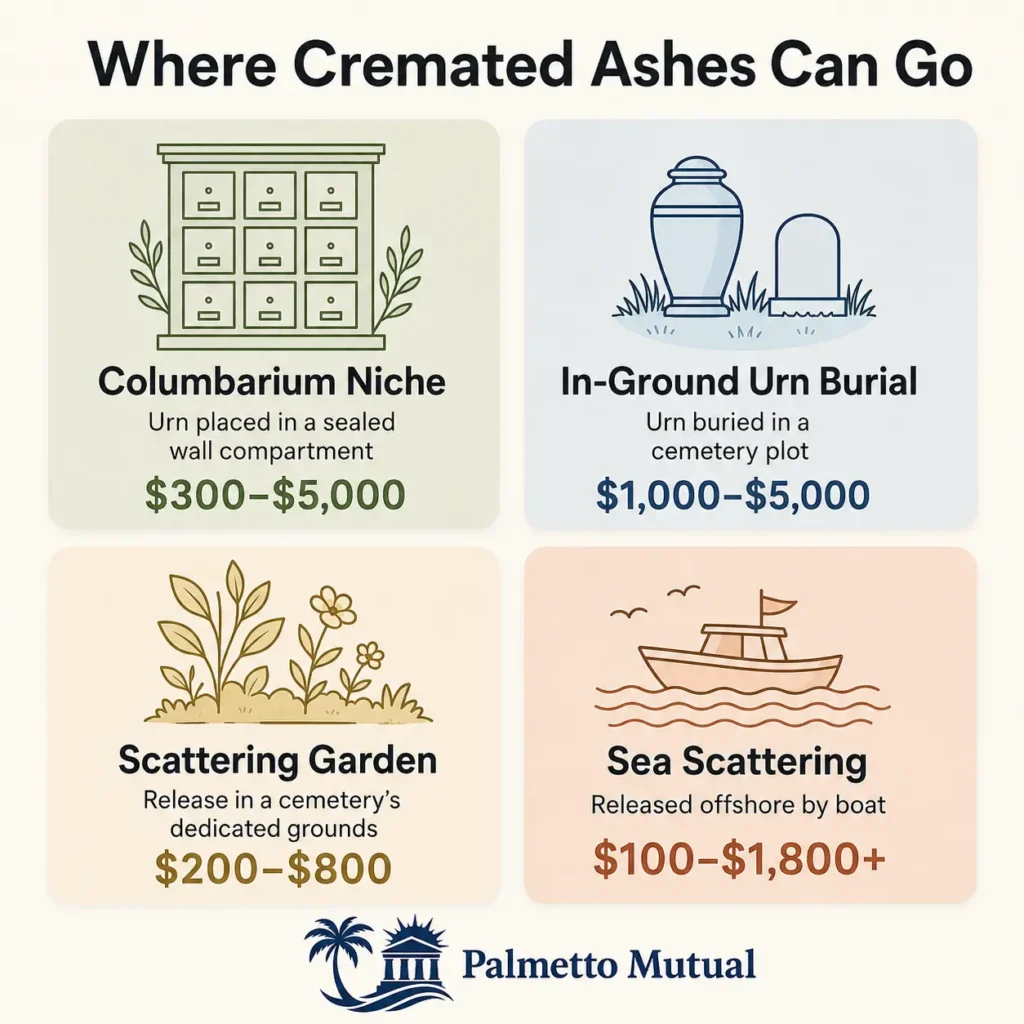
Many families want a permanent place to visit rather than keeping ashes at home or scattering them. There are two main ways to do this: placing the urn in a columbarium niche, or burying it in the ground. These are exactly the kinds of costs a final expense insurance policy is meant to help cover.
Columbarium Niches
A columbarium is a wall or building with small sealed compartments called niches, each made to hold one or more urns. Placing an urn in a niche is called an interment, and the charge for the space is an interment fee. Where the niche sits and what it's made of drive the price.
| Niche type | Typical 2026 price |
|---|---|
| Outdoor single niche | $300–$800 |
| Standard single niche (most common) | $750–$2,800 |
| Indoor single niche (mausoleum or chapel) | $1,200–$5,000 |
| Companion niche (holds two urns) | $1,500–$5,000+ |
Outdoor wall niches sit at the low end, the most common single niche runs $750 to $2,800, indoor mausoleum niches reach $1,200 to $5,000, and companion niches for two can run $1,500 to $5,000 or more.
A few things raise or lower the cost. Eye-level niches cost more than ones near the floor or ceiling, glass-front niches that show the urn run about 20 to 40 percent more than sealed granite, and buying in advance rather than at the time of death usually saves 20 to 25 percent.
Plan for a few extra charges beyond the niche itself. These include an opening-and-closing fee to unseal and reseal the niche, which can run from a few hundred dollars to over $1,000, plus engraving or a plaque at around $200 to $600 and a perpetual care contribution.
In-Ground Urn Burial
Burying an urn places it in a cemetery plot, either in its own small space or on top of a family member already buried there. Burying ashes on top of a relative is common and is often called companion interment, letting a couple share one plot and one headstone.
| Cost piece | What it covers | Typical 2026 cost |
|---|---|---|
| Cremation plot or urn garden | The space in the ground | $300–$2,500 |
| Opening and closing | Cemetery staff opening and refilling the space (interment fee) | A few hundred to over $1,000 |
| Urn vault (where required) | An outer container that keeps the ground from settling | $100–$600 |
| Marker or headstone (optional) | The visible memorial | Varies |
Burying cremated ashes runs about $1,000 to $5,000 all in, with the plot itself between $300 and $2,500 — rural and municipal cemeteries charge the least. Many cemeteries require an urn vault, a sturdy outer box costing about $100 to $400, though not every cemetery requires one.
One note on the law: the FTC says no state law requires an outer burial container anywhere, but individual cemeteries can require one to keep the grave from caving in. Always ask before you buy.
Scattering Ashes: Options and Fees
Scattering is usually the lowest-cost way to handle ashes, and it gives families a meaningful, personal goodbye. The two most common routes with set fees are a cemetery scattering garden and scattering at sea. For families covering costs with funeral insurance, scattering leaves more of the benefit for other final expenses.
Scattering Gardens
A scattering garden is a dedicated, landscaped area inside a cemetery, memorial park, or church where families can release ashes. These gardens are permanent and maintained, and many let families add a plaque or marker so there's still a spot to visit.
The cost is modest. A facilitated scattering — at a garden, at sea, or another spot — typically runs $200 to $800 beyond the cremation itself. Adding an engraved plaque raises the total.
Sea Scattering
Scattering at sea follows federal rules. Under the Marine Protection, Research and Sanctuaries Act, the EPA requires that ocean scattering happen at least three nautical miles from shore, that any container be biodegradable with no plastic, and that families notify the EPA within 30 days — there's no permit needed and no fee to the EPA.
You can scatter from your own boat or hire a charter service. The cost depends mainly on whether your family comes along.
| Sea scattering option | What it involves | Typical 2026 fee |
|---|---|---|
| Unattended | The captain scatters offshore; family does not come aboard | ~$100–$425 |
| Attended charter | Family joins the boat for the ceremony offshore | ~$375–$1,800+ |
Attended services where families join the ceremony run $375 to $1,800 or more depending on group size and length, while unattended services where the captain scatters alone start around $100 to $425. Charters usually handle the EPA paperwork and provide a certificate with the GPS coordinates.
One caution: rivers, lakes, and bays are not covered by the federal ocean rule. Scattering in inland waters is governed by state law instead, and some states prohibit it, so check your state before planning.
What Makes Cremation Cost More or Less
You've seen prices in this guide swing from under $1,000 to $8,000 or more. A handful of factors explain that gap, and most of them are within your control. Knowing them helps you plan ahead and size a burial insurance policy to match.
The biggest factor is the one covered earlier: the service level you choose. Direct cremation sits at the bottom, a memorial service adds to it, and a full-service cremation with a viewing sits at the top. After that, three things move the price most.
The first is the type of provider. Dedicated cremation providers and online-first companies skip the funeral-home overhead and often run $995 to $1,995 for direct cremation, while a traditional funeral home may charge $2,000 to $3,500 or more for the same thing.
| Provider type | What it is | Typical direct cremation price |
|---|---|---|
| Online or dedicated cremation provider | Cremation-only, low overhead | ~$995–$1,995 |
| Traditional funeral home | Full-service, higher overhead | ~$2,000–$3,500+ |
One thing surprises many families: a nationally advertised cremation society or "budget" brand is not always cheaper. Some national cremation-society brands charge 30 to 50 percent more than independent local specialists offering the exact same direct cremation. Corporate-owned chains also tend to charge more than independent homes, and the price for an identical service can vary by 50 to 300 percent between providers in the same city.
The second factor is where you live. Major metro areas often run 20 to 50 percent above the regional average, while rural areas run 15 to 30 percent below it. The gap between the cheapest and most expensive states can top $2,000 for the same service.
The third factor is timing. Arranging cremation at the time of death means making money decisions quickly and under stress, which tends to cost more, while planning ahead lets you compare providers calmly and lock in pricing. Same-day or after-hours requests can also add fees.
Ways to Lower Cremation Costs
Cremation is already the more affordable path, but there's room to bring the cost down further without giving up dignity. These levers are specific to cremation, and most take only a phone call or two. Whether you pay out of pocket or from a funeral insurance payout, every dollar saved is a dollar kept for your family.
| Money-saving lever | How it helps | Typical savings |
|---|---|---|
| Choose direct over full-service | Skips embalming, viewing, ceremony, and casket | $3,000–$5,000 |
| Compare at least three providers | The same service varies widely by provider | Hundreds to $1,000+ |
| Buy the urn online | Avoids funeral-home markup | $100–$500 |
| Decline embalming | Not required for direct cremation | ~$700–$1,000 |
| Provide your own simple container | No casket is required for cremation | Hundreds to thousands vs. a rental casket |
| Order death certificates from the state | Avoids per-copy markups | Varies |
The single biggest saver is separating the cremation from the gathering. Choosing direct cremation and holding your own memorial later at a home, restaurant, or community center can save $3,000 to $5,000 compared with full funeral-home services, and you can still have flowers, music, and photos.
Comparing providers is the most powerful step you can take. Because identical services can vary by 50 to 300 percent in one city, calling at least three and asking for an itemized price list is the best protection against overpaying. The FTC Funeral Rule requires every provider to share that list and to give prices over the phone.
A few targeted declines add up. Embalming averages around $760 and is almost never required for direct cremation, and you can choose the least expensive container since no casket is legally required. The urn is another easy win — a basic urn that costs $30 to $80 online may be priced $200 to $500 at the funeral home, which by law must accept your outside urn with no handling fee.
Even the non-declinable basic services fee is worth shopping. It cannot be waived, but it varies from one provider to the next, so comparing it across your three quotes is a fair way to judge value. Planning ahead can also lock in today's prices through a pre-need direct cremation arrangement — just read any contract carefully before signing.
Frequently Asked Questions
Keep Reading







About the Author
Dvir Mosche is an award-winning independent insurance agent and the founder of Palmetto Mutual, a trusted insurance brokerage specializing in Final Expense Life Insurance. Since entering the industry in 2017, he has been recognized multiple times as a top agent for his dedication to educating and assisting seniors in finding the proper coverage. His mission is to simplify the process, provide honest and personalized guidance, and ensure that every client gets coverage they can depend on for life.


