
Home > Funeral Cost > Direct Cremation
What Is Direct Cremation?
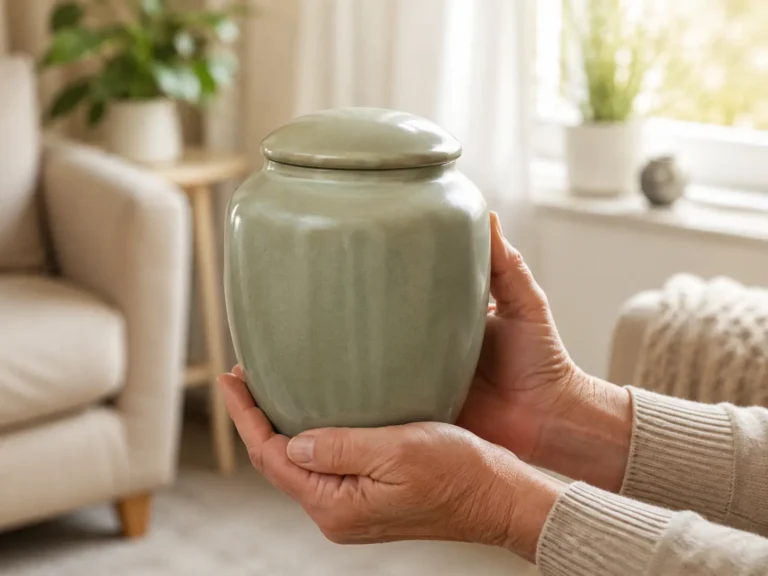
Direct cremation is the simplest and lowest-cost way to handle a person’s remains after death. It skips the viewing, the embalming, and the formal funeral-home service, moving straight to cremation, with the ashes returned to the family afterward. Because it costs far less than a traditional burial, direct cremation is a common choice for families who want something simple — and a natural fit for anyone planning ahead with a final expense insurance policy.
How Direct Cremation Works
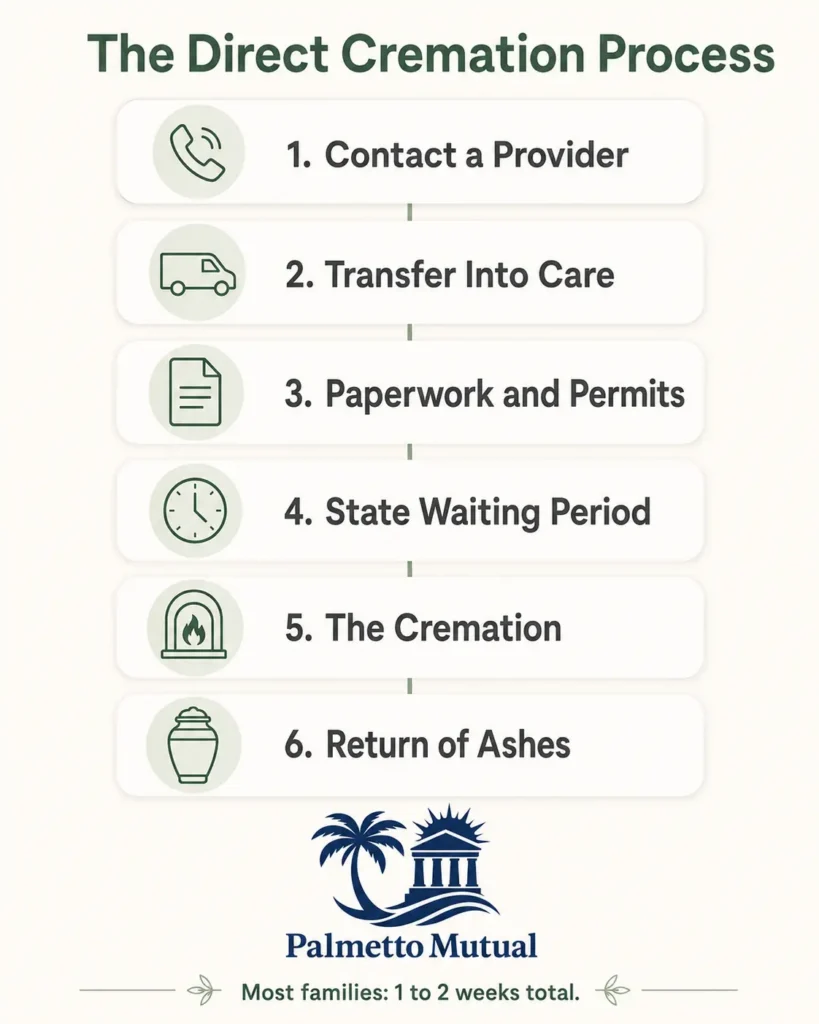
Direct cremation is the simplest path a body can take after death. There is no viewing, no embalming, and no service held before the cremation. The body is cremated soon after death, and the ashes are returned to the family afterward.
For families planning ahead, this is often the option a burial insurance policy is meant to cover. Here is how the process moves from start to finish.
| Step | What Happens |
|---|---|
| 1. First contact | The family calls or goes online to a cremation provider and shares basic details. |
| 2. Transfer into care | The provider picks up the body from the place of death — a home, hospital, or nursing home — and brings it to their facility. |
| 3. Paperwork and permits | The provider files the death certificate and gets a signed cremation authorization and permit. This is the part that takes the most time. |
| 4. State waiting period | Some states require a wait of about 24 to 48 hours before cremation can take place. |
| 5. The cremation | The body is placed in a simple, sturdy container and cremated. This part usually takes two to four hours. |
| 6. Return of ashes | The ashes are placed in a basic container, or an urn the family provides, and returned to the family. |
One thing stays the same no matter who handles it. Every direct cremation ends with the ashes coming back to the family — there are no exceptions to this.
The ashes usually come back in a temporary plastic or cardboard container unless the family supplies an urn. The whole process, from the first call to the return of ashes, generally takes about three to seven days, though some states run closer to one or two weeks.
Because the body is not on public display, embalming is not needed and is not required for direct cremation in most states. The body is simply kept cool until the cremation takes place.
What Direct Cremation Costs — and Why It’s the Lowest-Cost Option
Direct cremation is the least expensive way to handle final arrangements. It costs less than every other option because it leaves out the parts that drive up a traditional funeral — the embalming, the casket, the viewing, and the staffed service.
The national average for a direct cremation in 2026 is about $2,200, based on Funeralocity survey data. Prices swing widely by location, from a few hundred dollars in low-cost markets to well over $4,000 in the most expensive states.
| Cremation or Funeral Type | Typical 2026 Cost |
|---|---|
| Direct cremation | ~$2,200 national average (roughly $800–$4,200 by state) |
| Cremation with a memorial service | $3,000–$5,000 |
| Full-service cremation (viewing, casket, ceremony) | $4,000–$8,000+ |
| Traditional funeral with viewing and burial | ~$8,300–$10,000 |
A few things explain the wide price gap. Where you live is the single biggest factor — states like Connecticut, Massachusetts, and New York run high, while Arizona, Nevada, and Colorado tend to run low.
Some low-cost provider networks advertise complete direct cremation packages for as little as $495 to $1,795, with no hidden fees. Whether a price that low is available depends entirely on the providers in your area.
This is why direct cremation sets the floor for end-of-life costs. Families who choose it often save $5,000 to $9,000 compared to a traditional funeral with burial — money that can fund a memorial later or simply stay with the family.
One note worth keeping in mind. A few costs can fall outside the quoted package, such as extra death certificate copies (about $10 to $25 each) and mileage fees if the pickup is far away. It always pays to ask exactly what a price includes.
What You Get for the Price — and What You Don’t
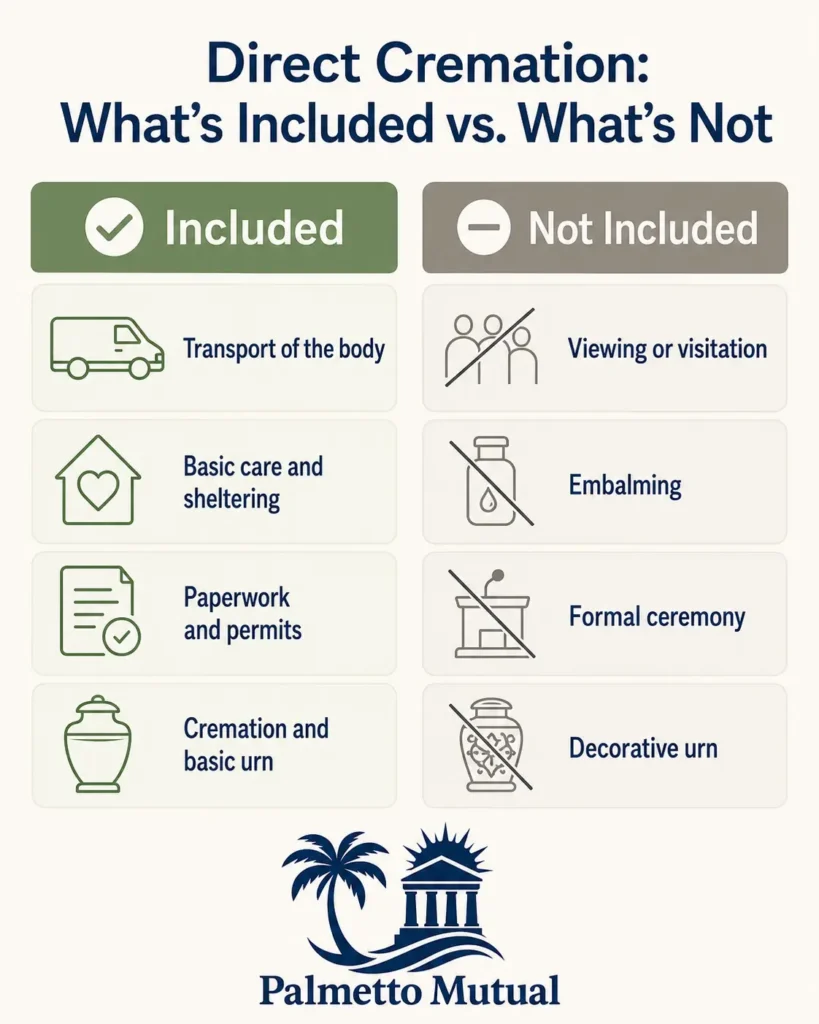
A direct cremation package covers the basics needed to handle the body, and nothing more. Knowing exactly what is in the price — and what is left out — helps families avoid surprise costs.
This is also useful when planning a funeral insurance payout, since it shows how far a small benefit can stretch.
What’s Included
Most direct cremation packages cover the same core set of services. Providers may use slightly different words, but the list is fairly standard across the country.
| Included Item | What It Covers |
|---|---|
| Transfer of the body | Pickup from the place of death and transport to the provider’s facility, usually within a set local radius (often 25 to 50 miles). |
| Basic care and sheltering | Refrigeration or temporary storage while paperwork is processed. Embalming is not part of direct cremation. |
| Paperwork and permits | Filing the death certificate, the signed cremation authorization, and any required permits. |
| Alternative container | A simple, sturdy, combustible box made of cardboard or pressed wood — used in place of a casket. |
| The cremation | The cremation process itself at the crematory. |
| Return of ashes | The cremated remains returned in a basic temporary container. |
One point worth knowing: federal law is on your side here. The FTC Funeral Rule says no state requires a casket for cremation, and providers must offer the simple alternative container instead.
What’s Not Included
The things that make a traditional funeral expensive are exactly the things a direct cremation leaves out. These are not flaws — they are the reason the price is low.
| Not Included | Notes |
|---|---|
| Viewing or visitation | No public time with the body before cremation. |
| Embalming | Not needed and not required, since there is no viewing. |
| Formal ceremony | No staffed funeral service before the cremation. |
| Decorative urn | Ashes come back in a basic container; a nicer urn is a separate purchase. |
A few costs can also fall outside the quoted package, even though they are not part of the service itself. Common ones include extra certified death certificate copies (often around $10 to $25 each), mileage fees for a far-away pickup, and weekend or after-hours pickup charges.
The simplest way to avoid surprises is to ask one plain question before booking: when you say “included,” does that cover transport, permits, the container, and the cremation fee?
Pros and Cons of Direct Cremation
Direct cremation is a good fit for some families and the wrong fit for others. The honest answer depends on what matters most to the people left behind.
Here is a fair look at both sides, which can also help when deciding how much burial insurance to set aside for final plans.
The Advantages
The strengths of direct cremation are simple to state. It costs the least, it asks the least of a grieving family, and it leaves the door open for a memorial later.
- Lowest cost. It is the most affordable end-of-life option, often a fraction of a traditional funeral with burial.
- Simplicity. There are few decisions to make at a hard time — no casket to choose, no service to plan on a deadline.
- Flexibility. Families can hold a memorial whenever and wherever feels right, rather than rushing one in the first few days.
- Speed. Because there is no service to schedule first, arrangements can move quickly — helpful when relatives are far away.
The Drawbacks
The downsides are real and mostly emotional rather than financial. They are worth thinking through before deciding.
- No formal goodbye. Skipping the viewing and service can leave some family and friends feeling they had no chance to say goodbye.
- Closure can be harder. For people who find comfort in ritual, the lack of a service may make grief feel unfinished.
- Possible family pushback. Relatives may disagree with the choice, or feel a memorial never happened if one is not planned promptly.
- No fixed place to visit. Without a burial site, some who want a spot to return to may feel that absence.
A common middle path is to choose direct cremation for the practical part, then add small touches — a gathering at home, a slideshow, a reading — to bring back a sense of closure without the full funeral-home cost.
Holding a Memorial After Direct Cremation
Choosing direct cremation does not mean skipping a goodbye. It simply separates the cremation from the memorial, so a family can gather whenever and wherever feels right.
This is one reason many people pair a small funeral insurance policy with direct cremation — the cremation cost stays low, leaving room for a meaningful gathering on the family’s own terms.
The biggest advantage is freedom from the funeral home’s clock and price list. A memorial after cremation can happen days, weeks, or even months later — long enough for distant relatives to plan travel.
It can also happen almost anywhere. Families commonly choose a home, a backyard, a park, a beach, a community hall, or a place of worship — none of which carries a funeral-home venue fee.
Here are common ways families memorialize a loved one after a direct cremation:
- A gathering at home. Photos, music, food, and shared stories in a living room or backyard, at little to no cost.
- A celebration of life. A less formal event focused on the person’s personality and happy memories rather than solemn ritual.
- A scattering ceremony. A small service built around scattering the ashes in a meaningful place.
- A service at a place of worship. A traditional ceremony without the body present, on a date the family chooses.
The cost is whatever a family decides to spend. Hosting at home or in a public park can be nearly free, while a cremation paired with a later memorial service tends to run somewhere in the $2,000 to $4,000 range once a venue and added services are included — still far below a full traditional funeral.
A simple outline helps a memorial feel complete. Many families include a few opening words, a reading or prayer, and an open invitation for guests to share memories — often the most meaningful part.
There is no deadline and no single right way to do this. The point is to acknowledge the loss, honor the life, and give the people left behind a chance to grieve together.
How to Arrange a Direct Cremation
Arranging a direct cremation is more straightforward than most families expect. Knowing the path ahead — and the few key questions to ask — makes the whole thing far less stressful.
This also helps families see how a burial insurance benefit can be put to work quickly and simply when the time comes.
The Steps, Start to Finish
The process follows a fairly standard sequence, whether arranged ahead of time or right after a death. Here is how it usually unfolds.
| Step | What You Do |
|---|---|
| 1. Contact a provider | Call or go online to a cremation provider. They will ask where the person is, confirm the next of kin, and begin coordinating. |
| 2. Choose direct cremation | Tell them you want a direct cremation — no viewing or service before the cremation — and ask for the all-inclusive price. |
| 3. Complete the paperwork | Sign the cremation authorization and provide the person’s details for permits and the death certificate. |
| 4. Arrange transport | The provider picks up the body from the place of death and brings it into their care. |
| 5. Pay and confirm | Settle the cost and confirm how and when the ashes will be returned. |
| 6. Receive the ashes | The ashes are returned by pickup, delivery, or shipping, usually within one to two weeks. |
To start the process, families should have a few documents ready: the person’s full legal name, date of birth, and similar details needed for the permits and death certificate.
Online vs. Local Providers
There are two main ways to arrange a direct cremation, and both are valid. The right choice depends on what matters most to the family.
| Factor | Online Provider | Local Funeral Home |
|---|---|---|
| How it works | Arrange by phone or website; they partner with a local crematory to perform the cremation. | |
| Pricing | Often lower, with less overhead. | Sometimes higher, since direct cremation may not be their main service. |
| Personal contact | More remote; no in-person visit needed. | Face-to-face staff and a local presence you can visit. |
Either way, a reputable provider is run by licensed professionals. An online company should be held to the same standards as any local funeral home — licensing, clear pricing, and respectful care.
One useful question for either type: who actually performs the cremation, and at what facility? Some providers own their crematory; others use a separate one. Both can be fine, but you deserve to know which.
What to Ask Before You Book
A few plain questions reveal whether a provider is transparent and fairly priced. Federal law backs you up here — the FTC Funeral Rule requires providers to give a General Price List on request, in person or by phone.
Ask each provider the same core questions so you can compare fairly:
- What is the total, all-inclusive price for a direct cremation?
- Are there extra fees not in that price, such as death certificate copies, mileage, or after-hours pickup?
- What does “included” cover — transport, sheltering, permits, the container, and the cremation fee?
- How long does the whole process take, and what causes delays?
- How are the ashes returned — pickup, delivery, or shipping?
- Who performs the cremation, and is that crematory licensed?
Clear, direct answers are a good sign. Vague answers or pressure to buy extras are a reason to keep calling.
Frequently Asked Questions
Keep Reading





About the Author
Dvir Mosche is an award-winning independent insurance agent and the founder of Palmetto Mutual, a trusted insurance brokerage specializing in Final Expense Life Insurance. Since entering the industry in 2017, he has been recognized multiple times as a top agent for his dedication to educating and assisting seniors in finding the proper coverage. His mission is to simplify the process, provide honest and personalized guidance, and ensure that every client gets coverage they can depend on for life.


