
Home > Burial Insurance with Pre-Existing Conditions > Pacemaker
Final Expense Insurance with a Pacemaker

A pacemaker rarely keeps you from getting burial insurance. For most people, the device itself is a manageable part of the picture — what carriers look at most is why it was placed, how long ago, and the rest of your heart history. This guide covers how companies underwrite a pacemaker, what you can expect to pay, and which ones tend to approve these cases most easily.
Can you get final expense insurance with a pacemaker?
Yes. Having a pacemaker will not, by itself, keep you from getting final expense insurance. Most people with one can qualify for a policy that pays out from day one.
Here is the part that surprises people: most burial insurance applications never ask about a “pacemaker” by name. They ask whether you have had heart or circulatory surgery, and insurers count the procedure to place a pacemaker as exactly that.
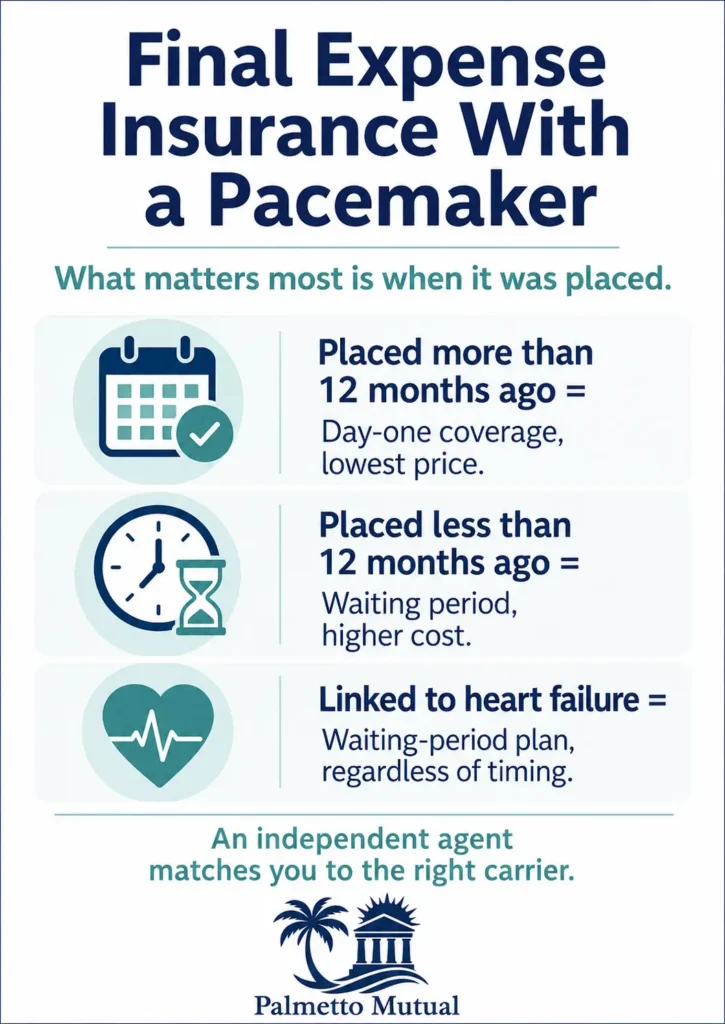
So the real question is not whether you have a pacemaker. It is how long ago it was placed. That one detail decides which kind of plan you can get.
| Time since your pacemaker was placed | What you can usually get |
|---|---|
| More than 12 months ago | Day-one coverage at the lowest price, with no waiting period |
| Less than 12 months ago | A plan with a waiting period and a higher price |
| Pacemaker linked to congestive heart failure | A waiting-period plan, no matter when it was placed |
When your pacemaker was placed more than a year ago, many companies will offer you their best level plan. You are covered the day your first payment clears.
If it went in within the past year, you can still get covered. You will most likely start on a waiting-period plan and move to a better one later, once more time has passed.
There is one main exception. If your pacemaker is tied to congestive heart failure, a waiting period is hard to avoid, no matter how long ago the device went in. Other heart history can shape your options too, which is why the reason it was placed matters.
The next sections walk through how companies look at all of this and what you can expect to pay.
How carriers underwrite a pacemaker
Most burial insurance companies do not ask about a pacemaker by name. The application asks whether you have had heart or circulatory surgery, or any procedure to improve circulation. Placing a pacemaker counts as that kind of procedure, so you answer yes.
That single question is the center of how a pacemaker gets underwritten. What decides your outcome is the time frame the company asks about.
Most final expense carriers ask about heart or circulatory surgery in the last 12 months. Some look back 24 months.
- If your pacemaker was placed outside that window, you can answer no to the timed question and usually qualify for day-one coverage.
- If it was placed inside that window, you answer yes, which moves you to a waiting-period plan at a higher price.
The reason the device was placed matters too. A pacemaker put in for a slow heartbeat is viewed very differently from one tied to congestive heart failure. If heart failure is part of your history, expect a waiting period no matter the dates, so be ready to explain why your pacemaker was placed.
One detail people miss: a battery or generator change can count as a new heart procedure with some companies, which can restart the clock. A good independent agent knows which carriers treat a battery swap that way and which do not.
Companies also pull your prescription history to confirm what you wrote on the application. We explain how that check works, and how to prepare for it, in our guide to prescription history checks.
Medications underwriters watch for with a pacemaker
Your medicine list tells an underwriter a story about why you have a pacemaker and how serious things are. You do not need to memorize any of this. The point is simple: if you recognize a drug below, you can see what it likely signals and what it may mean for your application.
| Medication group | Common examples | What it usually signals |
|---|---|---|
| Heart rate or blood pressure pills | Metoprolol, atenolol, diltiazem | Routine control of heart rate or blood pressure. The easiest group, and on its own rarely a problem. |
| Blood thinners | Warfarin, apixaban (Eliquis), rivaroxaban (Xarelto) | Often points to atrial fibrillation or clot risk. Usually fine on its own; underwriters look at the reason behind it. |
| Heart rhythm drugs | Amiodarone, sotalol, flecainide | A more serious or active rhythm problem. This group can narrow your carrier options. |
| Heart failure drug combos | A water pill (furosemide) plus an ACE or ARB, paired with carvedilol or bisoprolol | A pattern that points to congestive heart failure — the one history that usually forces a waiting period. |
Notice the pattern. A single rate or blood pressure pill rarely changes your options. It is the move toward heart rhythm drugs, and especially heart failure combinations, that signals higher risk to an underwriter.
If you take a blood thinner, that often traces back to atrial fibrillation. We cover that drug class and how carriers treat it in our blood thinners guide.
Honest answers always win here. Your prescription history will show these drugs anyway, so listing them up front keeps your application clean and your approval on track.
Best companies and what you’ll pay with a pacemaker
Here is the good news on price. Once you are past the timing window from the last section, a pacemaker by itself usually does not raise your rate. You pay the same level price as someone in similar health who never had one.
What sets your price is not the device. It is which tier you land in, and that comes down to timing and the rest of your heart history.
| Plan tier | Who lands here | How it pays | Price |
|---|---|---|---|
| Level (day-one) | Pacemaker placed outside the look-back window, no heart failure | Full benefit from day one | Lowest. No extra charge for the device alone. |
| Graded or modified | Pacemaker placed inside the window | Partial benefit in years 1–2, full after | Higher than level |
| Guaranteed issue | Heart failure or another knockout history | Full benefit only after a 2-year wait | Highest |
For a sense of scale, a level $10,000 burial insurance policy for a non-smoker often runs about $30 to $45 a month in the early 60s, and about $45 to $70 a month in the early 70s. Graded plans cost more, and guaranteed issue runs roughly 30 to 50 percent above a level plan.
Your exact number depends on age, gender, state, coverage amount, and tobacco use. See our cost-by-coverage and cost-by-age guides for the full rate tables.
There is no single best company for a pacemaker. Carriers differ in two ways that matter most: how they word the heart or circulatory surgery question, and how far back they look. A pacemaker placed 14 months ago can earn day-one coverage at one company and a waiting period at another.
That is why shopping matters. An independent agency can check several carriers at once and match your timing and history to the company most likely to approve you at the best price.
How to get the best rate and coverage with a pacemaker
Getting your best price on burial insurance with a pacemaker is mostly about preparation. The more clearly you can show why the device went in and how stable you are, the easier it is to match you with the right company.
Before you apply, have these ready:
- The exact date your pacemaker was placed
- The reason it was placed, such as a slow or blocked heartbeat
- Whether heart failure is part of your history (and records showing it is not, if that is true)
- A complete, up-to-date list of your medications
- Notes that you keep regular cardiology visits and that your device checks are normal
Your implant date is the one detail that moves you between tiers. If you are close to the 12-month mark, crossing it can shift you from a waiting-period plan to day-one level coverage. A good agent will flag your file to re-apply for a lower rate once you pass that mark.
The reason for the device matters almost as much. A pacemaker placed for a slow or blocked heartbeat is viewed more kindly than one tied to heart failure, so be ready to show that difference.
Honesty is not only the right call, it is the smart one. Your prescription history and records will reveal your heart history anyway, so leaving something off can lead to a denied claim or a voided policy down the road.
Apply with the right company, not just any company. Some funeral insurance carriers look back only 12 months on heart or circulatory surgery, while most look back 24 months. If your device is past a year but under two, those 12-month carriers are your path to day-one coverage, and an independent agency knows which ones they are.
One trap to avoid: a recent battery or generator change. Some companies treat that swap as a brand-new heart procedure, which restarts the clock. The right agent steers you toward a carrier that does not.
If your device went in recently and a waiting period cannot be avoided for now, that is not a dead end. You can take a waiting-period plan today and move to a better one later. See our guide on no-waiting-period coverage for how those waiting periods work, and our guide on whether you can be denied for what happens if a company says no.
With your dates, your reason, and your medication list in hand, you give an agent everything needed to find the company most likely to cover you at the lowest price.
Keep Reading







About the Author
Dvir Mosche is an award-winning independent insurance agent and the founder of Palmetto Mutual, a trusted insurance brokerage specializing in Final Expense Life Insurance. Since entering the industry in 2017, he has been recognized multiple times as a top agent for his dedication to educating and assisting seniors in finding the proper coverage. His mission is to simplify the process, provide honest and personalized guidance, and ensure that every client gets coverage they can depend on for life.


