
Home > Burial Insurance with Pre-Existing Conditions > Final Expense Insurance Smokers Tobacco
Final Expense Insurance for Smokers & Tobacco Users

Final expense insurance is available to smokers and tobacco users, and qualifying is rarely the hard part. The real question is cost — most carriers charge tobacco users a higher monthly rate than non-users for the same coverage. This guide explains how that surcharge works, how carriers decide what counts as tobacco use, and how some applicants can still qualify for non-tobacco or better rates.
Tobacco Rate Comparison
Slide to set your age and coverage — rates update instantly
Sample tobacco-rate estimates for comparison only. Actual premiums depend on health underwriting, state availability, and carrier approval. Not all carriers are available at every age or coverage amount; blank rates indicate the plan is not offered at your selected combination. CICA Life of America does not charge tobacco users a higher rate. Rates require answering health questions and approval is not guaranteed.
Can smokers get final expense insurance?
Yes. If you smoke or use tobacco, you can still get burial insurance, and getting approved is rarely the hard part. Almost every carrier in this market accepts tobacco users.
Here is the reason it works so smoothly. Final expense insurance uses simplified-issue underwriting, which means no medical exam and no blood or urine test. Instead, you answer a short list of health questions over the phone.
Because there is no lab test, your tobacco use does not get “caught” the way it would on a traditional life insurance exam. You simply report it on the application, and the carrier prices your policy from there.
So for tobacco users, smoking changes your rate, not your ability to qualify. You are placed in a tobacco rate class and pay a higher monthly premium, but the door to coverage stays open.
This is also true for many smokers who carry related health conditions. Issues like high blood pressure, high cholesterol, and even mild COPD are often accepted, sometimes with full day-one coverage. Smoking by itself almost never forces you into a worse plan type on its own.
The one rule that matters most is honesty. Tobacco status is self-reported, and a false answer can let the carrier void the policy or deny the claim during the first two years. Reporting your tobacco use correctly is what keeps the coverage solid.
How much more tobacco users pay
This is the real question for most smokers, and the honest answer is that you will pay more, but probably less than you fear. The higher cost comes from a tobacco surcharge built into the rate.
A tobacco surcharge is the extra amount carriers add because tobacco users, on average, have shorter life expectancies. It is priced into your premium from the first day of the policy.
Across the final expense market, tobacco users typically pay about 30% to 50% more than non-tobacco users for the same coverage. A few cost guides put the gap as high as 40% to 60%. The exact number depends on the carrier, your age, and the coverage amount.
Final expense pricing works on a per-$1,000 model. The carrier sets a monthly cost for each $1,000 of coverage, then multiplies it by how much coverage you buy. The tobacco surcharge raises that per-$1,000 cost, so the dollar gap grows as your coverage amount and age go up.
Here is what that looks like in practice. The table below compares typical monthly premiums for a $10,000 funeral insurance policy at non-tobacco versus tobacco rates.
| Age | Non-Tobacco (Monthly) | Tobacco (Monthly) | Approx. Difference |
|---|---|---|---|
| 55 | $36 | $51 | +$15 |
| 60 | $44 | $61 | +$17 |
| 65 | $57 | $77 | +$20 |
| 70 | $75 | $99 | +$24 |
| 75 | $100 | $133 | +$33 |
Sample monthly rates for level benefit at $10,000 of coverage. Non-tobacco rates shown from one carrier and tobacco rates from another, so the difference reflects both tobacco use and the differing carrier. Rates require answering health questions, and approval is not guaranteed.
| Age | Non-Tobacco (Monthly) | Tobacco (Monthly) | Approx. Difference |
|---|---|---|---|
| 55 | $28 | $39 | +$11 |
| 60 | $33 | $46 | +$13 |
| 65 | $42 | $58 | +$16 |
| 70 | $54 | $73 | +$19 |
| 75 | $73 | $95 | +$22 |
Sample monthly rates for level benefit at $10,000 of coverage. Non-tobacco rates shown from one carrier and tobacco rates from another, so the difference reflects both tobacco use and the differing carrier. Rates require answering health questions, and approval is not guaranteed.
The takeaway is that the surcharge is real but manageable. Most tobacco users still find that a right-sized policy fits a fixed budget, and shopping more than one carrier is the simplest way to keep the surcharge as small as possible.
One more point worth knowing: the surcharge is not permanent for everyone. If you quit and stay tobacco-free long enough, many carriers will reclassify you at non-tobacco rates, which is covered later on this page.
What counts as tobacco use
This is where things get less obvious, because carriers do not all define tobacco the same way. What one company calls tobacco use, another may ignore completely.
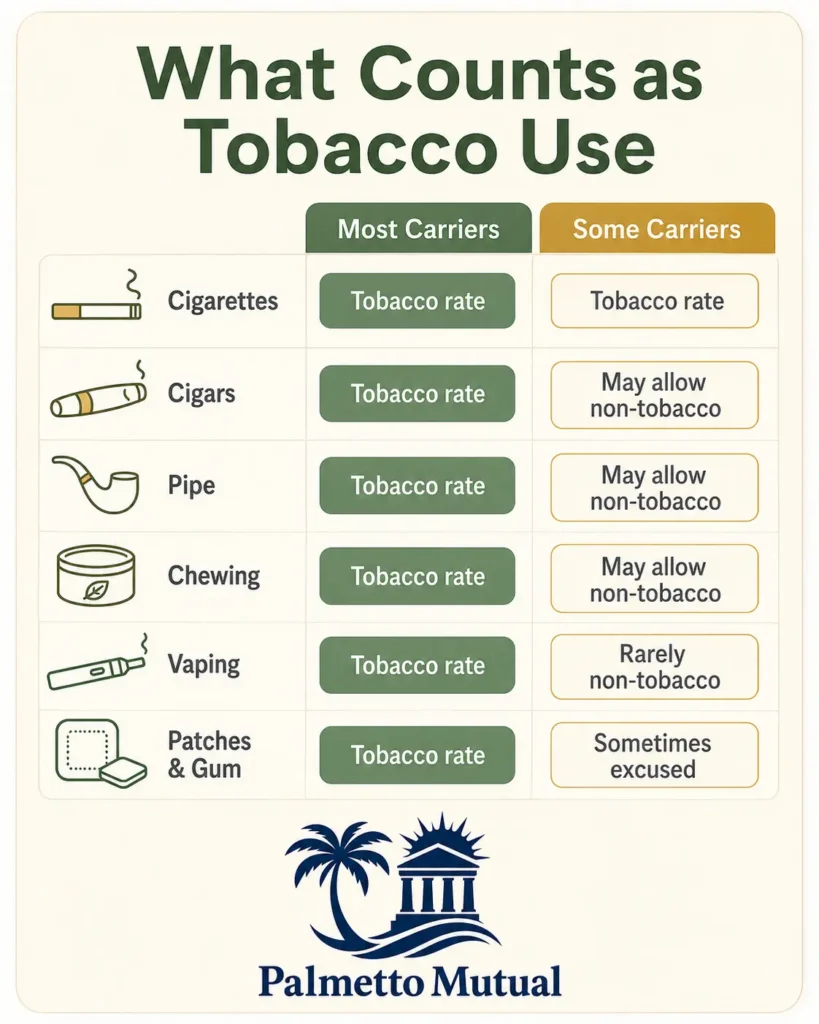
Most final expense carriers take the broad view. If you have used any nicotine or tobacco product in the past 12 months, you get the tobacco rate, no matter the form. This look-back period is the window carriers ask about.
A smaller group of carriers is narrower and only counts cigarettes. With those companies, cigar, pipe, smokeless, or vape users can sometimes qualify at non-tobacco rates. This is why the carrier you choose matters so much.
The table below shows how each form is usually handled. “Most carriers” means the broad-view majority; “some carriers” means the narrower group.
| Form of use | How most carriers treat it | How some carriers treat it |
|---|---|---|
| Cigarettes | Tobacco rate | Tobacco rate (no exceptions) |
| Cigars | Tobacco rate | May allow non-tobacco rate |
| Pipe tobacco | Tobacco rate | May allow non-tobacco rate |
| Chewing/smokeless | Tobacco rate | May allow non-tobacco rate |
| Vaping/e-cigarettes | Tobacco rate | Tobacco rate (no exceptions) |
| Nicotine patches/gum | Tobacco rate | Tobacco rate (no exceptions) |
One more thing to keep in mind. Your tobacco status is self-identified, which means you report it yourself on the application, and there is no exam to catch it. The sections below break down each form.
Cigarettes
Cigarettes are the baseline. Every carrier treats a current cigarette smoker as a tobacco user, and there are no carve-outs anywhere in the burial insurance market.
If you smoke cigarettes, even occasionally, you should expect the tobacco rate. The good news is that approval itself is almost never a problem, and day-one coverage is still available.
Cigars
Cigars are where carrier definitions start to split. Most carriers treat any cigar use, even a few a year, the same as cigarette smoking.
But a handful of carriers only count cigarettes as tobacco. With one of those companies, a cigar smoker can sometimes qualify for non-tobacco pricing. Because the rules vary this much, cigar users benefit most from comparing several carriers.
Chewing tobacco
Chewing tobacco, dip, and snuff are smokeless forms. Most carriers still rate them as tobacco use, the same as smoking.
That said, smokeless tobacco is one of the more common exceptions. Several carriers offer non-tobacco rates to smokeless users who do not smoke cigarettes, which is an easy savings opportunity many people miss.
Vaping
Vaping is the least consistent category across the market. Most carriers treat e-cigarettes as tobacco use because they still deliver nicotine, and the FDA classified vaping products as tobacco products in 2016.
A small number of carriers are starting to treat vapers differently, but this is not yet standard in final expense. For now, most vapers should plan on the tobacco rate unless an agent confirms otherwise.
Nicotine patches
Nicotine patches, gum, and lozenges are cessation aids, but many carriers still count them as nicotine use. This surprises people, since these products are meant to help you quit.
The logic is that the carrier is pricing nicotine exposure, not the delivery method. Some carriers make an exception if you have been cigarette-free for a qualifying period, so it is worth asking.
How tobacco use is determined
Final expense insurance is self-reported. The application asks a short yes-or-no question about tobacco or nicotine use in the past 12 months, and there is no blood, urine, or saliva test at the time you apply.
Your honest answer is what sets your rate. But “self-reported” does not mean unchecked, because carriers can verify your answer using the MIB (a shared industry database of past applications) and a prescription history check that can flag nicotine-replacement medications.
This matters most during the contestability period, the first two years of the policy. If a carrier discovers undisclosed tobacco use during that window, it can void the policy and refund premiums instead of paying the death benefit. Answering the tobacco question honestly is what protects your family’s payout.
How to qualify for non-tobacco or better rates
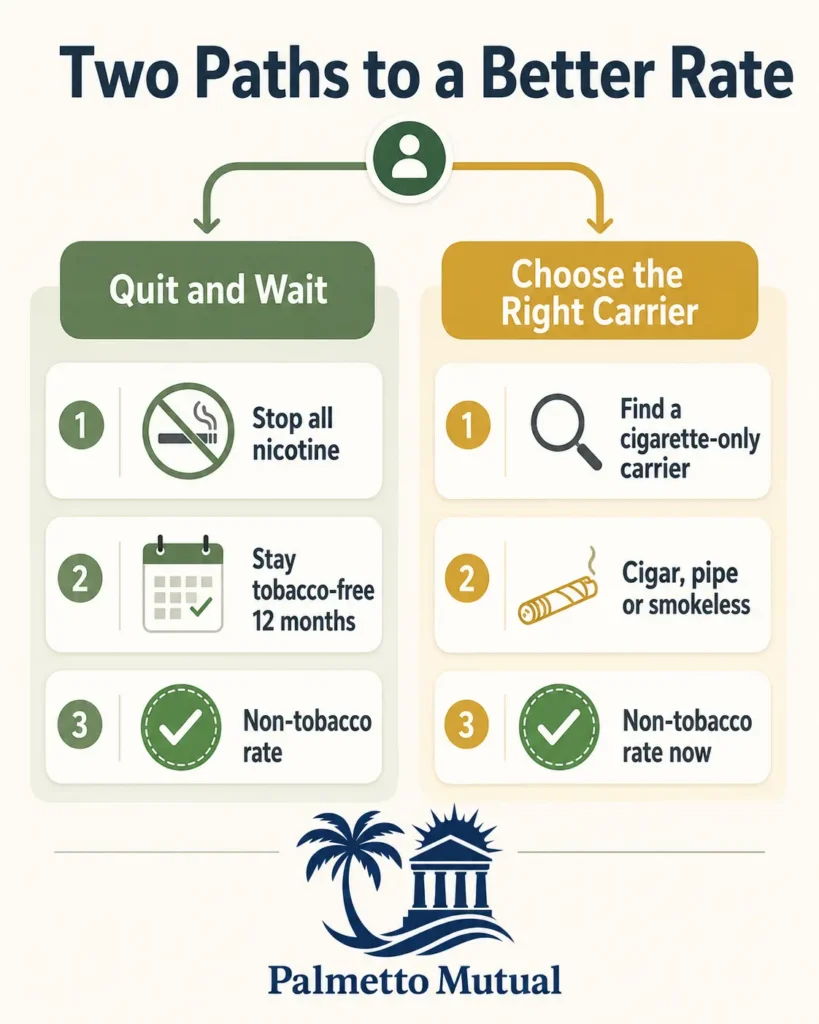
You are not necessarily locked into the tobacco rate forever, and there are two practical paths to a better one. The first is quitting and waiting out the look-back window; the second is choosing a carrier whose definition works in your favor.
Both paths can meaningfully lower the cost of funeral insurance, and an independent broker can line up carriers so you see which option saves the most.
Cessation timelines
The industry standard in final expense is a 12-month tobacco-free window. Once you have gone 12 months without any nicotine or tobacco, the majority of carriers will price you at non-tobacco rates.
Some carriers ask for longer, typically 24 months, before they will reclassify you. The window covers all nicotine, including patches, gum, and vaping, not just cigarettes.
If you already hold a policy, some carriers allow a rate reclassification request after the first policy anniversary, once you have been nicotine-free for 12 straight months. Often, though, the cleaner path is simply applying for a fresh policy at non-tobacco rates, which a broker can compare against keeping your current one.
Carriers lenient on cigars or occasional use
The faster path, if you use a non-cigarette product, is finding a carrier whose definition only counts cigarettes. With those companies, cigar, pipe, or smokeless users can land non-tobacco rates without quitting or waiting.
These cigarette-only definitions are the single biggest savings lever for occasional users, and they are not advertised on rate sheets. You have to know which carriers write them.
Because these rules shift and are not posted publicly, this is exactly where working with an independent broker pays off. The broker already knows which carriers carve out non-cigarette use and can match you to one before you apply.
Best companies for tobacco users
There is no single “best” company for every tobacco user, because the right carrier depends on your age, health, state, and what you use. The honest goal is to find the carrier that costs you the least for solid coverage.
For tobacco users, two things separate a good carrier from an average one. Both can save you real money each month.
The first lever is the size of the surcharge. Most carriers add 30% to 50% for tobacco use, but a few price tobacco users at or near non-tobacco rates. Landing with one of those carriers can erase most of the gap.
The second lever is how the carrier defines tobacco. As covered earlier, a narrow, cigarette-only definition can let cigar, pipe, or smokeless users qualify at non-tobacco rates outright. For non-cigarette users, this is often the bigger win of the two.
Here is what to weigh when comparing carriers for burial insurance as a tobacco user.
| What to compare | Why it matters for tobacco users |
|---|---|
| Size of the tobacco surcharge | A smaller surcharge directly lowers your monthly premium |
| How tobacco is defined | A cigarette-only definition may get non-cigarette users non-tobacco rates |
| Day-one (level) coverage | Avoids a waiting period, so the full benefit is payable immediately |
| Financial strength rating | A low rate only helps if the carrier reliably pays claims |
| Reclassification policy | Lets you drop to non-tobacco rates after 12 months tobacco-free |
A cheap rate is only worth as much as the company behind it, so weigh a carrier’s financial strength alongside its price. The lowest quote from a weak carrier is not the better deal.
| Rank | Carrier | Plan |
|---|---|---|
| 1 |  | Senior Choice — immediate level benefit |
| 2 |  | Standard Issue — charges tobacco users the same as non-tobacco |
| 3 |  | Protection Series — issues through age 89 |
Carriers shown are a sample of competitive options for tobacco users and may not reflect every applicant’s best rate. Availability and pricing depend on age, health, and state. Rates require answering health questions unless noted; approval is not guaranteed.
| Rank | Carrier | Plan |
|---|---|---|
| 1 | | Senior Choice — immediate level benefit |
| 2 |  | Living Promise — immediate level benefit |
| 3 | | Protection Series — issues through age 89 |
Carriers shown are a sample of competitive options for tobacco users and may not reflect every applicant’s best rate. Availability and pricing depend on age, health, and state. Rates require answering health questions; approval is not guaranteed.
This is the practical case for buying through an independent broker rather than a single company. A captive agent can only quote one carrier’s surcharge and one carrier’s tobacco definition, while a broker can shop both levers across many carriers and place you where your specific habit costs the least.
Frequently Asked Questions
Keep Reading







About the Author
Dvir Mosche is an award-winning independent insurance agent and the founder of Palmetto Mutual, a trusted insurance brokerage specializing in Final Expense Life Insurance. Since entering the industry in 2017, he has been recognized multiple times as a top agent for his dedication to educating and assisting seniors in finding the proper coverage. His mission is to simplify the process, provide honest and personalized guidance, and ensure that every client gets coverage they can depend on for life.


