
Final Expense Insurance After a Stroke

If you’ve had a stroke, you can still qualify for final expense insurance — where you land depends mostly on how long ago it happened and how your recovery has gone. This guide covers the bottom line on approval, how insurance companies review a stroke history, which carriers tend to be most forgiving, and what you can expect to pay. It also walks through a few simple steps that can help you secure the best rate and coverage available to you.
Can you get final expense insurance after a stroke?
Yes. A stroke on your record does not close the door on coverage — in most cases it simply shapes which policy and price you’re offered. Whether you qualify for the best option comes down mainly to the date of your most recent stroke or TIA and what your recovery looks like today.
Here’s the bottom line for the three situations you’re most likely to fall into.
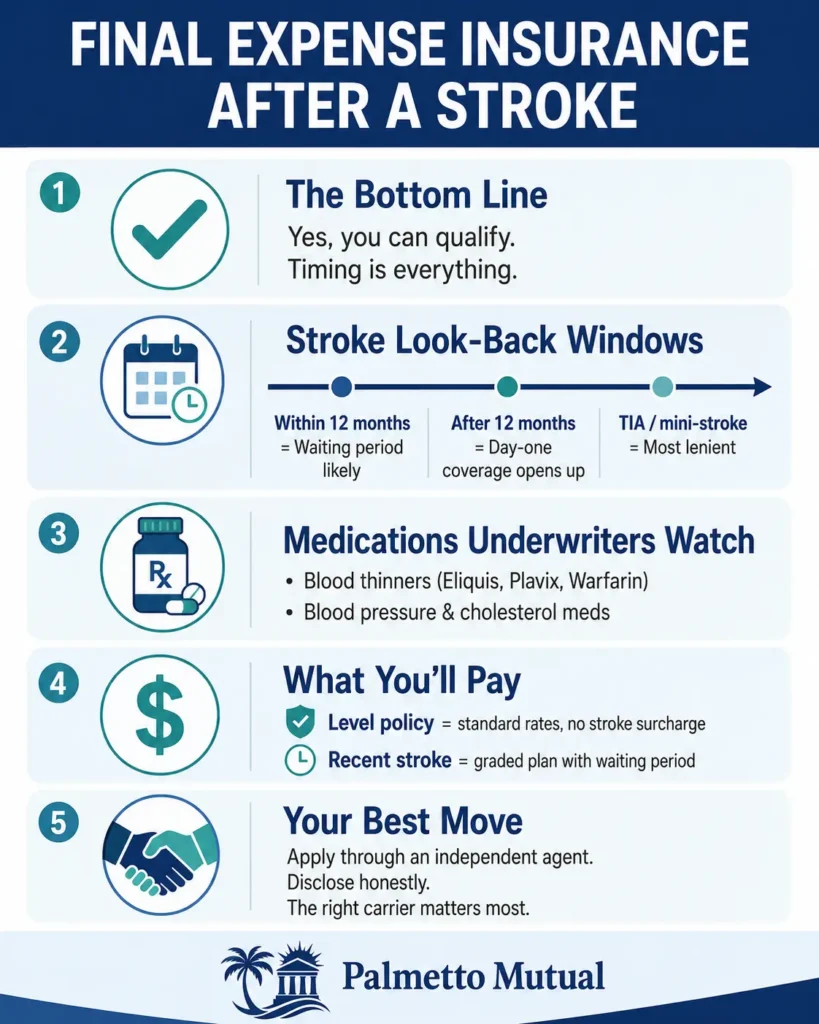
If your stroke was more than 12 months ago and you’ve recovered well, you can usually qualify for a level policy — full coverage from day one at standard rates, with no waiting period. This is the best-case tier, and more people land here than expect to. Once you’re past the 24-month mark with continued stability, your options widen even further into the lowest-priced level plans.
If your stroke was within the last 12 months, most carriers will place you on a graded or modified plan with a waiting period. Applications for a full stroke are commonly postponed to a higher-rate plan inside that first 12 months, and a two-year waiting period is typical, meaning full benefits are payable if you pass away after 24 months. The important exception: a handful of carriers will still consider level, day-one coverage even soon after a stroke, which is covered further down this page.
If your stroke left lasting effects that require help with daily activities — bathing, dressing, moving around — guaranteed issue is usually the path. When a stroke leaves someone needing home health care or assistance with activities of daily living, guaranteed issue burial insurance is generally the route to coverage. These plans accept everyone regardless of health but carry a two-year waiting period.
One distinction matters from the start: a mini-stroke (TIA) is treated more favorably than a full stroke (CVA). TIAs are commonly underwritten much like minor strokes in simplified-issue final expense, with the timing since your most recent event usually the biggest factor. If your event was a TIA, your odds of immediate coverage are stronger than for a full stroke at the same point in time.
The takeaway: a stroke rarely means no coverage. It means the right carrier and the timing of your application do the heavy lifting — and the rest of this guide walks through exactly how to get the strongest offer available to you.
How carriers underwrite a stroke history
When you apply for burial insurance after a stroke, the company is asking one core question: how long ago did it happen? That single answer — paired with your prescription record — does most of the work in deciding which policy and price you’re offered.
Carriers don’t run a medical exam for final expense coverage. Instead, they ask a short list of yes-or-no health questions and check your prescription history through databases like Milliman IntelliScript. The mechanics of how that prescription check works are covered on our prescription history page; here we’ll focus on what carriers ask specifically about stroke.
Nearly every company asks about stroke using a fixed look-back window — a set number of months counting backward from your application date. Where your stroke falls relative to that window decides your outcome. The windows vary widely from carrier to carrier, which is exactly why one company can decline you while another offers day-one coverage.
Here’s how the look-back windows line up across common final expense carriers:
| Carrier | Stroke / TIA look-back | Result if inside the window |
|---|---|---|
| Aetna | 24 months | Declined (knockout question) |
| Aflac | 12 months | Modified plan (waiting period) |
| CVS / Accendo | 12 months | Modified plan (waiting period) |
| Mutual of Omaha | 2 years | Graded benefit (waiting period) |
| American Amicable | 2–3 years | Return of Premium or Graded plan |
| Liberty Bankers | 2 years | Modified Whole Life (waiting period) |
| Royal Neighbors | Considers level day-one coverage 1–2 years out | Level (no waiting period) |
| CICA | 10-year look-back, but only if untreated | Guaranteed issue if untreated; level path if treated |
A few patterns are worth pulling out of that table.
The most important is that a treated, stable stroke is viewed very differently from an untreated one. CICA’s question, for example, only knocks you out if your stroke was diagnosed and you have not been treated or taken medication for it. A “yes” answer there points you to guaranteed issue — but if you’ve been actively managed by a doctor, a different and better path opens up. Staying on top of your care helps you, not hurts you.
The second pattern is the cliff at certain time marks. If your stroke was within the last 12 months of a 24-month look-back, most carriers offer only their highest-rate policies with a minimum two-year waiting period. Once your stroke is more than 24 months back, you’re often eligible for a level policy with the lowest rates and no waiting period — immediate coverage from day one.
The third pattern is the standout exception. A handful of carriers will write level, day-one coverage on a much shorter timeline than the rest. CICA and Transamerica will consider level day-one coverage for a stroke within the past year, and Royal Neighbors will consider level day-one coverage for a stroke that occurred one to two years ago. That gap — day-one coverage where another carrier would force a two-year wait — is the entire reason it pays to apply through an agent who knows which carrier to match you to.
One thing that affects every carrier: if your stroke left you needing help with activities of daily living — bathing, dressing, eating, getting in and out of bed — that’s a separate knockout for almost all final expense companies, regardless of how long ago the stroke happened. In that situation, a guaranteed issue policy is usually the path forward. Whether you can manage day-to-day living on your own matters as much to underwriters as the stroke date itself.
Medications underwriters watch for after a stroke
Even before a carrier reads your answers, your prescription record tells a story. After a stroke, the medications you fill are a map of what happened and how serious it was — and underwriters read that map closely. If you take one of these, it’s worth knowing what it signals, because the carrier already does.
The medications below are grouped by what they tend to tell an underwriter, not by how dangerous they are to you. Many people read this list and recognize a drug they take every day with no trouble at all.
Blood thinners (anticoagulants and antiplatelets). This is the category underwriters watch most closely after a stroke. Drugs like warfarin (Coumadin), apixaban (Eliquis), rivaroxaban (Xarelto), clopidogrel (Plavix), and even prescription-strength aspirin therapy fall here. These medications generally signal a higher risk of a future stroke, which is why they draw extra attention. Of all the cardiovascular drugs, antiplatelet agents are the ones most likely to flag an application, largely because they’re typically prescribed right after a major event like a stroke, heart attack, or surgery.
Here’s the part that surprises people: being on a blood thinner is not a decline. Anticoagulants, statins, ACE inhibitors, ARBs, beta-blockers, and aspirin do not negatively affect most life insurance applications. The carrier mainly wants to confirm two things — that the prescription lines up with a stroke you disclosed, and that the fill date doesn’t suggest a more recent event than you reported. As one stroke specialty agency notes, certain carriers will write level coverage even if blood thinners were prescribed just a day earlier, because the medication itself isn’t the disqualifier — the timing and the disclosure are.
Blood pressure and cholesterol medications. Drugs like lisinopril, amlodipine, metoprolol, and atorvastatin (Lipitor) often show up alongside a stroke history because high blood pressure and high cholesterol are the conditions that led to it. On their own, these are routine and carry no penalty. To an underwriter they mostly confirm the background picture — they rarely change the outcome by themselves.
Seizure and neurological medications. If your stroke caused lasting damage, you may be on medications that signal that severity — for example anti-seizure drugs prescribed after a stroke, or medications tied to mobility and nerve damage. These can point an underwriter toward a more serious event with lingering effects, which may move you to a graded or modified plan even when the stroke date alone would have qualified you for better.
The honest takeaway: the specific drug matters less than what it implies about how recent and how severe your stroke was. The best move is never to stop or hide a medication — your prescription record is checked against what you disclose, and the two need to match. Each of these drug families is covered in more depth on its own page if you want the full picture.
Best companies and what you’ll pay after a stroke
Here’s the field reality that most websites won’t tell you plainly: with a stroke history, the company you apply to matters more than almost anything else about you. Two carriers can look at the identical stroke, the same date, the same medications — and one offers you full coverage from day one while the other makes you wait two years. Picking the right carrier is the single biggest lever on both your approval and your price.
Which carriers are most lenient after a stroke
The companies that tend to treat a stroke history best are the ones with shorter look-back windows or special stroke provisions. Based on the carrier guidelines and field experience behind this page, a few stand out.
CICA and Transamerica will consider level, day-one coverage for a stroke that occurred within the past year — a window where most carriers would still force a waiting period. Royal Neighbors will consider level, day-one coverage for a stroke that happened one to two years ago, and it’s especially flexible on blood thinners, which makes it a strong option when your prescription record shows recent anticoagulant use. For a mini-stroke (TIA), the door is even wider: at least one carrier offers immediate coverage regardless of when the TIA occurred, and even setting that carrier aside, immediate coverage is generally available once the TIA is more than 12 months back.
For a full stroke (CVA), the general market rule is the 12-month line. Once your stroke is more than 12 months in the past, you can qualify for immediate coverage; if it’s been less than 12 months, you’re looking at a waiting period and a higher price with most companies. The carriers named above are the exceptions that beat that rule — which is exactly why they’re worth knowing.
The carrier picks here are a production-time input. The lineup above reflects current guidelines, but underwriting niches shift, so the live carrier list should be confirmed at the time this page is published.
What you’ll actually pay
Your price comes down to which tier your stroke lands you in, and there are really three scenarios.
If your stroke is far enough back that you qualify for a level (immediate) policy, you pay standard final expense rates — there’s no stroke surcharge baked in. A stroke that’s safely in your past and well-managed doesn’t, by itself, raise the price of a level policy. What you pay is driven mainly by your age, gender, coverage amount, and tobacco use, the same as any other applicant.
To put real numbers on that level-policy scenario, here’s where standard 2026 rates land for a non-tobacco applicant:
| Age | $10,000 coverage (female) | $10,000 coverage (male) |
|---|---|---|
| 60 | ~$35–$45/mo | ~$45–$55/mo |
| 65 | ~$40–$55/mo | ~$55–$70/mo |
| 70 | ~$55–$65/mo | ~$70–$90/mo |
| 75 | ~$75/mo | ~$100+/mo |
A 65-year-old non-smoking woman in reasonable health might pay roughly $40 to $55 a month for a $10,000 policy, while a man the same age runs closer to $55 to $70. By 75, a woman might pay around $75 and a man $100 or more. These are illustrative ranges, not quotes — your exact rate depends on the carrier and your full profile.
If your stroke is recent enough to push you into a graded or modified policy, the cost works differently. You’re not paying a higher monthly rate for the stroke so much as accepting a waiting period: for the first two years, a natural-cause death generally returns your premiums plus interest rather than the full benefit, with the full amount payable after that. Accidental death is typically covered in full from day one even on these plans.
If a stroke complication knocks you out of health-question plans entirely — for example, needing help with daily activities — guaranteed issue is the fallback. Every guaranteed acceptance policy carries a two-year waiting period; there are no exceptions, and any company claiming no questions and no waiting period isn’t being straight with you. These plans also cost more for the same coverage, because the insurer is pricing blind to your health.
For a quote tailored to your exact age, coverage amount, and stroke timeline, use the rate calculator below — it’s the fastest way to see real numbers for your situation.
How to get the best rate and coverage after a stroke
Where you land after a stroke isn’t fixed. The exact same person can be offered a level policy or a two-year wait depending on how the application is handled — so a little preparation goes a long way. Here’s how to put yourself in the best position for the strongest funeral insurance offer available to you.
Know your numbers before you apply
The single most useful thing you can do is have your stroke details ready and accurate. Carriers ask about a stroke using a specific look-back window, so the date is what decides your tier. Before you apply, pin down:
- The exact date of your most recent stroke or TIA.
- Whether it was a full stroke (CVA) or a mini-stroke (TIA) — this distinction matters, because TIAs are treated more leniently than full strokes.
- The names of your current medications and roughly how long you’ve been taking them.
- Any lasting effects, especially whether you need help with activities of daily living like bathing, dressing, or moving around.
Having these straight does two things: it lets you (or your agent) match you to a carrier whose window you clear, and it keeps your answers consistent with what the prescription database will show.
Let time work in your favor
For a stroke history, the calendar is the biggest factor that improves your tier — and it’s the one that improves on its own. Crossing certain time marks changes what you qualify for. Once a full stroke is more than 12 months back, immediate-coverage carriers open up; once a TIA is past the 12-month mark, the same is true with even more options. If you’re close to one of those marks, it can be worth understanding how a short wait changes your options — though that’s a personal call, and an agent can walk you through whether applying now or waiting serves you better.
What you can’t do is speed up the clock, but you can avoid working against yourself: staying consistently treated and keeping up with your prescriptions reads far better to an underwriter than gaps in care.
Be honest — it’s the strategy, not just the right thing
This is the most important point on the page. Never leave a stroke off an application or fudge the date. Carriers verify your answers against your prescription record and other databases, so an inaccurate answer doesn’t help you — it usually backfires. The carrier questionnaires behind this page state plainly that answers are checked against your health records.
There’s a practical reason honesty wins, too: a recent stroke that’s disclosed correctly may route you to a carrier that accepts it for level coverage. The same stroke hidden and then discovered during a claim investigation can leave your family with nothing but a refund of premiums. Accurate disclosure is what lets an agent steer you to the carrier built for your situation in the first place.
Work with an independent agent who knows the stroke market
Because the carrier you apply to matters more than any other single factor with a stroke history, applying blindly to one company is the most expensive mistake you can make. An independent agency works with many carriers at once and knows which ones have the shortest stroke look-backs, which are flexible on blood thinners, and which to avoid for your timeline. The general guidance across the field is to see whether you qualify for a simplified-issue plan through an independent broker before settling for a guaranteed-issue policy — that’s how you avoid an unnecessary waiting period and an inflated price.
For the mechanics of how no-waiting-period coverage actually works, see our no-waiting-period page. And if you’re worried about being turned down, our page on whether you can be denied walks through what a decline does and doesn’t mean for your next step.
Keep Reading







About the Author
Dvir Mosche is an award-winning independent insurance agent and the founder of Palmetto Mutual, a trusted insurance brokerage specializing in Final Expense Life Insurance. Since entering the industry in 2017, he has been recognized multiple times as a top agent for his dedication to educating and assisting seniors in finding the proper coverage. His mission is to simplify the process, provide honest and personalized guidance, and ensure that every client gets coverage they can depend on for life.


