
Home > Funeral Cost > Casket Cost
Average Cost of a Casket
Most caskets cost between $2,000 and $4,000, with a national median of around $2,500 for a standard metal casket. The casket is often the single most expensive item bought during the funeral process, and the full range runs from a few hundred dollars at the low end up to $10,000 or more for premium options. What you pay comes down mostly to the material — and you have the right to buy your casket wherever you like, not only from the funeral home. Because a casket is one of the largest end-of-life expenses, it’s also one of the main costs that burial insurance is meant to help cover.
What a Casket Actually Costs
Most families pay somewhere between $2,000 and $4,000 for a casket. The national median for a standard metal casket sits right around $2,500, and the Federal Trade Commission puts the typical casket at a little more than $2,000.
That average hides a very wide range, though. The least expensive caskets start at a few hundred dollars, while the most expensive ones can reach $10,000 or more. Here is the full spread at a glance.
| Where it falls | Typical price |
|---|---|
| Lowest-cost models | $200 to $1,000 |
| Mid-range (most common) | $2,000 to $4,000 |
| Premium and luxury | $4,000 to $10,000 and up |
The casket is usually the single most expensive item in a traditional funeral. The Federal Trade Commission notes it is often the costliest item purchased during the funeral process.
It helps to see where that fits in the bigger picture. The NFDA puts the median cost of a funeral with viewing and burial at about $8,300 — and the casket alone is a big slice of that, before any cemetery costs like a plot or vault.
Because the casket is such a large expense, it is one of the main costs people plan for when they buy final expense insurance. The rest of this guide explains why prices vary so much, so you can judge whether a quote is fair.
What Drives the Price
Almost all of that price difference comes down to one thing: the material. Once you know how each material is priced, the spread above stops looking random — and it is easier to size a funeral insurance policy to match. The sections below walk the full ladder, from the budget floor up to the top.
Metal caskets: steel, stainless, bronze and copper
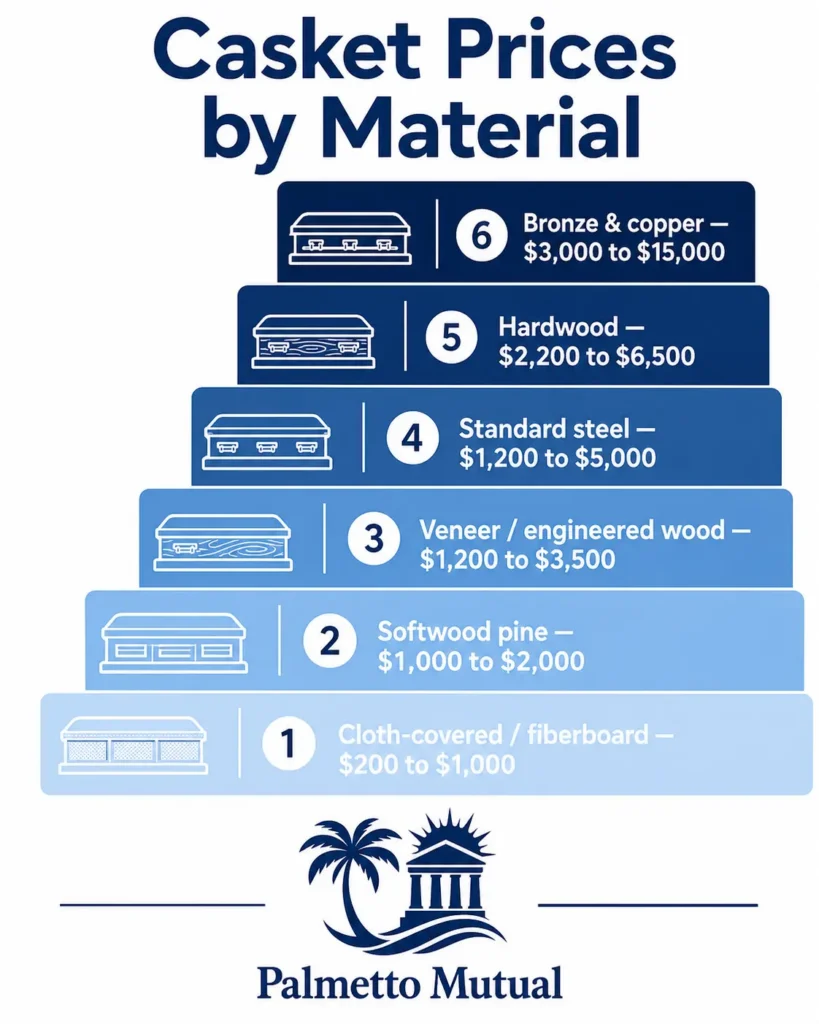
Steel is the most common casket material, and it is priced by gauge. Gauge is just a measure of thickness, and it works backward from what you might expect: a lower gauge number means thicker steel, which costs more. The common choices are 20, 18, and 16 gauge, with 20 the thinnest and least expensive and 16 the thickest.
Stainless steel is a step up from standard steel. It resists rust better than basic carbon steel and runs about 30 to 50 percent less than bronze or copper.
Bronze and copper sit at the genuine high end, and they are not sold by gauge. Instead they are priced by weight — a heavier bronze casket costs more than a lighter one of the same size. These two metals are what drive the very top of the price range.
| Metal | How it’s priced | Typical range |
|---|---|---|
| Standard (carbon) steel | By gauge — lower number, thicker, pricier | $1,200 to $5,000 |
| Stainless steel | By gauge; rust-resistant, a step above standard steel | $2,000 to $5,000 |
| Copper | By weight | $3,000 to $12,000 |
| Bronze | By weight | $4,000 to $15,000 |
Wood caskets: hardwood vs. softwood
With wood, the type of tree sets the price. Wooden caskets generally run from about $1,000 to $3,550, and the exact wood determines where you land.
Softwoods like pine are the most affordable. Pine caskets are the cheapest of the wood options, and a simple solid-pine model often falls in the lower thousands.
Hardwoods are the premium tier. Caskets made of mahogany, maple, or oak can run from about $2,200 to $6,500, and exotic woods can climb toward $10,000.
| Wood | Examples | Typical range |
|---|---|---|
| Softwood | Pine | $1,000 to $2,000 |
| Veneer / engineered wood | — | $1,200 to $3,500 |
| Hardwood | Oak, cherry, maple, walnut, mahogany | $2,200 to $6,500 and up |
Cloth-covered and fiberboard
At the very bottom of the range are cloth-covered caskets. These are made of corrugated fiberboard or pressed wood, then covered with cloth.
They are the budget floor for a reason. Simple cardboard, fiberboard, or softwood models run from about $200 to $1,000, and a cloth-covered casket averages around $600.
For that price you still get a presentable, usable casket. A typical model includes:
- A finished cloth exterior, often in a soft blue-gray or similar tone
- A simple lined interior, usually crepe fabric
- Attached handles strong enough for carrying
- A structure that works for either burial or cremation
The trade-off is that the shell is pressed board or cardboard underneath, so it is lighter and less rigid than metal or solid wood. For many families that is a fair exchange for the lower cost.
Why two caskets of the same material cost different amounts
Two steel caskets can sit side by side and one can cost double the other. The gap is usually not one thing — it is a stack of choices: how the casket is built, what features and finishes are included, and how it is sold. The main drivers within a single material are:
- Finish. Polished, painted, and multi-color finishes cost more than a plain coat.
- Interior. Linings range from simple fabric up to velvet, silk, or satin, and some add memory-foam padding or adjustable pillows — all of which raise the price.
- Hardware. Heavier handles, decorative corners, and trim add cost.
- Thickness or weight. Within metal, a lower-gauge steel or a heavier bronze costs more than a thinner or lighter version of the same metal.
- Brand. A well-known manufacturer’s name carries its own markup, even when the box is similar to a cheaper one.
Sealed vs. Unsealed Caskets — and the “Protective” Upsell
When you shop for a metal casket, you will often see ones labeled “gasketed,” “protective,” or “sealer.” These terms mean the casket has a rubber gasket or similar feature meant to slow water from getting in and to prevent rust. The gasket is designed to protect the casket, not the body, and is never required by law.
These caskets are usually marketed as a way to seal out air and moisture and “preserve” your loved one. That sounds reassuring, but it is not what a seal actually does.
Here is the honest version. A gasket may keep out air and water for a while, but the body will break down no matter what. In fact, a sealed casket can interfere with the natural drying process, so it may trap moisture and rust from the inside over time.
This is also where the law steps in. The FTC’s Funeral Rule flatly prohibits any claim that funeral goods or services will delay the natural breakdown of remains for a long term or indefinitely. The Rule forbids claims that these features preserve remains because they don’t — they simply add to the cost of the casket.
So what is the price gap worth? A gasket or sealer typically adds somewhere between $500 and $2,000 to the price of a casket.
That money buys a feature for the box, not protection for the body. And if the cemetery requires an outer burial container, that vault or liner is what keeps the grave from sinking — so the seal adds little beyond cost.
If you are working from a set budget, such as the payout from a burial insurance policy, this is one of the easiest places to avoid spending on something that does not deliver what it sounds like it does.
Buying a Casket Somewhere Other Than the Funeral Home
You do not have to buy your casket from the funeral home, and buying elsewhere is often where the biggest savings on a funeral insurance budget come from. Federal law protects this choice, and several large retailers sell caskets for far less than a funeral home showroom.
Your right to bring your own casket
The FTC’s Funeral Rule is clear on this point. A funeral provider cannot refuse to handle a casket you bought online, at a casket store, or anywhere else — and cannot charge you a fee to do it.
You also do not have to be there for the delivery. The funeral home cannot require you to be present when the casket is delivered to them.
One practical note: most funeral homes will accept a shipped casket but take no responsibility for the condition it arrives in, and most will not store one for you ahead of time.
Where to buy for less
The same casket can cost a fraction of the funeral home price elsewhere. Online retailers often sell for 40 to 60 percent less than funeral home prices, and families commonly save $800 to $1,500 on the casket alone.
| Retailer | Typical price range | Shipping |
|---|---|---|
| Costco | $900 to $1,500 | Included in the price; not available in every state |
| Walmart | $995 to about $5,100 (many near $1,000) | Free on most; a flat fee may apply if not shipping to a funeral home |
| Amazon | $999 to about $2,900 | Often free; two-day on some models for Prime members |
| Independent online sellers | $600 to $6,000 and up | Varies; many offer free standard delivery |
A quick note on price-matching: some funeral homes will match online casket prices, which can let you save while still seeing the casket in person. It never hurts to ask.
Making sure it arrives in time
Cheaper online only works if the casket shows up when you need it. Most major sellers move quickly, but timing has rules.
- Costco delivers by 5 p.m. local time three business days after your order, but only if you order before 10 a.m. Pacific — miss that cutoff by a minute and it slips to the next business day.
- Walmart and Amazon orders generally ship in about two to three business days, and some sellers offer next-business-day fulfillment.
- Weather, credit card holds, and similar issues can push delivery past the estimate.
- State availability varies — not every retailer ships caskets to every state, so confirm yours is covered.
Two habits make this go smoothly. Call the retailer to confirm availability and the exact delivery date before you order. And call the funeral home to let them know a casket is coming at least one business day before it arrives.
Cremation Caskets, Rentals, and Alternative Containers
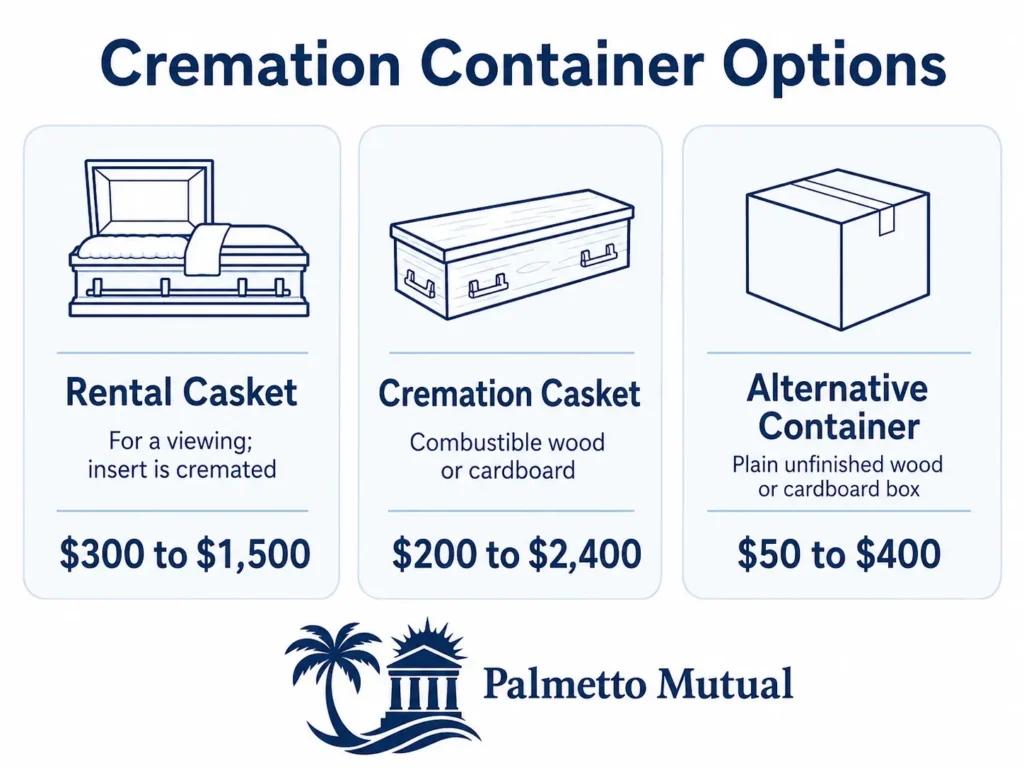
If you are planning cremation, you usually do not need a traditional casket at all. There are three lower-cost container options, and the right one depends on whether you want a viewing first.
| Option | What it is | Typical cost |
|---|---|---|
| Rental casket | A ceremonial casket for the viewing, with an insert that is cremated | $300 to $1,500 |
| Cremation casket | A combustible wood or cardboard casket built for cremation | $200 to about $2,400 |
| Alternative container | A plain unfinished wood or cardboard box | $50 to $400 |
Rental caskets
A rental casket lets you have a nice casket for the viewing without buying one you will never bury. You pay a rental fee to use a high-quality outer casket for the service, and the casket you see is not the container that goes into the crematory.
It works as a two-part system. The body rests inside a separate removable insert; after the service, that insert is taken out and used for the cremation, while the outer casket is cleaned and prepared for future use.
The savings can be real. A rental runs a few hundred dollars to around $1,500, compared with $2,000 to $10,000 to buy a casket outright. The funeral home must clearly disclose, in writing, that the casket is for rental use.
Cremation caskets and combustible containers
A cremation casket is a casket built to burn along with the body, so it has no metal parts. These can be very inexpensive — cardboard or pressed wood for as little as $200 — or more finished display models that run roughly $625 to $2,425.
You are never required to buy one for a direct cremation. If you do want a container, the funeral home must provide one, but the rule does not require them to offer a high-end version, so most provide inexpensive models.
The minimum “alternative container” rule
This is a separate Funeral Rule protection from your right to bring your own casket. No state or local law requires a casket for cremation, and a funeral home that offers cremation must tell you that alternative containers are available and must make them available.
An alternative container is the bare-bones option. It is an unfinished wood box or other non-metal enclosure, without ornamentation or a fixed lining, made of fiberboard, pressed wood, or similar material.
The rule has teeth here. It is an unfair or deceptive practice for a funeral provider or crematory to require that a casket be purchased for direct cremation. If someone says you must buy one, it is fair to ask them to show you the written requirement.
Knowing these options matters when you are deciding how much funeral insurance to carry, since a cremation plan can need far less coverage than a full burial.
How to Avoid Overpaying on a Casket
A casket bought from a funeral home is often the same box you can find for far less elsewhere — the difference is markup and how the showroom is set up. Knowing both helps you judge whether a price is fair.
What the markup actually is
Funeral homes buy caskets at wholesale and resell them at a large markup. Industry figures put that markup in the range of 200 to 400 percent, and some pricing breakdowns put it higher.
A few real-world examples show the gap:
| Wholesale cost to the funeral home | Typical retail price |
|---|---|
| $600 to $800 | $2,500 to $3,000 |
| $1,200 | $4,000 to $5,000 |
| $2,000 to $3,000 | $8,000 to $10,000 |
For contrast, a retailer like Costco never marks caskets up more than about 15 percent. The reason the gap stays hidden is simple: most families have no idea what a casket costs at wholesale, so they have no reference point for a fair price.
Upsell tactics to recognize
Showrooms are arranged to guide you toward pricier models, often without a word being said. Industry studies show the average shopper buys one of the first three caskets shown, usually the middle-priced one — so it is in the seller’s interest to start with higher-end models.
A few patterns to watch for:
- Anchoring. The first caskets you see are often the most expensive, which makes everything after them feel reasonable.
- Social proof. Phrases like “this is what most families choose” nudge you toward a specific tier.
- Hidden low-end models. Lower-priced caskets may not be prominently displayed, and pine caskets in particular are rarely put out on the floor.
What the funeral home is required to show you
You have the right to full price information before you ever look at a casket. The Funeral Rule requires the funeral director to show you a list of caskets with descriptions and prices before showing you the actual caskets.
That list is your tool for seeing every option, not just the displayed ones. If lower-priced models are not on the list or the floor, you can ask to see them. You can also get price information by phone, and the funeral home does not require your name or contact details to give it.
And nothing has to be decided on the spot. You have the right to a written, itemized statement of what you have chosen before you pay. Using these rights is simply how the process is meant to work — they exist so any family can compare clearly and choose with full information. This kind of transparency is exactly what an independent broker brings to final expense insurance, too: options laid out plainly so you can pick what fits.
Frequently Asked Questions
Keep Reading







About the Author
Dvir Mosche is an award-winning independent insurance agent and the founder of Palmetto Mutual, a trusted insurance brokerage specializing in Final Expense Life Insurance. Since entering the industry in 2017, he has been recognized multiple times as a top agent for his dedication to educating and assisting seniors in finding the proper coverage. His mission is to simplify the process, provide honest and personalized guidance, and ensure that every client gets coverage they can depend on for life.


