
Home > Burial Insurance with Pre-Existing Conditions > Hepatitis C
Final Expense Insurance with Hepatitis C

A hepatitis C diagnosis does not shut you out of final expense insurance. Whether you qualify for immediate, day-one coverage or land in a graded plan comes down mostly to how the virus is being managed and where you stand in treatment. This guide walks through where hepatitis C usually places, how carriers underwrite it, what you can expect to pay, and which companies tend to be the most forgiving.
Can you get final expense insurance with hepatitis C?
Yes. For most people, hepatitis C is a day-one condition. You can qualify for a level plan that covers you in full from your first payment, with no waiting period.
Several burial insurance carriers treat it this way, so the diagnosis by itself does not push you into a waiting-period plan. Where you land comes down to two things: whether the virus has been cleared, and whether it has left any lasting damage to your liver.
| Your situation | What you can usually expect |
|---|---|
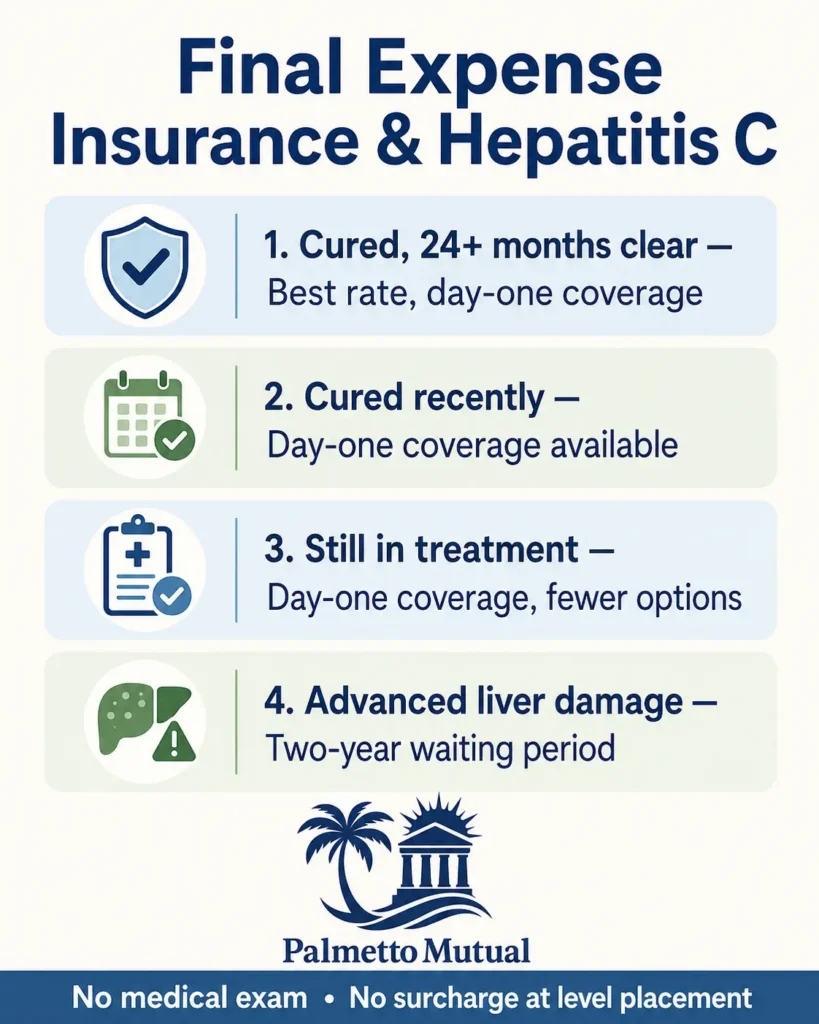
| Cured and more than 24 months clear | Best tier — level, day-one coverage, lowest price, and the widest choice of carriers |
| Cured within the last 24 months | Level, day-one coverage is available; pricing and options improve once you pass 24 months |
| Still in treatment or not yet cleared | Day-one coverage is still available with multiple carriers, usually with fewer choices and a higher price |
| Hepatitis C that led to advanced liver damage | A two-year waiting period is likely |
The one situation that changes the answer is advanced liver disease. If hepatitis C has progressed to cirrhosis with liver failure, or your doctor has advised a transplant, most carriers will move you to a graded or guaranteed-issue plan with a two-year wait.
Short of that, hepatitis C is one of the friendlier conditions in funeral insurance underwriting. The next section covers what carriers actually ask and look at.
How carriers underwrite hepatitis C
Underwriting for hepatitis C in final expense insurance comes down to three inputs: the application questions, how far back the carrier looks, and what your prescription record shows.
On the application, carriers ask whether you have been diagnosed with or treated for hepatitis or any liver disease. Many go a step further and ask about complications — cirrhosis, liver failure, fluid buildup, or a recommended transplant — because those, not the infection itself, are what usually move the decision.
Look-back windows vary from one carrier to the next. Some ask only about a recent diagnosis or treatment, often within about two years; others ask whether you have ever been diagnosed. The recency of your treatment and whether the virus has cleared carry more weight than the original diagnosis date.
Carriers also run an electronic check of your prescription record, which is where your hepatitis C medications show up even if a question gets missed. How that prescription and MIB check works is covered in full on our prescription history page.
Medications underwriters watch for with hepatitis C
Your prescriptions tell an underwriter a short story about your hepatitis C — how recently you were treated, whether it cleared, and whether your liver has been affected. They fall into groups that send very different signals.
| Medication group | Examples | What it signals to an underwriter |
|---|---|---|
| Antiviral cure medications | Mavyret, Epclusa, Harvoni, Sovaldi, Vosevi, Zepatier | You were treated for hepatitis C. A completed course with the virus cleared is a good sign the infection is resolved. A very recent or ongoing course signals active or recent hepatitis C. |
| Older antiviral regimens | Peginterferon, ribavirin (Copegus) | An earlier era of treatment, mostly before 2014. Signals a past treatment history rather than a current one. |
| Liver-complication medications | Lactulose, rifaximin (Xifaxan), spironolactone, furosemide, propranolol, nadolol | These treat advanced liver damage, not the virus. They point toward cirrhosis or its complications — the severity signals that lead to a waiting period. |
If you take one of the antiviral medications, that drug is the part of your record telling the underwriter your hepatitis C was addressed. If you take one of the liver-complication medications, context matters: a few of them, like furosemide or a beta-blocker, are also common for blood pressure or heart conditions, and on their own they are not a liver flag.
Best companies and what you’ll pay with hepatitis C
The best carrier for hepatitis C is the one that asks the least about it and still gives you level, day-one coverage. Leniency here is specific. It comes down to how short a carrier’s look-back on hepatitis is, whether it will place an active or uncured case at the top tier, and whether it treats your antiviral prescriptions as routine instead of a red flag.
Here is the part that surprises people: at level placement, hepatitis C adds nothing to your price. Final expense insurance does not use the table ratings or health surcharges that fully underwritten life insurance relies on. You are quoted on your age, gender, tobacco use, and coverage amount — the same as an applicant who never had the condition.
For a rough sense of the numbers, a $10,000 policy generally runs about $50 to $100 a month, with your exact rate driven mostly by age and gender. The full breakdowns live on our cost-by-coverage and cost-by-age pages.
The only time hepatitis C moves your price is when advanced liver disease pushes you into a guaranteed-issue plan. Those cost more and carry a two-year waiting period, because approval is guaranteed and the carrier is pricing without any health questions.
How to get the best rate and coverage with hepatitis C
A few condition-specific moves can be the difference between the best burial insurance rate and an unnecessary decline.
Document that the virus is cleared. If you have reached a sustained virologic response — what your doctor means by “cured” — have the date your treatment ended and the confirmation the virus is gone. Being able to state that plainly, with a date, is what earns the top tier.
Know your timeline. Have three dates ready: when you were diagnosed, when treatment finished, and when you were declared clear. The 24-month mark is the threshold where the most carriers and the lowest prices open up.
Disclose it honestly. Your antiviral prescriptions appear in the electronic record regardless, so there is nothing to gain by leaving hepatitis C off the application — and a misstatement can cause a denial now or a claim problem later. How a decline actually works is covered on our can-you-be-denied page.
If your liver has been affected, know your status. There is a real difference between compensated cirrhosis, where the liver still works, and decompensated cirrhosis. Some carriers still write level coverage for a compensated case, so knowing exactly where you stand helps you and your agent aim at the right company.
Apply with the right carrier the first time. Because carriers differ so much on hepatitis C, applying blindly can saddle you with a waiting period you did not need. An independent agent who knows which companies are easiest on the condition can point you to a level plan on the first try.
If you do end up with a waiting period, our no-waiting-period page explains how that coverage works.

About the Author
Dvir Mosche is an award-winning independent insurance agent and the founder of Palmetto Mutual, a trusted insurance brokerage specializing in Final Expense Life Insurance. Since entering the industry in 2017, he has been recognized multiple times as a top agent for his dedication to educating and assisting seniors in finding the proper coverage. His mission is to simplify the process, provide honest and personalized guidance, and ensure that every client gets coverage they can depend on for life.