
Home > Burial Insurance with Pre-Existing Conditions > Organ Transplant
Final Expense Insurance After an Organ Transplant

If you’ve had an organ transplant, you’ve probably wondered whether life insurance is still an option for you. It is, but the path depends on how long ago the transplant happened and how you’re doing today. Burial insurance companies each treat transplant recipients differently, and the difference between one carrier and another can mean immediate coverage or a two-year wait. This guide walks through what to expect, which companies are worth your time, and what your coverage is likely to cost.
Can You Get Final Expense Insurance After an Organ Transplant?
Yes. Every transplant recipient can get a policy. The real question is not whether you can be covered — it’s whether your coverage starts on day one or after a two-year wait.
For most transplant recipients, it starts after a wait. Time since surgery is the single biggest factor, and most companies treat a transplant as a knockout question that pushes you straight to a guaranteed issue plan.
There is a narrow exception. If your transplant was years ago, the organ is doing well, and you’ve had no rejection episodes, a small number of final expense insurance companies will consider you for day-one coverage. This is more realistic for a kidney transplant than for a heart or lung.
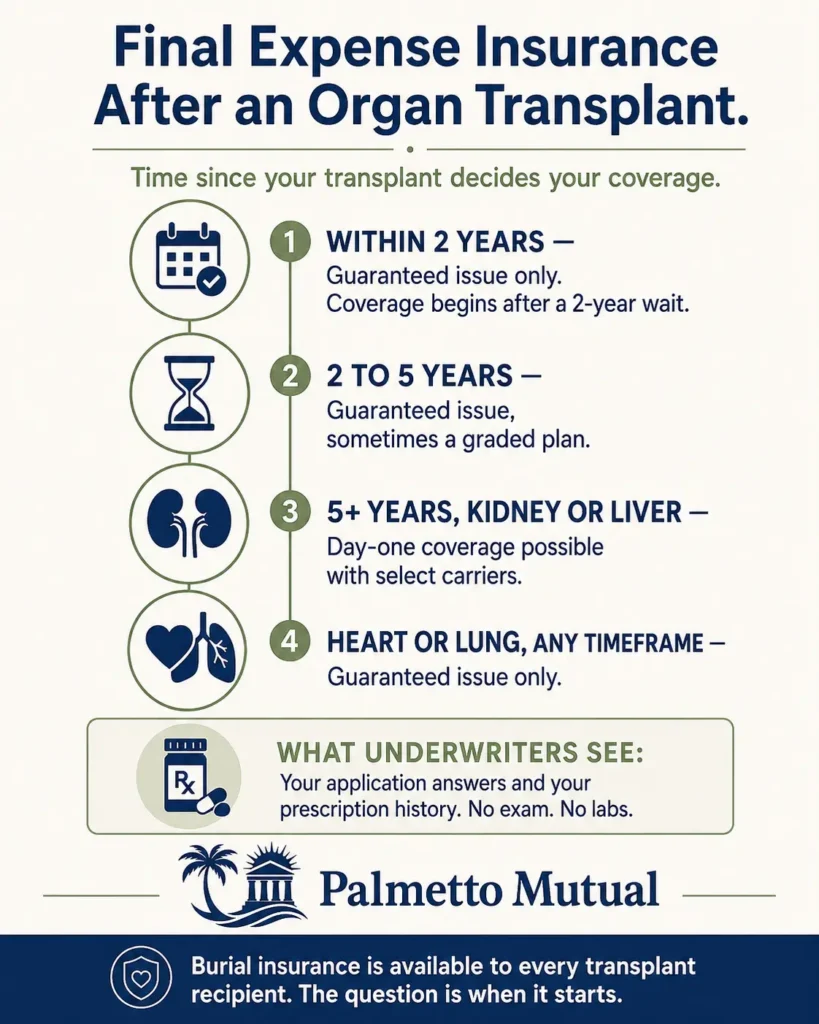
Here is where most people land:
| Your situation | Plan type you’ll likely qualify for | When coverage begins |
|---|---|---|
| Transplant within the last 2 years | Guaranteed issue | After a 2-year waiting period |
| Transplant 2 to 5 years ago | Guaranteed issue, sometimes a graded plan | After a waiting period, or partial coverage |
| Kidney or liver transplant 5+ years ago, stable, no rejection | Level tier with a select few carriers | Day one |
| Heart or lung transplant, any timeframe | Guaranteed issue | After a 2-year waiting period |
| Currently on a transplant list, or advised to get one | Guaranteed issue | After a 2-year waiting period |
That last row surprises people. Being told you need a transplant is treated the same as having had one. You do not need to have gone through the surgery for the knockout question to apply.
A guaranteed issue policy asks no health questions at all, so approval is certain. During the waiting period, a natural-cause death returns your premiums plus interest rather than the full benefit. Accidental death is usually covered from day one.
How Carriers Underwrite Organ Transplants
Every burial insurance application asks about transplants. The wording is almost always some version of: Have you ever received, or been advised to receive, an organ transplant?
That question usually sits in the knockout section — the first block of questions on the application. A yes answer there ends your eligibility for that particular plan and moves you to a different product.
The word that matters is ever. Most carriers write the question with no time limit, which is why so many transplant recipients get routed to guaranteed issue no matter how long ago the surgery was.
A minority of carriers attach a look-back window instead. That is the opening. If a company asks only about the last 24 months, or the last five years, a transplant outside that window is a legal no.
| How the question is written | What it means for you |
|---|---|
| “Have you EVER received or been advised to receive an organ transplant?” | Knockout. Guaranteed issue only with this carrier. |
| “Within the last 24 months…” | Transplant more than 2 years ago is a no. You may qualify for a graded or level plan. |
| “Within the last 5 years…” | Transplant more than 5 years ago is a no. Best shot at day-one coverage. |
Beyond the transplant question itself, underwriters weigh a few things you should expect to be asked about. Which organ was replaced. Whether you’ve had any rejection episode. Whether you’ve had dialysis in the last 12 months. And whether the disease that damaged the original organ is still active.
Kidney and liver recipients generally get the most flexibility. Heart and lung recipients almost never see day-one offers, because the mortality data behind those transplants is far less forgiving.
Carriers also run an electronic check of your prescription history and your MIB file before they approve anything. There is no medical exam, no blood work, and no lab review on a final expense policy — but your medication list tells them nearly everything the exam would have.
Medications Underwriters Watch For After a Transplant
Your medication list is the fastest way for an underwriter to confirm a transplant, estimate how long ago it happened, and spot complications. The drugs below are grouped by what they signal — not by how common they are.
Expected maintenance drugs. These confirm you’re a transplant recipient. Seeing them is not a problem by itself. Underwriters expect them, and their presence alone doesn’t mean instability.
- Calcineurin inhibitors: tacrolimus (Prograf, Envarsus), cyclosporine (Neoral, Sandimmune, Gengraf)
- Antiproliferatives: mycophenolate (CellCept, Myfortic), azathioprine (Imuran)
- mTOR inhibitors: sirolimus (Rapamune), everolimus (Zortress)
- Low-dose maintenance corticosteroids: prednisone, prednisolone
Drugs that signal a recent transplant or a rejection episode. These raise a flag because they point to the acute phase or to the graft being attacked.
- High-dose or pulse steroids, methylprednisolone
- Belatacept (Nulojix), antithymocyte globulin
- Any recent, sharp change in the dose of your maintenance drugs
Drugs that signal infection risk from immunosuppression. Long-term immunosuppression leaves you open to infections, and preventive prescriptions tell that story.
- Valganciclovir (Valcyte), acyclovir
- Sulfamethoxazole-trimethoprim (Bactrim, Septra)
- Antifungal prophylaxis such as nystatin
Drugs that signal the underlying disease is still in play. These matter more than the transplant drugs, because they suggest the new organ is under strain or the original illness never resolved.
- Phosphate binders (sevelamer, Renvela), epoetin (Procrit, Aranesp) — pointing to kidney failure
- Lactulose, rifaximin (Xifaxan) — pointing to liver disease
- Entecavir, tenofovir — pointing to chronic hepatitis B
- High-dose loop diuretics such as furosemide
Drugs that signal complications from years of immunosuppression. Anti-rejection drugs cause their own problems over time. Underwriters know this and read these as secondary risk.
- Insulin or metformin started after the transplant — post-transplant diabetes
- Multiple blood pressure medications
- Warfarin or a newer blood thinner, common after heart transplant
Best Companies and What You’ll Pay After an Organ Transplant
There is no single best company for transplant recipients. There is only the company whose transplant question happens to be written in a way you can answer no to.
That’s the whole game. Two carriers can charge nearly identical rates, and one will decline you outright while the other issues a level plan — because one asks “have you ever” and the other asks “in the last five years.”
A few things hold true across the market:
Carriers that ask a time-limited transplant question are worth applying to first. They are rare, but if your transplant is five or more years behind you and the organ is stable, these are the only companies that can offer day-one coverage. Kidney and liver recipients have the best odds here.
Carriers with the friendliest guaranteed issue pricing are where most transplant recipients end up. Guaranteed issue rates are set entirely by age, gender, state, and coverage amount. Your transplant does not raise the price, because the company never asked about it.
Tobacco use does not change a guaranteed issue rate. Since there are no health or lifestyle questions, smokers and nonsmokers pay the same. This is the one place in funeral insurance where smoking costs you nothing.
What it actually costs
Two numbers shape your premium: your age and how much coverage you buy. Your transplant does not enter into it on a guaranteed issue plan.
That spread is why shopping matters more than anything else you can do.
| What you should know about the price | Detail |
|---|---|
| Coverage cap on most guaranteed issue plans | $25,000, occasionally $30,000 |
| Waiting period | 24 months, never shorter |
| If you die during the wait, natural causes | Premiums refunded, plus about 10% interest |
| If you die during the wait, accidental causes | Full death benefit, with most carriers |
| Surcharge for the transplant itself | None |
| Premium after year one | Fixed for life. It never increases. |
If you qualify for a level tier with a time-limited carrier, you’ll pay standard final expense rates — the same as anyone else your age with no surcharge for the transplant. That’s the prize for waiting out the look-back window.
Need more than $25,000? Buy from two different companies. Stacking policies is the only way to exceed the guaranteed issue ceiling.
How to Get the Best Rate and Coverage After an Organ Transplant
Start by knowing your own file. Before you talk to anyone, write down the month and year of your transplant, which organ it was, whether the donor was living or deceased, and whether you’ve ever had a rejection episode treated.
Those four facts determine which companies will even look at you. Guessing at the date can cost you a level-tier offer if you’re near a look-back boundary.
Pull your current medication list too. An underwriter is going to see it in the prescription check no matter what you say, so there’s nothing to gain by leaving anything off.
Answer every question honestly. This is not moral advice. A false answer voids the policy during the two-year contestability window, meaning your family gets nothing at the moment they need it most. Our page on being denied coverage explains how carriers catch this.
Do not apply online, and do not apply to one company at a time. Transplant recipients need someone who knows which applications use a time-limited transplant question. An independent broker can check several carriers before a single application is submitted. Applying blind and getting declined puts a record in your MIB file that the next carrier will see.
If you’re close to a look-back boundary, ask what waiting changes. If your transplant was four years and eight months ago, a few months of patience may move you from a two-year wait to day-one coverage. If it was eight months ago, waiting gains you nothing — buy the guaranteed issue plan now and start the clock. Our no waiting period page covers how those two-year clocks work.
Buy the guaranteed issue policy today rather than someday. The waiting period runs from your policy date. Every month you delay is a month added to the day your family is fully covered. And guaranteed issue premiums rise with your age at purchase, then lock forever.
Keep the policy even if you later qualify for something better. If you buy a guaranteed issue plan now and become eligible for a level-tier burial insurance policy five years from now, you can add the second policy. Dropping the first one after you’ve already served most of the waiting period rarely makes sense.
Here is what improves your position, and what does not:
| Helps your tier | Does not help |
|---|---|
| More years since the transplant | A letter from your transplant surgeon |
| A living-donor kidney or liver | Recent lab results |
| No rejection episodes on record | Quitting smoking (no effect on GI pricing) |
| No dialysis in the past 12 months | Losing weight |
| Stable, unchanged medication doses | Explaining your case to the carrier |
That right-hand column catches people off guard. Simplified issue final expense insurance has no labs, no medical exam, and no underwriter reviewing your records. Nobody reads your surgeon’s letter. The application answers and the prescription check are the entire decision.
Keep Reading







About the Author
Dvir Mosche is an award-winning independent insurance agent and the founder of Palmetto Mutual, a trusted insurance brokerage specializing in Final Expense Life Insurance. Since entering the industry in 2017, he has been recognized multiple times as a top agent for his dedication to educating and assisting seniors in finding the proper coverage. His mission is to simplify the process, provide honest and personalized guidance, and ensure that every client gets coverage they can depend on for life.


