
Home > Burial Insurance with Pre-Existing Conditions > High Blood Pressure
Final Expense Insurance with High Blood Pressure

High blood pressure is one of the most common conditions among adults over 55, and it rarely creates any obstacle to getting covered. If your blood pressure is managed with medication, you can typically qualify for a final expense insurance policy at the best available rates, with full coverage that begins on day one. This guide walks through how carriers look at high blood pressure, what you can expect to pay, and which companies tend to be the most flexible.
Can you get final expense insurance with high blood pressure?
Yes. High blood pressure on its own is one of the easiest conditions to get covered with, and in most cases it has no negative effect on your application at all. If your blood pressure is treated and stable, you’ll typically qualify for the best tier a final expense carrier offers, with full coverage starting on day one.
That top tier is called “level” coverage. It means no waiting period and the lowest premium the carrier offers for your age. Blood pressure controlled with medication is one of the most commonly accepted conditions in final expense underwriting. Taking a pill or two for it does not count against you.
This is a common worry that turns out to be a non-issue, and there’s a simple reason for it. According to the CDC, nearly half of U.S. adults have high blood pressure. A product built for seniors cannot treat a condition that common as a red flag, so carriers price treated, stable hypertension as a normal part of life rather than an added risk.
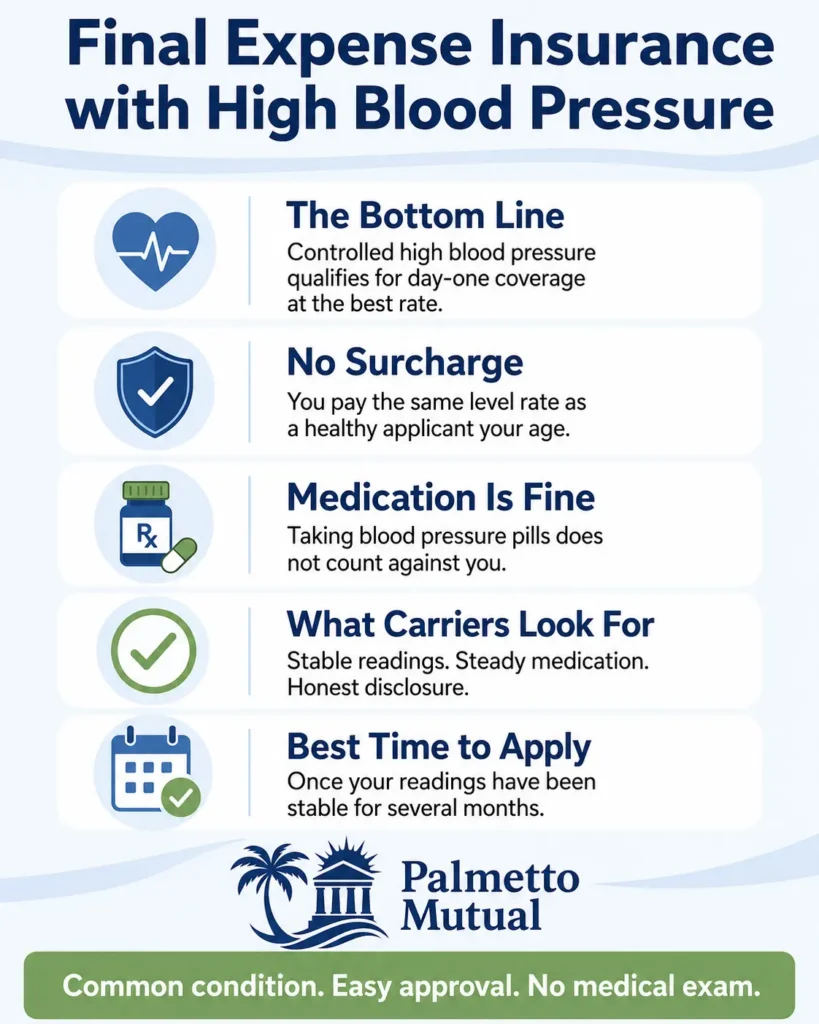
The bottom line for most readers: if your high blood pressure is controlled, you are looking at level, day-one burial insurance at standard rates. No surcharge, no graded waiting period, no guaranteed-issue compromise.
There are two situations where the answer shifts, and both are about something beyond the blood pressure itself:
| Your situation | What to expect |
|---|---|
| Treated and stable | Level coverage, full benefit day one, best rate tier |
| Uncontrolled, or very recently diagnosed and not yet stable | Often still approved, but a carrier may want stability first or move you to a lower tier |
| Combined with stroke, heart disease, or kidney problems | The other condition drives the decision, not the blood pressure — see the page for that condition |
In short, high blood pressure rarely changes your outcome by itself. What matters is whether it’s controlled and whether it travels with a more serious condition. The next section walks through exactly what carriers ask and review when they look at it.
How carriers underwrite high blood pressure
When you apply for a burial insurance policy, there’s no medical exam and no nurse visit. Instead, you answer a short list of health questions, and the carrier checks a few databases to confirm what you told them.
For high blood pressure, the questions are narrow and predictable. A carrier mainly wants to know three things: how high your readings run, how well controlled the condition is on treatment, and whether it has caused any complications such as heart disease, stroke, or kidney damage. Treated and stable answers all three in your favor.
You can expect questions along these lines:
- When were you diagnosed with high blood pressure?
- What medications do you take for it, and at what dose?
- Have you had any complications, such as a stroke or heart trouble?
- Have you been in the hospital for it recently?
The reason these stay simple is the timing. Untreated high blood pressure is what carriers view as the higher risk — not the diagnosis itself. A reading that’s managed with a daily pill reads as low risk, which is why this condition lands in the best tier so often.
There’s no long look-back window working against you here either. High blood pressure isn’t treated like a recent heart attack or cancer, where carriers count back a set number of years before they’ll offer level coverage. With treated hypertension, what matters is your current control, not how long ago you were diagnosed.
One thing carriers will not do is rely on your word alone. They confirm your answers against prescription and medical-record databases, so honest disclosure is simply the smart play. The mechanics of how that database check works — what the carrier pulls and how to prepare for it — live on our prescription history page rather than here.
Medications underwriters watch for with high blood pressure
Your prescriptions tell the carrier a quiet story about how involved your condition is. With high blood pressure, the signal is mostly about how many drugs it takes to keep you controlled — not which specific pill you take.
Blood pressure medicine comes in a handful of families. You may recognize yours below.
| Drug family | Common names | What it tends to signal |
|---|---|---|
| Water pills (diuretics) | hydrochlorothiazide (HCTZ), chlorthalidone | Often a first or add-on drug; usually a mild, routine picture |
| ACE inhibitors | lisinopril, enalapril, benazepril | Standard first-line treatment; a common, well-managed signal |
| ARBs | losartan, valsartan | Same role as ACE inhibitors; routine |
| Beta-blockers | metoprolol, atenolol, carvedilol | Sometimes prescribed for the heart, not just blood pressure — may prompt a closer look |
| Calcium channel blockers | amlodipine, diltiazem | Common add-on; routine on its own |
Here’s how to read your own list. Being on one of these, by itself, points to a mild and controlled case and rarely changes your outcome.
Taking two or three of them together isn’t a problem either, but it signals that your blood pressure took more effort to settle. A carrier may simply look a little more carefully before placing you, and treated-and-stable usually still earns level coverage.
The one pattern worth flagging is when a blood pressure drug doubles as a heart medication. Beta-blockers like metoprolol and atenolol are also used to treat chest pain and other heart conditions. If you take one for AFib, a past heart attack, or heart failure, the underwriter is really evaluating that heart condition, not the blood pressure. In that case, the page for your specific heart condition will give you the accurate picture.
The takeaway: with high blood pressure, your medication list almost never works against you. It mostly confirms what the carrier already assumes — that this is a common, manageable condition.
Best companies and what you’ll pay with high blood pressure
Here’s the part that matters most for your wallet: controlled high blood pressure carries no surcharge. You pay the same level rate a perfectly healthy applicant of your age pays. There’s no “high blood pressure tax” built into the premium.
That’s because the price of a final expense policy is driven mostly by your age and gender, not by a managed condition like this one. Age has the largest effect on price of any factor. So the real lever on your cost is when you apply, not whether you take a blood pressure pill.
What you’ll pay
These are representative monthly rates for $10,000 of coverage at non-tobacco, level (day-one) pricing. Because controlled hypertension qualifies for that level tier, these are the numbers that apply to you.
| Age | Female (approx.) | Male (approx.) |
|---|---|---|
| 55 | $28–$38 | $35–$48 |
| 60 | $36–$50 | $45–$62 |
| 65 | $40–$68 | $55–$85 |
| 70 | $65–$95 | $82–$120 |
| 75 | $88–$135 | $113–$165 |
Actual rates vary by carrier, and these 2026 industry averages are a benchmark rather than a quote. Waiting from 65 to 75 to apply can nearly double the price — and once you lock a rate in, it never goes up.
For the complete tables broken out by every age and every coverage amount, see our cost-by-age and cost-by-coverage guides.
Why the company you pick still matters
Even though controlled high blood pressure is easy to place, where you apply changes your price and your experience. Across the final expense market, rate differences of 50% or more between carriers are common for the same person. Each carrier keeps its own underwriting guidelines and its own list of which conditions it accepts and how.
That’s the case for working with an independent agent who shops multiple carriers rather than calling one company. One carrier may wave controlled hypertension through at its best rate while another nitpicks a recent dosage change. Matching your specific profile to the right carrier is where the savings live.
How to get the best rate and coverage with high blood pressure
With controlled high blood pressure, you don’t have to earn your way into level coverage — you’re already there. So the goal of preparing isn’t to overcome the condition. It’s to make sure nothing about your timing or paperwork knocks you out of the tier you already qualify for.
A few simple steps do that.
Apply when your readings are stable. This is the one piece of timing that matters. If you were just diagnosed, or your doctor recently changed your medication or dose, your readings may still be settling. Waiting six to twelve months to establish consistent control before applying leads to better outcomes, while a recent diagnosis with unstable readings can mean higher rates or a postponed decision. If your blood pressure has been steady for a while, there’s nothing to wait for.
Keep taking your medication as prescribed. Staying on your treatment is what tells a carrier the condition is managed. Underwriters view one well-tolerated medication more favorably than multiple drugs or frequent changes, because stability signals good management. Skipping doses doesn’t help your application — consistency does.
Have your basics documented. You don’t need to assemble a medical file, but it helps to know your current medications and doses and roughly when you were diagnosed before you apply. That’s the same short list the application asks about, and having it handy keeps your answers accurate.
Be honest on the application. This is the simplest tactic and the most important. Carriers confirm your answers against prescription and medical-record databases, so leaving off a blood pressure pill gains you nothing. Controlled hypertension qualifies anyway, so hiding it risks a decline or a denied claim later in exchange for no benefit at all. Disclose it plainly and let it work in your favor.
Here’s the quick version:
| Do this | Why it helps |
|---|---|
| Apply once readings are stable | Avoids a postpone or a worse tier after a recent change |
| Stay on your medication | Signals a managed, low-risk condition |
| Know your meds and diagnosis date | Keeps your application answers accurate |
| Disclose your high blood pressure honestly | Verified anyway; controlled cases qualify regardless |
Two things worth a quick word, both with their own dedicated pages. Because controlled high blood pressure qualifies for level coverage, you generally have no waiting period — your full benefit is active from day one. How waiting periods work, and which situations trigger one, is covered in full on our no-waiting-period page.
And while an outright decline is rare for this condition on its own, it’s reasonable to wonder what would cause one. The mechanics of how and why an application gets declined live on our dedicated page rather than here.
The bottom line for funeral insurance with high blood pressure is an easy one. Stable readings, steady medication, and an honest application are all it takes to lock in level coverage at the best rate for your age — and that rate never goes up once your policy is in force.
Keep Reading







About the Author
Dvir Mosche is an award-winning independent insurance agent and the founder of Palmetto Mutual, a trusted insurance brokerage specializing in Final Expense Life Insurance. Since entering the industry in 2017, he has been recognized multiple times as a top agent for his dedication to educating and assisting seniors in finding the proper coverage. His mission is to simplify the process, provide honest and personalized guidance, and ensure that every client gets coverage they can depend on for life.


