
Home > Burial Insurance with Pre-Existing Conditions > Parkinsons Disease
Final Expense Insurance with Parkinson’s Disease

If you have Parkinson’s disease, you can still qualify for final expense insurance — often more easily than you might think. This guide gives you the straight answer on whether you can get covered, how insurance companies look at Parkinson’s when you apply, which carriers tend to be the most lenient, and what you can expect to pay. You’ll also find simple steps that can help you get a better rate and more coverage.
Can you get final expense insurance with Parkinson’s disease?
Yes. A Parkinson’s diagnosis does not close the door on final expense insurance, and most people who have it can still get a policy that pays out from the very first day.
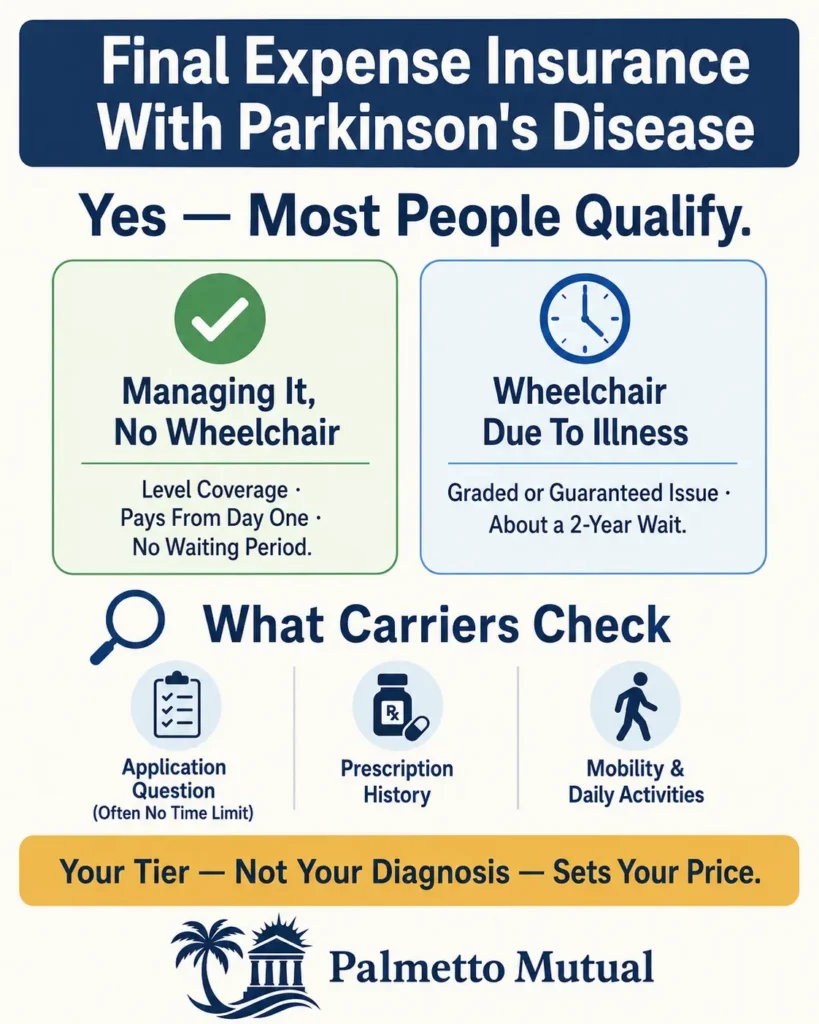
The deciding factor is how far the condition has progressed — and the clearest signal carriers look at is your mobility. If you have Parkinson’s and are managing it without needing a wheelchair, some burial insurance companies will approve you for day-one coverage at their best price.
Where it gets stricter is advanced mobility loss. If you use a wheelchair because of Parkinson’s, you’ll have to accept a waiting period instead. That still means coverage — the full benefit just waits about two years before it pays.
Here’s the quick verdict based on where you are with the condition:
| Your situation | Coverage you’ll usually qualify for | Waiting period |
|---|---|---|
| Parkinson’s, managing it, not using a wheelchair due to illness | Level (day-one) coverage | None |
| Parkinson’s with wheelchair use due to illness or disease | Graded or guaranteed issue | About 2 years |
One caveat matters more here than with common conditions like high blood pressure: only some carriers write day-one coverage for Parkinson’s, not all of them. That makes the company you apply with a real deciding factor in both your price and your outcome — which is why matching you to the right carrier is where the work is.
And even in the toughest case, no one with Parkinson’s is left uninsurable. Guaranteed acceptance plans ask no health questions at all and approve everyone, with a mandatory two-year waiting period. So the real question is rarely whether you can get funeral insurance — it’s which tier you land in.
How carriers underwrite Parkinson’s disease
Every burial insurance company handles Parkinson’s a little differently, but the underwriting comes down to two things: the health question on the application and the prescription history the carrier pulls behind the scenes.
On the application, Parkinson’s is treated as a lifelong condition. Because it can’t be cured, the question usually has no time limit attached the way a heart attack or cancer question does, and it’s grouped with other permanent conditions. You’ll often see it worded something like: “Have you ever been diagnosed with, treated for, or taken medication for Parkinson’s disease?”
That “ever” matters. A diagnosis from years ago counts the same as one from last month — there’s no clock running it out.
A smaller number of carriers do attach a window and ask only about the last 24 months. Those applications are worth finding, since a timeframe like that can open up better options. Knowing which carriers phrase the question that way is part of matching you to the right one.
The second half is your prescription history. Even if the words “Parkinson’s disease” never appear on your application, carriers electronically review the medications you’ve filled — and the drugs used to treat Parkinson’s make the diagnosis plain. For how that prescription check works and how far back it reaches, see our guide on prescription history.
What carriers are really weighing isn’t the diagnosis by itself — it’s how far the condition has moved. Two people can both have Parkinson’s and land in different tiers depending on their mobility, whether they need help with daily activities, and what their medication list says about the stage of the disease. That last signal is worth a closer look.
Medications underwriters watch for with Parkinson’s disease
Your medication list tells an underwriter more than a single yes-or-no answer ever could. No one drug is a red flag on its own — it’s the combination that signals how advanced the condition is. Here’s how carriers tend to read the common Parkinson’s medications:
| Medication group (examples) | What it usually signals to an underwriter |
|---|---|
| Standard first-line therapy — carbidopa-levodopa (Sinemet, Rytary), dopamine agonists like pramipexole (Mirapex) and ropinirole (Requip), MAO-B inhibitors like rasagiline (Azilect) and selegiline | Confirmed Parkinson’s being managed on a typical regimen. This is the controlled, expected picture carriers are most comfortable approving for day-one coverage. |
| Add-on “wearing-off” and dyskinesia drugs — COMT inhibitors like entacapone (Comtan), Stalevo, and opicapone (Ongentys); amantadine (Gocovri); istradefylline (Nourianz) | The standard dose no longer holds steady, so more medicine has been layered on. Signals motor fluctuations or involuntary movements — a step further along. |
| Advanced delivery therapies — apomorphine (Apokyn) rescue injections, carbidopa-levodopa infusion gel or pump (Duopa) | Reserved for advanced Parkinson’s with significant daily “off” time. A strong marker of later-stage disease. |
| Complication drugs — pimavanserin (Nuplazid) for Parkinson’s psychosis, rivastigmine (Exelon) for Parkinson’s-related dementia | Points to non-motor complications like hallucinations or memory loss. Psychosis in particular tends to occur in more advanced disease — the end of the range most likely to push toward a waiting-period plan. |
If your list sits in the top row, you’re the kind of applicant many final expense carriers will write at their best level. The further down the table your regimen reaches, the more it points toward a graded or guaranteed-issue plan — which is exactly why which company you apply with matters so much.
Best companies and what you’ll pay with Parkinson’s disease
With most conditions, the price gap between carriers is modest. With Parkinson’s, it’s the whole ballgame. Because only some final expense companies write day-one coverage for Parkinson’s, the carrier you apply with decides both what you pay and whether you wait at all.
There’s no single “best” company here. The best one is whichever carrier’s Parkinson’s rules line up with your situation — how you’re getting around, what your medication list shows, and whether you use a wheelchair. Matching those details to the right carrier is the entire job.
What it actually costs
If you qualify at the level (day-one) tier, here’s the part that surprises people: Parkinson’s does not add a surcharge. A level approval means you pay the same standard burial insurance rate as any other applicant your age — your price is set by age, gender, coverage amount, and tobacco use, not by the diagnosis itself.
To give you a rough idea, here’s what $10,000 of level, non-tobacco coverage tends to run in 2026. These are market averages across carriers, not a single company’s rates:
| Age | Female (approx.) | Male (approx.) |
|---|---|---|
| 50 | $20–$35 / mo | $25–$40 / mo |
| 60 | $30–$50 / mo | $40–$65 / mo |
| 70 | $50–$85 / mo | $60–$100+ / mo |
Exact rates depend on the carrier and your underwriting class, and women generally pay less than men because they tend to live longer. For the full breakdowns, see our cost-by-age and cost-by-coverage guides.
If your Parkinson’s has advanced to wheelchair use, the math changes. You’ll be looking at a graded or guaranteed-issue plan, which costs more for the same coverage and comes with a waiting period of about two years before the full benefit pays. It’s still real coverage — it just carries a higher price and that upfront wait.
The takeaway is simple: your tier, not your diagnosis, sets your price. And your tier depends heavily on which carrier reviews your file.
How to get the best rate and coverage with Parkinson’s disease
With Parkinson’s, the smartest move happens before you ever fill out an application. Because carriers differ so much on this one condition, applying blindly — or firing off several applications at once — is how people end up stuck with a waiting period they didn’t actually need.
The better path is to get matched to the right carrier first. Companies use different question wording and different look-back periods, so an independent agency can compare them and point you toward the one least likely to trip you up. Working with an independent agent costs you nothing extra — the carriers pay them, not you.
Because your tier hangs on mobility and medications, having a few details ready makes the process smoother and helps your agent place you correctly:
- The year you were diagnosed.
- Your current medication list, with the exact drug names and doses.
- Whether you use any mobility aid — cane, walker, or wheelchair — and the reason why.
- Whether you need help with daily activities like dressing or bathing.
- Any recent hospital stays connected to Parkinson’s.
A few things tend to push a Parkinson’s application toward day-one coverage:
- Being able to truthfully answer “no” to the wheelchair question. This is the single biggest factor.
- Stable, well-managed disease on a standard medication regimen.
- No complications like hallucinations or memory loss in your records.
You can’t reshape your health to fit a form. But putting an accurate, complete picture in front of the right carrier is often the difference between level pricing and a graded plan.
One thing you should never do is leave Parkinson’s off the application. The prescription check surfaces it anyway, and a false answer gives the insurer the right to deny the claim if you pass away within the first two years. The reassuring part is that you rarely need to hide anything — with the right carrier, an honest “yes” to Parkinson’s still leads to full burial insurance coverage from day one.
For exactly how that immediate coverage works, see our guide on no-waiting-period plans. And if being turned down is your worry, our guide on whether you can be denied walks through what actually triggers a decline.
Keep Reading







About the Author
Dvir Mosche is an award-winning independent insurance agent and the founder of Palmetto Mutual, a trusted insurance brokerage specializing in Final Expense Life Insurance. Since entering the industry in 2017, he has been recognized multiple times as a top agent for his dedication to educating and assisting seniors in finding the proper coverage. His mission is to simplify the process, provide honest and personalized guidance, and ensure that every client gets coverage they can depend on for life.


