
Home > Burial Insurance with Pre-Existing Conditions > Sleep Apnea
Final Expense Insurance with Sleep Apnea

This guide covers how final expense insurance works when you have sleep apnea — whether you can qualify, how insurers look at the condition, what coverage usually costs, and how to put yourself in the best position to be approved. Sleep apnea is one of the more common conditions among older applicants, and for most people it does not get in the way of finding solid coverage. The sections below walk through the questions carriers ask on the application, the medications they pay attention to, and the steps that can help you land a better rate.
Can you get final expense insurance with sleep apnea?
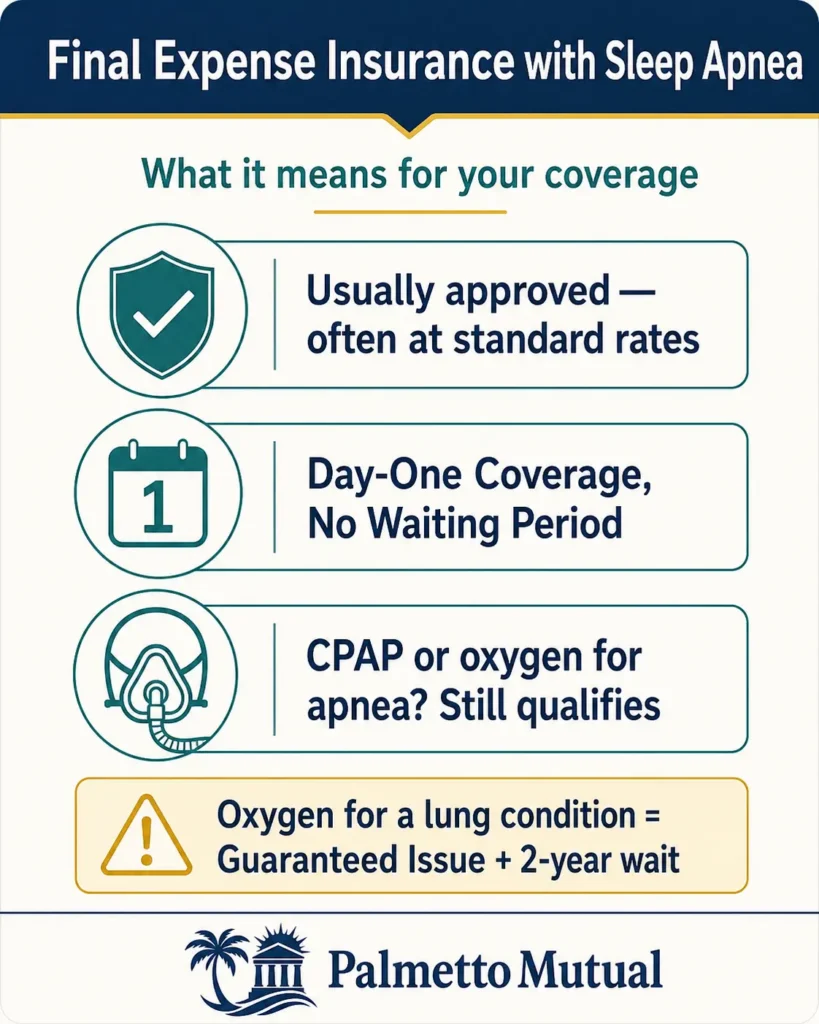
Yes. For most people, sleep apnea does not stand in the way of getting covered, and in most cases it does not raise your price at all. With burial insurance, sleep apnea is treated as a common, manageable condition rather than a red flag.
In fact, many companies do not even ask about sleep apnea on their health questions. When a carrier does ask, an honest “yes” is normally all it takes, and if you use a CPAP or oxygen only because of sleep apnea, you are still eligible for a simplified plan.
That best outcome is called immediate, or “day-one,” coverage. It means your full benefit is in place from the very first day, with no waiting period, and you pay the lowest available rate. If you have sleep apnea and no other major health condition, you can usually qualify for this level benefit at the lowest premium.
There is one detail that can change the result: oxygen use. Many applications include a “knockout” question about oxygen, but it almost always reads “excluding use for sleep apnea”. So if your oxygen or CPAP is only for sleep apnea, you still qualify for day-one coverage. Oxygen used for a different lung problem, such as COPD or emphysema, is what moves an application toward a guaranteed-issue plan instead.
Here is the quick verdict based on your situation:
| Your situation | What you usually qualify for |
|---|---|
| Sleep apnea treated with CPAP or an oral appliance, no other major conditions | Immediate (day-one) coverage at the best rate, with no extra charge for the apnea |
| Sleep apnea and you use oxygen only for the apnea | Still day-one coverage with most carriers; the oxygen question excludes sleep apnea |
| Sleep apnea plus oxygen for a lung condition, or other serious health problems | Often guaranteed issue with a two-year waiting period |
Guaranteed-issue coverage is the kind with no health questions and a built-in two-year waiting period. For someone whose oxygen use is tied to sleep apnea, a small number of carriers will still offer first-day coverage, while oxygen for COPD or another lung condition is what pushes you to guaranteed issue. For sleep apnea on its own, that guaranteed-issue route is rarely needed.
The bottom line: sleep apnea by itself is one of the easier conditions to get covered with, and most applicants land in the best rate class. The next section breaks down exactly what carriers ask about it and how they confirm your answers.
How carriers underwrite sleep apnea
Final expense insurance uses what is called “simplified issue” underwriting. There is no medical exam — you answer health questions, and the insurer electronically reviews your medication history to confirm your answers. No nurse visit, no blood draw.
For sleep apnea, the surprising part is how little the application usually asks. Most burial insurance companies never ask about sleep apnea in their health questions at all, which means it simply never enters the decision.
When a carrier does ask, the question is short and only needs a yes or no. The wording tends to follow a few predictable patterns:
| What the application asks | What it means for you |
|---|---|
| Nothing about sleep apnea | The condition is a non-factor; just answer the other questions honestly |
| “Have you been diagnosed or treated for sleep apnea?” | A simple “yes” is expected, and you can still qualify for day-one coverage |
| “Do you use oxygen to assist with breathing?” | This knockout question almost always adds “excluding use for sleep apnea,” so oxygen or a CPAP used only for apnea does not count against you |
About look-back periods. Many conditions carry a “look-back” — a set number of years the carrier reviews before deciding. Sleep apnea is usually not one of them; many conditions are not even a red flag on the application. Carriers care about your current status — whether you use oxygen for a lung condition, and whether other health problems are present — far more than the date you were first diagnosed.
How carriers confirm your answers. After the questions, the carrier checks the record. They review your prescription history and pull your file from the Medical Information Bureau to make sure your answers match. We explain exactly how those checks work on our prescription history page. What matters here is what they reveal about sleep apnea — and that comes down to the medications tied to it.
Medications underwriters watch for with sleep apnea
Sleep apnea itself is not treated with a daily pill — the main treatment is a device like a CPAP machine. So when sleep-apnea-related medications appear on your prescription check, they are usually doing one of two things: confirming the diagnosis, or pointing to a related condition. Here is how to read them.
| Medication group | Common examples | What it signals |
|---|---|---|
| Wakefulness (alertness) drugs | modafinil (Provigil), armodafinil (Nuvigil), solriamfetol (Sunosi), pitolisant (Wakix) | Prescribed for daytime sleepiness that lingers even with treatment; confirms a sleep apnea diagnosis |
| Blood pressure and heart medications | drugs for high blood pressure, heart rhythm, and related issues | These conditions often travel with sleep apnea and usually carry more underwriting weight than the apnea itself |
The drugs in the first row are the ones tied most directly to sleep apnea. Modafinil, armodafinil, solriamfetol, and pitolisant are wake-promoting agents used when some daytime sleepiness remains after the apnea is being treated. That residual sleepiness affects somewhere between roughly 9% and 22% of people using CPAP, so these prescriptions are not unusual. On a final expense application, seeing one mainly confirms what you already disclosed — it rarely changes a sleep-apnea-only decision.
The bigger signals are usually the related conditions, not the apnea. High blood pressure, heart rhythm problems such as atrial fibrillation, and type 2 diabetes commonly appear alongside sleep apnea, and those are what carriers weigh most. Each has its own page explaining how it is treated and underwritten — and if a heart rhythm condition has led to a blood thinner, that medication is covered in depth on our blood thinners page.
If you take one of these medications, the takeaway is simple: do not worry about the drug name on its own. Disclose what you take, and let the carrier match it to the condition it treats.
Best companies and what you’ll pay with sleep apnea
Here is the part that sets sleep apnea apart from many other conditions: it usually costs you nothing extra. Because most carriers treat it as low risk, you can usually still qualify for “level” coverage with the full death benefit starting on day one, the same as someone without the condition.
Your price is set by your rate tier, not by the apnea itself. Here is how the tiers line up:
| Your situation | Coverage type | What you pay |
|---|---|---|
| Sleep apnea, treated, no other major health issues | Level (day-one) | Standard rates — no extra charge for the apnea |
| Sleep apnea with oxygen used only for the apnea | Level (day-one) | Standard rates, with carriers that exclude apnea from the oxygen question |
| Sleep apnea plus oxygen for a lung condition, or another serious illness | Guaranteed issue | Higher cost per dollar of coverage, plus a two-year waiting period |
Notice that the apnea is almost never the deciding factor. What moves you from the standard price to guaranteed-issue pricing is oxygen for a lung condition or a serious related illness — not the sleep apnea on its own.
Which carriers are easiest to work with. Not every company handles sleep apnea the same way. The most forgiving ones either leave sleep apnea off their health questions entirely or word their oxygen question to exclude it, so the condition never affects your price. An agent who knows which carriers do this can place you with one that overlooks the apnea completely, while a less experienced agent might put you with a company that charges more or adds a delay.
This is where shopping makes a real difference. For the same person, one carrier might charge about $60 a month for a $10,000 policy while another charges $95 — so matching your health profile to the right company is what keeps your rate down. With sleep apnea, that match is usually the difference between a small monthly premium and an unnecessary surcharge.
What it actually costs. Since sleep apnea usually qualifies for the same level-benefit pricing as a healthy applicant, the figures below are a realistic guide for a $10,000 funeral insurance policy at non-tobacco rates:
- Around age 65: roughly $50 to $70 a month for a non-smoking man, with a woman closer to $40 to $50.
- Around age 75: closer to $80 to $140 a month for the same coverage.
- Women pay less than men at every age and coverage amount.
If your situation puts you in the guaranteed-issue group instead, the price climbs. For an older applicant, a $10,000 guaranteed-issue policy may run $140 to $240 a month, and it commonly carries a two-to-three-year waiting period for full benefits.
These are ballpark numbers. Your exact premium depends on your age, the coverage amount you choose, and your state, and our cost-by-age and cost-by-coverage pages carry the full rate tables.
Run a quick quote with your age and the coverage amount you have in mind to see exactly where your sleep apnea places you.
How to get the best rate and coverage with sleep apnea
With sleep apnea, getting the best rate is less about changing your health and more about applying the right way, with the right company. A few simple steps keep you in the lowest-priced, day-one tier.
Be upfront about your diagnosis. When a carrier asks about sleep apnea, answer yes. The insurer reviews your prescription history either way, so a CPAP or related prescription on file will reveal the condition, and an answer that does not match can slow the process or cost you the policy. Honesty works in your favor here, because sleep apnea rarely hurts your rate. Our page on whether you can be denied covers the uncommon situations where it plays a role.
Make sure your oxygen or CPAP is recorded as being for sleep apnea. This is the single most important detail. The oxygen “knockout” question almost always excludes apnea, so your equipment should never push you into a costlier plan — but only if the application clearly notes it is for sleep apnea and not a lung condition. A careful agent confirms this so you are not wrongly bumped to guaranteed issue.
Apply with a company that treats sleep apnea as a non-event. Carriers differ widely. The same person can be quoted a low level rate by one company and a higher price by another, so the goal is to land with one that overlooks the apnea entirely. An independent agent who knows the market can match you to one of those carriers instead of leaving it to chance.
Keep your related conditions in good shape. With final expense insurance, your sleep apnea usually matters less than the conditions that travel with it — high blood pressure, heart problems, and diabetes. Keeping those managed is what actually strengthens your overall health picture in the carrier’s eyes.
You will not need a sleep study for this. If you have read about life insurance and sleep apnea, you may have run into talk of AHI scores, sleep-study reports, CPAP compliance downloads, and “table ratings.” Those belong to fully underwritten life insurance, not burial insurance. Final expense is simplified issue — a few yes-or-no questions and a prescription check, with no medical exam and no sleep records required.
Because a level, day-one policy carries no waiting period, the sooner you are placed with the right carrier, the sooner your full coverage begins. Our no-waiting-period page explains exactly how immediate coverage works once you are approved.
Keep Reading







About the Author
Dvir Mosche is an award-winning independent insurance agent and the founder of Palmetto Mutual, a trusted insurance brokerage specializing in Final Expense Life Insurance. Since entering the industry in 2017, he has been recognized multiple times as a top agent for his dedication to educating and assisting seniors in finding the proper coverage. His mission is to simplify the process, provide honest and personalized guidance, and ensure that every client gets coverage they can depend on for life.


