
Home > Burial Insurance with Pre-Existing Conditions > Thyroid Disease
Final Expense Insurance with Thyroid Disease

If you have thyroid disease and are looking into final expense insurance, you probably want to know whether your condition will affect your application — and by how much. This guide covers whether you can qualify, how carriers review a thyroid condition, what you’ll likely pay, and which companies tend to be the most flexible. The focus stays on how thyroid disease specifically shapes your coverage and rate, not on the condition itself.
Can you get final expense insurance with thyroid disease?
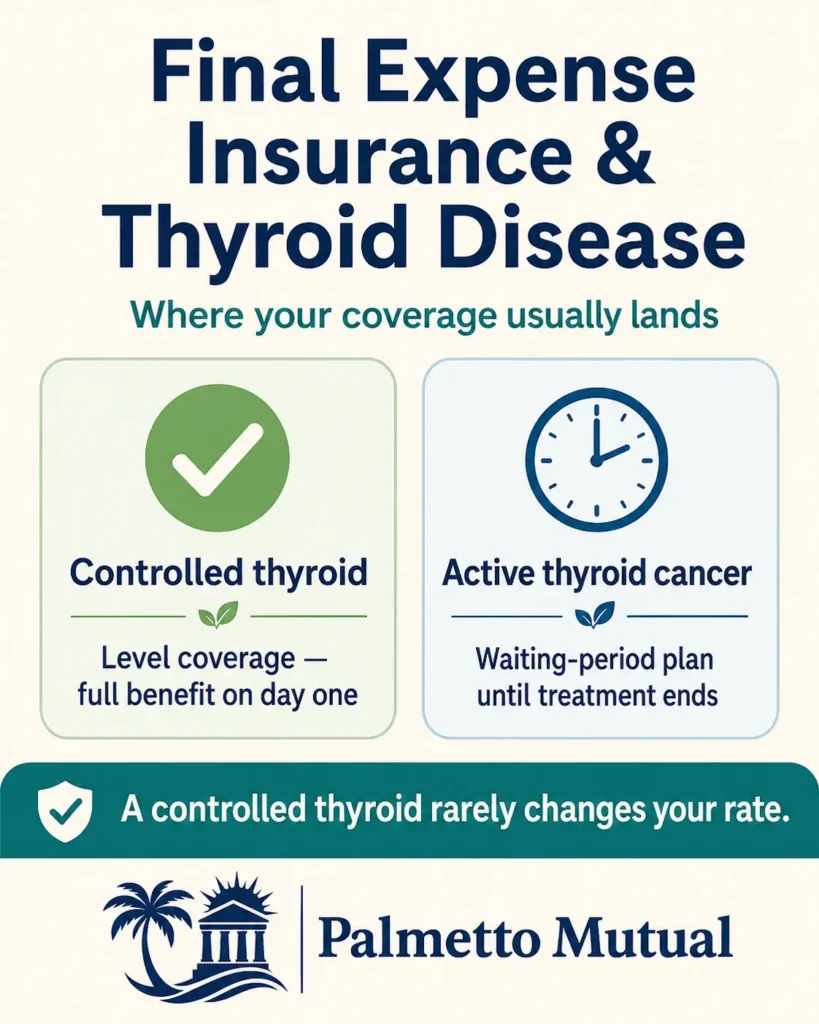
Yes. For almost everyone with a thyroid condition, the answer is a clear yes — usually at the best rates, with coverage that starts on day one.
Thyroid disease is one of the most common health issues carriers see, and most of the time it barely moves the needle. Those with hypothyroidism can usually get the best rating available as long as the condition is being managed and kept under good control. The same is true for a well-managed overactive thyroid.
That top tier of coverage is called “level” or “immediate.” It pays the full benefit right away, with no waiting period and no extra charge for the thyroid by itself. Below it sit “graded” plans (partial benefit during a two-year wait) and “guaranteed issue” plans (no health questions, but a full two-year wait) — and most people with thyroid disease never need those lower tiers.
Here’s the general picture of where a thyroid condition tends to land:
| Your thyroid situation | What most people can expect |
|---|---|
| Underactive thyroid (hypothyroidism), controlled on medication | Level coverage — full benefit, day one |
| Overactive thyroid or Graves’ disease, controlled | Level coverage in most cases |
| Goiter, nodules, thyroiditis, or Hashimoto’s that’s stable | Level coverage |
| Thyroid cancer, treatment finished and in remission | Often level coverage once past the carrier’s look-back window |
| Thyroid cancer, currently being treated | Graded or guaranteed issue, with a waiting period |
The one situation that changes the answer is thyroid cancer. If you actively have or are being treated for cancer, most carriers apply a two-year waiting period until that treatment is behind you. Once treatment is finished and you’ve been stable for a while, level coverage usually becomes available again.
The bottom line: a thyroid condition by itself rarely stands between you and good burial insurance. What matters far more is the full picture — your other health conditions, your medications, and which carrier you apply to.
How carriers underwrite thyroid disease
Underwriting a thyroid condition for final expense insurance comes down to three simple things: a short list of health questions, how recently anything changed, and what your prescription record shows. There’s no medical exam — just honest answers and a quick background check.
The questions are targeted, not open-ended. Carriers care less about the fact that you have a thyroid condition and more about whether anything is recent or unsettled — a brand-new diagnosis, a dose your doctor is still adjusting, a recent hospital stay, or a cancer history inside their look-back window.
A long-controlled thyroid usually sits outside any window that matters. The clock that counts most is the cancer one. Many applications ask whether you actively have or are being treated for cancer — commonly looking back about two years — and the exact window depends on the carrier.
Carriers also pull your prescription history, which fills in the picture your answers start. How that prescription check actually works, and what to do if something on it catches you off guard, is covered in full on our prescription history guide — so we won’t repeat the mechanics here.
Medications underwriters watch for with thyroid disease
Your medication list tells a story, and with thyroid disease most of that story is reassuring. The drug you take points to which thyroid issue you have and how settled it is. Here’s how to read your own list:
| What you take | What it usually signals |
|---|---|
| Levothyroxine (Synthroid, Levoxyl, Unithroid, Tirosint), liothyronine (Cytomel), or Armour Thyroid | An underactive thyroid being replaced — the most routine, lowest-concern picture there is |
| Methimazole (Tapazole) or propylthiouracil (PTU) | An overactive thyroid or Graves’ disease being actively managed |
| A beta-blocker (propranolol, atenolol) | Could be thyroid-related, but these also treat heart conditions, so carriers often look closer to see which |
| A record of radioactive iodine (I-131) | Treatment for either an overactive thyroid or thyroid cancer — the rest of your file shows which |
| High-dose levothyroxine after the thyroid was removed | Often a sign of a thyroid cancer history rather than ordinary hypothyroidism |
| Amiodarone or lithium | These point to a heart-rhythm or mental-health condition that affected the thyroid, not a thyroid problem on its own |
If you take a daily replacement pill, that’s the green-light group — most people in this category are simply on levothyroxine replacement and living completely normal lives. Anti-thyroid drugs are read much the same way: medications like methimazole are viewed favorably as evidence of proper treatment.
A couple of items deserve a quick note. Because beta-blockers also treat other health concerns, they can raise a flag during underwriting, and radioactive iodine therapy is also used to treat thyroid cancer — so both can prompt a second look. And when a drug really points to another condition — a heart-rhythm issue or a mental-health condition — that’s where the underwriting attention shifts, and those are covered on their own condition pages rather than here.
Best companies and what you’ll pay with thyroid disease
Here’s the part that surprises most people: a controlled thyroid condition usually doesn’t add a single dollar to your premium. Taking levothyroxine for a well-controlled thyroid does not increase premiums; the vast majority of people on thyroid replacement therapy receive standard rates. In final expense terms, that means you qualify for level pricing — the same rate a healthy person your age would pay.
So what does set your price? Four things, none of them your thyroid: your age, your gender, whether you use tobacco, and how much coverage you buy. Age is the biggest driver, women generally pay less than men, and tobacco use adds roughly 30% to 40%.
To give you a rough idea, a $10,000 level policy for a 60-year-old in good health often runs around $35 to $55 a month, climbing toward $80 to $100 by age 75. Your exact number depends on the details above — our cost-by-coverage and cost-by-age guides have the full breakdowns by policy size and age, so head there for the complete tables.
There are really only two pricing tracks with a thyroid condition:
| Your situation | What you pay |
|---|---|
| Thyroid condition that’s controlled (the large majority) | Standard level pricing — no thyroid surcharge, full coverage day one |
| Active thyroid cancer or treatment still underway | Guaranteed-issue pricing, which costs more per $1,000 and comes with a two-year wait until that treatment is behind you |
Once treatment is finished and you’ve been stable for a while, most people move off that second track and back onto standard level pricing.
Which companies are best for a thyroid condition
This is where working with an independent agency earns its keep. Carriers don’t view thyroid disease identically — the right one for your situation is usually easy to find because so many accept a controlled thyroid at their best level tier, but the most competitive carrier depends on your specific picture and which thyroid issue you have.
How to get the best rate and coverage with thyroid disease
With a thyroid condition, getting the best rate is less about luck and more about showing up prepared. A little groundwork before you apply can be the difference between a smooth approval and a delay.
Know your numbers and your history
The single most useful thing you can bring is your most recent TSH result. TSH is the single most important number for thyroid underwriting, and saying “my thyroid is fine” without knowing it makes underwriters assume the worst. Be ready to name your exact condition too — hypothyroidism, Graves’, Hashimoto’s, or a cancer history — rather than just “a thyroid problem.”
Here’s what’s worth having on hand before you apply:
| What to have ready | Why it helps |
|---|---|
| Your most recent TSH lab result | Shows your thyroid is in the normal range right now |
| Your medication and how long you’ve been on the same dose | A steady dose signals the condition is settled |
| Your specific diagnosis and roughly when it began | Lets the carrier place you accurately instead of guessing |
| Your follow-up schedule with your doctor | Regular monitoring reads as responsible management |
| Cancer history only: pathology report, treatment dates, clean follow-ups | These decide the tier and whether any wait applies |
What actually improves your tier
Stability is the whole game. If your most recent test is in the normal range and your dose has been stable for at least six months, you’re in excellent shape — it’s frequent recent dose changes that give underwriters pause. Time helps too after any thyroid cancer treatment, since better rates become available as more time passes since treatment. Keeping your other health conditions in check and staying tobacco-free lift your rate class as well.
Be upfront — it pays off here
Disclose everything. Carriers pull your medical records and prescription history, so your answers need to match what’s on file. With a controlled thyroid there’s no reason to hold back anyway — disclosing a well-controlled thyroid condition has virtually no negative impact, and you’ll still receive standard rates in most cases. That honest, complete disclosure is what protects the payout your family will one day collect from your funeral insurance.
Two things this page won’t re-explain, because each has its own home: if a waiting period could apply to your situation, our no-waiting-period guide breaks down how those work and which conditions trigger one. And if being turned down is on your mind, our guide on whether you can be denied covers what actually causes a decline and how to steer clear of it.
Keep Reading







About the Author
Dvir Mosche is an award-winning independent insurance agent and the founder of Palmetto Mutual, a trusted insurance brokerage specializing in Final Expense Life Insurance. Since entering the industry in 2017, he has been recognized multiple times as a top agent for his dedication to educating and assisting seniors in finding the proper coverage. His mission is to simplify the process, provide honest and personalized guidance, and ensure that every client gets coverage they can depend on for life.


