
Home > Funeral Cost > Green Burial Eco Friendly
Green Burial & Eco-Friendly Options
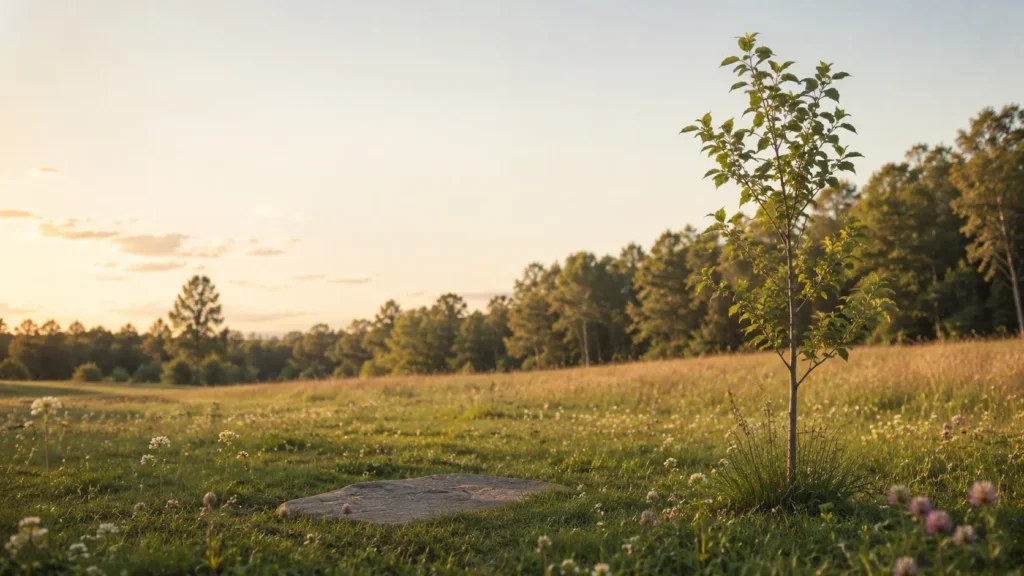
Green burial is a simpler, more natural way to lay a loved one to rest. It skips embalming chemicals, metal or hardwood caskets, and concrete vaults in favor of biodegradable materials and, in many cases, protected land. This guide walks through what green and eco-friendly burial options are, what they cost, where they are legal, and how to plan one. Because final expense insurance can help families pre-fund any type of burial — green or traditional — it helps to understand your options before you make a plan.
What Is a Green (Natural) Burial?
A green burial is easiest to understand by what it leaves out. There is no embalming, no metal or hardwood casket, and no concrete vault around the grave. The body is placed in the earth in a way that lets it break down naturally.
Embalming is the part that surprises most people, because many assume it is required. It usually is not. No state automatically requires it, and only a few require it in rare cases, such as a long delay before burial or transport across state lines.
So what replaces embalming? Instead of chemicals, funeral homes keep the body cool with refrigeration or dry ice. This holds the body safely for a viewing or a few extra days before burial.
Because there are no preserving chemicals, the timeline is shorter. Most green burials happen within about two to three days. Knowing what counts as a green burial also helps when you plan ahead, since burial insurance can be used to cover a natural burial just like any other.
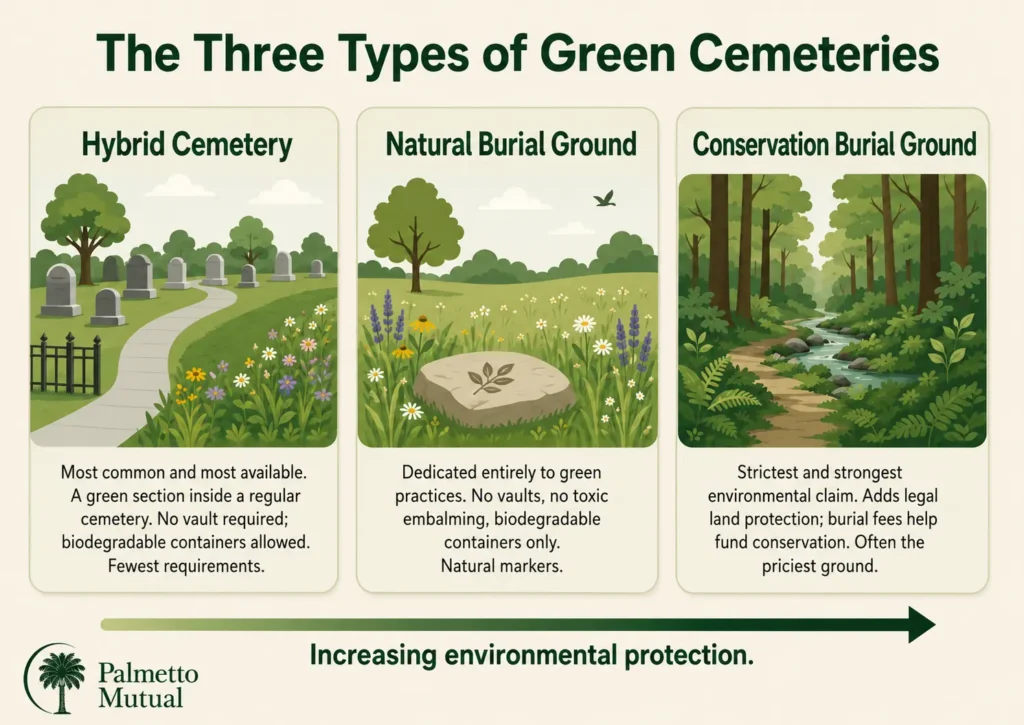
Green burial is not one single thing. It runs along a spectrum, from a green section inside a regular cemetery all the way to a protected nature preserve. The three types below are the ones you will run into most often.
Natural Burial
A natural burial takes place in a cemetery dedicated fully to green practices, called a natural burial ground. Everything about the site is built around letting the body return to the earth.
These grounds do not allow vaults or grave liners, and they do not allow bodies embalmed with toxic chemicals. Burial containers must be biodegradable, such as a shroud or a simple wood casket.
Markers tend to be simple and natural. Many sites use flat native stones, small plantings, or GPS mapping instead of large upright headstones. The land often looks more like a meadow or woodland than a manicured cemetery.
Conservation Burial
A conservation burial is a natural burial with an added layer of land protection. The burial ground is tied to a conservation group through a legal agreement, such as a conservation easement, that protects the land far into the future.
Part of what you pay helps fund the care and restoration of that protected land. In plain terms, your burial fee does double duty: it lays your loved one to rest and helps keep wild land wild.
This is the strictest of the three types and carries the strongest environmental claim. It is also often the most expensive ground, and true conservation cemeteries are less common, so families sometimes have to travel to reach one.
Hybrid-Cemetery Burial
A hybrid cemetery is a regular cemetery that sets aside a section, or sometimes allows throughout the grounds, for vault-free, embalming-free burial. It blends conventional and green practices in one place.
In a certified green section, vaults are not required, and biodegradable containers like shrouds and soft wood caskets are allowed. The section may look much like the rest of the cemetery, just with different rules about vaults and containers.
For most readers, this is the easiest place to start. Hybrid cemeteries are the most common and most widely available type, which makes them the realistic option for families who want green practices without driving hours to a remote preserve.
What Green Burial Costs vs. a Traditional Funeral
Green burial is usually cheaper than a traditional funeral, but not always, and not automatically. The honest answer is that it depends on the cemetery you choose and the services you add.
A full traditional funeral with a viewing and burial runs high once everything is added in. The National Funeral Directors Association puts the median at roughly $7,800, climbing past $9,400 when a vault is included, and an all-in total with plot, opening and closing, and a headstone can reach $15,000 to $20,000.
Green burial usually lands far below that. Many families spend somewhere between $2,500 and $5,000, though simple plans can come in lower and conservation grounds can push higher.
Here is a rough line-by-line look at where the two compare. These are typical national ranges, not quotes for any one cemetery.
| Cost item | Traditional burial | Green burial |
|---|---|---|
| Embalming | $500–$900 | $0 (skipped) |
| Casket or container | $2,000–$5,000+ (metal or hardwood) | $0–$2,500 (shroud or biodegradable casket) |
| Burial vault or liner | $1,000–$5,000 | $0 (not used) |
| Cemetery plot | $1,000–$4,000+ | $500–$5,000 (conservation often higher) |
| Opening and closing | $800–$1,500 | $500–$1,500 |
| Headstone or marker | $1,000–$3,000+ | Often $0 or low (natural marker) |
The savings come from three things you skip: embalming, an expensive sealed casket, and the concrete vault. Those three alone can add $5,000 to $8,000 to a traditional bill. A simpler container and a small natural marker save more still.
But green burial is not free, and a few costs do not disappear. The plot at a conservation ground can run higher than a standard plot, since part of the fee supports land protection.
Body transport and refrigeration still apply, because the body must be moved and kept cool before burial. And green cemeteries are still fairly scarce, so the nearest one may be far enough away to add real travel cost.
The cleanest way to compare is to request an itemized, written price list from both the cemetery and any funeral home involved, then compare totals that include the same services. Under the federal Funeral Rule, funeral homes must give you that itemized pricing.
For families who want to set money aside ahead of time, final expense insurance is one way to pre-fund a green burial, the same as it would cover any other kind. The point here is simply that green can be the lower-cost path, as long as you compare real numbers rather than assume.
Biodegradable Caskets, Shrouds, and Containers
A green burial calls for a container that breaks down naturally, the same way the body does. That rules out metal, sealed caskets, and anything finished with glue, varnish, or synthetic liners.
The choices fall into two simple groups: a soft shroud or a rigid container made from natural materials. Both are accepted at most green cemeteries, though each site has its own rules, so it is always worth asking first.
A shroud is a wrap of natural cloth, such as cotton, linen, or wool. It is the simplest and lowest-impact option, and some families even sew their own. Many cemeteries ask that a shroud be carried on a rigid board so the body can be lowered safely.
Rigid containers range from a plain cardboard box to an unfinished pine casket to a hand-woven basket. The woven styles, made from wicker, willow, seagrass, or bamboo, are usually the priciest because they are made by hand.
Here is a rough look at what each type costs. Prices vary by maker and region, so treat these as national ranges, not quotes.
| Container | Typical cost | Notes |
|---|---|---|
| Burial shroud (cotton, linen, wool) | $100–$1,000 | Simplest option, lowest impact |
| Cardboard casket | $50–$500 | Most affordable rigid container |
| Untreated pine or poplar casket | $400–$1,500 | Familiar box shape, simple wood |
| Woven casket (wicker, willow, seagrass, bamboo) | $900–$3,500 | Handmade, usually the priciest green choice |
One rule sits at the center of all green burial: no vault. A traditional burial places the casket inside a concrete vault or grave liner, a heavy “box around the box” that keeps the ground from settling. Green burial skips it entirely so the body can return to the soil.
It also helps to know your rights when shopping. Under the federal Funeral Rule, a funeral home must accept a casket or container you bought somewhere else, and it cannot charge you a fee for using it.
Because these containers cost far less than a traditional casket, they are easy to plan for. Funeral insurance can cover the container along with the rest of a green burial, so the choice can rest on what feels right rather than on price alone.
Human Composting and Aquamation: The Newer Alternatives
Not everyone who wants an eco-friendly goodbye pictures a grave. Two newer methods, human composting and aquamation, offer a green path that sits alongside both burial and flame cremation.
Human composting is also called terramation or natural organic reduction. The body is placed in a closed vessel with natural materials like wood chips, straw, and alfalfa, then gently warmed and turned over several weeks until it becomes clean, nutrient-rich soil.
Aquamation goes by water cremation or alkaline hydrolysis. The body rests in a pressurized chamber filled with warm water and an alkali solution, which breaks it down over a matter of hours and leaves behind soft white bone ash returned to the family.
The deeper mechanics of flame cremation belong on the cremation pages, so here the key point is simply how these two compare side by side.
| Human composting (terramation) | Aquamation (water cremation) | |
|---|---|---|
| Also known as | Natural organic reduction | Alkaline hydrolysis, water cremation |
| How it works | Vessel with wood chips, straw, alfalfa; several weeks plus curing | Warm water and alkali in a pressurized chamber; a few hours |
| What the family receives | Nutrient-rich soil | White bone ash, like cremated remains |
| Typical cost | About $3,000–$7,000 | About $2,000–$5,000 |
On cost, aquamation often lands close to flame cremation, sometimes a few hundred dollars more, while human composting runs higher and is offered by fewer providers. Simple direct aquamation can be found around $1,000 to $1,500 in some areas.
The environmental case is the main draw for both. A single flame cremation releases several hundred pounds of carbon dioxide, with estimates ranging from about 535 to 880 pounds, plus mercury from dental fillings.
Aquamation avoids that. It uses a fraction of the energy of flame cremation, around a tenth by most estimates, and produces no direct air emissions.
Human composting is gentler still in some ways, using no artificial heat and returning soil that can nourish new growth. Both methods also use no burial land at all.
Where each option is legal varies quite a bit from state to state, and that is covered fully in the next section. Like any disposition, these methods can be pre-funded ahead of time, including with final expense insurance, so families are not left to cover the cost in a hurry.
Where Green Burial Is Legal and Available by State
The rules here depend on which method you mean. Green burial itself is legal in all 50 states, while the two newer options, human composting and aquamation, are legal in a smaller set of states. This section pulls all three together so you can see where each one stands.
The most important thing to understand is the gap between “legal” and “available.” A state can allow a method on paper while having no nearby facility or cemetery that actually offers it.
| Method | Where it is legal | What to know |
|---|---|---|
| Green (natural) burial | All 50 states | Legal everywhere, but certified grounds are unevenly spread |
| Aquamation (water cremation) | 26 states | Legal does not always mean a local provider exists |
| Human composting (terramation) | 14 states | Newest option, with the fewest providers so far |
Green burial is legal nationwide because no state bans burying a body without embalming, a vault, or a metal casket. What varies is whether a green or hybrid cemetery exists near you. There are several hundred green cemeteries in the United States, and most are hybrid sections inside conventional cemeteries.
Aquamation, also called water cremation, is legal in 26 states as of 2026, according to the Cremation Association of North America. Those states are Alabama, Arizona, California, Colorado, Connecticut, Florida, Georgia, Hawaii, Idaho, Illinois, Kansas, Maine, Maryland, Minnesota, Missouri, Nevada, North Carolina, Oklahoma, Oregon, South Carolina, Tennessee, Utah, Vermont, Washington, West Virginia, and Wyoming.
Human composting is legal in 14 states: Washington, Colorado, Oregon, Vermont, California (services expected in 2027), New York, Nevada, Arizona, Maryland, Delaware, Minnesota, Maine, Georgia, and New Jersey.
These lists change often, as new bills pass most years, so it is wise to confirm the current status for your state before making firm plans. When a method is legal but not offered nearby, families can usually work with a local funeral home that arranges transport to a licensed facility in another state.
To find a green or hybrid cemetery near you, the best starting point is the Green Burial Council’s cemetery provider map, which lets you search by location and filter by type (hybrid, natural, or conservation).
Treat any directory as a starting point, not the final word. Some good local cemeteries follow green practices without being certified, so call directly to confirm the rules, the pricing, and what the section actually allows.
Wherever you live and whatever method you choose, the cost can be set aside ahead of time. Final expense insurance covers these plans the same way it covers a traditional funeral.
The Real Environmental Case
Green burial is often described as the kindest choice for the planet, and the broad strokes of that are true. But the honest picture has nuance, and a guide that skips the nuance is just marketing. Here is the fair comparison.
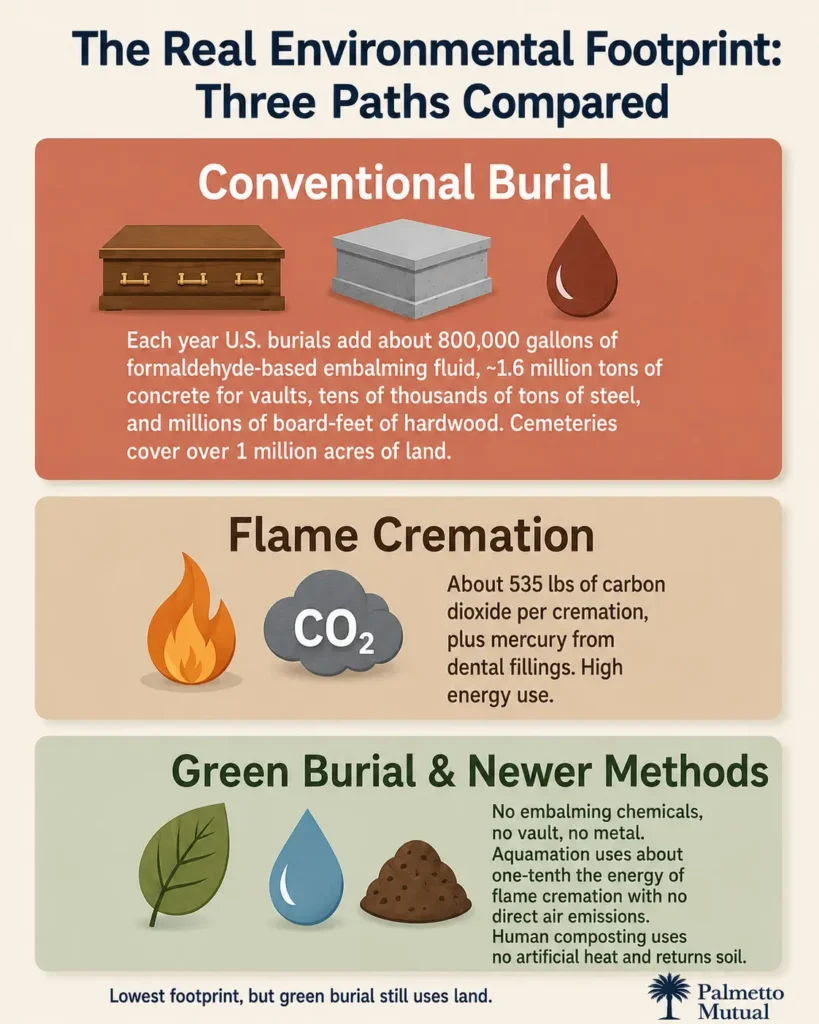
Conventional burial carries the heaviest material footprint of the common options. Each year, American burials put roughly 800,000 gallons of formaldehyde-based embalming fluid, about 1.6 million tons of concrete for vaults, tens of thousands of tons of steel, and millions of board-feet of hardwood into the ground.
Cemeteries also use land permanently. U.S. cemeteries cover more than a million acres, and that ground needs ongoing mowing, watering, and chemical treatment year after year.
Flame cremation trades materials for energy. It burns natural gas at very high heat, and a single cremation releases roughly 535 pounds of carbon dioxide, along with mercury vapor from dental fillings.
Green burial and the newer methods sit at the low-impact end. They skip embalming chemicals, vaults, and metal, and aquamation and human composting use far less energy than flame cremation while producing no direct air emissions.
Here is where credibility matters: green is not impact-free. A green burial still uses burial land, and a body placed in the earth is still a permanent use of that plot.
The phrase “carbon neutral” also gets stretched. Some providers market it heavily, but the claim often leans on offsets or favorable accounting, so it is fair to read it with a healthy dose of caution.
Conservation burial is the one case where the land argument is strongest, since the burial fee helps protect and restore real habitat. That benefit is genuine, but it is specific to conservation grounds, not to every cemetery that calls itself green.
It is also worth noting the research is not one-sided. A widely cited 2017 Dutch study found that when all environmental categories are weighed together, conventional burial has a slightly larger overall impact than flame cremation, with green burial lowest of the three.
The takeaway is simple and honest. If the smallest footprint is your goal, green burial and the newer methods clearly beat conventional burial, but each still has trade-offs worth understanding. Whichever path fits your values, a funeral life insurance policy can fund it just as easily as any other.
How to Plan a Green Burial
Planning a green burial comes down to three practical jobs: finding the right cemetery, asking a funeral home the right questions, and arranging body care without embalming. None of it is complicated once you know what to ask.
Start with the cemetery, because it sets the rules everything else follows. Use the Green Burial Council’s provider map to find a green, hybrid, or conservation ground near you, then call to confirm the details, since policies differ from site to site.
When you call a cemetery, a few direct questions clear up most of the uncertainty:
- Is this section vault-free, or is a vault or liner required?
- Which containers do you accept, such as a shroud, a carrier board, or a simple wood casket?
- Can you bury an unembalmed body, and what timing do you expect?
- How are graves marked, and what marker materials or sizes are allowed?
- Can you send a full, itemized price list in writing?
Next comes the funeral home, if you use one. The key is to know your rights so you only pay for what you actually want.
Useful questions to ask a funeral home include:
- Do you own refrigeration, and is it included in the base price?
- Will you accept a casket or shroud I bought elsewhere, with no extra fee?
- Can you handle body care and transport without embalming?
Body care without embalming is simpler than many families expect. Instead of chemicals, the body is kept cool with refrigeration or dry ice, which holds it safely for a viewing or for the days before burial.
Because there is no long-term preservation, the timeline is short. Most green burials happen within a few days, and during any transport the body is kept cold and placed in a leak-proof, covered container.
A brief, honest word on cost. A green burial is often less expensive than a traditional funeral, and families cover it in the usual ways: out of savings, through pre-paid funeral arrangements, or with insurance set aside ahead of time.
There is no single right answer here, and no need to decide everything at once. Final expense insurance is one tool that can pre-fund a green burial the same as any other plan, so the choice can rest on what fits your family rather than on timing or budget pressure.
Common Questions About Green Burial
Here are short, direct answers to the questions families ask most when planning a green burial, whether they are paying out of pocket or using burial insurance.
Is embalming ever legally required? Almost never. No state requires embalming as a routine matter, and federal law bars funeral homes from claiming otherwise. A few narrow exceptions exist, such as certain delays before disposition, transport across some state lines, or specific communicable-disease cases.
Do you have to use a casket? No. A simple cloth shroud is accepted at most green cemeteries, though some ask that it rest on a rigid carrier board so the body can be lowered safely. The cemetery sets the container rules, so confirm before you buy.
Can you have a green burial in a regular cemetery? Sometimes. Many conventional cemeteries have a hybrid green section, and some allow vault-free, embalming-free burial throughout. Ask specifically whether the section you want requires a vault or liner.
Are headstones or markers allowed? Usually, but they tend to be natural and simple. Many natural grounds use flat native stones, small plantings, or GPS mapping instead of upright monuments, often with size limits. Hybrid sections may allow more traditional markers.
How soon must the burial happen? Generally within a few days, since the body is not embalmed. Refrigeration or dry ice can safely extend that window to about a week if family needs more time.
Can the family transport the body themselves? In most states, yes. About 41 states let families handle transport with the proper burial-transit permit and a leak-proof, covered container, while 9 states require a licensed funeral director for at least one step. Crossing state lines is more involved and often needs a funeral home’s help.
Frequently Asked Questions
Keep Reading


About the Author
Dvir Mosche is an award-winning independent insurance agent and the founder of Palmetto Mutual, a trusted insurance brokerage specializing in Final Expense Life Insurance. Since entering the industry in 2017, he has been recognized multiple times as a top agent for his dedication to educating and assisting seniors in finding the proper coverage. His mission is to simplify the process, provide honest and personalized guidance, and ensure that every client gets coverage they can depend on for life.


