
Home > Burial Insurance with Pre-Existing Conditions > Osteoporosis
Final Expense Insurance with Osteoporosis

Osteoporosis is one of the most common conditions among adults over 55, and most people who have it can still buy burial insurance without much trouble. What matters to a carrier is not the diagnosis itself, but how the condition is being managed, what medications you take, and whether you have had a fracture or a fall in recent years. This guide covers where osteoporosis lands in underwriting, which companies treat it most fairly, what you can expect to pay, and how to apply so you get the best coverage available to you.
Can You Get Final Expense Insurance with Osteoporosis?
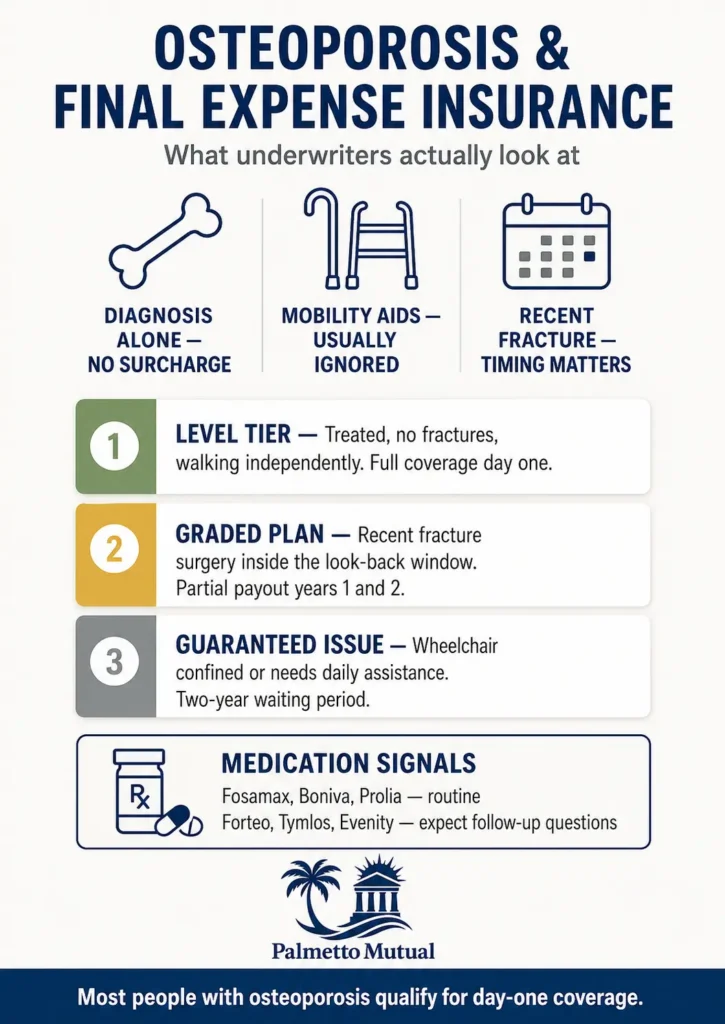
Yes. Osteoporosis by itself is one of the easier conditions to insure. In most cases it lands you in the level tier — the best plan a company offers, with full day-one coverage and no waiting period.
Here is why. Osteoporosis on its own does not meaningfully shorten life expectancy. Insurance companies price policies around how long you are likely to live. A diagnosis that does not move that number does not move your rate.
What carriers actually care about is not the bone scan. It is what has happened because of the bones.
| Your situation | Likely outcome |
|---|---|
| Osteoporosis or osteopenia, no fractures, on treatment | Level tier, day-one coverage |
| Older fracture, fully healed, walking normally | Level tier with most companies |
| Recent hip fracture or fracture surgery | Often a short wait, or a graded plan, depending on how recent |
| Use a cane or walker, but independent | Nearly all companies still offer immediate coverage |
| Confined to a wheelchair, or need help with daily activities | Graded or guaranteed issue |
| Living in a nursing home or receiving home health care | Guaranteed issue only |
The dividing line is mobility and recent fracture history, not the diagnosis. A woman with a T-score of -3.0 who golfs twice a week is a better risk to a burial insurance underwriter than a woman with milder bone loss who broke her hip six months ago.
That second scenario is not a denial. It is a timing problem. Pooled research puts one-year mortality after a hip fracture at roughly 22 percent, which is why carriers treat the first year or two after a serious fracture with caution. Wait out the look-back window and the same person usually qualifies for a level plan.
If you have osteoporosis and nothing else going on, plan on being approved at the best rates available for your age and gender. The rest of this guide covers the details that can move you off that best tier — and how to stay on it.
How Carriers Underwrite Osteoporosis
Here is the thing that surprises most people: almost no final expense application asks about osteoporosis. There is no “have you been diagnosed with osteoporosis” question on the health questionnaire at most companies.
So how does the underwriter find out? Two ways. The questions that surround the condition, and your prescription history.
The questions that catch osteoporosis indirectly. Carriers do not ask about your bones. They ask about the consequences. Typical questions on a burial insurance application include:
- Are you currently confined to a bed, wheelchair, or nursing facility?
- Do you need help from another person with bathing, dressing, eating, toileting, or moving around?
- Do you receive home health care or assistance in your home?
- In the past 12 to 24 months, have you been hospitalized, or been advised to have surgery that has not yet been done?
- Have you fallen more than once in the past 12 months? (asked by some carriers only)
Notice that osteoporosis passes every one of these unless it has progressed to the point of causing falls, fractures, or lost independence. That is the whole story of this condition in underwriting.
Look-back windows that matter. Two windows are worth knowing. Recent surgery — a hip replacement or spinal repair after a fracture — usually falls inside a 12-to-24-month look-back. Recent hospitalization runs on a similar window at most companies. Both are asking about the same underlying event: a bad break.
Assisted living is its own category. Some carriers decline it outright, some allow it if you are independent within the facility, and some do not ask. Nursing home confinement is a knockout at nearly every company.
The prescription check. Every carrier runs an electronic review of your medication history. No medical exam is required, but the insurer will electronically analyze your prescription history alongside the health questions — largely to confirm that your answers match your records. This is where osteoporosis becomes visible, because the drugs are unmistakable.
Medications Underwriters Watch For with Osteoporosis
Underwriters do not read your drug list as a list of drugs. They read it as a story about how severe your condition is and what has already happened to you.
| What you take | What it signals | Effect on your tier |
|---|---|---|
| Alendronate (Fosamax), risedronate (Actonel), ibandronate (Boniva) | Standard first-line treatment for mild to moderate bone loss | Neutral. Level tier |
| Zoledronic acid (Reclast) infusion | Same treatment goal, delivered by IV — often because pills were not tolerated | Neutral in most cases |
| Denosumab (Prolia) injection | Treatment has been escalated a step, or bisphosphonates did not work | Usually neutral. Occasionally prompts a closer look |
| Teriparatide (Forteo), abaloparatide (Tymlos), romosozumab (Evenity) | Bone-building drugs reserved for severe osteoporosis and very high fracture risk. Often prescribed after a fracture has already happened | Meaningful signal. Expect questions about fractures |
| Calcitonin (Miacalcin, Fortical) | Frequently prescribed for pain after a spinal compression fracture | Signals a fracture has occurred |
| Raloxifene (Evista) | Bone treatment, but also used to reduce breast cancer risk | Prompts the underwriter to check for a cancer history |
| Long-term prednisone or other corticosteroids | Suggests steroid-induced osteoporosis — meaning there is a second condition driving it, such as rheumatoid arthritis, lupus, or COPD | The underlying condition is what gets underwritten. |
| Oxycodone, hydrocodone, tramadol, fentanyl | Often prescribed after a fracture or fracture surgery | Signals recent injury and recovery. |
| Calcium and vitamin D | Over the counter. Not tracked | No signal at all |
Read that table one column at a time. The first four rows are ordinary treatment for a common condition, and funeral insurance carriers see them on applications every single day. Nobody is going to blink.
The bottom four rows are different. They are not worse drugs. They are drugs that tell the underwriter to ask a follow-up question — about a fracture, about a cancer history, about what condition the steroids are treating. Answer those follow-ups cleanly and most people are still approved at the level tier.
One more point worth making plainly. Being on osteoporosis medication is a good sign to an underwriter, not a bad one. It means the condition is diagnosed, monitored, and treated. Untreated bone loss with a history of falls is the profile that causes problems.
Best Companies and What You’ll Pay with Osteoporosis
There is no single best burial insurance company for osteoporosis, and any site that names one is selling you something. What exists is a group of carriers whose underwriting treats bone loss the way it deserves to be treated — as a routine, managed condition rather than a red flag.
Here is what separates the lenient carriers from the strict ones on this specific condition:
| What the carrier does | Why it matters to you |
|---|---|
| Does not ask about walkers, canes, or mobility aids | The single biggest divider. Some applications ask; most do not |
| Uses a 12-month look-back on surgery instead of 24 | Cuts your wait in half after a fracture repair |
| Does not treat assisted living as an automatic decline | Matters if you moved after a fall |
| Ignores bone-building drugs like Forteo, Tymlos, and Evenity | Strict carriers flag these and ask about fractures |
| Allows a “yes” on falls without pushing you to a graded plan | Some carriers ask about falls in the past 12 months |
Production note — carrier field data required. Insert the current leniency ranking here: which carriers ask no mobility question, which use 12-month versus 24-month surgery look-backs, tier placement for an applicant with a healed fracture inside two years, and which carriers flag anabolic bone drugs on the prescription screen. Do not publish generic carrier names without verification.
What you’ll actually pay. This is the part people brace for, and it is better than they expect.
If your osteoporosis is treated and you have not had a fracture, there is no osteoporosis surcharge. None. You pay the same as a person your age without the diagnosis. Final expense insurance does not use table ratings or extra premiums for individual conditions the way large term life policies do. You either qualify for the level plan or you do not, and osteoporosis by itself does not push you out of it.
The cost only changes if the condition has pushed you into a different plan type:
| Plan type | What you pay | What you get |
|---|---|---|
| Level tier (most people with osteoporosis) | The company’s standard rate for your age and gender | Full death benefit from day one |
| Graded plan | Somewhat more per thousand of coverage | Partial payout in years one and two, full benefit after |
| Guaranteed issue | The most expensive option, and coverage caps out around $25,000 | Two-year waiting period. Premiums refunded with interest if you die of natural causes before it ends |
To put a number to it, burial insurance for a healthy 60-year-old runs somewhere near $53 a month for $10,000 in coverage, and around $84 a month at age 70. Your age and the amount of coverage you buy drive that figure far more than your bone density ever will.
How to Get the Best Rate and Coverage with Osteoporosis
Nothing on this list changes your bones. All of it changes how an underwriter reads your file.
Know your fracture dates before you apply. Not “a few years back.” The month and the year. Whether a hip repair happened 19 months ago or 25 months ago decides which plan a carrier offers you, and you cannot let an agent guess. Pull the surgical date off a discharge summary or an explanation of benefits statement if you have to.
If you are close to a look-back window closing, wait. This is the highest-leverage move available to anyone with a recent fracture. Someone 20 months out from hip surgery who applies today may be offered a graded plan. The same person, four months later, is often approved for a level plan with day-one coverage — same health, same body, better answer. Four months of patience can buy two years of full coverage. Our no waiting period page explains how those windows work across the market.
Be able to explain your medication. If you are on Prolia, Forteo, Tymlos, or Evenity, an underwriter is going to want context. “My doctor moved me to it because Fosamax upset my stomach” is a completely different file than “my doctor moved me to it after I broke my back.” Know which one you are, and say it plainly.
Do not answer “no” to a mobility question you should answer “yes” to. People hedge on the cane and walker questions constantly, and it is the wrong instinct. Most companies do not care. The ones that do care will find out anyway, and a mismatch between your answers and your records is a much bigger problem than the walker ever was. Read can you be denied for how those mismatches actually play out.
Do not volunteer your T-score. No final expense application asks for it. There are no labs, no bone scans, no exam of any kind in this market. Handing an underwriter a number that says -3.4 when nobody asked invites a question that was never going to be asked.
Steroid users, know your primary condition. If long-term prednisone caused your bone loss, the underwriter is not underwriting osteoporosis at all. They are underwriting the rheumatoid arthritis, lupus, or COPD underneath it. That is the condition to research and prepare for.
Have someone shop it before you sign it. Underwriting for burial insurance varies enormously between companies on precisely the things osteoporosis touches — mobility aids, falls, surgery windows, bone drugs. One carrier’s decline is another carrier’s routine approval. An independent agent who represents ten or more companies can find the match before an application ever goes in, and it costs you nothing, because rates are filed with the state and cannot be discounted or marked up by anyone.
And apply while you can answer the questions cleanly. Osteoporosis is progressive. The version of you that walks unassisted qualifies for things the version of you five years from now may not. That is not a scare tactic; it is just how the questionnaire works.
Back to top ↑ostep
Keep Reading







About the Author
Dvir Mosche is an award-winning independent insurance agent and the founder of Palmetto Mutual, a trusted insurance brokerage specializing in Final Expense Life Insurance. Since entering the industry in 2017, he has been recognized multiple times as a top agent for his dedication to educating and assisting seniors in finding the proper coverage. His mission is to simplify the process, provide honest and personalized guidance, and ensure that every client gets coverage they can depend on for life.


