
Home > Burial Insurance with Pre-Existing Conditions > Peripheral Artery Disease
Final Expense Insurance with Peripheral Artery Disease

If you’ve been diagnosed with peripheral artery disease (PAD), you can usually still buy final expense insurance — and in many cases you can qualify for first-day, full coverage rather than a waiting period. What you’ll pay and how fast you’re approved depends mostly on the details of your case, including which medications you take. This guide walks through where PAD typically lands with underwriters, which carriers tend to be most flexible, and how to position your application for the best rate.
Can you get final expense insurance with peripheral artery disease?
Yes. In almost every case, you can get final expense insurance with peripheral artery disease (PAD). For most people, you can also get the best kind of policy: one that covers you from day one with no waiting period.
This is the type of plan you want. It pays your full benefit the moment your first premium clears, even if you were to pass away the very next day. It also comes with the lowest price the carrier offers.
PAD on its own is not a “knockout” condition. Carriers see it as a health issue that can be managed with medication and follow-up care, so they treat it far more kindly than conditions like dementia or congestive heart failure.
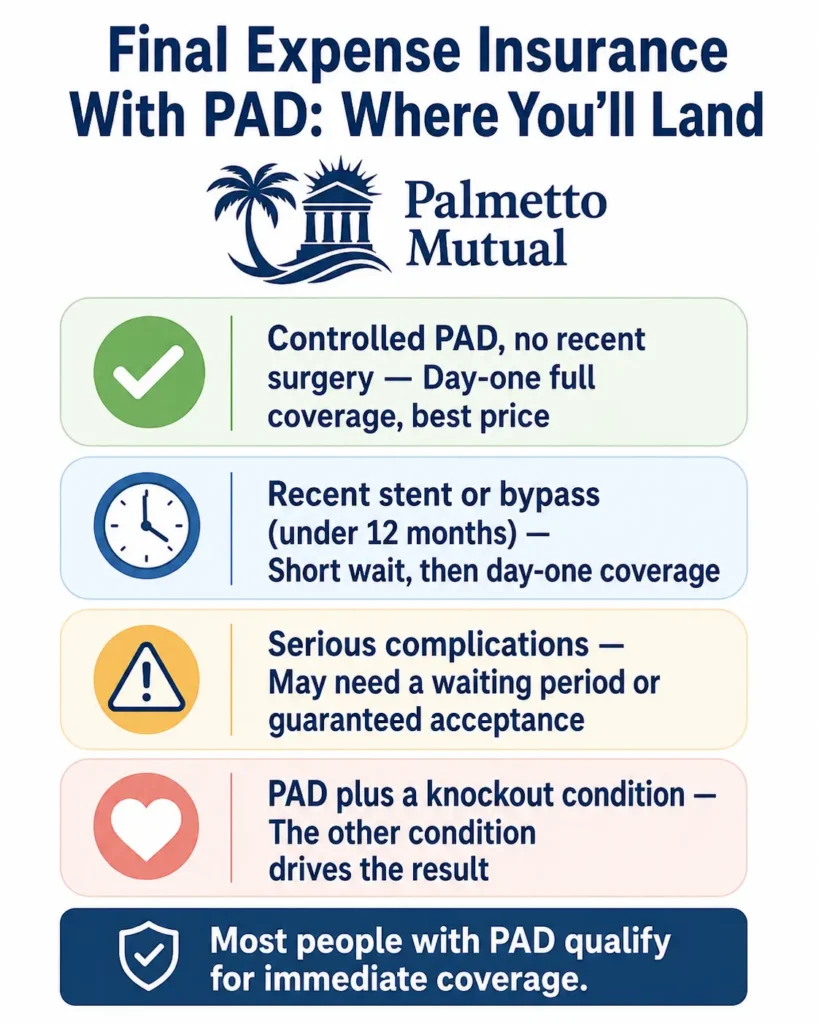
What decides your outcome is the bigger picture: how long ago you were diagnosed, whether you’ve had recent surgery, any complications, and which medications you take. Here is where PAD usually lands.
| Your situation | Likely outcome |
|---|---|
| PAD managed with medication, no recent surgery or major complications | Day-one full coverage at the best price |
| Recent stent, bypass, or other circulation surgery (within about 12 months) | Waiting period until enough time passes, then day-one coverage opens up |
| Serious complications (such as amputation, gangrene, or non-healing ulcers) | May need a waiting period or a guaranteed acceptance plan |
| PAD alongside a knockout condition (such as CHF or kidney dialysis) | The other condition drives the result, not the PAD |
So the honest bottom line is this: most people with PAD qualify for immediate, full burial insurance coverage. A waiting period only comes into play when there’s been recent vascular surgery or a serious complication. Even then, coverage is still available — it just may start as a guaranteed acceptance plan with a two-year wait.
The rest of this guide walks through exactly how carriers look at PAD, which companies tend to be most forgiving, and what you’ll pay.
How carriers underwrite peripheral artery disease
Final expense insurance does not use a medical exam. Instead, carriers learn about your PAD in two ways: the yes/no health questions on the application, and an electronic check of your prescription history.
That prescription check is how they confirm your answers and spot conditions you might not mention. The mechanics of how that check works are covered in full on our prescription history page, so we won’t repeat them here.
What matters for PAD is which questions get asked and how far back they look. Not every carrier asks about PAD the same way, and some don’t ask about it at all.
Here is the kind of language you’ll see, and the typical window each question covers.
| What the application asks | Typical look-back window |
|---|---|
| Have you ever been treated for or advised to seek treatment for PAD or PVD? | Ever (no time limit) |
| In the past 12 months, have you been diagnosed or treated for a vascular disease? | 12 months |
| In the past 12 months, have you had or been advised to have circulation surgery? | 12 months |
| In the past 2 years, have you been treated, prescribed medication, or had surgery for circulation problems in the legs, heart, or brain? | 24 months |
The key point is this: when a question is tied to a window, a “yes” only counts if the event falls inside that window. PAD you’ve managed quietly for years often clears the shorter questions with no problem.
These questions are really screening for severity. Carriers are not worried about mild, well-managed PAD. They are looking for the warning signs that the disease is advanced or unstable.
The three things that move you toward a waiting period are recent circulation surgery, such as a stent, bypass, or angioplasty within the last 12 months; serious complications, such as leg ulcers that won’t heal, gangrene, or amputation; and other major conditions that often travel with PAD, like coronary artery disease, diabetes, or kidney disease.
If none of those apply, most carriers treat your burial insurance application as a routine, day-one approval.
Medications underwriters watch for with peripheral artery disease
Because carriers check your prescription history, the drugs you take tell them a story about your PAD before you say a word. The medication itself isn’t a problem. What matters is what it signals about how serious your condition is.
Here is how the common PAD-related medications usually read to an underwriter.
| Medication type | Common examples | What it usually signals |
|---|---|---|
| Antiplatelet drugs | Aspirin, clopidogrel (Plavix), ticagrelor (Brilinta) | Routine PAD management. A low-concern signal that points to standard, controlled disease. |
| Cholesterol drugs (statins) | Atorvastatin (Lipitor), rosuvastatin (Crestor), simvastatin | Very common and rarely a concern on their own. They point to plaque control, not severity. |
| Claudication drugs | Cilostazol (Pletal) | Prescribed specifically for leg pain from PAD. Signals symptoms are active, which carriers note but usually still approve. |
| Blood thinners (anticoagulants) | Warfarin (Coumadin), rivaroxaban (Xarelto), apixaban (Eliquis) | A higher-attention signal. May point to blood clots or more involved vascular disease. See our blood thinners page for how these are handled. |
If you take a drug on this list, the goal is to recognize what it tells the carrier so nothing on your prescription record catches you off guard. A medication that lines up cleanly with controlled PAD works in your favor.
The medications that draw more questions are the ones that hint at clots or at the co-existing conditions in the rows above, since those raise the overall risk picture rather than the PAD alone.
Best companies and what you’ll pay with peripheral artery disease
There is no single best company for peripheral artery disease. Final expense insurance carriers compete on two things: price and which health conditions they accept. The best carrier for you is simply the one whose PAD rules match your situation.
This is where working with an independent agency pays off. One carrier might place your controlled PAD at its best rate, while another bumps you to a waiting period for the exact same history. Comparing several carriers at once is how you avoid overpaying.
Here is the cost reality, and it’s good news for most people.
If your PAD is controlled and you have no recent surgery or complications, you qualify for a level (day-one) plan. That means you pay the carrier’s normal rate for your age and tobacco status. There is no special PAD surcharge. You are priced like any other healthy applicant.
If your case includes a knockout factor, such as recent vascular surgery or a serious complication, the math changes. You may be routed to a guaranteed acceptance plan. Those cost more and come with a two-year waiting period, since the carrier is taking on more unknown risk.
So your price is driven far less by the PAD label and far more by which tier you land in. Controlled PAD usually means standard pricing. A knockout factor usually means guaranteed-issue pricing plus the wait.
What you’ll actually pay also depends on your age and how much coverage you buy. We keep the full rate tables on two dedicated pages so they stay current: see our cost-by-coverage page for pricing by benefit amount, and our cost-by-age page for pricing by age band. Rather than repeat those tables here, use the calculator below to pull a real quote for your profile.
The bottom line on carriers: the right one is whichever company most willingly gives you a level plan for your specific PAD history and medications. That match is what determines both your approval and your price.
How to get the best rate and coverage with peripheral artery disease
The goal is simple: land on a level (day-one) plan at the lowest rate. With PAD, a few things you do before you apply can move you toward that result.
Start by knowing your own details. When an agent asks about your PAD, clear and confident answers help them place you with the right carrier the first time. Have these ready:
- When you were diagnosed
- Whether you’ve had any surgery or procedure (stent, bypass, angioplasty) and the date
- Any complications, such as leg ulcers or amputation
- Your current medications
- Other conditions you manage, like diabetes, high blood pressure, or high cholesterol
Next, focus on the levers that actually improve your tier. These are the things carriers reward.
Being tobacco-free is the big one. Smoking is a primary driver of PAD, and tobacco use moves you to a higher rate class. If you’ve quit, that matters, and the longer you’ve been tobacco-free, the better.
Showing your PAD is controlled also helps. Taking your medications as prescribed, keeping up with doctor visits, and managing related conditions all signal stability to an underwriter. Carriers look closely at whether you follow your treatment plan.
Timing matters too. If you’ve had a recent stent or bypass, waiting until enough time has passed can open up day-one coverage that wasn’t available right after surgery. How those waiting-period windows work is covered on our no-waiting-period page.
Finally, be honest on every answer. Carriers verify what you tell them against your prescription history and records, so an undisclosed condition can surface later and even void a claim. Full disclosure is what protects your family.
One more point in your favor: you don’t have to find the right carrier alone. Because each company treats PAD differently, an independent agent can match your exact history to the carrier most likely to approve you at a level rate. That single step is often the difference between a great offer and an unnecessary waiting period.
And if you’ve already been turned down somewhere, that’s not the end of the road. A decline from one carrier doesn’t mean every carrier will say no. Our page on whether you can be denied final expense insurance explains what to do next.
Keep Reading







About the Author
Dvir Mosche is an award-winning independent insurance agent and the founder of Palmetto Mutual, a trusted insurance brokerage specializing in Final Expense Life Insurance. Since entering the industry in 2017, he has been recognized multiple times as a top agent for his dedication to educating and assisting seniors in finding the proper coverage. His mission is to simplify the process, provide honest and personalized guidance, and ensure that every client gets coverage they can depend on for life.


